Thank you for visiting SNEWPapers!
Sign up free
Literary
June 29, 1859
Weekly Standard
Raleigh, Wake County, North Carolina
What is this article about?
Address by William W. Holden to young ladies of Raleigh Female Seminary on June 1, 1859, praising teachers, reflecting on education's role in moral development, women's duties in domestic sphere, value of common sense, careful reading, and the Bible as source of truth and virtue.
Clipping
OCR Quality
98%
Excellent
Full Text
The Standard.
[Published by request of the Principal and Young Ladies of Raleigh Female Seminary.]
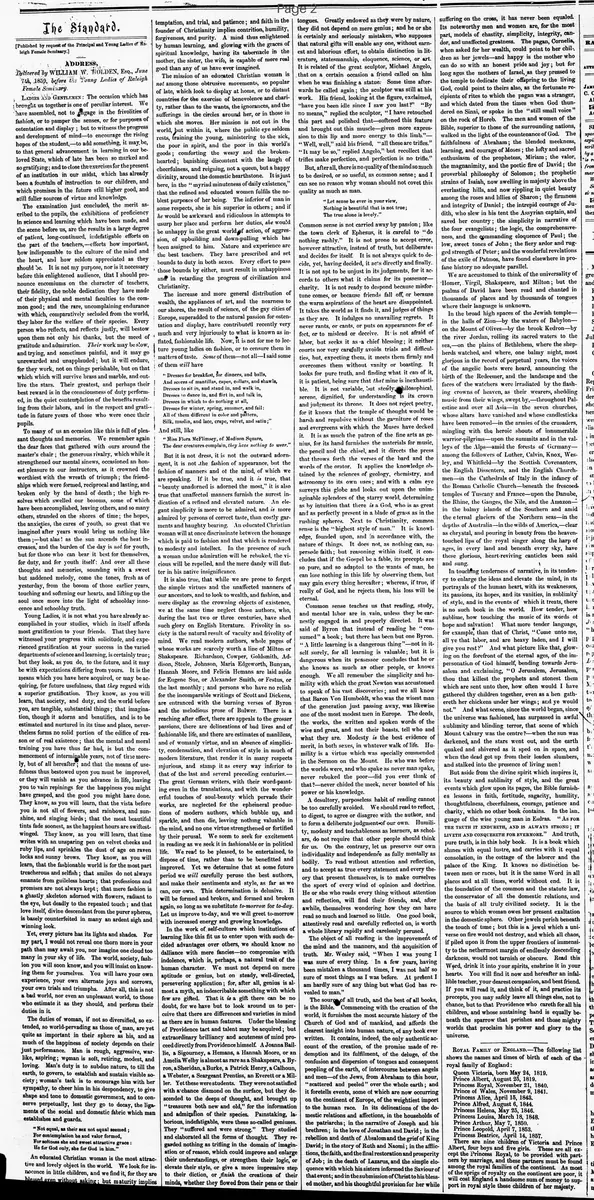
ADDRESS
Delivered by WILLIAM W. HOLDEN, Esq., June 1st, 1859, before the Young Ladies of Raleigh Female Seminary.
Ladies and Gentlemen: The occasion which has brought us together is one of peculiar interest. We have assembled, not to engage in the frivolities of fashion, or to pamper the senses, or for purposes of ostentation and display; but to witness the progress and development of mind—to encourage the rising hopes of the student,—to add something, it may be, to that general advancement in learning in our beloved State, which of late has been so marked and so gratifying; and to close the exercises for the present of an institution in our midst, which has already been a fountain of instruction to our children, and which promises in the future still higher good, and still fuller sources of virtue and knowledge.
The examination just concluded, the merit ascribed to the pupils, the exhibitions of proficiency in science and learning which have been made, and the scene before us, are the results in a large degree of patient, long-continued, indefatigable efforts on the part of the teachers,—efforts how important, how indispensable to the culture of the mind and the heart, and how seldom appreciated as they should be. It is not my purpose, nor is it necessary before this enlightened audience, that I should pronounce encomiums on the character of teachers, their fidelity, the noble dedication they have made of their physical and mental faculties to the common good; and the rare, uncomplaining endurance with which, comparatively secluded from the world, they labor for the welfare of their species. Every person who reflects, and reflects justly, will bestow upon them not only his thanks, but the meed of gratitude and admiration. Their work may be slow, and trying, and sometimes painful, and it may go unrewarded and unapplauded; but it will endure, for they work, not on things perishable, but on that which will survive brass and marble, and outlive the stars. Their greatest, and perhaps their best reward is in the consciousness of duty performed, in the quiet contemplation of the benefits resulting from their labors, and in the respect and gratitude in future years of those who were once their pupils.
To many of us an occasion like this is full of pleasant thoughts and memories. We remember again the dear faces that gathered with ours around the master's chair; the generous rivalry, which while it strengthened our mental sinews, occasioned an honest pleasure to our instructors, as it crowned the worthiest with the wreath of triumph; the friendships which were formed, reciprocal and lasting, and broken only by the hand of death; the high resolves which swelled our bosoms, some of which have been accomplished, leaving others, and so many others, stranded on the shores of time; the hopes, the anxieties, the cares of youth, so great that we imagined after years would bring us nothing like them;—but alas! as the sun ascends the heat increases, and the burden of the day is not for youth, but for those who can bear it best for themselves, for duty, and for youth itself: And over all these thoughts and memories, sounding with a sweet but saddened melody, come the tones, fresh as of yesterday, from the bosom of those earlier years, touching and softening our hearts, and lifting up the soul once more into the light of schoolday innocence and schoolday truth.
Young Ladies, it is not what you have already accomplished in your studies, which in itself affords most gratification to your friends. That they have witnessed your progress with solicitude, and experienced gratification at your success in the varied departments of science and learning, is certainly true; but they look, as you do, to the future, and it may be with expectations differing from yours. It is the means which you have here acquired, or may be acquiring, for future usefulness, that they regard with a superior gratification. They know, as you will learn, that society, and duty, and the world before you, are tangible, substantial things; that imagination, though it adorns and beautifies, and is to be estimated and nurtured in its time and place, nevertheless forms no solid portion of the edifice of reason or of real existence; that the mental and moral training you have thus far had, is but the commencement of interminable years, not of time merely, but of all hereafter; and that the means of usefulness thus bestowed upon you must be improved or they will vanish as you advance in life, leaving you to vain repinings for the happiness you might have grasped, and the good you might have done.
They know, as you will learn, that the vista before you is not all of flowers, and rainbows, and sunshine, and singing birds; that the most beautiful tints fade soonest, as the happiest hours are swiftest winged. They know, as you will learn, that time writes with an unsparing pen on velvet cheeks and ruby lips, and sprinkles the dust of age on raven locks and sunny brows. They know, as you will learn, that the fashionable world is for the most part treacherous and selfish: that smiles do not always emanate from guileless hearts; that professions and promises are not always kept; that mere fashion is a ghastly skeleton adorned with flowers, radiant to the eye, but deadly to the repeated touch; and that love itself, divine descendant from the purer spheres, is basely counterfeited in many an ardent sigh and winning look.
Yet, every picture has its lights and shades. For my part, I would not reveal one thorn more in your path than may await you, nor imagine one cloud too many in your sky of life. The world, society, fashion you will soon know, and you will insist on knowing them for yourselves. You will have your own experience, your own alternate joys and sorrows, your own trials and triumphs. After all, this is not a bad world, nor even an unpleasant world, to those who estimate it as they should, and perform their duties in it.
The duties of woman, if not so diversified, so extended, so world-pervading as those of man, are yet quite as important in their sphere as his, and as much of the happiness of society depends on their just performance. Man is rough, aggressive, warlike, aspiring; woman is soft, retiring, modest, and loving. Man's duty is to subdue nature, to till the earth, to govern, to establish and sustain visible society; woman's task is to encourage him with her sympathy, to cheer him in his despondency, to give shape and tone to domestic government, and to conserve perpetually, lest they go to decay, the ligaments of the social and domestic fabric which man establishes and guards.
"Not equal, as their sex not equal seemed;
For contemplation he and valor formed,
For softness she and sweet attractive grace:
He for God only, she for God in him."
An educated Christian woman is the most attractive and lovely object in the world. We look for innocence in little children, and we find it, for they are blessed even without asking: but maturity implies temptation, and trial, and patience; and faith in the founder of Christianity implies contrition, humility, forgiveness, and purity. A mind thus enlightened by human learning, and glowing with the graces of spiritual knowledge, having its tabernacle in the mother, the sister, the wife, is capable of more real good than any of us have ever imagined.
The mission of an educated Christian woman is not among those obtrusive movements, so popular of late, which look to display at home, or to distant countries for the exercise of benevolence and charity, rather than to the wants, the ignorances, and the sufferings in the circles around her, or in those in which she moves. Her mission is not out in the world, but within it where the public eye seldom rests, training the young, ministering to the sick, the poor in spirit, and the poor in this world's goods; comforting the weary and the broken-hearted; banishing discontent with the laugh of cheerfulness, and reigning, not as a queen, but as a happy divinity, around the domestic hearthstone. It is just here, in the "myriad minuteness of daily existence," that the refined and educated woman fulfils the noblest purposes of her being. The inferior of man in some respects, she is his superior in others; and if he would be awkward and ridiculous in attempts to usurp her place and perform her duties, she would be unhappy in the great world of action, of aggression, of upbuilding and down-pulling which has been assigned to him. Nature and experience are the best teachers. They have prescribed and set bounds to duty in both sexes. Every effort to pass those bounds by either, must result in unhappiness and in retarding the progress of civilization and Christianity.
The increase and more general distribution of wealth, the appliances of art, and the nearness to our shores, the result of science, of the gay cities of Europe, superadded to the natural passion for ostentation and display, have contributed recently very much and very injuriously to what is known as inflated, fashionable life. Now, it is not for me to lecture young ladies on fashion, or to censure them in matters of taste. Some of them—not all—I said some of them will have
"Dresses for breakfast, for dinners, and balls,
And scores of mantillas, capes, collars, and shawls,
Dresses to sit in, and stand in, and walk in,
Dresses to dance in, and flirt in, and talk in,
Dresses in which to do nothing at all
Dresses for winter, spring, summer, and fall:
All of them different in color and pattern.
Silk, muslin, and lace, crape, velvet, and satin;"
And still, like
"Miss Flora McFlimsey, of Madison Square,
The dear creatures complain, they have nothing to wear."
But it is not dress, it is not the outward adornment, it is not the fashion of appearance, but the fashion of manners and of the mind, of which we are speaking. If it be true, and it is true, that "beauty unadorned is adorned the most," it is also true that unaffected manners furnish the surest indication of a refined and elevated nature. An elegant simplicity is more to be admired, and is more admired by persons of correct taste, than costly garments and haughty bearing. An educated Christian woman will at once discriminate between the homage which is paid to fashion and that which is rendered to modesty and intellect. In the presence of such a woman undue admiration will be rebuked, the vicious will be repelled, and the mere dandy will flutter in his native insignificance.
It is also true, that while we are prone to forget the simple virtues and the unaffected manners of our ancestors, and to look to wealth, and fashion, and mere display as the crowning objects of existence, we at the same time neglect those authors, who during the last two or three centuries, have shed such glory on English literature. Frivolity in society is the natural result of vacuity and frivolity of mind. We read modern authors, whole pages of whose works are scarcely worth a line of Milton or Shakspeare. Richardson, Cowper, Goldsmith, Addison, Steele, Johnson, Maria Edgeworth, Bunyan, Hannah More, and Felicia Hemans are laid aside for Eugene Sue, or Alexander Smith, or Festus, or the last monthly: and persons who have no relish for the incomparable writings of Scott and Dickens, are entranced with the burning verses of Byron and the melodious prose of Bulwer. There is a reaching after effect, there are appeals to the grosser passions, there are delineations of bad lives and of fashionable life, and there are estimates of manliness, and of womanly virtue, and an absence of simplicity, condensation, and elevation of style in much of modern literature, that render it in many respects injurious, and stamp it as every way inferior to that of the last and several preceding centuries.—The great German writers, with their word-painting even in the translations, and with the wonderful touches of soul-beauty which pervade their works, are neglected for the ephemeral productions of modern authors, which bubble up, and sparkle, and then die, leaving nothing valuable in the mind, and no one virtue strengthened or fortified by their perusal. We seem to seek for excitement in reading as we seek it in fashionable or in political life. We read to be pleased, to be entertained, to dispose of time, rather than to be benefitted and improved. Yet we determine that at some future period we will carefully peruse the best authors and make their sentiments and style, as far as we can, our own. This determination is delusive. It will be formed and broken, and formed and broken again, so long as we substitute to-morrow for to-day. Let us improve to-day, and we will greet to-morrow with increased energy and growing knowledge.
In the work of self-culture which institutions of learning like this fit us to enter upon with such decided advantages over others, we should know no dalliance with mere fancies—no compromise with indolence, which is, perhaps, a natural trait of the human character. We must not depend on mere aptitude or genius, but on steady, well-directed persevering application; for, after all, genius is almost a myth, an indescribable something with which few are gifted. That it is a gift there can no doubt, for we have but to look around us to perceive that there are differences and varieties in mind as there are in human features. Under the blessing of Providence tact and talent may be acquired; but extraordinary brilliancy and acuteness of mind proceed directly from Providence himself. A Joanna Baillie, a Sigourney, a Hemans, a Hannah More, or an Amelia Welby is almost as rare as a Shakspeare, a Byron, a Sheridan, a Burke, a Patrick Henry, a Calhoun, a Webster, a Seargeant Prentiss, an Everett or a Miller. Yet these were students. They were not satisfied with a chance diamond on the surface, but they descended to the deeps of thought, and brought up "treasures both new and old," for the information and admiration of their species. Painstaking, laborious, indefatigable, were these so-called geniuses. They "suffered and were strong." They studied and elaborated all the forms of thought. They regarded nothing as trifling in the domain of imagination or of reason, which could improve and enlarge their understandings, or strengthen their logic, or elevate their style, or give a more impressive step to their diction, or finish the creations of their minds, whether they flowed from their pens or their tongues. Greatly endowed as they were by nature, they did not depend on mere genius; and he or she is certainly and seriously mistaken, who supposes that natural gifts will enable any one, without earnest and laborious effort, to obtain distinction in literature, statesmanship, eloquence, science, or art.
It is related of the great sculptor, Michael Angelo, that on a certain occasion a friend called on him when he was finishing a statue: Some time afterwards he called again; the sculptor was still at his work. His friend, looking at the figure, exclaimed, "Have you been idle since I saw you last?" "By no means," replied the sculptor, "I have retouched this part and polished that—softened this feature and brought out this muscle—given more expression to this lip and more energy to this limb." "Well, well," said his friend, all these are trifles." "It may be so," replied Angelo, "but recollect that trifles make perfection, and perfection is no trifle."
But, after all, there is no quality of the mind so much to be desired, or so useful, as common sense; and I can see no reason why woman should not covet this quality as much as man.
"Let sense be ever in your view.
Nothing is beautiful that is not true;
The true alone is lovely.'"
Common sense is not carried away by passion; like the town clerk of Ephesus, it is careful to "do nothing rashly." It is not prone to accept error, however attractive, instead of truth, but deliberates and decides for itself. It is not always quick to decide, yet, having decided, it acts directly and finally. It is not apt to be unjust in its judgments, for it accords to others what it claims for its possessor—charity. It is not ready to despond because misfortune comes, or because friends fall off, or because the warm aspirations of the heart are disappointed. It takes the world as it finds it, and judges of things as they are. It indulges no unavailing regrets. It never rants, or cants, or puts on appearances for effect, or to mislead or deceive. It is not afraid of labor, but seeks it as a chief blessing; it neither courts nor very carefully avoids trials and difficulties, but, expecting them, it meets them firmly and overcomes them without vanity or boasting. It looks for pure truth, and finding what it can of it, it is patient, being sure that that mine is inexhaustible. It is not variable, but steady, philosophical, serene, dignified, for understanding is its crown and judgment its throne. It does not reject poetry, for it knows that the temple of thought would be harsh and repulsive without the garniture of roses and evergreens with which the Muses have decked it. It is as much the patron of the fine arts as genius, for its hand furnishes the materials for music, the pencil and the chisel, and it directs the press that throws forth the verses of the bard and the words of the orator. It applies the knowledge obtained by the sciences of geology, chemistry, and astronomy to its own uses; and with a calm eye surveys this globe and looks out upon the unimaginable splendors of the starry world, determining as by intuition that there is a God, who is as great and as perfectly present in a blade of grass as in the rushing spheres. Next to Christianity, common sense is the "highest style of man." It is knowledge, founded upon, and in accordance with, the nature of things. It does not, as nothing can, supersede faith; but reasoning within itself, it concludes that if the Gospel be a fable, its precepts are so pure, and so adapted to the wants of man, he can lose nothing in this life by observing them, but may gain everything hereafter; whereas, if true, if really of God, and he rejects them, his loss will be eternal.
Common sense teaches us that reading, study and mental labor are in vain, unless they be earnestly engaged in and properly directed. It was said of Byron that instead of reading he "consumed" a book: but there has been but one Byron. "A little learning is a dangerous thing"—not in itself surely, for all learning is valuable; but it is dangerous when its possessor concludes that he or she knows as much as other people, or knows enough. We all remember the simplicity and humility with which the great Newton was accustomed to speak of his vast discoveries; and we all know that Baron Von Humboldt, who was the wisest man of the generation just passing away, was likewise one of the most modest men in Europe. The deeds, the works, the written and spoken words of the wise and great, and not their boasts, tell who and what they are. Modesty is the best evidence of merit, in both sexes, in whatever walk of life. Humility is a virtue which was specially commended in the Sermon on the Mount. He who was before the worlds were, and who spake as never man spake, never rebuked the poor—did you ever think of that?—never chided the meek, never boasted of his power or his knowledge.
A desultory, purposeless habit of reading cannot be too carefully avoided. We should read to reflect, to digest, to agree or disagree with the author, and to form a deliberate judgment of our own. Humility, modesty and teachableness as learners, as scholars, do not require that other people should think for us. On the contrary, let us preserve our own individuality and independence as fully mentally as bodily. To read without attention and reflection, and to accept as true every statement and every theory that present themselves, is to make ourselves the sport of every wind of opinion and doctrine. He or she who reads everything without attention and reflection, will find their friends, and, after awhile, themselves wondering how they can have read so much and learned so little. One good book, attentively read and carefully reflected on, is worth a whole library rapidly and carelessly perused.
The object of all reading is the improvement of the mind and the manners, and the acquisition of truth. Mr. Wesley said, "When I was young I was sure of everything. In a few years, having been mistaken a thousand times, I was not half so sure of most things as I was before. At present I am hardly sure of anything but what God has revealed to man."
The source of all truth, and the best of all books, is the Bible. Commencing with the creation of the world, it furnishes the most accurate history of the Church of God and of mankind, and affords the clearest insight into human nature, of any book ever written. It contains, indeed, the only authentic account of the creation, of the promise made of redemption and its fulfilment, of the deluge, of the confusion and dispersion of tongues and consequent peopling of the earth, of intercourse between angels and men—of the Jews, from Abraham to this hour "scattered and peeled" over the whole earth; and it foretells events, some of which are now occurring on the continent of Europe, of the weightiest import to the human race. In its delineations of the domestic relations and affections, in the households of the patriarchs; in the narrative of Joseph and his brethren; in the love of Jonathan and David: in the rebellion and death of Absalom and the grief of King David; in the story of Ruth and Naomi; in the afflictions, the faith, and the final restoration and prosperity of Job; in the death of Lazarus, and the simple eloquence with which his sisters informed the Saviour of that event; and in the submission of Christ to his blessed mother, and his thoughtful provision for her while suffering on the cross, it has never been equaled.
Its noteworthy men and women are, for the most part, models of chastity, simplicity, integrity, candor, and unaffected greatness. The pagan, Cornelia, when asked for her wealth, could point to her children as her jewels—and happy is the mother who can do so with an honest pride and joy; but for long ages the mothers of Israel, as they pressed to the temple to dedicate their offspring to the living God, could point to theirs also, as the fortunate recipients of rites to which the pagan was a stranger, and which dated from the times when God thundered on Sinai, or spoke in the "still small voice" on the rock of Horeb. The men and women of the Bible, superior to those of the surrounding nations, walked in the light of the countenance of God. The faithfulness of Abraham; the blended meekness, learning, and courage of Moses; the lofty and sacred enthusiasm of the prophetess, Miriam; the valor, the magnanimity, and the poetic fire of David; the proverbial philosophy of Solomon; the prophetic strains of Isaiah, now swelling in majesty above the everlasting hills, and now rippling in quiet beauty among the roses and lilies of Sharon; the firmness and integrity of Daniel; the intrepid courage of Judith, who slew in his tent the Assyrian captain, and saved her country; the simplicity in narrative of the four evangelists; the logic, the comprehensiveness, and the commanding eloquence of Paul; the low, sweet tones of John; the fiery ardor and rugged strength of Peter; and the wonderful revelations of the exile of Patmos, have found elsewhere in profane history no adequate parallel.
We are accustomed to think of the universality of Homer, Virgil, Shakspeare, and Milton; but the psalms of David have been read and chanted in thousands of places and by thousands of tongues where their language is unknown. In the broad high spaces of the Jewish temple—in the halls of Zion—by the waters of Babylon—on the Mount of Olives—by the brook Kedron—by the river Jordan, rolling its sacred waters to the sea,—on the plains of Bethlehem, where the shepherds watched, and where, one balmy night, most glorious in the record of perpetual years, the voices of the angelic hosts were heard, announcing the birth of the Redeemer, and the landscape and the faces of the watchers were irradiated by the flashing crowns of heaven, as their wearers, shedding music from their wings, swept by,—throughout Palestine and over all Asia—in the seven churches, whose altars have vanished and whose candlesticks have been removed—in the armies of the crusaders, mingling with the heroic shouts of innumerable warrior-pilgrims—upon the summits and in the valleys of the Alps—amid the forests of Germany—among the followers of Luther, Calvin, Knox, Wesley, and Whitfield—by the Scottish Covenanters, the English Dissenters, and the English Churchmen—in the Cathedrals of Italy in the infancy of the Roman Catholic Church—beneath the frescoed temples of Tuscany and France—upon the Danube, the Rhine, the Ganges, the Nile, and the Amazon in the balmy islands of the Southern and amid the eternal glaciers of the Northern seas—in the depths of Australia—in the wilds of America,—clear as crystal, and pouring in beauty from the heaven-touched lips of the royal singer along the harp of ages, in every land and beneath every sky, have these glorious, heart-reviving canticles been said and sung.
In touching tenderness of narrative, in its tendency to enlarge the ideas and elevate the mind, in its portrayals of the human heart, with its weaknesses, its passions, its hopes, and its vanities, in sublimity of style, and in the events of which it treats, there is no such book in the world. How tender, how sublime, how touching the music of its words of hope and salvation! What more tender language, for example, than that of Christ, "Come unto me, all ye that labor, and are heavy laden, and I will give you rest?" And what picture like that, glowing on the forefront of the eternal ages, of the impersonation of God himself, bending towards Jerusalem and exclaiming, "O Jerusalem, Jerusalem, thou that killest the prophets and stonest them which are sent unto thee, how often would I have gathered thy children together, even as a hen gathereth her chickens under her wings; and ye would not." And what scene, since the world began, since the universe was fashioned, has surpassed in awful sublimity and blinding terror, that scene of which Mount Calvary was the centre? when the sun was darkened, and the stars went out, and the earth quaked and shivered as it sped on in space, and when the dead got up from their leaden slumbers, and stalked into the presence of living men!
But aside from the divine spirit which inspires it, its beauty and sublimity of style, and the great events which glow upon its pages, the Bible furnishes lessons in faith, fortitude, sagacity, humility, thoughtfulness, cheerfulness, courage, patience and charity, which no other book contains. In the language of the wise young man in Esdras, "As for THE TRUTH IT ENDURETH, AND IS ALWAYS STRONG; IT LIVETH AND CONQUERETH FOR EVERMORE."
And truth, pure truth, is in this holy book. It is a book which shines with equal lustre, and carries with it equal consolation, in the cottage of the laborer and the palace of the King. It knows no distinction between men or races, but it is the same Word in all places and at all times, world without end. It is the foundation of the common and the statute law, the conservator of all the domestic relations, and the basis of all truly civilized society. It is the source to which woman owes her present exaltation in the domestic sphere. Other jewels perish beneath the touch of time; but this is a jewel which a universe on fire would not destroy, and which all chaos, if piled upon it from the upper frontiers of immensity to the nethermost margin of endlessly descending darkness, would not tarnish or obscure. Read this Word, drink it into your spirits, enshrine it in your hearts. You will find it now and hereafter an infallible teacher, your dearest companion, and best friend. If you will read it, and think of it, and practice its precepts, you may safely leave all things else, not to chance, but to that Providence who careth for all his children, and whose sustaining hand is equally beneath the sparrow that perishes and those mighty worlds that proclaim his power and glory to the universe.
[Published by request of the Principal and Young Ladies of Raleigh Female Seminary.]
ADDRESS
Delivered by WILLIAM W. HOLDEN, Esq., June 1st, 1859, before the Young Ladies of Raleigh Female Seminary.
Ladies and Gentlemen: The occasion which has brought us together is one of peculiar interest. We have assembled, not to engage in the frivolities of fashion, or to pamper the senses, or for purposes of ostentation and display; but to witness the progress and development of mind—to encourage the rising hopes of the student,—to add something, it may be, to that general advancement in learning in our beloved State, which of late has been so marked and so gratifying; and to close the exercises for the present of an institution in our midst, which has already been a fountain of instruction to our children, and which promises in the future still higher good, and still fuller sources of virtue and knowledge.
The examination just concluded, the merit ascribed to the pupils, the exhibitions of proficiency in science and learning which have been made, and the scene before us, are the results in a large degree of patient, long-continued, indefatigable efforts on the part of the teachers,—efforts how important, how indispensable to the culture of the mind and the heart, and how seldom appreciated as they should be. It is not my purpose, nor is it necessary before this enlightened audience, that I should pronounce encomiums on the character of teachers, their fidelity, the noble dedication they have made of their physical and mental faculties to the common good; and the rare, uncomplaining endurance with which, comparatively secluded from the world, they labor for the welfare of their species. Every person who reflects, and reflects justly, will bestow upon them not only his thanks, but the meed of gratitude and admiration. Their work may be slow, and trying, and sometimes painful, and it may go unrewarded and unapplauded; but it will endure, for they work, not on things perishable, but on that which will survive brass and marble, and outlive the stars. Their greatest, and perhaps their best reward is in the consciousness of duty performed, in the quiet contemplation of the benefits resulting from their labors, and in the respect and gratitude in future years of those who were once their pupils.
To many of us an occasion like this is full of pleasant thoughts and memories. We remember again the dear faces that gathered with ours around the master's chair; the generous rivalry, which while it strengthened our mental sinews, occasioned an honest pleasure to our instructors, as it crowned the worthiest with the wreath of triumph; the friendships which were formed, reciprocal and lasting, and broken only by the hand of death; the high resolves which swelled our bosoms, some of which have been accomplished, leaving others, and so many others, stranded on the shores of time; the hopes, the anxieties, the cares of youth, so great that we imagined after years would bring us nothing like them;—but alas! as the sun ascends the heat increases, and the burden of the day is not for youth, but for those who can bear it best for themselves, for duty, and for youth itself: And over all these thoughts and memories, sounding with a sweet but saddened melody, come the tones, fresh as of yesterday, from the bosom of those earlier years, touching and softening our hearts, and lifting up the soul once more into the light of schoolday innocence and schoolday truth.
Young Ladies, it is not what you have already accomplished in your studies, which in itself affords most gratification to your friends. That they have witnessed your progress with solicitude, and experienced gratification at your success in the varied departments of science and learning, is certainly true; but they look, as you do, to the future, and it may be with expectations differing from yours. It is the means which you have here acquired, or may be acquiring, for future usefulness, that they regard with a superior gratification. They know, as you will learn, that society, and duty, and the world before you, are tangible, substantial things; that imagination, though it adorns and beautifies, and is to be estimated and nurtured in its time and place, nevertheless forms no solid portion of the edifice of reason or of real existence; that the mental and moral training you have thus far had, is but the commencement of interminable years, not of time merely, but of all hereafter; and that the means of usefulness thus bestowed upon you must be improved or they will vanish as you advance in life, leaving you to vain repinings for the happiness you might have grasped, and the good you might have done.
They know, as you will learn, that the vista before you is not all of flowers, and rainbows, and sunshine, and singing birds; that the most beautiful tints fade soonest, as the happiest hours are swiftest winged. They know, as you will learn, that time writes with an unsparing pen on velvet cheeks and ruby lips, and sprinkles the dust of age on raven locks and sunny brows. They know, as you will learn, that the fashionable world is for the most part treacherous and selfish: that smiles do not always emanate from guileless hearts; that professions and promises are not always kept; that mere fashion is a ghastly skeleton adorned with flowers, radiant to the eye, but deadly to the repeated touch; and that love itself, divine descendant from the purer spheres, is basely counterfeited in many an ardent sigh and winning look.
Yet, every picture has its lights and shades. For my part, I would not reveal one thorn more in your path than may await you, nor imagine one cloud too many in your sky of life. The world, society, fashion you will soon know, and you will insist on knowing them for yourselves. You will have your own experience, your own alternate joys and sorrows, your own trials and triumphs. After all, this is not a bad world, nor even an unpleasant world, to those who estimate it as they should, and perform their duties in it.
The duties of woman, if not so diversified, so extended, so world-pervading as those of man, are yet quite as important in their sphere as his, and as much of the happiness of society depends on their just performance. Man is rough, aggressive, warlike, aspiring; woman is soft, retiring, modest, and loving. Man's duty is to subdue nature, to till the earth, to govern, to establish and sustain visible society; woman's task is to encourage him with her sympathy, to cheer him in his despondency, to give shape and tone to domestic government, and to conserve perpetually, lest they go to decay, the ligaments of the social and domestic fabric which man establishes and guards.
"Not equal, as their sex not equal seemed;
For contemplation he and valor formed,
For softness she and sweet attractive grace:
He for God only, she for God in him."
An educated Christian woman is the most attractive and lovely object in the world. We look for innocence in little children, and we find it, for they are blessed even without asking: but maturity implies temptation, and trial, and patience; and faith in the founder of Christianity implies contrition, humility, forgiveness, and purity. A mind thus enlightened by human learning, and glowing with the graces of spiritual knowledge, having its tabernacle in the mother, the sister, the wife, is capable of more real good than any of us have ever imagined.
The mission of an educated Christian woman is not among those obtrusive movements, so popular of late, which look to display at home, or to distant countries for the exercise of benevolence and charity, rather than to the wants, the ignorances, and the sufferings in the circles around her, or in those in which she moves. Her mission is not out in the world, but within it where the public eye seldom rests, training the young, ministering to the sick, the poor in spirit, and the poor in this world's goods; comforting the weary and the broken-hearted; banishing discontent with the laugh of cheerfulness, and reigning, not as a queen, but as a happy divinity, around the domestic hearthstone. It is just here, in the "myriad minuteness of daily existence," that the refined and educated woman fulfils the noblest purposes of her being. The inferior of man in some respects, she is his superior in others; and if he would be awkward and ridiculous in attempts to usurp her place and perform her duties, she would be unhappy in the great world of action, of aggression, of upbuilding and down-pulling which has been assigned to him. Nature and experience are the best teachers. They have prescribed and set bounds to duty in both sexes. Every effort to pass those bounds by either, must result in unhappiness and in retarding the progress of civilization and Christianity.
The increase and more general distribution of wealth, the appliances of art, and the nearness to our shores, the result of science, of the gay cities of Europe, superadded to the natural passion for ostentation and display, have contributed recently very much and very injuriously to what is known as inflated, fashionable life. Now, it is not for me to lecture young ladies on fashion, or to censure them in matters of taste. Some of them—not all—I said some of them will have
"Dresses for breakfast, for dinners, and balls,
And scores of mantillas, capes, collars, and shawls,
Dresses to sit in, and stand in, and walk in,
Dresses to dance in, and flirt in, and talk in,
Dresses in which to do nothing at all
Dresses for winter, spring, summer, and fall:
All of them different in color and pattern.
Silk, muslin, and lace, crape, velvet, and satin;"
And still, like
"Miss Flora McFlimsey, of Madison Square,
The dear creatures complain, they have nothing to wear."
But it is not dress, it is not the outward adornment, it is not the fashion of appearance, but the fashion of manners and of the mind, of which we are speaking. If it be true, and it is true, that "beauty unadorned is adorned the most," it is also true that unaffected manners furnish the surest indication of a refined and elevated nature. An elegant simplicity is more to be admired, and is more admired by persons of correct taste, than costly garments and haughty bearing. An educated Christian woman will at once discriminate between the homage which is paid to fashion and that which is rendered to modesty and intellect. In the presence of such a woman undue admiration will be rebuked, the vicious will be repelled, and the mere dandy will flutter in his native insignificance.
It is also true, that while we are prone to forget the simple virtues and the unaffected manners of our ancestors, and to look to wealth, and fashion, and mere display as the crowning objects of existence, we at the same time neglect those authors, who during the last two or three centuries, have shed such glory on English literature. Frivolity in society is the natural result of vacuity and frivolity of mind. We read modern authors, whole pages of whose works are scarcely worth a line of Milton or Shakspeare. Richardson, Cowper, Goldsmith, Addison, Steele, Johnson, Maria Edgeworth, Bunyan, Hannah More, and Felicia Hemans are laid aside for Eugene Sue, or Alexander Smith, or Festus, or the last monthly: and persons who have no relish for the incomparable writings of Scott and Dickens, are entranced with the burning verses of Byron and the melodious prose of Bulwer. There is a reaching after effect, there are appeals to the grosser passions, there are delineations of bad lives and of fashionable life, and there are estimates of manliness, and of womanly virtue, and an absence of simplicity, condensation, and elevation of style in much of modern literature, that render it in many respects injurious, and stamp it as every way inferior to that of the last and several preceding centuries.—The great German writers, with their word-painting even in the translations, and with the wonderful touches of soul-beauty which pervade their works, are neglected for the ephemeral productions of modern authors, which bubble up, and sparkle, and then die, leaving nothing valuable in the mind, and no one virtue strengthened or fortified by their perusal. We seem to seek for excitement in reading as we seek it in fashionable or in political life. We read to be pleased, to be entertained, to dispose of time, rather than to be benefitted and improved. Yet we determine that at some future period we will carefully peruse the best authors and make their sentiments and style, as far as we can, our own. This determination is delusive. It will be formed and broken, and formed and broken again, so long as we substitute to-morrow for to-day. Let us improve to-day, and we will greet to-morrow with increased energy and growing knowledge.
In the work of self-culture which institutions of learning like this fit us to enter upon with such decided advantages over others, we should know no dalliance with mere fancies—no compromise with indolence, which is, perhaps, a natural trait of the human character. We must not depend on mere aptitude or genius, but on steady, well-directed persevering application; for, after all, genius is almost a myth, an indescribable something with which few are gifted. That it is a gift there can no doubt, for we have but to look around us to perceive that there are differences and varieties in mind as there are in human features. Under the blessing of Providence tact and talent may be acquired; but extraordinary brilliancy and acuteness of mind proceed directly from Providence himself. A Joanna Baillie, a Sigourney, a Hemans, a Hannah More, or an Amelia Welby is almost as rare as a Shakspeare, a Byron, a Sheridan, a Burke, a Patrick Henry, a Calhoun, a Webster, a Seargeant Prentiss, an Everett or a Miller. Yet these were students. They were not satisfied with a chance diamond on the surface, but they descended to the deeps of thought, and brought up "treasures both new and old," for the information and admiration of their species. Painstaking, laborious, indefatigable, were these so-called geniuses. They "suffered and were strong." They studied and elaborated all the forms of thought. They regarded nothing as trifling in the domain of imagination or of reason, which could improve and enlarge their understandings, or strengthen their logic, or elevate their style, or give a more impressive step to their diction, or finish the creations of their minds, whether they flowed from their pens or their tongues. Greatly endowed as they were by nature, they did not depend on mere genius; and he or she is certainly and seriously mistaken, who supposes that natural gifts will enable any one, without earnest and laborious effort, to obtain distinction in literature, statesmanship, eloquence, science, or art.
It is related of the great sculptor, Michael Angelo, that on a certain occasion a friend called on him when he was finishing a statue: Some time afterwards he called again; the sculptor was still at his work. His friend, looking at the figure, exclaimed, "Have you been idle since I saw you last?" "By no means," replied the sculptor, "I have retouched this part and polished that—softened this feature and brought out this muscle—given more expression to this lip and more energy to this limb." "Well, well," said his friend, all these are trifles." "It may be so," replied Angelo, "but recollect that trifles make perfection, and perfection is no trifle."
But, after all, there is no quality of the mind so much to be desired, or so useful, as common sense; and I can see no reason why woman should not covet this quality as much as man.
"Let sense be ever in your view.
Nothing is beautiful that is not true;
The true alone is lovely.'"
Common sense is not carried away by passion; like the town clerk of Ephesus, it is careful to "do nothing rashly." It is not prone to accept error, however attractive, instead of truth, but deliberates and decides for itself. It is not always quick to decide, yet, having decided, it acts directly and finally. It is not apt to be unjust in its judgments, for it accords to others what it claims for its possessor—charity. It is not ready to despond because misfortune comes, or because friends fall off, or because the warm aspirations of the heart are disappointed. It takes the world as it finds it, and judges of things as they are. It indulges no unavailing regrets. It never rants, or cants, or puts on appearances for effect, or to mislead or deceive. It is not afraid of labor, but seeks it as a chief blessing; it neither courts nor very carefully avoids trials and difficulties, but, expecting them, it meets them firmly and overcomes them without vanity or boasting. It looks for pure truth, and finding what it can of it, it is patient, being sure that that mine is inexhaustible. It is not variable, but steady, philosophical, serene, dignified, for understanding is its crown and judgment its throne. It does not reject poetry, for it knows that the temple of thought would be harsh and repulsive without the garniture of roses and evergreens with which the Muses have decked it. It is as much the patron of the fine arts as genius, for its hand furnishes the materials for music, the pencil and the chisel, and it directs the press that throws forth the verses of the bard and the words of the orator. It applies the knowledge obtained by the sciences of geology, chemistry, and astronomy to its own uses; and with a calm eye surveys this globe and looks out upon the unimaginable splendors of the starry world, determining as by intuition that there is a God, who is as great and as perfectly present in a blade of grass as in the rushing spheres. Next to Christianity, common sense is the "highest style of man." It is knowledge, founded upon, and in accordance with, the nature of things. It does not, as nothing can, supersede faith; but reasoning within itself, it concludes that if the Gospel be a fable, its precepts are so pure, and so adapted to the wants of man, he can lose nothing in this life by observing them, but may gain everything hereafter; whereas, if true, if really of God, and he rejects them, his loss will be eternal.
Common sense teaches us that reading, study and mental labor are in vain, unless they be earnestly engaged in and properly directed. It was said of Byron that instead of reading he "consumed" a book: but there has been but one Byron. "A little learning is a dangerous thing"—not in itself surely, for all learning is valuable; but it is dangerous when its possessor concludes that he or she knows as much as other people, or knows enough. We all remember the simplicity and humility with which the great Newton was accustomed to speak of his vast discoveries; and we all know that Baron Von Humboldt, who was the wisest man of the generation just passing away, was likewise one of the most modest men in Europe. The deeds, the works, the written and spoken words of the wise and great, and not their boasts, tell who and what they are. Modesty is the best evidence of merit, in both sexes, in whatever walk of life. Humility is a virtue which was specially commended in the Sermon on the Mount. He who was before the worlds were, and who spake as never man spake, never rebuked the poor—did you ever think of that?—never chided the meek, never boasted of his power or his knowledge.
A desultory, purposeless habit of reading cannot be too carefully avoided. We should read to reflect, to digest, to agree or disagree with the author, and to form a deliberate judgment of our own. Humility, modesty and teachableness as learners, as scholars, do not require that other people should think for us. On the contrary, let us preserve our own individuality and independence as fully mentally as bodily. To read without attention and reflection, and to accept as true every statement and every theory that present themselves, is to make ourselves the sport of every wind of opinion and doctrine. He or she who reads everything without attention and reflection, will find their friends, and, after awhile, themselves wondering how they can have read so much and learned so little. One good book, attentively read and carefully reflected on, is worth a whole library rapidly and carelessly perused.
The object of all reading is the improvement of the mind and the manners, and the acquisition of truth. Mr. Wesley said, "When I was young I was sure of everything. In a few years, having been mistaken a thousand times, I was not half so sure of most things as I was before. At present I am hardly sure of anything but what God has revealed to man."
The source of all truth, and the best of all books, is the Bible. Commencing with the creation of the world, it furnishes the most accurate history of the Church of God and of mankind, and affords the clearest insight into human nature, of any book ever written. It contains, indeed, the only authentic account of the creation, of the promise made of redemption and its fulfilment, of the deluge, of the confusion and dispersion of tongues and consequent peopling of the earth, of intercourse between angels and men—of the Jews, from Abraham to this hour "scattered and peeled" over the whole earth; and it foretells events, some of which are now occurring on the continent of Europe, of the weightiest import to the human race. In its delineations of the domestic relations and affections, in the households of the patriarchs; in the narrative of Joseph and his brethren; in the love of Jonathan and David: in the rebellion and death of Absalom and the grief of King David; in the story of Ruth and Naomi; in the afflictions, the faith, and the final restoration and prosperity of Job; in the death of Lazarus, and the simple eloquence with which his sisters informed the Saviour of that event; and in the submission of Christ to his blessed mother, and his thoughtful provision for her while suffering on the cross, it has never been equaled.
Its noteworthy men and women are, for the most part, models of chastity, simplicity, integrity, candor, and unaffected greatness. The pagan, Cornelia, when asked for her wealth, could point to her children as her jewels—and happy is the mother who can do so with an honest pride and joy; but for long ages the mothers of Israel, as they pressed to the temple to dedicate their offspring to the living God, could point to theirs also, as the fortunate recipients of rites to which the pagan was a stranger, and which dated from the times when God thundered on Sinai, or spoke in the "still small voice" on the rock of Horeb. The men and women of the Bible, superior to those of the surrounding nations, walked in the light of the countenance of God. The faithfulness of Abraham; the blended meekness, learning, and courage of Moses; the lofty and sacred enthusiasm of the prophetess, Miriam; the valor, the magnanimity, and the poetic fire of David; the proverbial philosophy of Solomon; the prophetic strains of Isaiah, now swelling in majesty above the everlasting hills, and now rippling in quiet beauty among the roses and lilies of Sharon; the firmness and integrity of Daniel; the intrepid courage of Judith, who slew in his tent the Assyrian captain, and saved her country; the simplicity in narrative of the four evangelists; the logic, the comprehensiveness, and the commanding eloquence of Paul; the low, sweet tones of John; the fiery ardor and rugged strength of Peter; and the wonderful revelations of the exile of Patmos, have found elsewhere in profane history no adequate parallel.
We are accustomed to think of the universality of Homer, Virgil, Shakspeare, and Milton; but the psalms of David have been read and chanted in thousands of places and by thousands of tongues where their language is unknown. In the broad high spaces of the Jewish temple—in the halls of Zion—by the waters of Babylon—on the Mount of Olives—by the brook Kedron—by the river Jordan, rolling its sacred waters to the sea,—on the plains of Bethlehem, where the shepherds watched, and where, one balmy night, most glorious in the record of perpetual years, the voices of the angelic hosts were heard, announcing the birth of the Redeemer, and the landscape and the faces of the watchers were irradiated by the flashing crowns of heaven, as their wearers, shedding music from their wings, swept by,—throughout Palestine and over all Asia—in the seven churches, whose altars have vanished and whose candlesticks have been removed—in the armies of the crusaders, mingling with the heroic shouts of innumerable warrior-pilgrims—upon the summits and in the valleys of the Alps—amid the forests of Germany—among the followers of Luther, Calvin, Knox, Wesley, and Whitfield—by the Scottish Covenanters, the English Dissenters, and the English Churchmen—in the Cathedrals of Italy in the infancy of the Roman Catholic Church—beneath the frescoed temples of Tuscany and France—upon the Danube, the Rhine, the Ganges, the Nile, and the Amazon in the balmy islands of the Southern and amid the eternal glaciers of the Northern seas—in the depths of Australia—in the wilds of America,—clear as crystal, and pouring in beauty from the heaven-touched lips of the royal singer along the harp of ages, in every land and beneath every sky, have these glorious, heart-reviving canticles been said and sung.
In touching tenderness of narrative, in its tendency to enlarge the ideas and elevate the mind, in its portrayals of the human heart, with its weaknesses, its passions, its hopes, and its vanities, in sublimity of style, and in the events of which it treats, there is no such book in the world. How tender, how sublime, how touching the music of its words of hope and salvation! What more tender language, for example, than that of Christ, "Come unto me, all ye that labor, and are heavy laden, and I will give you rest?" And what picture like that, glowing on the forefront of the eternal ages, of the impersonation of God himself, bending towards Jerusalem and exclaiming, "O Jerusalem, Jerusalem, thou that killest the prophets and stonest them which are sent unto thee, how often would I have gathered thy children together, even as a hen gathereth her chickens under her wings; and ye would not." And what scene, since the world began, since the universe was fashioned, has surpassed in awful sublimity and blinding terror, that scene of which Mount Calvary was the centre? when the sun was darkened, and the stars went out, and the earth quaked and shivered as it sped on in space, and when the dead got up from their leaden slumbers, and stalked into the presence of living men!
But aside from the divine spirit which inspires it, its beauty and sublimity of style, and the great events which glow upon its pages, the Bible furnishes lessons in faith, fortitude, sagacity, humility, thoughtfulness, cheerfulness, courage, patience and charity, which no other book contains. In the language of the wise young man in Esdras, "As for THE TRUTH IT ENDURETH, AND IS ALWAYS STRONG; IT LIVETH AND CONQUERETH FOR EVERMORE."
And truth, pure truth, is in this holy book. It is a book which shines with equal lustre, and carries with it equal consolation, in the cottage of the laborer and the palace of the King. It knows no distinction between men or races, but it is the same Word in all places and at all times, world without end. It is the foundation of the common and the statute law, the conservator of all the domestic relations, and the basis of all truly civilized society. It is the source to which woman owes her present exaltation in the domestic sphere. Other jewels perish beneath the touch of time; but this is a jewel which a universe on fire would not destroy, and which all chaos, if piled upon it from the upper frontiers of immensity to the nethermost margin of endlessly descending darkness, would not tarnish or obscure. Read this Word, drink it into your spirits, enshrine it in your hearts. You will find it now and hereafter an infallible teacher, your dearest companion, and best friend. If you will read it, and think of it, and practice its precepts, you may safely leave all things else, not to chance, but to that Providence who careth for all his children, and whose sustaining hand is equally beneath the sparrow that perishes and those mighty worlds that proclaim his power and glory to the universe.
What sub-type of article is it?
Essay
What themes does it cover?
Moral Virtue
Religious
Social Manners
What keywords are associated?
Education
Women Duties
Common Sense
Bible
Literature
Moral Virtue
Christian Woman
Reading
Fashion
Truth
What entities or persons were involved?
William W. Holden, Esq.
Literary Details
Title
Address Delivered By William W. Holden, Esq., June 1st, 1859, Before The Young Ladies Of Raleigh Female Seminary.
Author
William W. Holden, Esq.
Subject
Delivered Before The Young Ladies Of Raleigh Female Seminary At The Close Of Their Examinations.
Form / Style
Prose Oration On Education, Women's Roles, Literature, And The Bible.
Key Lines
"Not Equal, As Their Sex Not Equal Seemed; For Contemplation He And Valor Formed, For Softness She And Sweet Attractive Grace: He For God Only, She For God In Him."
"Let Sense Be Ever In Your View. Nothing Is Beautiful That Is Not True; The True Alone Is Lovely.'"
"Come Unto Me, All Ye That Labor, And Are Heavy Laden, And I Will Give You Rest?"
"O Jerusalem, Jerusalem, Thou That Killest The Prophets And Stonest Them Which Are Sent Unto Thee, How Often Would I Have Gathered Thy Children Together, Even As A Hen Gathereth Her Chickens Under Her Wings; And Ye Would Not."
"As For The Truth It Endureth, And Is Always Strong; It Liveth And Conquereth For Evermore."