Thank you for visiting SNEWPapers!
Sign up free
The Rhode Island Republican
Newport, Newport County, Rhode Island
What is this article about?
On February 14, 1825, a volcano on Narborough Island in the Galapagos erupted spectacularly, spewing lava into the sea and creating extreme heat. The ship Tartar, nearby, faced peril from boiling waters and scorching air but escaped northward to Charles's Island amid ongoing fury. (248 characters)
Clipping
OCR Quality
Full Text
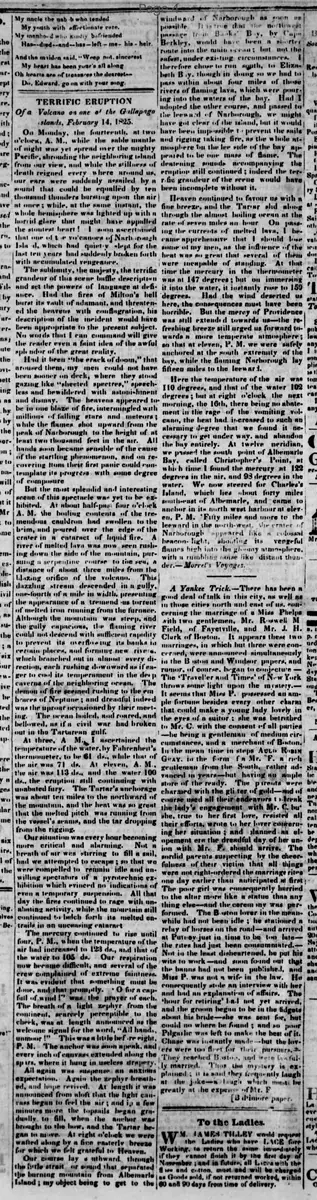
Of a Volcano on one of the Gallapagos Islands, February 14, 1825.
On Monday, the fourteenth, at two o'clock, A. M., while the sable mantle of night was yet spread o'er the mighty Pacific, shrouding the neighboring islands from our view, and while the still hunters of death reigned everywhere around us, our ears were suddenly assailed by a sound that could be equalled by ten thousand thunders bursting upon the air at once: while, at the same instant, the whole hemisphere was lighted up with a horrid glare that might have appalled the stoutest heart! I soon ascertained that one of the volcanoes of Narborough Island, which had quietly slept for the last ten years had suddenly broken forth with accumulated vengeance.
The sublimity, the majesty, the terrific grandeur of this scene baffle description and set the powers of language at defiance. Had the fires of Milton's hell burst its vault of adamant, and threatened the heavens with conflagration, his description of the incident would have been appropriate to the present subject.
No words that I can command will give the reader even a faint idea of the awful splendor of the great reality. Had it been "the crack of doom," that aroused them, my men could not have been sooner on deck, where they stood gazing like "sheeted spectres," speechless and bewildered with astonishment and dismay. The heavens appeared to be in one blaze of fire, intermingled with millions of falling stars and meteors; while the fumes shot upward from the peak of Narborough to the height of at least two thousand feet in the air. All hands soon became sensible of the cause of the startling phenomenon, and on recovering from their first panic could contemplate its progress, with some degree of composure
But the most splendid and interesting scene of this spectacle was yet to be exhibited. At about half-past four o'clock A. M. the boiling contents of the tremendous cauldron had swollen to the brim, and poured over the edge of the crater in a cataract of liquid fire. A river of melted lava was now seen rushing down the side of the mountain, pursuing a serpentine course to the sea, a distance of about three miles from the blazing orifice of the volcano. This dazzling stream descended in a gully, one-fourth of a mile in width, presenting the appearance of a tremendous torrent of melted iron running from the furnace.
Although the mountain was steep, and the gully capacious, the flaming river could not descend with sufficient rapidity to prevent its overflowing its banks in certain places, and forming new rivers, which branched out in almost every direction, each rushing downward as if eager to cool its temperament in the deep caverns of the neighboring ocean. The demon of fire seemed rushing to the embraces of Neptune; and dreadful indeed was the uproar occasioned by their meeting. The ocean boiled, and roared, and bellowed, as if a civil war had broken out in the Tartarean gulf.
At three, A. M. I ascertained the temperature of the water, by Fahrenheit's thermometer, to be 61 degs., while that of the air was 71 degs. At eleven, A. M., the air was 113 degs., and the water 100 degs., the eruption still continuing with unabated fury. The Tartar's anchorage was about ten miles to the northward of the mountain, and the heat was so great that the melted pitch was running from the vessel's seams, and the tar dropping from the rigging.
Our situation was every hour becoming more critical and alarming. Not breath of air was stirring to fill a sail, had we attempted to escape; so that we were compelled to remain idle and unwilling spectators of a pyrotechnic exhibition which evinced no indications of even a temporary suspension. All that day the fires continued to rage with unabating activity, while the mountain still continued to belch forth its melted entrails in an unceasing cataract
-The mercury continued to rise until four, P. M., when the temperature of the air had increased to 123 degs., and that of the water to 105 degs. Our respiration now became difficult, and several of the crew complained of extreme faintness. It was evident that something must be done, and that promptly. "O for a capful of wind!" was the prayer of each.
The breath of a light zephyr from the continent, scarcely perceptible to the cheek, was at length announced as the welcome signal for the word, "All hands, unmoor!" This was a little before eight, P. M. The anchor was soon apeak, and every inch of canvas extended along the yards, where it hung in useless drapery.
All again was suspense and anxious expectation. Again the zephyr breathed, and hope revived. At length it was announced from aloft that the light canvas began to feel the air; and in a few minutes more the topsails began gradually to fill, when the anchor was brought to the bow, and the Tartar began to move. At eight o'clock we were wafted along by a fine easterly breeze for which we felt grateful to Heaven.
Our course lay northward, through the narrow strait or sound that separated the burning mountain from Albemarle Island; my object being to get to the windward of Narborough as soon as possible. It is true that the northwest passage from Banks' Bay, by Cape Berkeley, would have been a shorter route into the main ocean; but not the safest, under existing circumstances. Therefore chose to run south, to Elizabeth Bay, though in doing so we had to pass within about four miles of those rivers of flaming lava, which were pouring into the waters of the bay. Had I adopted the other course, and passed to the leeward of Narborough, we might have got clear of the island, but it would have been impossible to prevent the sails and rigging taking fire, as the whole atmosphere to the lee side of the bay appeared to be one mass of flame. The deafening sounds accompanying the eruption still continued; indeed the terrific grandeur of the scene would have been incomplete without it.
Heaven continued to favour me with a fine breeze, and the Tartar slid along through the almost boiling ocean at the rate of seven miles an hour. On passing the currents of melted lava, I became apprehensive that I should lose some of my men, as the influence of the heat was so great that several of them were incapable of standing. At that time the mercury in the thermometer was at 147 degrees; but on immersing it into the water, it instantly rose to 159 degrees. Had the wind deserted us here, the consequences must have been horrible. But the mercy of Providence was still extended towards us—the refreshing breeze still urged us forward towards a more temperate atmosphere; so that at eleven, P. M. we were safely anchored at the south extremity of the bay, while the shining Narborough lay fifteen miles to the leeward.
Here the temperature of the air was 110 degrees, and that of the water 102 degrees; but at eight o'clock the next morning, the 15th, there being no abatement in the rage of the vomiting volcano, the heat had increased to such an alarming degree that we found it necessary to get under way, and abandon the bay entirely. At twelve meridian, we passed the south point of Albemarle Bay, called Christopher's Point, at which time I found the mercury at 122 degrees in the air, and 93 degrees in the water. We now steered for Charles's Island, which lies about forty miles south-east of Albemarle, and came to anchor in its north-west harbour at eleven, P. M. Fifty miles and more to the leeward in the north-west, the crater of Narborough appeared like a colossal beacon-light, shooting its vengeful flames high into the gloomy atmosphere, with a rumbling noise like distant thunder.—Morrell's Voyages.
What sub-type of article is it?
What keywords are associated?
Where did it happen?
Foreign News Details
Primary Location
Narborough Island, Galapagos
Event Date
February 14, 1825
Outcome
no casualties reported; ship tartar escapes safely to charles's island after navigating near lava flows and extreme heat.
Event Details
A volcano on Narborough Island erupted violently at 2 A.M. on February 14, 1825, lighting the sky with fire and ejecting lava that flowed into the sea, causing the ocean to boil. The ship Tartar, anchored nearby, experienced intense heat (air up to 147 degrees, water 159 degrees), melted pitch, and difficult conditions. The crew unmoored and sailed north through a strait, passing close to lava rivers, and anchored safely at Elizabeth Bay, then proceeded to Charles's Island as the eruption continued.