Thank you for visiting SNEWPapers!
Sign up free
Gazette Of The United States And Daily Evening Advertiser
Philadelphia, Philadelphia County, Pennsylvania
What is this article about?
In the House of Commons on July 10, Mr. Grey and Mr. Sheridan criticized the government's war policy against France, highlighting losses in the Netherlands, failed alliances like the Prussian treaty, and urged acknowledging the French Republic for peace. Mr. Pitt defended persistence in destroying the Jacobin system. The motion was carried without division.
Clipping
OCR Quality
Full Text
LONDON, July
PARLIAMENTARY INTELLIGENCE.
HOUSE OF COMMONS.
Thursday, July 10.
THE WAR.
(CONTINUED.)
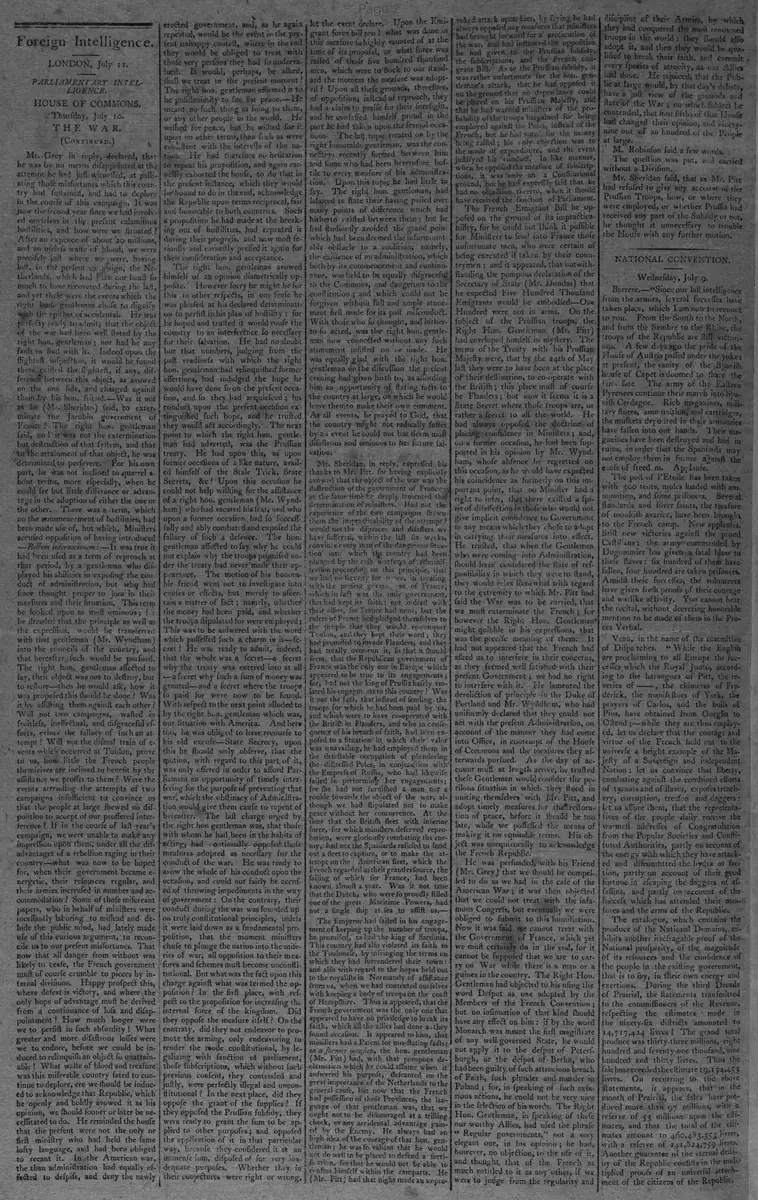
Mr. Grey in reply, declared, that he was by no means disappointed at the attempt he had just witnessed, at palliating those misfortunes which this country had sustained, and had to deplore in the course of this campaign. It was now the second year since we had involved ourselves in the present calamitous hostilities, and how were we situated? After an expense of about 20 millions, and an useless waste of blood, we were precisely just where we were, having lost, in the present campaign, the Netherlands, which had been our boast so much to have recovered during the last, and yet these were the events which the right hon. gentleman chose to dignify with the epithet of accidental. He was perfectly ready to admit, that the object of the war had been well stated by the right hon. gentleman; nor had he any fault to find with it. Indeed upon the lightest inspection, it would be found there existed the slightest, if any, difference between this object, as avowed on the one side, and charged against them by his hon. friend. Was it not, as he (Mr. Sheridan) said, to exterminate the Jacobin government of France? The right hon. gentleman said, no! it was not the extermination but destruction of that system, and that to the attainment of that object, he was determined to persevere. For his own part, he was not inclined to quarrel about terms, more especially, when he could see but little difference or advantage in the adoption of either the one or the other. There was a term, which on the commencement of hostilities, had been made use of, but which, Ministers accused opposition of having introduced—Bellum internecionem: It was true it had been used as a term of reproach at that period, by a gentleman who displayed his abilities in exposing the conduct of administration, but who had since thought proper to join in their measures and their situation. This term he looked upon as most ominous; for he dreaded that the principle as well as the expression, would be transferred with that gentleman (Mr. Wyndham) into the councils of the country, and that hereafter such would be pursued. The right hon. gentleman affected to say, their object was not to destroy, but to restore—then he would ask, how it was proposed this should be done? Was it by setting them against each other? Will not two campaigns, wasted in fruitless, ineffectual, and disgraceful efforts, evince the fallacy of such an attempt? Will not the dismal train of events which occurred at Toulon, prove to us, how little the French people themselves are inclined to benefit by the assistance we proffer to them? Were the events attending the attempts of two campaigns insufficient to convince us that the people at large showed no disposition to accept of our proffered interference? If in the course of last year's campaign, we were unable to make any impression upon them, under all the disadvantages of a rebellion raging in their country—what was now to be hoped for, when their government became energetic, their resources regular, and their armies increased in number and accommodation? Some of those miscreant papers, who in behalf of ministers were incessantly laboring to mislead and delude the public mind, had lately made use of this curious argument, to reconcile us to our present misfortunes. That now that all danger from without was likely to cease, the French government must of course crumble to pieces by internal divisions. Happy prospect this, where defeat is victory, and where the only hope of advantage must be derived from a continuance of loss and disappointment! How much longer were we to persist in such absurdity! What greater and more disastrous loss were we to endure, before we could be induced to relinquish an object so unattainable! What waste of blood and treasure was this miserable country fated to continue to deplore, ere we should be induced to acknowledge that Republic, which he openly and boldly avowed it as his opinion, we should sooner or later be necessitated to do. He reminded the house that the present were not the only or first ministry who had held the same lofty language, and had been obliged to recant it. In the American war, the then administration had equally affected to despise, and deny the newly erected government, and, as he again repeated, would be the event in the present unhappy contest, where in the end they would be obliged to treat with those very persons they had so undervalued. It would, perhaps, be asked, shall we treat in the present moment? The right hon. gentleman assumed it to be pusillanimity to sue for peace. He meant no such thing as suing to them, or any other people in the world. He wished for peace, but he wished for it upon no other terms, than such as were consistent with the interests of the nation. He had therefore no hesitation to repeat his proposition, and again earnestly exhorted the house, to do that in the present instance, which they would be bound to do in the end, acknowledge the Republic upon terms reciprocal, fair and honorable to both countries. Such a proposition he had made at the breaking out of hostilities, had repeated it during their progress, and now most earnestly pressed it again for their consideration and acceptance. The right hon. gentleman avowed himself of an opinion diametrically opposite. However sorry he might be for this in other respects, in one sense he was pleased at his declared determination to persist in his plan of hostility: for he hoped and trusted it would rouse the country to an interference so necessary for their salvation. He had no doubt but that numbers, judging from the past readiness with which the right hon. gentleman had relinquished former assertions, had indulged the hope he would have done so on the present occasion, and so they had acquiesced; his conduct upon the present occasion extinguished such hope, and he trusted they would act accordingly. The next point to which the right hon. gentleman had adverted, was the Prussian treaty. He had upon this, as upon former occasions of a like nature, availed himself of the stale trick, State Secrets, &c! Upon this occasion he could not help wishing for the assistance of a right hon. gentleman (Mr. Wyndham) who had vacated his seat, and who upon a former occasion had so successfully and ably combated and exposed the fallacy of such a defence. The hon. gentleman affected to say why he could not explain why the troops promised under the treaty had never made their appearance. The motion of his honorable friend went not to investigate into causes or effects, but merely to ascertain a matter of fact: namely, whether the money had been paid, and whether the troops stipulated for were employed; This was to be answered with the word which possessed such a charm in it—secret! He was ready to admit, indeed, that the whole was a secret—a secret why the treaty was entered into at all—a secret why such a sum of money was granted—and a secret where the troops so paid for were now to be found. With respect to the next point alluded to by the right hon. gentleman which was, our situation with America. And here too, he was obliged to have recourse to his old excuse—State Secrecy, upon this he should only observe, that the motion, with regard to this part of it, was only offered in order to afford Parliament an opportunity of timely interfering for the purpose of preventing that war, which the obstinacy of Administration would give them cause to repent of hereafter. The last charge urged by the right hon. gentleman was, that those with whom he had been in the habits of acting, had continually opposed those measures adopted as necessary for the conduct of the war. He was ready to avow the whole of his conduct upon the occasion, and could not fairly be accused of throwing impediments in the way of government: On the contrary, their conduct during the war was founded upon truly constitutional principles, unless it were laid down as a fundamental proposition, that the moment ministers chose to plunge the nation into the miseries of war, all opposition to their measures and schemes must become unconstitutional. But what was the fact upon this charge against what was termed the opposition? In the first place, with respect to the proposition for increasing the internal force of the kingdom. Did they oppose the measure itself? On the contrary, did they not endeavor to promote the arming, only endeavoring to render the mode constitutional, by legalizing with sanction of parliament, those subscriptions, which without such previous consent, they contended and justly, were perfectly illegal and unconstitutional? In the next place, did they oppose the grant of the supplies? If they opposed the Prussian subsidy, they were ready to grant the sum to be applied to other purposes; and opposed the application of it in that particular way, because they considered it as an immense sum, disposed of for very inadequate purposes. Whether they in their conjectures were right or wrong, let the event declare. Upon the Emigrant force bill too! what was done in this measure so highly vaunted of at the time of its proposal, or what force was raised of those five hundred thousand men, which were to flock to our standard the moment the measure was adopted? Upon all these grounds, therefore, of opposition, instead of reproach, they had a claim to praise for their foresight, and he confessed himself proud in the part he had taken upon the several occasions. The last topic treated on by the right honorable gentleman, was the connection recently formed between him and some who had been heretofore hostile to every measure of his administration. Upon this topic he had little to say. The right hon. gentleman, had labored to state their having passed over many points of difference which had hitherto existed between them; but he had studiously avoided the grand point which had been deemed the insurmountable obstacle to a coalition, namely, the existence of an administration, which both by its commencement and continuance, was held to be equally disgraceful to the Commons, and dangerous to the constitution; and which could not be forgiven without full and ample atonement being made for its past misconduct. With those who so thought, and hitherto so acted, was the right hon. gentleman now connected without any such atonement insisted on or made. He was equally glad with the right hon. gentleman on the discussion the present evening had given birth to, as affording him an opportunity of stating facts to the country at large, on which he would leave them to make their own comment. At all events, he prayed to God, that the country might not radically suffer by an event he could not but deem most disastrous and ominous to her future salvation:
Mr. Sheridan, in reply, expressed his thanks to Mr. Pitt for having explicitly avowed that the object of the war was the destruction of the government of France; at the same time he deeply lamented this determination of ministers. Had not the experience of the two campaigns shown them the impracticability of the attempt? would not the disgraces and disasters we have suffered, within the last six weeks, convince every man of the dangerous situation into which the country had been plunged by the rash measures of administration proceeding on this principle, that we had no security for peace, in treating with the present government of France, which in fact was the only government, that had kept its faith; not indeed with their allies, for France had none, but the rulers of France had pledged themselves to the people that they would re-conquer Toulon, and they kept their word; they had promised to invade Flanders, and they had totally over-run it, so that it should seem, that the Republican government of France was the only one in Europe which appeared to be true to its engagements; for, had not the king of Prussia basely violated his engagements to this country? Was it not the fact, that instead of sending the troops for which he had been paid by us, and which were to have co-operated with the British in Flanders, and who in consequence of his breach of faith, had been exposed to a situation in which their valor was unavailing, he had employed them in the detestable occupation of plundering the distressed Poles, in conjunction with the Empress of Russia, who had likewise failed in performing her engagements; for she had not furnished a man nor a rouble towards the object of the war, although we had stipulated not to make peace without her concurrence. At the time that the British fleet with inferior force, for which ministers deserved reprobation, were gloriously combating the enemy, had not the Spaniards refused to send out a fleet to capture, or to make the attempt on the American fleet, which the French regarded as their grand resource, the failing of which for France, had been known almost a year. Was it not true that the Dutch, who were so proudly styled one of the great Maritime Powers, had not a single ship at sea to aid us. The Emperor had failed in his engagement of keeping up the number of troops, he promised, as had the king of Sardinia. This country had also violated its faith to the Toulonese, by infringing the terms on which they had surrendered their town: and also with regard to the hopes held out to the royalists in Normandy of assistance from us, when we had contented ourselves with keeping a body of troops on the coast of Hampshire. Thus it appeared, that the French government was the only one that appeared to have no privilege to break its faith, which all the allies had done as they found occasion. It appeared to him, that ministers had a Patent for mis-stating facts; on a former occasion, the hon. gentleman (Mr. Pitt) had, with that pompous declamation which he could assume when it answered his purpose, descanted on the great importance of the Netherlands to the general cause, but now that the French had possession of those Provinces, the language of that gentleman was, that we ought not to be discouraged at a trifling check, or any accidental advantage gained by the Enemy. He always had a high idea of the courage of that hon. gentleman; he was so valiant that he would not do well to be placed to defend a fortification, for that he would not be able to confine himself within the ramparts. He (Mr. Pitt) had that night made an unprovoked attack upon him, by saying he had always opposed any measures that ministers had brought forward for a prosecution of the war, and had instanced the opposition he had given to the Prussian subsidy, the subscriptions, and the French emigrant Bill. As to the Prussian subsidy, it was rather unfortunate for the hon. gentleman's attack, that he had opposed it on the ground that no dependence could be placed on his Prussian Majesty, and that he had warned ministers of the probability of the troops bargained for being employed against the Poles, instead of the French, but he had voted for the money being raised; his only objection was to the mode of expenditure, and the event justified his conduct. In like manner, when he opposed the measure of subscriptions, it was only on a Constitutional ground, but he had expressly said that he had no objection thereto, when it should have received the sanction of Parliament. The French Emigrant Bill he opposed on the ground of its impracticability, for he could not think it possible for Ministers to send into France those unfortunate men, who were certain of being executed if taken by their countrymen; and it appeared, that notwithstanding the pompous declaration of the Secretary of State (Mr. Dundas) that he expected Five Hundred Thousand Emigrants would be embodied—One Hundred were not in arms. On the subject of the Prussian troops, the Right Hon. Gentleman (Mr. Pitt) had enveloped himself in mystery. The terms of the Treaty with his Prussian Majesty were, that by the 24th of May last they were to have been at the place of their destination, to co-operate with the British; this place must of course be Flanders: but now it seems it is a State Secret where those troops are, or rather a secret to all the world. He had always opposed the doctrine of placing confidence in Ministers; and, on a former occasion, he had been supported in his opinion by Mr. Wyndham, whose absence he regretted on this occasion, as he would have expected his coincidence as formerly on this important point, that no Minister had a right to infer, that there existed a spirit of disaffection in those who would not give implicit confidence to Government in any means which they chose to adopt in carrying their measures into effect. He trusted; that when the Gentlemen who were coming into Administration, should have considered the state of responsibility in which they were to stand, they would relax somewhat with regard to the extremity to which Mr. Pitt had said the War was to be carried, that we must exterminate the French; for however the Right Hon. Gentleman might quibble in his expressions, that was the precise meaning of them. It had not appeared that the French had asked us to interfere in their concerns, as they seemed well satisfied with their present Government; we had no right to interfere with it. He lamented the dereliction of principle in the Duke of Portland and Mr. Wyndham, who had uniformly declared that they could not act with the present Administration, on account of the manner they had come into Office, in contempt of the House of Commons and the measures they afterwards pursued. As the day of account must at length arrive, he trusted these Gentlemen would consider the perilous situation in which they stood in uniting themselves with Mr. Pitt, and adopt timely measures for the restoration of peace, before it should be too late, while we possessed the means of making it on equitable terms. His object was unequivocally to acknowledge the French Republic. He was persuaded, with his Friend (Mr. Grey) that we should be compelled to do as we had in the case of the American War: it was then objected that we could not treat with the infamous Congress, but eventually we were obliged to submit to this humiliation. Now it was said we cannot treat with the Government of France, which yet we must certainly do in the end, for it cannot be supposed that we are to carry on War while there is a man or a guinea in the country. The Right Hon. Gentleman had objected to his using the word Depôt as one adopted by the Members of the French Convention; but no insinuation of that kind should have any effect on him: if by the word Monarch was meant the first magistrate of any well-governed State, he would not apply it to the despot of Petersburg, or the despot of Berlin, who had been guilty of such atrocious breach of Faith, such plunder and murder in Poland; for, in speaking of such nefarious actions, he could not be very nice in the election of his words. The Right Hon. Gentleman, in speaking of these our worthy Allies, had used the phrase "Regular governments," not a very elegant one, in his opinion; he had, however, no objection, to the use of it, and thought that of the French as much entitled to it as any other, if we were to judge from the regularity and discipline of their Armies, by which they had conquered the most renowned troops in the world: they should also adopt it, and then they would be qualified to break their faith, and commit every species of atrocity, as our Allies had done. He rejoiced, that the Public at large would, by that day's debate, have a just view of the grounds and state of the War; on which subject he contended, that four fifths of that House had changed their opinion, and ninety-nine out of an hundred of the People at large.
Mr. Robinson said a few words.
The question was put, and carried without a Division.
Mr. Sheridan said, that as Mr. Pitt had refused to give any account of the Prussian Troops, how, or where they were employed, or whether Prussia had received any part of the Subsidy or not, he thought it unnecessary to trouble the House with any further motion.
What sub-type of article is it?
What keywords are associated?
What entities or persons were involved?
Where did it happen?
Foreign News Details
Primary Location
France
Event Date
Thursday, July 10.
Key Persons
Outcome
the question was put, and carried without a division. mr. sheridan decided not to pursue further motion on prussian troops.
Event Details
Debate in House of Commons on the war with France, where Mr. Grey and Mr. Sheridan criticized government policy, losses in Netherlands, failed Prussian treaty, and urged peace by acknowledging French Republic. Mr. Pitt defended destruction of Jacobin system and persistence. Discussion covered alliances' breaches, past measures like subsidies and emigrant bill.