Thank you for visiting SNEWPapers!
Sign up free
Daily National Democrat
Marysville, Yuba County, California
What is this article about?
Mr. DeLong speaks in the Assembly about his arrest by Speaker Stratton during a heated political debate, explains the circumstances involving interruptions and an unheeded appeal, and details their reconciliatory conversation after adjournment, affirming mutual satisfaction with parliamentary rules.
Clipping
OCR Quality
Full Text
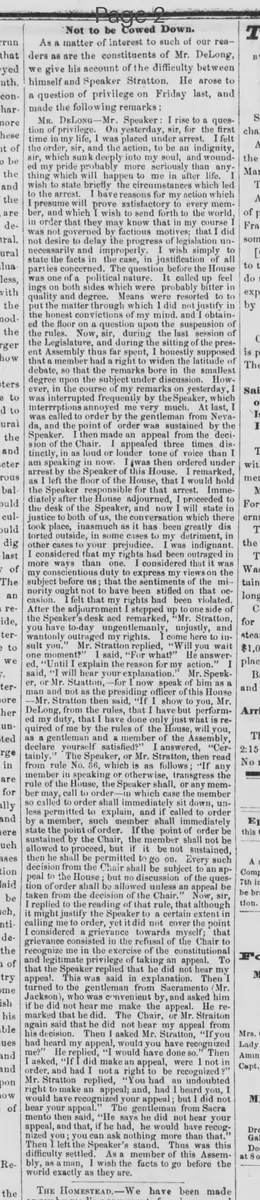
At a matter of Interest to such of our readers as are the constituents of Mr. DeLong we give his account of the difficulty between himself and Speaker Stratton. He arose to a question of privilege on Friday last, and made the following remarks;
Mr. DeLong—Mr. Speaker: I rise to a question of privilege. On yesterday, sir, for the first time in my life, I was placed under arrest. I felt the order, sir, and the action, to be an indignity, sir, which sunk deeply into my soul, and wounded my pride probably more seriously than anything which will happen to me in after life. I wish to state briefly the circumstances which led to the arrest. I have reasons for my action which I presume will prove satisfactory to every member, and which I wish to send forth to the world, in order that they may know that in my course I was not governed by factious motives; that I did not desire to delay the progress of legislation unnecessarily and improperly. I wish simply to state the facts in the case, in justification of all parties concerned. The question before the House was one of a political nature. It called up feelings on both sides which were probably bitter in quality and degree. Means were resorted to to put the matter through which I did not justify in the honest convictions of my mind, and I obtained the floor on a question upon the suspension of the rules. Now, sir, during the last session of the Legislature, and during the sitting of the present Assembly thus far spent, I honestly supposed that a member had a right to widen the latitude of debate, so that the remarks bore in the smallest degree upon the subject under discussion. However, in the course of my remarks on yesterday, I was interrupted frequently by the Speaker, which interruptions annoyed me very much. At last, I was called to order by the gentleman from Nevada, and the point of order was sustained by the Speaker. I then made an appeal from the decision of the Chair. I appealed three times distinctly, in as loud or louder tone of voice than I am speaking in now. I was then ordered under arrest by the Speaker of this House. I remarked, as I left the floor of the House, that I would hold the Speaker responsible for that arrest. Immediately after the House adjourned, I proceeded to the desk of the Speaker, and now I will state in justice to both of us, the conversation which there took place, inasmuch as it has been greatly distorted outside, in some cases to my detriment, in other cases to your prejudice. I was indignant. I considered that my rights had been outraged in more ways than one. I considered that it was my conscientious duty to express my views on the subject before us: that the sentiments of the minority ought not to have been stifled on that occasion. I felt that my rights had been violated. After the adjournment I stepped up to one side of the Speaker's desk and remarked, "Mr. Stratton, you have to-day ungentlemanly, unjustly, and wantonly outraged my rights. I come here to insult you." Mr. Stratton replied, "Will you wait one moment?" I said, "For what?" He answered, "Until I explain the reason for my action." I said, "I will hear your explanation." Mr. Speaker, or Mr. Stratton,—for I now speak of him as a man and not as the presiding officer of this House—Mr. Stratton then said, "If I show to you, Mr. DeLong, from the rules, that I have but performed my duty, that I have done only just what is required of me by the rules of the House, will you, as a gentleman and a member of the Assembly, declare yourself satisfied?" I answered, "Certainly." The Speaker, or Mr. Stratton, then read from rule No. 36, which is as follows: If any member in speaking or otherwise, transgress the rule of the House, the Speaker shall, or any member may, call to order—in which case the member so called to order shall immediately sit down, unless permitted to explain, and if called to order by a member, such member shall immediately state the point of order. If the point of order be sustained by the Chair, the member shall not be allowed to proceed, but if it be not sustained, then he shall be permitted to go on. Every such decision from the Chair shall be subject to an appeal to the House: but no discussion of the question of order shall be allowed unless an appeal be taken from the decision of the Chair." Now, sir, I replied to the reading of that rule, that although it might justify the Speaker to a certain extent in calling me to order, yet it did not cover the point I considered a grievance towards myself: that grievance consisted in the refusal of the Chair to recognize me in the exercise of the constitutional and legitimate privilege of taking an appeal. To that the Speaker replied that he did not hear my appeal. This was said in explanation. Then I turned to the gentleman from Sacramento (Mr. Jackson), who was convenient by, and asked him if he did not hear me make the appeal. He remarked that he did. The Chair, or Mr. Stratton again said that he did not hear my appeal from his decision. Then I asked Mr. Stratton, "If you had heard my appeal, would you have recognized me?" He replied, "I would have done so." Then I asked, "If I did make an appeal, were I not in order, and had I not a right to be recognized?" Mr. Stratton replied, "You had an undoubted right to make an appeal; and, had I heard you, I would have recognized your appeal; but I did not hear your appeal." The gentleman from Sacramento then said, "He says he did not hear your appeal, and that, if he had, he would have recognized you; you can ask nothing more than that." Then I left the Speaker's stand. Thus was this difficulty settled. As a member of this Assembly, as a man, I wish the facts to go before the world exactly as they are.
What sub-type of article is it?
What keywords are associated?
What entities or persons were involved?
Domestic News Details
Event Date
Friday Last
Key Persons
Outcome
the difficulty was settled amicably after a conversation where mr. stratton explained he did not hear the appeal and would have recognized it if he had, leading to mutual satisfaction.
Event Details
During a political debate in the House, Mr. DeLong was interrupted by Speaker Stratton, called to order by the gentleman from Nevada, and ordered under arrest after making an unheeded appeal from the Chair's decision. After adjournment, Mr. DeLong confronted Mr. Stratton, who cited House rule No. 36 and explained he had not heard the appeal, resolving the issue with Mr. Jackson as witness.