Thank you for visiting SNEWPapers!
Sign up free
The Literary Echo
Westerly, Washington County, Rhode Island
What is this article about?
On May 19, 1851, a New York correspondent describes the grand reception of President Fillmore and his departure via the Erie Railroad, then critiques the 1850 city mortality report showing 16,978 deaths, including 10,567 children, attributing it to over-medication, parental vices, and poor conditions rather than natural causes.
Clipping
OCR Quality
Full Text
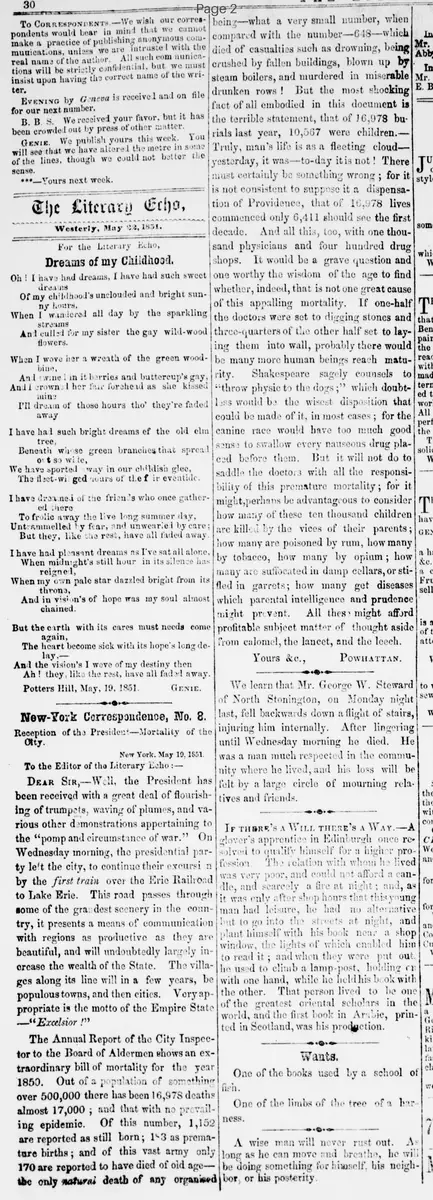
Reception of the President—Mortality of the City.
New York, May 19, 1851.
To the Editor of the Literary Echo:
Dear Sir,—Well, the President has been received with a great deal of flourishing of trumpets, waving of plumes, and various other demonstrations appertaining to the "pomp and circumstance of war." On Wednesday morning, the presidential party left the city, to continue their excursion by the first train over the Erie Railroad to Lake Erie. This road passes through some of the grandest scenery in the country, it presents a means of communication with regions as productive as they are beautiful, and will undoubtedly largely increase the wealth of the State. The villages along its line will in a few years, be populous towns, and then cities. Very appropriate is the motto of the Empire State "Excelsior!"
The Annual Report of the City Inspector to the Board of Aldermen shows an extraordinary bill of mortality for the year 1850. Out of a population of something over 500,000 there has been 16,978 deaths almost 17,000; and that with no prevailing epidemic. Of this number, 1,152 are reported as still born; 1,3 as premature births; and of this vast army only 170 are reported to have died of old age— the only natural death of any organized being—what a very small number, when compared with the number—648—which died of casualties such as drowning, being crushed by fallen buildings, blown up by steam boilers, and murdered in miserable drunken rows! But the most shocking fact of all embodied in this document is the terrible statement, that of 16,978 burials last year, 10,567 were children. Truly, man's life is as a fleeting cloud— yesterday, it was—to-day it is not! There must certainly be something wrong; for it is not consistent to suppose it a dispensation of Providence, that of 16,978 lives commenced only 6,411 should see the first decade. And all this, too, with one thousand physicians and four hundred drug shops. It would be a grave question and one worthy the wisdom of the age to find whether, indeed, that is not one great cause of this appalling mortality. If one-half the doctors were set to digging stones and three-quarters of the other half set to laying them into wall, probably there would be many more human beings reach maturity. Shakespeare sagely counsels to "throw physic to the dogs;" which doubtless would be the wisest disposition that could be made of it, in most cases; for the canine race would have too much good sense to swallow every nauseous drug placed before them. But it will not do to saddle the doctors with all the responsibility of this premature mortality; for it might, perhaps be advantageous to consider how many of these ten thousand children are killed by the vices of their parents; how many are poisoned by rum, how many by tobacco, how many by opium; how many are suffocated in damp cellars, or stifled in garrets; how many get diseases which parental intelligence and prudence might prevent. All these might afford profitable subject matter of thought aside from calomel, the lancet, and the leech.
Yours, etc.,
POWHATAN.
What sub-type of article is it?
What themes does it cover?
What keywords are associated?
What entities or persons were involved?
Letter to Editor Details
Author
Powhatan
Recipient
To The Editor Of The Literary Echo
Main Argument
the 1850 new york mortality rate of nearly 17,000 deaths, especially 10,567 children, is alarmingly high and attributable to excessive medical practices, parental vices like alcohol and tobacco, and poor living conditions, rather than natural or providential causes.
Notable Details