Thank you for visiting SNEWPapers!
Sign up free
Letter to Editor
April 14, 1788
The Daily Advertiser
New York, New York County, New York
What is this article about?
A letter to Mr. Childs defends the study of Greek as essential to education, refuting arguments by 'Filetus' who claims it wastes time and offers little benefit. The author praises its value for literature, memory, professions like law and clergy, and criticizes Filetus for promoting indolence.
Clipping
OCR Quality
98%
Excellent
Full Text
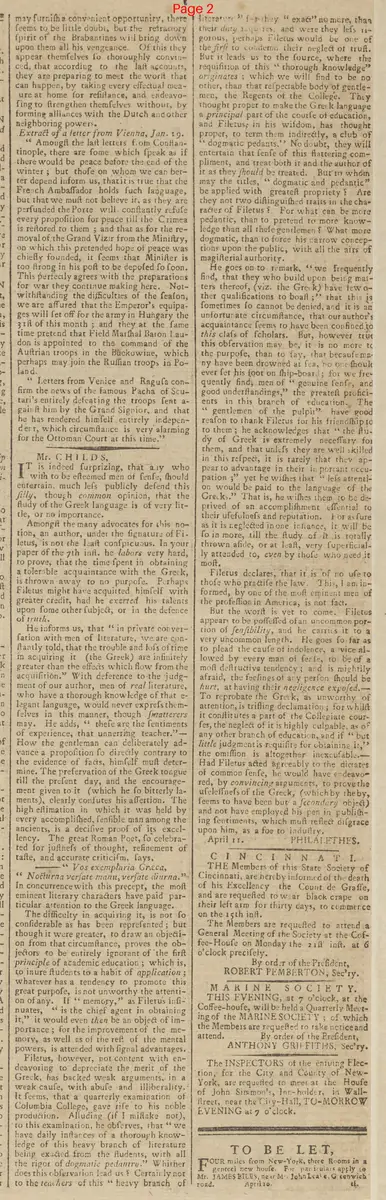
Mr. CHILDS,
It is indeed surprising, that any who wish to be esteemed men of sense, should entertain, much less publicly defend this silly, though common opinion, that the study of the Greek language is of very little, or no importance.
Amongst the many advocates for this notion, an author, under the signature of Filetus, is not the least conspicuous. In your paper of the 7th inst. he labors very hard, to prove, that the time spent in obtaining a tolerable acquaintance with the Greek, is thrown away to no purpose. Perhaps Filetus might have acquitted himself with greater credit, had he exerted his talents upon some other subject, or in the defence of truth.
He informs us, that "in private conversation with men of literature, we are constantly told, that the trouble and loss of time in acquiring it (the Greek) are infinitely greater than the effects which flow from the acquisition." With deference to the judgment of our author, men of real literature, who have a thorough knowledge of that elegant language, would never express themselves in this manner, though smatterers may. He adds. "these are the sentiments of experience, that unerring teacher."
How the gentleman can deliberately advance a proposition so directly contrary to the evidence of facts, himself must determine. The preservation of the Greek tongue till the present day, and the encouragement given to it (which he so bitterly laments), clearly confutes his assertion. The high estimation in which it was held by every accomplished, sensible man among the ancients, is a decisive proof of its excellency. The great Roman Poet, so celebrated for justness of thought, refinement of taste, and accurate criticism, says,
"Vos exemplaria Graeca,
Nocturna versate manu, versate diurna."
In concurrence with this precept, the most eminent literary characters have paid particular attention to the Greek language. The difficulty in acquiring it, is not so considerable as has been represented; but though it were greater, to draw an objection from that circumstance, proves the objectors to be entirely ignorant of the first principle of academic education; which is, to inure students to a habit of application; whatever has a tendency to promote this great purpose, is not unworthy the attention of any. If "memory," as Filetus insinuates, "is the chief agent in obtaining it," it would even then be an object of importance; for the improvement of the memory, as well as of the rest of the mental powers, is attended with signal advantages.
Filetus, however, not content with endeavoring to depreciate the merit of the Greek, has backed weak arguments, in a weak cause, with abuse and illiberality. It seems, that a quarterly examination of Columbia College, gave rise to his noble production. Alluding (if I mistake not), to this examination, he observes, that "we have daily instances of a thorough knowledge of this heavy branch of literature being exacted from the students, with all the rigor of dogmatic pedantry." Whither does this observation lead us? Certainly not to the teachers of this "heavy branch of literature" for they "exact" no more than their duty requires, and were they less rigorous, perhaps Filetus would be one of the first to condemn their neglect of trust.
But it leads us to the source, where the requisition of this "thorough knowledge" originates; which we will find to be no other, than that respectable body of gentlemen, the Regents of the College. They thought proper to make the Greek language a principal part of the course of education, and Filetus, in his wisdom, has thought proper, to term them indirectly, a club of "dogmatic pedants." No doubt, they will entertain that sense of this flattering compliment, and treat both it and the author of it as they should be treated. But to whom may the titles, "dogmatic and pedantic" be applied with greatest propriety? Are they not two distinguished traits in the character of Filetus? For what can be more pedantic, than to pretend to more knowledge than all these gentlemen? What more dogmatic, than to force his narrow conceptions upon the public, with all the airs of magisterial authority.
He goes on to remark, "we frequently find, that they who build upon being masters thereof, (viz. the Greek) have few other qualifications to boast; " that this is sometimes so cannot be denied, and it is an unfortunate circumstance, that our author's acquaintance seems to have been confined to this class of scholars. But, however true this observation may be, it is no more to the purpose, than to say, that because many have been drowned at sea, no one should ever set his foot on ship-board: for we frequently find; men of "genuine sense, and good understandings," the greatest proficients in this branch of education. The "gentlemen of the pulpit" have good reason to thank Filetus for his friendship to them; he acknowledges that "the study of Greek is extremely necessary for them, and that unless they are well skilled in this respect, it is rarely that they appear to advantage in their important occupation;" yet he wishes that "less attention would be paid to the language of the Greeks." That is. he wishes them to be deprived of an accomplishment essential to their usefulness and reputation. For as sure as it is neglected in one instance, it will be so in more, till the study of it is totally thrown aside, or at least, very superficially attended to, even by those who need it most.
Filetus declares, that it is of no use to those who practice the law. This, I am informed, by one of the most eminent men of the profession in America, is not fact.
But the worst is yet to come. Filetus appears to be possessed of an uncommon portion of sensibility, and he carries it to a very uncommon length. He goes so far as to plead the cause of indolence, a vice allowed by every man of sense, to be of a most destructive tendency; and is mightily afraid, the feelings of any person should be hurt, at having their negligence exposed.-- To reprobate the Greek, as unworthy of attention, is trifling declamation; for whilst it constitutes a part of the Collegiate courses, the neglect of it is highly culpable, as to any other branch of education, and if "but little judgment is required for obtaining it," the omission is altogether inexcusable.-- Had Filetus acted agreeably to the dictates of common sense. he would have endeavored, by convincing arguments, to prove the uselessness of the Greek, (which by the bye. seems to have been but a secondary object) and not have employed his pen in publishing sentiments, which must reflect disgrace upon him, as a foe to industry.
April 11.
PHILALETHES.
It is indeed surprising, that any who wish to be esteemed men of sense, should entertain, much less publicly defend this silly, though common opinion, that the study of the Greek language is of very little, or no importance.
Amongst the many advocates for this notion, an author, under the signature of Filetus, is not the least conspicuous. In your paper of the 7th inst. he labors very hard, to prove, that the time spent in obtaining a tolerable acquaintance with the Greek, is thrown away to no purpose. Perhaps Filetus might have acquitted himself with greater credit, had he exerted his talents upon some other subject, or in the defence of truth.
He informs us, that "in private conversation with men of literature, we are constantly told, that the trouble and loss of time in acquiring it (the Greek) are infinitely greater than the effects which flow from the acquisition." With deference to the judgment of our author, men of real literature, who have a thorough knowledge of that elegant language, would never express themselves in this manner, though smatterers may. He adds. "these are the sentiments of experience, that unerring teacher."
How the gentleman can deliberately advance a proposition so directly contrary to the evidence of facts, himself must determine. The preservation of the Greek tongue till the present day, and the encouragement given to it (which he so bitterly laments), clearly confutes his assertion. The high estimation in which it was held by every accomplished, sensible man among the ancients, is a decisive proof of its excellency. The great Roman Poet, so celebrated for justness of thought, refinement of taste, and accurate criticism, says,
"Vos exemplaria Graeca,
Nocturna versate manu, versate diurna."
In concurrence with this precept, the most eminent literary characters have paid particular attention to the Greek language. The difficulty in acquiring it, is not so considerable as has been represented; but though it were greater, to draw an objection from that circumstance, proves the objectors to be entirely ignorant of the first principle of academic education; which is, to inure students to a habit of application; whatever has a tendency to promote this great purpose, is not unworthy the attention of any. If "memory," as Filetus insinuates, "is the chief agent in obtaining it," it would even then be an object of importance; for the improvement of the memory, as well as of the rest of the mental powers, is attended with signal advantages.
Filetus, however, not content with endeavoring to depreciate the merit of the Greek, has backed weak arguments, in a weak cause, with abuse and illiberality. It seems, that a quarterly examination of Columbia College, gave rise to his noble production. Alluding (if I mistake not), to this examination, he observes, that "we have daily instances of a thorough knowledge of this heavy branch of literature being exacted from the students, with all the rigor of dogmatic pedantry." Whither does this observation lead us? Certainly not to the teachers of this "heavy branch of literature" for they "exact" no more than their duty requires, and were they less rigorous, perhaps Filetus would be one of the first to condemn their neglect of trust.
But it leads us to the source, where the requisition of this "thorough knowledge" originates; which we will find to be no other, than that respectable body of gentlemen, the Regents of the College. They thought proper to make the Greek language a principal part of the course of education, and Filetus, in his wisdom, has thought proper, to term them indirectly, a club of "dogmatic pedants." No doubt, they will entertain that sense of this flattering compliment, and treat both it and the author of it as they should be treated. But to whom may the titles, "dogmatic and pedantic" be applied with greatest propriety? Are they not two distinguished traits in the character of Filetus? For what can be more pedantic, than to pretend to more knowledge than all these gentlemen? What more dogmatic, than to force his narrow conceptions upon the public, with all the airs of magisterial authority.
He goes on to remark, "we frequently find, that they who build upon being masters thereof, (viz. the Greek) have few other qualifications to boast; " that this is sometimes so cannot be denied, and it is an unfortunate circumstance, that our author's acquaintance seems to have been confined to this class of scholars. But, however true this observation may be, it is no more to the purpose, than to say, that because many have been drowned at sea, no one should ever set his foot on ship-board: for we frequently find; men of "genuine sense, and good understandings," the greatest proficients in this branch of education. The "gentlemen of the pulpit" have good reason to thank Filetus for his friendship to them; he acknowledges that "the study of Greek is extremely necessary for them, and that unless they are well skilled in this respect, it is rarely that they appear to advantage in their important occupation;" yet he wishes that "less attention would be paid to the language of the Greeks." That is. he wishes them to be deprived of an accomplishment essential to their usefulness and reputation. For as sure as it is neglected in one instance, it will be so in more, till the study of it is totally thrown aside, or at least, very superficially attended to, even by those who need it most.
Filetus declares, that it is of no use to those who practice the law. This, I am informed, by one of the most eminent men of the profession in America, is not fact.
But the worst is yet to come. Filetus appears to be possessed of an uncommon portion of sensibility, and he carries it to a very uncommon length. He goes so far as to plead the cause of indolence, a vice allowed by every man of sense, to be of a most destructive tendency; and is mightily afraid, the feelings of any person should be hurt, at having their negligence exposed.-- To reprobate the Greek, as unworthy of attention, is trifling declamation; for whilst it constitutes a part of the Collegiate courses, the neglect of it is highly culpable, as to any other branch of education, and if "but little judgment is required for obtaining it," the omission is altogether inexcusable.-- Had Filetus acted agreeably to the dictates of common sense. he would have endeavored, by convincing arguments, to prove the uselessness of the Greek, (which by the bye. seems to have been but a secondary object) and not have employed his pen in publishing sentiments, which must reflect disgrace upon him, as a foe to industry.
April 11.
PHILALETHES.
What sub-type of article is it?
Persuasive
Informative
Ethical Moral
What themes does it cover?
Education
Morality
What keywords are associated?
Greek Language
Classical Education
Columbia College
Filetus
Memory Improvement
Academic Rigor
Indolence
Clergy
Law Profession
What entities or persons were involved?
Philalethes
Mr. Childs
Letter to Editor Details
Author
Philalethes
Recipient
Mr. Childs
Main Argument
the study of greek is essential for academic education, promoting habits of application, memory improvement, and proficiency in professions like law and clergy; filetus's arguments against it are misguided and promote indolence.
Notable Details
Quotes Horace: 'Vos Exemplaria Graeca, Nocturna Versate Manu, Versate Diurna.'
References Columbia College Quarterly Examination And Regents
Criticizes Filetus For Illiberality And Defending Indolence