Thank you for visiting SNEWPapers!
Sign up free
Trainman News
Indianapolis, Marion County, Indiana
What is this article about?
Dr. Clyde Mitchell's study 'KOREA: SECOND FAILURE IN ASIA' analyzes US mistakes in Korea and China, offering lessons for successful policy in Asia's revolution. Key points: support reformist groups, use UN for aid to counter suspicion, avoid military control. Published by Public Affairs Institute.
Clipping
OCR Quality
Full Text
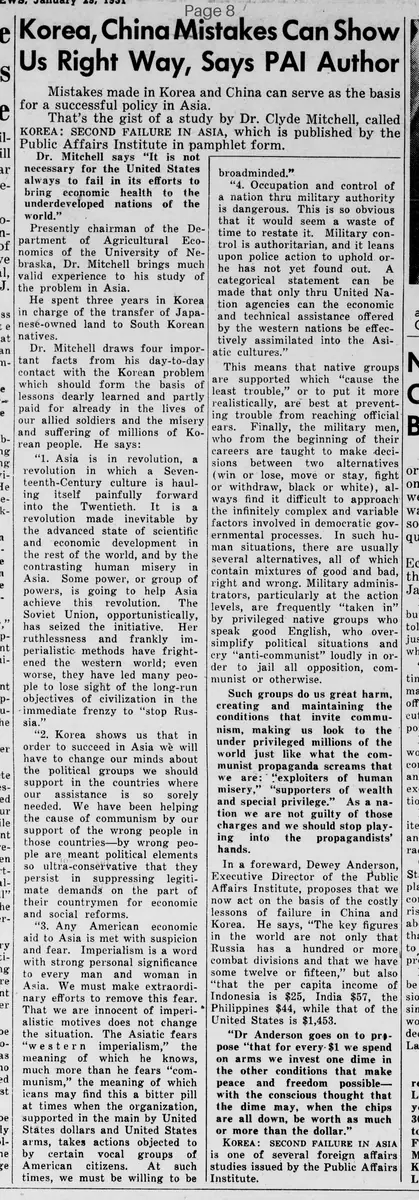
Mistakes made in Korea and China can serve as the basis for a successful policy in Asia.
That's the gist of a study by Dr. Clyde Mitchell, called KOREA: SECOND FAILURE IN ASIA, which is published by the Public Affairs Institute in pamphlet form.
Dr. Mitchell says "It is not necessary for the United States always to fail in its efforts to bring economic health to the underdeveloped nations of the world."
Presently chairman of the Department of Agricultural Economics of the University of Nebraska, Dr. Mitchell brings much valid experience to his study of the problem in Asia.
He spent three years in Korea in charge of the transfer of Japanese-owned land to South Korean natives.
Dr. Mitchell draws four important facts from his day-to-day contact with the Korean problem which should form the basis of lessons dearly learned and partly paid for already in the lives of our allied soldiers and the misery and suffering of millions of Korean people. He says:
"1. Asia is in revolution, a revolution in which a Seventeenth-Century culture is hauling itself painfully forward into the Twentieth. It is a revolution made inevitable by the advanced state of scientific and economic development in the rest of the world, and by the contrasting human misery in Asia. Some power, or group of powers, is going to help Asia achieve this revolution.
The Soviet Union, opportunistically, has seized the initiative. Her ruthlessness and frankly imperialistic methods have frightened the western world; even worse, they have led many people to lose sight of the long-run objectives of civilization in the immediate frenzy to "stop Russia."
"2. Korea shows us that in order to succeed in Asia we will have to change our minds about the political groups we should support in the countries where our assistance is so sorely needed. We have been helping the cause of communism by our support of the wrong people in those countries—by wrong people are meant political elements so ultra-conservative that they persist in suppressing legitimate demands on the part of their countrymen for economic and social reforms.
"3. Any American economic aid to Asia is met with suspicion and fear. Imperialism is a word with strong personal significance to every man and woman in Asia. We must make extraordinary efforts to remove this fear. That we are innocent of imperialistic motives does not change the situation. The Asiatic fears "western imperialism," the meaning of which he knows, much more than he fears "communism," the meaning of which he has not yet found out.
A categorical statement can be made that only thru United Nation agencies can the economic and technical assistance offered by the western nations be effectively assimilated into the Asiatic cultures."
This means that native groups are supported which "cause the least trouble," or to put it more realistically, are best at preventing trouble from reaching official ears.
Finally, the military men, who from the beginning of their careers are taught to make decisions between two alternatives (win or lose, move or stay, fight or withdraw, black or white), always find it difficult to approach the infinitely complex and variable factors involved in democratic governmental processes. In such human situations, there are usually several alternatives, all of which contain mixtures of good and bad, right and wrong. Military administrators, particularly at the action levels, are frequently "taken in" by privileged native groups who speak good English, who oversimplify political situations and cry "anti-communist" loudly in order to jail all opposition, communist or otherwise.
Such groups do us great harm, creating and maintaining the conditions that invite communism, making us look to the underprivileged millions of the world just like what the communist propaganda screams that we are: "exploiters of human misery, supporters of wealth and special privilege." As a nation we are not guilty of those charges and we should stop playing into the propagandists' hands.
In a foreword, Dewey Anderson, Executive Director of the Public Affairs Institute, proposes that we now act on the basis of the costly lessons of failure in China and Korea. He says, "The key figures in the world are not only that Russia has a hundred or more combat divisions and that we have some twelve or fifteen," but also "that the per capita income of Indonesia is $25, India $57, the Philippines $44, while that of the United States is $1,453."
Dr. Anderson goes on to propose "that for every $1 we spend on arms we invest one dime in the other conditions that make peace and freedom possible—with the conscious thought that the dime may, when the chips are all down, be worth as much or more than the dollar."
KOREA: SECOND FAILURE IN ASIA is one of several foreign affairs studies issued by the Public Affairs Institute.
"4. Occupation and control of a nation thru military authority is dangerous. This is so obvious that it would seem a waste of time to restate it. Military control is authoritarian, and it leans upon police action to uphold order."
What sub-type of article is it?
What keywords are associated?
What entities or persons were involved?
Where did it happen?
Foreign News Details
Primary Location
Asia
Key Persons
Outcome
lessons from failures in korea and china, including lives lost in korea and suffering of millions; recommendations for us policy to support reforms, use un aid, avoid military control to counter communism.
Event Details
Dr. Mitchell's study analyzes US policy failures in Korea and China as lessons for Asia. Asia is in revolution; Soviet Union has initiative. US must support reformist groups, not conservatives; channel aid through UN to alleviate imperialism fears; military occupation is dangerous and counterproductive.