Thank you for visiting SNEWPapers!
Sign up free
The Daily Phoenix
Columbia, Richland County, South Carolina
What is this article about?
In the South Carolina legislature, Nash spoke in favor of abolishing the Land Commissioner office, criticizing post-war Republican corruption that exploited freed Black people. The bill advanced to third reading with an amendment by Whittemore transferring duties to the Secretary of State. Commentary urges Nash to pursue broader anti-corruption efforts.
Clipping
OCR Quality
Full Text
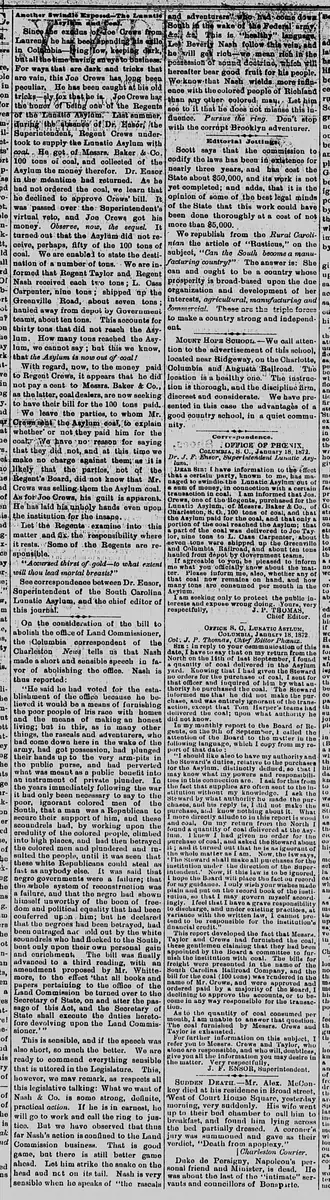
"He said he had voted for the establishment of the office because he believed it would be a means of furnishing the poor people of his race with homes and the means of making an honest living; but in this, as in many other things, the rascals and adventurers, who had come down here in the wake of the army, had got possession, had plunged their hands up to the very arm-pits in the public purse, and had perverted what was meant as a public benefit into an instrument of private plunder. In the years immediately following the war it had only been necessary to say to the poor, ignorant colored men of the South, that a man was a Republican to secure their support of him, and these scoundrels had, by working upon the credulity of the colored people, climbed into high places, and had then betrayed the colored men and plundered and insulted the people, until it was seen that these white Republicans could steal as fast as anybody else. It was said that negro governments were a failure; that the whole system of reconstruction was a failure, and that the negro had shown himself unworthy of the boon of freedom and political equality that had been conferred upon him; but he declared that the negroes had been betrayed, had been outraged and sold out by the white scoundrels who had flocked to the South, bent only upon their own personal gain and enrichment."
The bill was finally advanced to a third reading, with an amendment proposed by Mr. Whittemore, to the effect that all books and papers pertaining to the office of the Land Commissioner be turned over to the Secretary of State, on and after the passage of this Act, and the Secretary of State shall execute the duties heretofore devolving upon the Land Commissioner.
This is sensible, and if the speech was also short, so much the better. We are ready to commend everything sensible that is uttered in the Legislature. This, however, we may remark, as respects all this legislative talking: What we want of Nash & Co. is some strong, definite, practical action. If he is in earnest, he will go to work and call the ring to justice. But we have observed that thus far Nash's action is confined to the Land Commission business. That is good game, but there is still better game ahead. Let him strike the snake on the head and not on its tail. Nash is very sensible when he speaks of "the rascals and adventurers who have come down South in the wake of the Federal army." This is "healthy" language. Let Reverend Nash follow this vein and he will get rich—we mean rich in the possession of sound doctrines, which will hereafter bear good fruit for his people. Work now—that Nash wields more influence with the colored people of Richland than any other colored man. Let him see to it that he does not misuse this influence. Pursue the ring. Don't stop with the corrupt Brooklyn adventurer.
What sub-type of article is it?
What keywords are associated?
What entities or persons were involved?
Where did it happen?
Domestic News Details
Primary Location
Columbia
Key Persons
Outcome
the bill advanced to a third reading with an amendment transferring books, papers, and duties of the land commissioner to the secretary of state.
Event Details
Nash delivered a speech supporting the abolition of the Land Commissioner office, arguing it was corrupted by post-war adventurers who exploited freed Black people for personal gain. The bill progressed with Whittemore's amendment. Editorial commentary praises the speech and urges Nash to take stronger action against corruption.