Thank you for visiting SNEWPapers!
Sign up free
The Massachusetts Spy, And Worcester County Advertiser
Worcester, Worcester County, Massachusetts
What is this article about?
In Paris, the French Chamber of Deputies debated abolishing capital punishment, passing an amendment to address the King for a law ending it for many offenses, especially political crimes. The King received the address on Oct. 10 and pledged to propose such legislation, supported by Lafayette.
Clipping
OCR Quality
Full Text
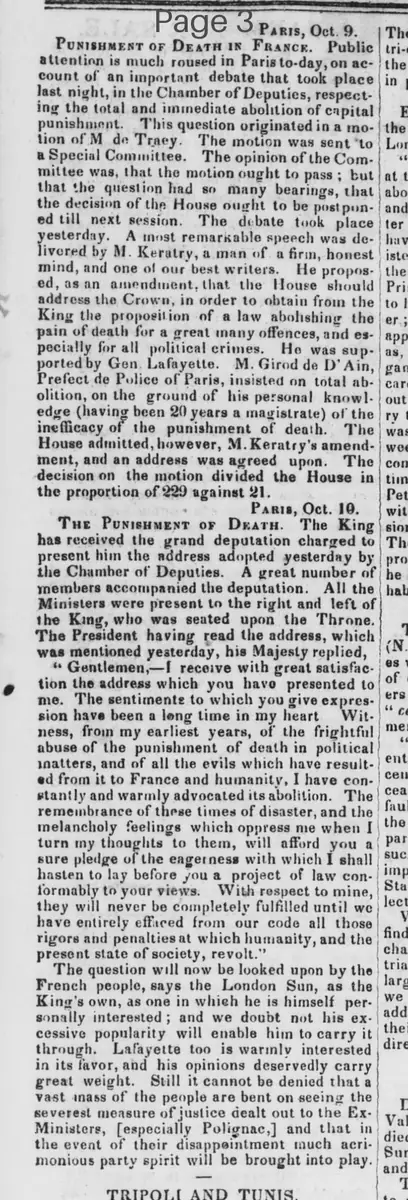
Public attention is much roused in Paris to-day, on account of an important debate that took place last night, in the Chamber of Deputies, respecting the total and immediate abolition of capital punishment. This question originated in a motion of M. de Tracy. The motion was sent to a Special Committee. The opinion of the Committee was, that the motion ought to pass; but that the question had so many bearings, that the decision of the House ought to be postponed till next session. The debate took place yesterday. A most remarkable speech was delivered by M. Keratry, a man of a firm, honest mind, and one of our best writers. He proposed, as an amendment, that the House should address the Crown, in order to obtain from the King the proposition of a law abolishing the pain of death for a great many offences, and especially for all political crimes. He was supported by Gen. Lafayette. M. Girod de l'Ain, Prefect de Police of Paris, insisted on total abolition, on the ground of his personal knowledge (having been 20 years a magistrate) of the inefficacy of the punishment of death. The House admitted, however, M. Keratry's amendment, and an address was agreed upon. The decision on the motion divided the House in the proportion of 229 against 21.
Paris, Oct. 10.
The Punishment of Death. The King has received the grand deputation charged to present him the address adopted yesterday by the Chamber of Deputies. A great number of members accompanied the deputation. All the Ministers were present to the right and left of the King, who was seated upon the Throne. The President having read the address, which was mentioned yesterday, his Majesty replied, "Gentlemen,—I receive with great satisfaction the address which you have presented to me. The sentiments to which you give expression have been a long time in my heart. Witness, from my earliest years, of the frightful abuse of the punishment of death in political matters, and of all the evils which have resulted from it to France and humanity, I have constantly and warmly advocated its abolition. The remembrance of these times of disaster, and the melancholy feelings which oppress me when I turn my thoughts to them, will afford you a sure pledge of the eagerness with which I shall hasten to lay before you a project of law conformably to your views. With respect to mine, they will never be completely fulfilled until we have entirely effaced from our code all those rigors and penalties at which humanity, and the present state of society, revolt."
The question will now be looked upon by the French people, says the London Sun, as the King's own, as one in which he is himself personally interested; and we doubt not his excessive popularity will enable him to carry it through. Lafayette too is warmly interested in its favor, and his opinions deservedly carry great weight. Still it cannot be denied that a vast mass of the people are bent on seeing the severest measure of justice dealt out to the Ex-Ministers, [especially Polignac,] and that in the event of their disappointment much acrimonious party spirit will be brought into play.
What sub-type of article is it?
What keywords are associated?
What entities or persons were involved?
Where did it happen?
Foreign News Details
Primary Location
Paris
Event Date
Oct. 10
Key Persons
Outcome
amendment passed 229 to 21; address to the king agreed upon; king pledges to propose law abolishing death penalty for many offenses, especially political crimes.
Event Details
Debate in Chamber of Deputies on motion by M. de Tracy to abolish capital punishment; committee recommended passage but postponement; M. Keratry's amendment for address to King passed with support from Lafayette and M. Girod de l'Ain; King received address and expressed support for abolition, promising to introduce legislation.