Thank you for visiting SNEWPapers!
Sign up free
Story
January 2, 1874
The Enquirer Southerner
Tarboro, Edgecombe County, North Carolina
What is this article about?
Madge laments her distant marriage to John while visiting friend Janet, who advises expressing ongoing love to bind husbands to home. Inspired, Madge warmly welcomes John after a stormy night, rekindling their affection, intimacy, and shared faith.
Clipping
OCR Quality
95%
Excellent
Full Text
Enquirer-Southerner.
FRIDAY. : : : JANUARY 2, 1874
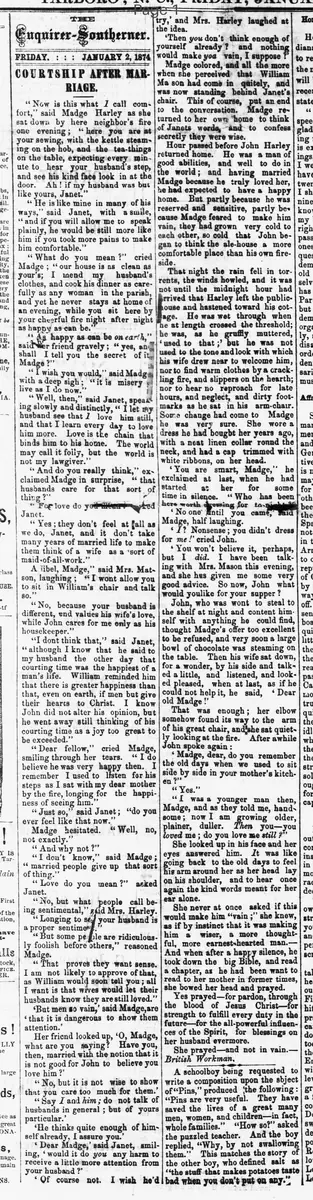
COURTSHIP AFTER MARRIAGE.
"Now is this what I call comfort," said Madge Harley as she sat down by her neighbor's fire one evening; "here you are at your sewing, with the kettle steaming on the hob, and the tea-things on the table, expecting every minute to hear your husband's step, and see his kind face look in at the door. Ah! if my husband was but like yours, Janet."
"He is like mine in many of his ways," said Janet, with a smile, "and if you will allow me to speak plainly, he would be still more like him if you took more pains to make him comfortable."
"What do you mean?" cried Madge; "our house is as clean as yours; I mend my husband's clothes, and cook his dinner as carefully as any woman in the parish, and yet he never stays at home of an evening, while you sit here by your cheerful fire night after night as happy as can be."
"As happy as can be on earth," said her friend gravely; "yes, and shall I tell you the secret of it, Madge?"
"I wish you would," said Madge with a deep sigh; "it is misery to live as I do now."
"Well, then," said Janet, speaking slowly and distinctly, "I let my husband see that I love him still, and that I learn every day to love him more. Love is the chain that binds him to his home. The world may call it folly, but the world is not my lawgiver."
"And do you really think," exclaimed Madge in surprise, "that husbands care for that sort of thing? For love do you mean, Janet."
"Yes; they don't feel at all as we do, Janet, and it don't take many years of married life to make them think of a wife as a 'sort of maid-of-all-work.'"
"A libel, Madge," said Mrs. Matson, laughing; "I won't allow you to sit in William's chair and talk so."
"No, because your husband is different, and values his wife's love, while John cares for me only as his housekeeper."
"I don't think that," said Janet, "although I know that he said to my husband the other day that courting time was the happiest of a man's life. William reminded him that there is greater happiness than that, even on earth, if men but give their hearts to Christ. I know John did not alter his opinion, but he went away still thinking of his courting time as a joy too great to be exceeded."
"Dear fellow," cried Madge, smiling through her tears. "I do believe he was very happy then. I remember I used to listen for his steps as I sat with my dear mother by the fire, longing for the happiness of seeing him."
"Just so," said Janet; "do you ever feel like that now?"
Madge hesitated. "Well, no, not exactly."
"I don't know," said Madge; "married people give up that sort of thing."
"Love do you mean?" asked Janet.
"No, but what people call being sentimental," said Mrs. Harley. "Longing to see your husband is a proper sentiment"
"But some people are ridiculously foolish before others," reasoned Madge.
"That proves they want sense. I am not likely to approve of that, as William would soon tell you; all I want is that wives would let their husbands know they are still loved."
"But men so vain," said Madge, "are that it is dangerous to show them attention."
Her friend looked up, "O, Madge, what are you saying? Have you, then, married with the notion that it is not good for John to believe you love him?"
"No, but it is not wise to show that you care too much for them."
"Say I and him; do not talk of husbands in general; but of yours particular."
"He thinks quite enough of himself already, I assure you."
"Dear Madge," said Janet, smiling, "would it do you any harm to receive a little more attention from your husband?"
"Of course not. I wish he'd try," and Mrs. Harley laughed at the idea.
"Then you don't think enough of yourself already? and nothing would make you vain, I suppose?"
Madge colored, and all the more when she perceived that William Mason had come in quietly, and was now standing behind Janet's chair. This of course, put an end to the conversation. Madge returned to her own home to think of Janet's words, and to confess secretly they were wise.
An hour passed before John Harley returned home. He was a man of good abilities, and well to do in the world; and having married Madge because he truly loved her, he had expected to have a happy home. But partly because he was reserved and sensitive, partly because Madge feared to make him vain, they had grown very cold to each other, so cold that John began to think the ale-house a more comfortable place than his own fireside.
That night the rain fell in torrents, the winds howled, and it was not until the midnight hour had arrived that Harley left the public-house and hastened toward his cottage. He was wet through when he at length crossed the threshold; he was, as he gruffly muttered, 'used to that;' but he was not used to the tone and look with which his wife drew near to welcome him, nor to find warm clothes by a crackling fire, and slippers on the hearth; nor to hear no reproach for late hours, and neglect, and dirty footprints as he sat in his arm-chair.
Some change had come to Madge he was very sure. She wore a dress he had bought her years ago, with a neat linen collar round the neck, and had a cap trimmed with white ribbons, on her head.
"You are smart, Madge," he exclaimed at last, when he had started as her for some time in silence. "Who has been here worth dressing for tonight?"
"No one till you came," said Madge, half laughing.
"I? Nonsense; you didn't dress for me!" cried John.
"You won't believe it, perhaps, but I did. I have been talking with Mrs. Mason this evening, and she has given me some very good advice. So now, John what would you like for your supper?"
John, who was wont to steal to the shelf at night and content himself with anything he could find, thought Madge's offer too excellent to be refused, and very soon a large bowl of chocolate was steaming on the table. Then his wife sat down, for a wonder, by his side and talked a little, and listened, and looked pleased, when at last, as if he could not help it, he said, "Dear old Madge!"
That was enough; her elbow somehow found its way to the arm of his great chair, and she sat quietly looking at the fire.
After awhile John spoke again: "Madge, dear, do you remember the old days when we used to sit side by side in your mother's kitchen?"
"Yes."
"I was a younger man then, Madge, and as they told me, handsome; now I am growing older, plainer, duller. Then you—you loved me; do you love me still?"
She looked up in his face and her eyes answered him. It was like going back to the old days to feel his arm around her as her head lay on his shoulder, and to hear once again the kind words meant for her ear alone.
She never at once asked if this would make him "vain;" she knew, as if by instinct that it was making him a wiser, a more thoughtful, more earnest-hearted man.
And when after a happy silence, he took down the big Bible, and read a chapter, as he had been wont to read to her mother in former times, she bowed her head and prayed.
Yes, prayed—for pardon, through the blood of Jesus Christ—for strength to fulfill every duty in the future—for the all-powerful influences of the Spirit, for blessings on her husband evermore.
She prayed—and not in vain.
British Workman.
FRIDAY. : : : JANUARY 2, 1874
COURTSHIP AFTER MARRIAGE.
"Now is this what I call comfort," said Madge Harley as she sat down by her neighbor's fire one evening; "here you are at your sewing, with the kettle steaming on the hob, and the tea-things on the table, expecting every minute to hear your husband's step, and see his kind face look in at the door. Ah! if my husband was but like yours, Janet."
"He is like mine in many of his ways," said Janet, with a smile, "and if you will allow me to speak plainly, he would be still more like him if you took more pains to make him comfortable."
"What do you mean?" cried Madge; "our house is as clean as yours; I mend my husband's clothes, and cook his dinner as carefully as any woman in the parish, and yet he never stays at home of an evening, while you sit here by your cheerful fire night after night as happy as can be."
"As happy as can be on earth," said her friend gravely; "yes, and shall I tell you the secret of it, Madge?"
"I wish you would," said Madge with a deep sigh; "it is misery to live as I do now."
"Well, then," said Janet, speaking slowly and distinctly, "I let my husband see that I love him still, and that I learn every day to love him more. Love is the chain that binds him to his home. The world may call it folly, but the world is not my lawgiver."
"And do you really think," exclaimed Madge in surprise, "that husbands care for that sort of thing? For love do you mean, Janet."
"Yes; they don't feel at all as we do, Janet, and it don't take many years of married life to make them think of a wife as a 'sort of maid-of-all-work.'"
"A libel, Madge," said Mrs. Matson, laughing; "I won't allow you to sit in William's chair and talk so."
"No, because your husband is different, and values his wife's love, while John cares for me only as his housekeeper."
"I don't think that," said Janet, "although I know that he said to my husband the other day that courting time was the happiest of a man's life. William reminded him that there is greater happiness than that, even on earth, if men but give their hearts to Christ. I know John did not alter his opinion, but he went away still thinking of his courting time as a joy too great to be exceeded."
"Dear fellow," cried Madge, smiling through her tears. "I do believe he was very happy then. I remember I used to listen for his steps as I sat with my dear mother by the fire, longing for the happiness of seeing him."
"Just so," said Janet; "do you ever feel like that now?"
Madge hesitated. "Well, no, not exactly."
"I don't know," said Madge; "married people give up that sort of thing."
"Love do you mean?" asked Janet.
"No, but what people call being sentimental," said Mrs. Harley. "Longing to see your husband is a proper sentiment"
"But some people are ridiculously foolish before others," reasoned Madge.
"That proves they want sense. I am not likely to approve of that, as William would soon tell you; all I want is that wives would let their husbands know they are still loved."
"But men so vain," said Madge, "are that it is dangerous to show them attention."
Her friend looked up, "O, Madge, what are you saying? Have you, then, married with the notion that it is not good for John to believe you love him?"
"No, but it is not wise to show that you care too much for them."
"Say I and him; do not talk of husbands in general; but of yours particular."
"He thinks quite enough of himself already, I assure you."
"Dear Madge," said Janet, smiling, "would it do you any harm to receive a little more attention from your husband?"
"Of course not. I wish he'd try," and Mrs. Harley laughed at the idea.
"Then you don't think enough of yourself already? and nothing would make you vain, I suppose?"
Madge colored, and all the more when she perceived that William Mason had come in quietly, and was now standing behind Janet's chair. This of course, put an end to the conversation. Madge returned to her own home to think of Janet's words, and to confess secretly they were wise.
An hour passed before John Harley returned home. He was a man of good abilities, and well to do in the world; and having married Madge because he truly loved her, he had expected to have a happy home. But partly because he was reserved and sensitive, partly because Madge feared to make him vain, they had grown very cold to each other, so cold that John began to think the ale-house a more comfortable place than his own fireside.
That night the rain fell in torrents, the winds howled, and it was not until the midnight hour had arrived that Harley left the public-house and hastened toward his cottage. He was wet through when he at length crossed the threshold; he was, as he gruffly muttered, 'used to that;' but he was not used to the tone and look with which his wife drew near to welcome him, nor to find warm clothes by a crackling fire, and slippers on the hearth; nor to hear no reproach for late hours, and neglect, and dirty footprints as he sat in his arm-chair.
Some change had come to Madge he was very sure. She wore a dress he had bought her years ago, with a neat linen collar round the neck, and had a cap trimmed with white ribbons, on her head.
"You are smart, Madge," he exclaimed at last, when he had started as her for some time in silence. "Who has been here worth dressing for tonight?"
"No one till you came," said Madge, half laughing.
"I? Nonsense; you didn't dress for me!" cried John.
"You won't believe it, perhaps, but I did. I have been talking with Mrs. Mason this evening, and she has given me some very good advice. So now, John what would you like for your supper?"
John, who was wont to steal to the shelf at night and content himself with anything he could find, thought Madge's offer too excellent to be refused, and very soon a large bowl of chocolate was steaming on the table. Then his wife sat down, for a wonder, by his side and talked a little, and listened, and looked pleased, when at last, as if he could not help it, he said, "Dear old Madge!"
That was enough; her elbow somehow found its way to the arm of his great chair, and she sat quietly looking at the fire.
After awhile John spoke again: "Madge, dear, do you remember the old days when we used to sit side by side in your mother's kitchen?"
"Yes."
"I was a younger man then, Madge, and as they told me, handsome; now I am growing older, plainer, duller. Then you—you loved me; do you love me still?"
She looked up in his face and her eyes answered him. It was like going back to the old days to feel his arm around her as her head lay on his shoulder, and to hear once again the kind words meant for her ear alone.
She never at once asked if this would make him "vain;" she knew, as if by instinct that it was making him a wiser, a more thoughtful, more earnest-hearted man.
And when after a happy silence, he took down the big Bible, and read a chapter, as he had been wont to read to her mother in former times, she bowed her head and prayed.
Yes, prayed—for pardon, through the blood of Jesus Christ—for strength to fulfill every duty in the future—for the all-powerful influences of the Spirit, for blessings on her husband evermore.
She prayed—and not in vain.
British Workman.
What sub-type of article is it?
Family Drama
Romance
Personal Triumph
What themes does it cover?
Love
Family
Moral Virtue
What keywords are associated?
Marital Discord
Rekindled Love
Wifely Affection
Domestic Harmony
Christian Faith
What entities or persons were involved?
Madge Harley
John Harley
Janet Mason
William Mason
Story Details
Key Persons
Madge Harley
John Harley
Janet Mason
William Mason
Story Details
Madge, feeling neglected by her husband John, confides in friend Janet, who advises showing continued love to maintain marital harmony. That night, Madge dresses up and warmly welcomes John home from the pub during a storm, leading to reconciliation, rekindled affection, and a shared moment of prayer and Bible reading.