Thank you for visiting SNEWPapers!
Sign up free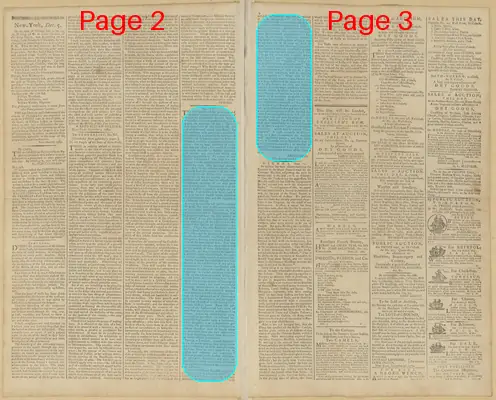
The Daily Advertiser
New York, New York County, New York
What is this article about?
In this essay, Americanus defends the proposed U.S. Constitution against Cato's objections, arguing that American republican government requires new principles distinct from Montesquieu's democratic theories, and that a moderate standing army is necessary but not dangerous in a united federation.
Merged-components note: This is a continuation of the same editorial piece (No. XIV responding to Cato) from page 2 to page 3, as the text flows directly without interruption.
Clippings
1 of 2
OCR Quality
Full Text
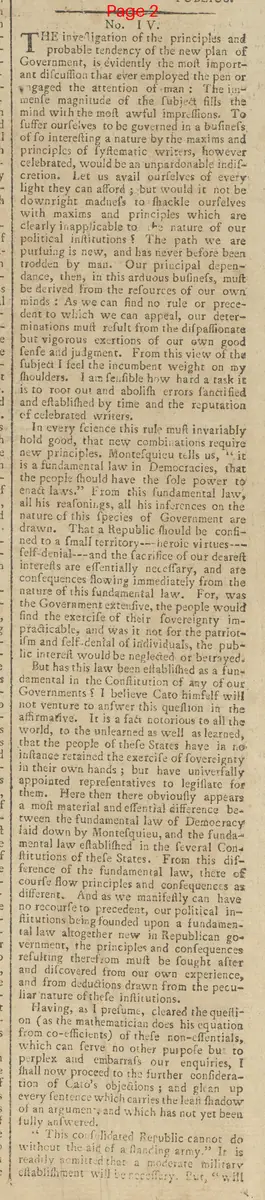
THE investigation of the principles and probable tendency of the new plan of Government, is evidently the most important discussion that ever employed the pen or engaged the attention of man: The immense magnitude of the subject fills the mind with the most awful impressions. To suffer ourselves to be governed in a business of so interesting a nature by the maxims and principles of systematic writers, however celebrated, would be an unpardonable indiscretion. Let us avail ourselves of every light they can afford; but would it not be downright madness to shackle ourselves with maxims and principles which are clearly inapplicable to the nature of our political institutions? The path we are pursuing is new, and has never before been trodden by man. Our principal dependence, then, in this arduous business, must be derived from the resources of our own minds: As we can find no rule or precedent to which we can appeal, our determinations must result from the dispassionate but vigorous exertions of our own good sense and judgment. From this view of the subject I feel the incumbent weight on my shoulders. I am sensible how hard a task it is to root out and abolish errors sanctified and established by time and the reputation of celebrated writers.
In every science this rule must invariably hold good, that new combinations require new principles. Montesquieu tells us, "it is a fundamental law in Democracies, that the people should have the sole power to enact laws." From this fundamental law, all his reasonings, all his inferences on the nature of this species of Government are drawn. That a Republic should be confined to a small territory---heroic virtues---self-denial---and the sacrifice of our dearest interests are essentially necessary, and are consequences flowing immediately from the nature of this fundamental law. For, was the Government extensive, the people would find the exercise of their sovereignty impracticable, and was it not for the patriotism and self-denial of individuals, the public interest would be neglected or betrayed.
But has this law been established as a fundamental in the Constitution of any of our Governments? I believe Cato himself will not venture to answer this question in the affirmative. It is a fact notorious to all the world, to the unlearned as well as learned, that the people of these States have in no instance retained the exercise of sovereignty in their own hands; but have universally appointed representatives to legislate for them. Here then there obviously appears a most material and essential difference between the fundamental law of Democracy laid down by Montesquieu, and the fundamental law established in the several Constitutions of these States. From this difference of the fundamental law, there of course flow principles and consequences as different. And as we manifestly can have no recourse to precedent, our political institutions being founded upon a fundamental law altogether new in Republican government, the principles and consequences resulting therefrom must be sought after and discovered from our own experience, and from deductions drawn from the peculiar nature of these institutions.
Having, as I presume, cleared the question (as the mathematician does his equation from coefficients) of these non-essentials, which can serve no other purpose but to perplex and embarrass our enquiries, I shall now proceed to the further consideration of Cato's objections; and glean up every sentence which carries the least shadow of an argument, and which has not yet been fully answered.
"This consolidated Republic cannot do without the aid of a standing army." It is readily admitted that a moderate military establishment will be necessary. But, "will
not political security, and even the opinion of it, be extinguished? By no means. There are various circumstances which will render it impossible for a standing army to become dangerous; provided these States continue United. The causes which require large military establishments in Europe, do not exist on this side the Atlantic. But why is the trifling force which it may be necessary for us to keep up, made so great a bug-bear of? Does not Great-Britain support a standing army vastly greater than we can ever have occasion for? Yet, if we go out of our own country, where shall we find more "political security;" less "force," less "violence," in the exercise of the powers of Government? But, "the malecontents in each State," who, as Cato informs us, "will not be a few, nor the least important, will be exciting factions against it." What will be the numbers of these malecontents, I know not. It will be sufficient if the majority in favor of the Constitution be clear and decided, which I sincerely hope, and firmly believe it will be. Indeed, should an Angel come down from Heaven. and present us with a Constitution of Government altogether perfect and free from blemish; should we not still have malecontents amongst us? Would there not be Cato's and Brutus's ready to disseminate groundless jealousies and vain fears? If a plan of Government must be rejected because some are opposed to it, is it not evident that none can ever be adopted? One remark, however, I must beg leave to address more immediately to Cato and his party: If there is any one "axiom in the science of politics," which may be deemed "irrefragable," it must certainly be this ;--- that in a free Government the majority must necessarily govern; and that, therefore, it becomes the indispensable duty of good citizens to acquiesce; to attempt an opposition by means of force and violence, would be to commit a crime of the blackest dye.
AMERICANUS.
(To be continued.)
What sub-type of article is it?
What keywords are associated?
What entities or persons were involved?
Editorial Details
Primary Topic
Defense Of The Proposed Federal Constitution Against Cato's Objections
Stance / Tone
Supportive Of The Constitution, Critical Of Anti Federalist Fears
Key Figures
Key Arguments