Thank you for visiting SNEWPapers!
Sign up free
Editorial
September 11, 1793
Gazette Of The United States
New York, New York County, New York
What is this article about?
A detailed refutation of a writer's argument claiming the U.S. executive can suspend treaties with France by refusing to recognize its revolutionary government, emphasizing constitutional limits on executive power in foreign affairs and treaty obligations.
Clipping
OCR Quality
95%
Excellent
Full Text
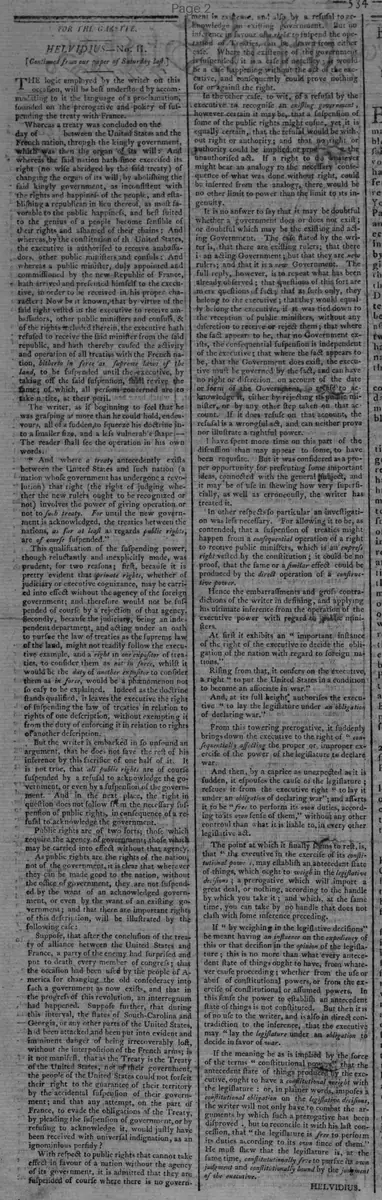
THE logic employed by the writer on this occasion, will be best understood by accommodating to it the language of a proclamation, founded on the prerogative and policy of suspending the treaty with France.
Whereas a treaty was concluded on the day of [date] between the United States and the French nation, through the kingly government, which was then the organ of its will: And whereas the said nation hath since exercised its right (nowise abridged by the said treaty) of changing the organ of its will, by abolishing the said kingly government, as inconsistent with the rights and happiness of the people, and establishing a republican in lieu thereof, as most favorable to the public happiness, and best suited to the genius of a people become sensible of their rights and ashamed of their chains: And whereas, by the constitution of the United States, the executive is authorized to receive ambassadors, other public ministers and consuls: And whereas a public minister, duly appointed and commissioned by the new Republic of France, hath arrived and presented himself to the executive, in order to be received in his proper character: Now be it known, that by virtue of the said right vested in the executive to receive ambassadors, other public ministers and consuls, and of the rights included therein, the executive hath refused to receive the said minister from the said republic, and hath thereby caused the activity and operation of all treaties with the French nation, heretofore in force as supreme laws of the land, to be suspended until the executive, by taking off the said suspension, shall revive the same; of which, all persons concerned are to take notice, at their peril.
The writer, as if beginning to feel that he was grasping at more than he could hold, endeavors, all of a sudden, to squeeze his doctrine into a smaller size, and a less vulnerable shape. The reader shall see the operation in his own words.
"And where a treaty antecedently exists between the United States and such nation (a nation whose government has undergone a revolution) that right (the right of judging whether the new rulers ought to be recognized or not) involves the power of giving operation or not to such treaty. For until the new government is acknowledged, the treaties between the nations, as far at least as regards public rights, are of course suspended."
This qualification of the suspending power, though reluctantly and inexplicitly made, was prudent, for two reasons; first, because it is pretty evident that private rights, whether of judiciary or executive cognizance, may be carried into effect without the agency of the foreign government; and therefore would not be suspended of course by a rejection of that agency. Secondly, because the judiciary, being an independent department, and acting under an oath to pursue the law of treaties as the supreme law of the land, might not readily follow the executive example, and a right in one expositor of treaties, to consider them as not in force, whilst it would be the duty of another expositor to consider them as in force, would be a phenomenon not easy to be explained. Indeed as the doctrine stands qualified, it leaves the executive the right of suspending the law of treaties in relation to rights of one description, without exempting it from the duty of enforcing it in relation to rights of another description.
But the writer is embarked in so unsound an argument, that he does not save the rest of his inference by this sacrifice of one half of it. It is not true, that all public rights are of course suspended by a refusal to acknowledge the government, or even by a suspension of the government. And in the next place, the right in question does not follow from the necessary suspension of public rights, in consequence of a refusal to acknowledge the government.
Public rights are of two sorts; those which require the agency of government; those which may be carried into effect without that agency. As public rights are the rights of the nation not of the government, it is clear that wherever they can be made good to the nation, without the office of government, they are not suspended by the want of an acknowledged government, or even by the want of an existing government; and that there are important rights of this description, will be illustrated by the following case:
Suppose, that after the conclusion of the treaty of alliance between the United States and France, a party of the enemy had surprised and put to death every member of congress; that the occasion had been used by the people of America for changing the old confederacy into such a government as now exists, and that in the progress of this revolution, an interregnum had happened. Suppose further, that during this interval, the states of South-Carolina and Georgia, or any other parts of the United States, had been attacked, and been put into evident and imminent danger of being irrecoverably lost, without the interposition of the French arms; is it not manifest, that as the Treaty is the Treaty of the United States, not of their government, the people of the United States could not forfeit their right to the guarantee of their territory by the accidental suspension of their government; and that any attempt, on the part of France, to evade the obligations of the Treaty, by pleading the suspension of government, or by refusing to acknowledge it, would justly have been received with universal indignation, as an ignominious perfidy?
With respect to public rights that cannot take effect in favour of a nation without the agency of its government, it is admitted that they are suspended of course where there is no government in existence, and also by a refusal to acknowledge an existing government. But no inference in favour of a right to suspend the operation of Treaties, can be drawn from either case. Where the existence of the government is suspended, it is a case of necessity; it would be a case happening without the act of the executive, and consequently could prove nothing for or against the right. In the other case, to wit, of a refusal by the executive to recognize an existing government, however certain it may be, that a suspension of some of the public rights might ensue, yet it is equally certain, that the refusal would be without right or authority: and that, no right or authority could be implied or proved from the unauthorized act. If a right to do whatever might bear an analogy to the necessary consequence of what was done without right, could be inferred from the analogy, there would be no other limit to power than the limit to its ingenuity.
It is no answer to say that it may be doubtful whether a government does or does not exist; or doubtful which may be the existing and acting Government. The case stated by the writer is, that there are existing rulers; that there is an acting Government; but that they are new rulers; and that it is a new Government. The full reply, however, is to repeat what has been already observed; that questions of this sort are mere questions of fact; that as such only, they belong to the executive; that they would equally belong to the executive, if he was tied down to the reception of public ministers, without any discretion to receive or reject them; that where the fact appears to be, that no Government exists, the consequential suspension is independent of the executive; that where the fact appears to be, that the Government does exist, the executive must be governed by the fact, and can have no right or discretion, on account of the date or form of the Government or of its rulers to acknowledge it, either by rejecting its minister, or by any other step taken on that account. If it does refuse on that account, the refusal is a wrongful act, and can neither prove nor illustrate a rightful power.
I have spent more time on this part of the discussion than may appear to some, to have been requisite. But it was considered as a proper opportunity for presenting some important ideas, connected with the general subject, and it may be of use in shewing how very superficially, as well as erroneously, the writer has treated it.
In other respects so particular an investigation was less necessary. For allowing it to be, as contended, that a suspension of treaties might happen from a consequential operation of a right to receive public ministers, which is an express right vested by the constitution: it could be no proof, that the same or a similar effect could be produced by the direct operation of a constructive power.
Hence the embarrassments and gross contradictions of the writer in defining, and applying his ultimate inference from the operation of the executive power with regard to allied ministers.
At first it exhibits an "important instance of the right of the executive to decide the obligation of the nation with regard to foreign nations."
Rising from that, it confers on the executive a right "to put the United States in a condition to become an associate in war."
And, at its full height, authorizes the executive "to lay the legislature under an obligation of declaring war."
From this towering prerogative, it suddenly brings down the executive to the right of "consequently affecting the proper or improper exercise of the power of the legislature to declare war."
And then, by a caprice as unexpected as it is sudden, it espouses the cause of the legislature; rescues it from the executive right to lay it under an obligation of declaring war"; and asserts it to be "free to perform its own duties, according to its own sense of them," without any other controul than what it is liable to, in every other legislative act.
The point at which it finally seems to rest, is, that "the executive in the exercise of its constitutional powers, may establish an antecedent state of things, which ought to weigh in the legislative decisions; a prerogative which will import a great deal, or nothing, according to the handle by which you take it; and which, at the same time, you can take by no handle that does not clash with some inference preceding.
If "by weighing in the legislative decisions" be meant having an influence on the expediency of this or that decision in the opinion of the legislature; this is no more than what every antecedent state of things ought to have, from whatever cause proceeding; whether from the use or abuse of constitutional powers, or from the exercise of constitutional or assumed powers. In this sense the power to establish an antecedent state of things is not contested. But then it is of no use to the writer, and is also in direct contradiction to the inference, that the executive may "lay the legislature under an obligation to decide in favor of war."
If the meaning be as is implied by the force of the terms "constitutional powers" that the antecedent state of things produced by the executive, ought to have a constitutional weight with the legislature: or, in plainer words, imposes a constitutional obligation on the legislative decisions, the writer will not only have to combat the arguments by which such a prerogative has been disproved: but to reconcile it with his last concession, that "the legislature is free to perform its duties according to its own sense of them."
He must shew that the legislature is, at the same time, constitutionally free to pursue its own judgment and constitutionally bound by the judgment of the executive.
Whereas a treaty was concluded on the day of [date] between the United States and the French nation, through the kingly government, which was then the organ of its will: And whereas the said nation hath since exercised its right (nowise abridged by the said treaty) of changing the organ of its will, by abolishing the said kingly government, as inconsistent with the rights and happiness of the people, and establishing a republican in lieu thereof, as most favorable to the public happiness, and best suited to the genius of a people become sensible of their rights and ashamed of their chains: And whereas, by the constitution of the United States, the executive is authorized to receive ambassadors, other public ministers and consuls: And whereas a public minister, duly appointed and commissioned by the new Republic of France, hath arrived and presented himself to the executive, in order to be received in his proper character: Now be it known, that by virtue of the said right vested in the executive to receive ambassadors, other public ministers and consuls, and of the rights included therein, the executive hath refused to receive the said minister from the said republic, and hath thereby caused the activity and operation of all treaties with the French nation, heretofore in force as supreme laws of the land, to be suspended until the executive, by taking off the said suspension, shall revive the same; of which, all persons concerned are to take notice, at their peril.
The writer, as if beginning to feel that he was grasping at more than he could hold, endeavors, all of a sudden, to squeeze his doctrine into a smaller size, and a less vulnerable shape. The reader shall see the operation in his own words.
"And where a treaty antecedently exists between the United States and such nation (a nation whose government has undergone a revolution) that right (the right of judging whether the new rulers ought to be recognized or not) involves the power of giving operation or not to such treaty. For until the new government is acknowledged, the treaties between the nations, as far at least as regards public rights, are of course suspended."
This qualification of the suspending power, though reluctantly and inexplicitly made, was prudent, for two reasons; first, because it is pretty evident that private rights, whether of judiciary or executive cognizance, may be carried into effect without the agency of the foreign government; and therefore would not be suspended of course by a rejection of that agency. Secondly, because the judiciary, being an independent department, and acting under an oath to pursue the law of treaties as the supreme law of the land, might not readily follow the executive example, and a right in one expositor of treaties, to consider them as not in force, whilst it would be the duty of another expositor to consider them as in force, would be a phenomenon not easy to be explained. Indeed as the doctrine stands qualified, it leaves the executive the right of suspending the law of treaties in relation to rights of one description, without exempting it from the duty of enforcing it in relation to rights of another description.
But the writer is embarked in so unsound an argument, that he does not save the rest of his inference by this sacrifice of one half of it. It is not true, that all public rights are of course suspended by a refusal to acknowledge the government, or even by a suspension of the government. And in the next place, the right in question does not follow from the necessary suspension of public rights, in consequence of a refusal to acknowledge the government.
Public rights are of two sorts; those which require the agency of government; those which may be carried into effect without that agency. As public rights are the rights of the nation not of the government, it is clear that wherever they can be made good to the nation, without the office of government, they are not suspended by the want of an acknowledged government, or even by the want of an existing government; and that there are important rights of this description, will be illustrated by the following case:
Suppose, that after the conclusion of the treaty of alliance between the United States and France, a party of the enemy had surprised and put to death every member of congress; that the occasion had been used by the people of America for changing the old confederacy into such a government as now exists, and that in the progress of this revolution, an interregnum had happened. Suppose further, that during this interval, the states of South-Carolina and Georgia, or any other parts of the United States, had been attacked, and been put into evident and imminent danger of being irrecoverably lost, without the interposition of the French arms; is it not manifest, that as the Treaty is the Treaty of the United States, not of their government, the people of the United States could not forfeit their right to the guarantee of their territory by the accidental suspension of their government; and that any attempt, on the part of France, to evade the obligations of the Treaty, by pleading the suspension of government, or by refusing to acknowledge it, would justly have been received with universal indignation, as an ignominious perfidy?
With respect to public rights that cannot take effect in favour of a nation without the agency of its government, it is admitted that they are suspended of course where there is no government in existence, and also by a refusal to acknowledge an existing government. But no inference in favour of a right to suspend the operation of Treaties, can be drawn from either case. Where the existence of the government is suspended, it is a case of necessity; it would be a case happening without the act of the executive, and consequently could prove nothing for or against the right. In the other case, to wit, of a refusal by the executive to recognize an existing government, however certain it may be, that a suspension of some of the public rights might ensue, yet it is equally certain, that the refusal would be without right or authority: and that, no right or authority could be implied or proved from the unauthorized act. If a right to do whatever might bear an analogy to the necessary consequence of what was done without right, could be inferred from the analogy, there would be no other limit to power than the limit to its ingenuity.
It is no answer to say that it may be doubtful whether a government does or does not exist; or doubtful which may be the existing and acting Government. The case stated by the writer is, that there are existing rulers; that there is an acting Government; but that they are new rulers; and that it is a new Government. The full reply, however, is to repeat what has been already observed; that questions of this sort are mere questions of fact; that as such only, they belong to the executive; that they would equally belong to the executive, if he was tied down to the reception of public ministers, without any discretion to receive or reject them; that where the fact appears to be, that no Government exists, the consequential suspension is independent of the executive; that where the fact appears to be, that the Government does exist, the executive must be governed by the fact, and can have no right or discretion, on account of the date or form of the Government or of its rulers to acknowledge it, either by rejecting its minister, or by any other step taken on that account. If it does refuse on that account, the refusal is a wrongful act, and can neither prove nor illustrate a rightful power.
I have spent more time on this part of the discussion than may appear to some, to have been requisite. But it was considered as a proper opportunity for presenting some important ideas, connected with the general subject, and it may be of use in shewing how very superficially, as well as erroneously, the writer has treated it.
In other respects so particular an investigation was less necessary. For allowing it to be, as contended, that a suspension of treaties might happen from a consequential operation of a right to receive public ministers, which is an express right vested by the constitution: it could be no proof, that the same or a similar effect could be produced by the direct operation of a constructive power.
Hence the embarrassments and gross contradictions of the writer in defining, and applying his ultimate inference from the operation of the executive power with regard to allied ministers.
At first it exhibits an "important instance of the right of the executive to decide the obligation of the nation with regard to foreign nations."
Rising from that, it confers on the executive a right "to put the United States in a condition to become an associate in war."
And, at its full height, authorizes the executive "to lay the legislature under an obligation of declaring war."
From this towering prerogative, it suddenly brings down the executive to the right of "consequently affecting the proper or improper exercise of the power of the legislature to declare war."
And then, by a caprice as unexpected as it is sudden, it espouses the cause of the legislature; rescues it from the executive right to lay it under an obligation of declaring war"; and asserts it to be "free to perform its own duties, according to its own sense of them," without any other controul than what it is liable to, in every other legislative act.
The point at which it finally seems to rest, is, that "the executive in the exercise of its constitutional powers, may establish an antecedent state of things, which ought to weigh in the legislative decisions; a prerogative which will import a great deal, or nothing, according to the handle by which you take it; and which, at the same time, you can take by no handle that does not clash with some inference preceding.
If "by weighing in the legislative decisions" be meant having an influence on the expediency of this or that decision in the opinion of the legislature; this is no more than what every antecedent state of things ought to have, from whatever cause proceeding; whether from the use or abuse of constitutional powers, or from the exercise of constitutional or assumed powers. In this sense the power to establish an antecedent state of things is not contested. But then it is of no use to the writer, and is also in direct contradiction to the inference, that the executive may "lay the legislature under an obligation to decide in favor of war."
If the meaning be as is implied by the force of the terms "constitutional powers" that the antecedent state of things produced by the executive, ought to have a constitutional weight with the legislature: or, in plainer words, imposes a constitutional obligation on the legislative decisions, the writer will not only have to combat the arguments by which such a prerogative has been disproved: but to reconcile it with his last concession, that "the legislature is free to perform its duties according to its own sense of them."
He must shew that the legislature is, at the same time, constitutionally free to pursue its own judgment and constitutionally bound by the judgment of the executive.
What sub-type of article is it?
Constitutional
Foreign Affairs
War Or Peace
What keywords are associated?
Executive Power
Treaty Suspension
French Revolution
Government Recognition
Public Rights
Constitutional Limits
Foreign Ministers
What entities or persons were involved?
The Writer
Executive
New Republic Of France
Legislature
Judiciary
Editorial Details
Primary Topic
Executive Power To Suspend Treaties With Revolutionary France
Stance / Tone
Strong Refutation Of Expanded Executive Authority
Key Figures
The Writer
Executive
New Republic Of France
Legislature
Judiciary
Key Arguments
Executive Refusal To Receive French Minister Does Not Suspend Treaties
Public Rights Not Automatically Suspended By Non Recognition
Treaties Bind Nations, Not Just Governments
Hypothetical Interregnum Does Not Forfeit Treaty Obligations
Executive Cannot Infer Suspension Power From Necessity Cases
Writer's Doctrine Leads To Contradictions On War Declaration Powers