Thank you for visiting SNEWPapers!
Sign up free
Story
January 2, 1958
The East Hartford Gazette
New Britain, Hartford County, Connecticut
What is this article about?
United Aircraft Corporation reported strong 1957 performance despite military cutbacks, with high production in engines, propellers, and helicopters. Key divisions expanded facilities and certified new jet engines for commercial use. AEC renewed nuclear propulsion contract, creating job openings.
Clipping
OCR Quality
98%
Excellent
Full Text
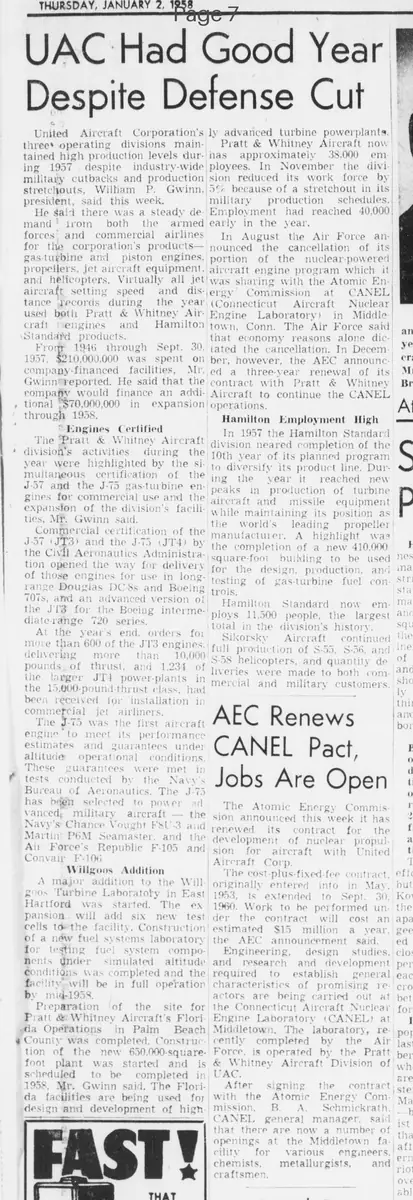
UAC Had Good Year Despite Defense Cut
United Aircraft Corporation's three operating divisions maintained high production levels during 1957 despite industry-wide military cutbacks and production stretchouts. William P. Gwinn, president, said this week.
He said there was a steady demand from both the armed forces and commercial airlines for the corporation's products—gas turbine and piston engines, propellers, jet aircraft equipment, and helicopters. Virtually all jet aircraft setting speed and distance records during the year used both Pratt & Whitney Aircraft engines and Hamilton Standard products.
From 1946 through Sept. 30, 1957, $210,000,000 was spent on company-financed facilities, Mr. Gwinn reported. He said that the company would finance an additional $70,000,000 in expansion through 1958.
Engines Certified
The Pratt & Whitney Aircraft division's activities during the year were highlighted by the simultaneous certification of the J-57 and the J-75 gas-turbine engines for commercial use and the expansion of the division's facilities. Mr. Gwinn said.
Commercial certification of the J57 (JT3) and the J-75 (JT4) by the Civil Aeronautics Administration opened the way for delivery of those engines for use in long range Douglas DC-8s and Boeing 707s, and an advanced version of the JT3 for the Boeing intermediate range 720 series.
At the year's end, orders for more than 600 of the JT3 engines delivering more than 10,000 pounds of thrust, and 123 of the larger JT4 power plants in the 15,000-pound thrust class, had been received for installation in commercial jet airliners.
The J75 was the first aircraft engine to meet its performance estimates and guarantees under altitude operational conditions. These guarantees were met in tests conducted by the Navy's Bureau of Aeronautics. The J75 has been selected to power advanced military aircraft - the Navy's Chance Vought F8U-3 and Martin P6M Seamaster, and the Air Force's Republic F-105 and Convair F-106.
Willgoos Addition
A major addition to the Willgoos Turbine Laboratory in East Hartford was started. The expansion will add six new test cells to the facility. Construction of a new fuel systems laboratory for testing fuel system components under simulated altitude conditions was completed and the facility will be in full operation by mid-1958.
Preparation of the site for Pratt & Whitney Aircraft's Florida Operations in Palm Beach County was completed. Construction of the new 650,000-square-foot plant was started and is scheduled to be completed in 1958, Mr. Gwinn said. The Florida facilities are being used for design and development of highly advanced turbine powerplants.
Pratt & Whitney Aircraft now has approximately 38,000 employees. In November the division reduced its work force by 5%, because of a stretchout in its military production schedules. Employment had reached 40,000 early in the year.
In August the Air Force announced the cancellation of its portion of the nuclear powered aircraft engine program which it was sharing with the Atomic Energy Commission at CANEL (Connecticut Aircraft Nuclear Engine Laboratory) in Middletown, Conn. The Air Force said that economy reasons alone dictated the cancellation. In December, however, the AEC announced a three-year renewal of its contract with Pratt & Whitney Aircraft to continue the CANEL operations.
Hamilton Employment High
In 1957 the Hamilton Standard division neared completion of the 10th year of its planned program to diversify its product line. During the year it reached new peaks in production of turbine aircraft and missile equipment while maintaining its position as the world's leading propeller manufacturer. A highlight was the completion of a new 410,000 square foot building to be used for the design, production, and testing of gas-turbine fuel controls.
Hamilton Standard now employs 11,500 people, the largest total in the division's history.
Sikorsky Aircraft continued full production of S-55, S-56, and S-58 helicopters, and quantity deliveries were made to both commercial and military customers.
AEC Renews CANEL Pact, Jobs Are Open
The Atomic Energy Commission announced this week it has renewed its contract for the development of nuclear propulsion for aircraft with United Aircraft Corp.
The cost plus fixed fee contract, originally entered into in May 1953, is extended to Sept. 30, 1960. Work to be performed under the contract will cost an estimated $15 million a year, the AEC announcement said.
Engineering, design studies, and research and development required to establish general characteristics of promising reactors are being carried out at the Connecticut Aircraft Nuclear Engine Laboratory (CANEL) at Middletown. The laboratory, recently completed by the Air Force, is operated by the Pratt & Whitney Aircraft Division of UAC.
After signing the contract with the Atomic Energy Commission, B.A. Schmickrath (CANEL general manager) said that there are now a number of openings at the Middletown facility for various engineers, chemists, metallurgists, and craftsmen.
United Aircraft Corporation's three operating divisions maintained high production levels during 1957 despite industry-wide military cutbacks and production stretchouts. William P. Gwinn, president, said this week.
He said there was a steady demand from both the armed forces and commercial airlines for the corporation's products—gas turbine and piston engines, propellers, jet aircraft equipment, and helicopters. Virtually all jet aircraft setting speed and distance records during the year used both Pratt & Whitney Aircraft engines and Hamilton Standard products.
From 1946 through Sept. 30, 1957, $210,000,000 was spent on company-financed facilities, Mr. Gwinn reported. He said that the company would finance an additional $70,000,000 in expansion through 1958.
Engines Certified
The Pratt & Whitney Aircraft division's activities during the year were highlighted by the simultaneous certification of the J-57 and the J-75 gas-turbine engines for commercial use and the expansion of the division's facilities. Mr. Gwinn said.
Commercial certification of the J57 (JT3) and the J-75 (JT4) by the Civil Aeronautics Administration opened the way for delivery of those engines for use in long range Douglas DC-8s and Boeing 707s, and an advanced version of the JT3 for the Boeing intermediate range 720 series.
At the year's end, orders for more than 600 of the JT3 engines delivering more than 10,000 pounds of thrust, and 123 of the larger JT4 power plants in the 15,000-pound thrust class, had been received for installation in commercial jet airliners.
The J75 was the first aircraft engine to meet its performance estimates and guarantees under altitude operational conditions. These guarantees were met in tests conducted by the Navy's Bureau of Aeronautics. The J75 has been selected to power advanced military aircraft - the Navy's Chance Vought F8U-3 and Martin P6M Seamaster, and the Air Force's Republic F-105 and Convair F-106.
Willgoos Addition
A major addition to the Willgoos Turbine Laboratory in East Hartford was started. The expansion will add six new test cells to the facility. Construction of a new fuel systems laboratory for testing fuel system components under simulated altitude conditions was completed and the facility will be in full operation by mid-1958.
Preparation of the site for Pratt & Whitney Aircraft's Florida Operations in Palm Beach County was completed. Construction of the new 650,000-square-foot plant was started and is scheduled to be completed in 1958, Mr. Gwinn said. The Florida facilities are being used for design and development of highly advanced turbine powerplants.
Pratt & Whitney Aircraft now has approximately 38,000 employees. In November the division reduced its work force by 5%, because of a stretchout in its military production schedules. Employment had reached 40,000 early in the year.
In August the Air Force announced the cancellation of its portion of the nuclear powered aircraft engine program which it was sharing with the Atomic Energy Commission at CANEL (Connecticut Aircraft Nuclear Engine Laboratory) in Middletown, Conn. The Air Force said that economy reasons alone dictated the cancellation. In December, however, the AEC announced a three-year renewal of its contract with Pratt & Whitney Aircraft to continue the CANEL operations.
Hamilton Employment High
In 1957 the Hamilton Standard division neared completion of the 10th year of its planned program to diversify its product line. During the year it reached new peaks in production of turbine aircraft and missile equipment while maintaining its position as the world's leading propeller manufacturer. A highlight was the completion of a new 410,000 square foot building to be used for the design, production, and testing of gas-turbine fuel controls.
Hamilton Standard now employs 11,500 people, the largest total in the division's history.
Sikorsky Aircraft continued full production of S-55, S-56, and S-58 helicopters, and quantity deliveries were made to both commercial and military customers.
AEC Renews CANEL Pact, Jobs Are Open
The Atomic Energy Commission announced this week it has renewed its contract for the development of nuclear propulsion for aircraft with United Aircraft Corp.
The cost plus fixed fee contract, originally entered into in May 1953, is extended to Sept. 30, 1960. Work to be performed under the contract will cost an estimated $15 million a year, the AEC announcement said.
Engineering, design studies, and research and development required to establish general characteristics of promising reactors are being carried out at the Connecticut Aircraft Nuclear Engine Laboratory (CANEL) at Middletown. The laboratory, recently completed by the Air Force, is operated by the Pratt & Whitney Aircraft Division of UAC.
After signing the contract with the Atomic Energy Commission, B.A. Schmickrath (CANEL general manager) said that there are now a number of openings at the Middletown facility for various engineers, chemists, metallurgists, and craftsmen.
What sub-type of article is it?
Corporate Report
Business News
What themes does it cover?
Triumph
Fortune Reversal
What keywords are associated?
United Aircraft
Pratt Whitney
Jet Engines
Military Cutbacks
Facility Expansion
Nuclear Propulsion
Employment
What entities or persons were involved?
William P. Gwinn
B.A. Schmickrath
Where did it happen?
East Hartford, Palm Beach County, Middletown, Conn.
Story Details
Key Persons
William P. Gwinn
B.A. Schmickrath
Location
East Hartford, Palm Beach County, Middletown, Conn.
Event Date
1957
Story Details
United Aircraft Corporation maintained high production in 1957 despite military cutbacks, certified new jet engines, expanded facilities, and received AEC contract renewal for nuclear propulsion, leading to job openings.