Thank you for visiting SNEWPapers!
Sign up free
Savannah Morning News
Savannah, Chatham County, Georgia
What is this article about?
In the U.S. Senate on April 5, debate on Logan's military bill to increase the army to 30,000 men featured opposition from Cockrell and Plumb, support from Sewell, and an interjection by Frye on North Atlantic fisheries tensions. Session ended with move to executive session.
Clipping
OCR Quality
Full Text
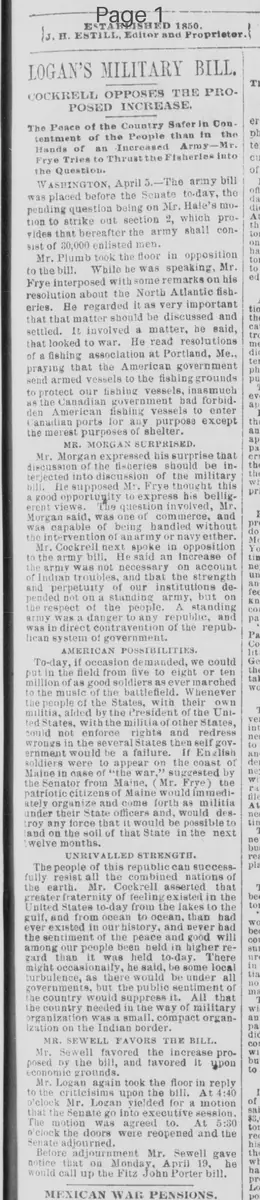
LOGAN'S MILITARY BILL.
COCKRELL OPPOSES THE PROPOSED INCREASE.
The Peace of the Country Safer in Contentment of the People than in the Hands of an Increased Army—Mr. Frye Tries to Thrust the Fisheries into the Question.
WASHINGTON, April 5.—The army bill was placed before the Senate to-day, the pending question being on Mr. Hale's motion to strike out section 2, which provides that hereafter the army shall consist of 30,000 enlisted men.
Mr. Plumb took the floor in opposition to the bill. While he was speaking, Mr. Frye interposed with some remarks on his resolution about the North Atlantic fisheries. He regarded it as very important that that matter should be discussed and settled. It involved a matter, he said, that looked to war. He read resolutions of a fishing association at Portland, Me., praying that the American government send armed vessels to the fishing grounds to protect our fishing vessels, inasmuch as the Canadian government had forbidden American fishing vessels to enter Canadian ports for any purpose except the merest purposes of shelter.
MR. MORGAN SURPRISED.
Mr. Morgan expressed his surprise that discussion of the fisheries should be interjected into discussion of the military bill. He supposed Mr. Frye thought this a good opportunity to express his belligerent views. The question involved, Mr. Morgan said, was one of commerce, and was capable of being handled without the intervention of an army or navy either.
Mr. Cockrell next spoke in opposition to the army bill. He said an increase of the army was not necessary on account of Indian troubles, and that the strength and perpetuity of our institutions depended not on a standing army, but on the respect of the people. A standing army was a danger to any republic, and was in direct contravention of the republican system of government.
AMERICAN POSSIBILITIES.
To-day, if occasion demanded, we could put in the field from five to eight or ten million of as good soldiers as ever marched to the music of the battlefield. Whenever the people of the States, with their own militia, aided by the President of the United States, with the militia of other States, could not enforce rights and redress wrongs in the several States then self-government would be a failure. If English soldiers were to appear on the coast of Maine in case of "the war," suggested by the Senator from Maine (Mr. Frye), the patriotic citizens of Maine would immediately organize and come forth as militia under their State officers and would destroy any force that it would be possible to land on the soil of that State in the next twelve months.
UNRIVALLED STRENGTH.
The people of this republic can successfully resist all the combined nations of the earth. Mr. Cockrell asserted that greater fraternity of feeling existed in the United States to-day from the lakes to the gulf, and from ocean to ocean, than had ever existed in our history, and never had the sentiment of the peace and good will among our people been held in higher regard than it was held to-day. There might occasionally, he said, be some local turbulence, as there would be under all governments, but the public sentiment of the country would suppress it. All that the country needed in the way of military organization was a small, compact organization on the Indian border.
MR. SEWELL FAVORS THE BILL.
Mr. Sewell favored the increase proposed by the bill, and favored it upon economic grounds.
Mr. Logan again took the floor in reply to the criticisms upon the bill. At 4:40 o'clock Mr. Logan yielded for a motion that the Senate go into executive session. The motion was agreed to. At 5:30 o'clock the doors were reopened and the Senate adjourned.
Before adjournment Mr. Sewell gave notice that on Monday, April 19, he would call up the Fitz John Porter bill.
What sub-type of article is it?
What keywords are associated?
What entities or persons were involved?
Where did it happen?
Domestic News Details
Primary Location
Washington
Event Date
April 5
Key Persons
Outcome
debate continued with opposition and support; senate moved to executive session at 4:40 and adjourned at 5:30. notice given for fitz john porter bill on april 19.
Event Details
Senate debated Logan's army bill to increase enlisted men to 30,000. Plumb opposed; Frye interjected on North Atlantic fisheries resolution, reading Portland, Me. fishing association pleas for armed protection against Canadian restrictions. Morgan criticized interjection. Cockrell opposed increase, emphasizing militia over standing army, republican dangers, and national unity. Sewell supported on economic grounds. Logan replied before yielding to executive session.