Thank you for visiting SNEWPapers!
Sign up free
Editorial
July 17, 1928
Imperial Valley Press
El Centro, Imperial County, California
What is this article about?
Editorial optimistically reports progress on international treaties renouncing war, led by the US with France, England, and Germany, expecting more nations to join soon. Credits Secretary Kellogg for the peace efforts ten years after WWI, emphasizing wars' futility.
Clipping
OCR Quality
95%
Excellent
Full Text
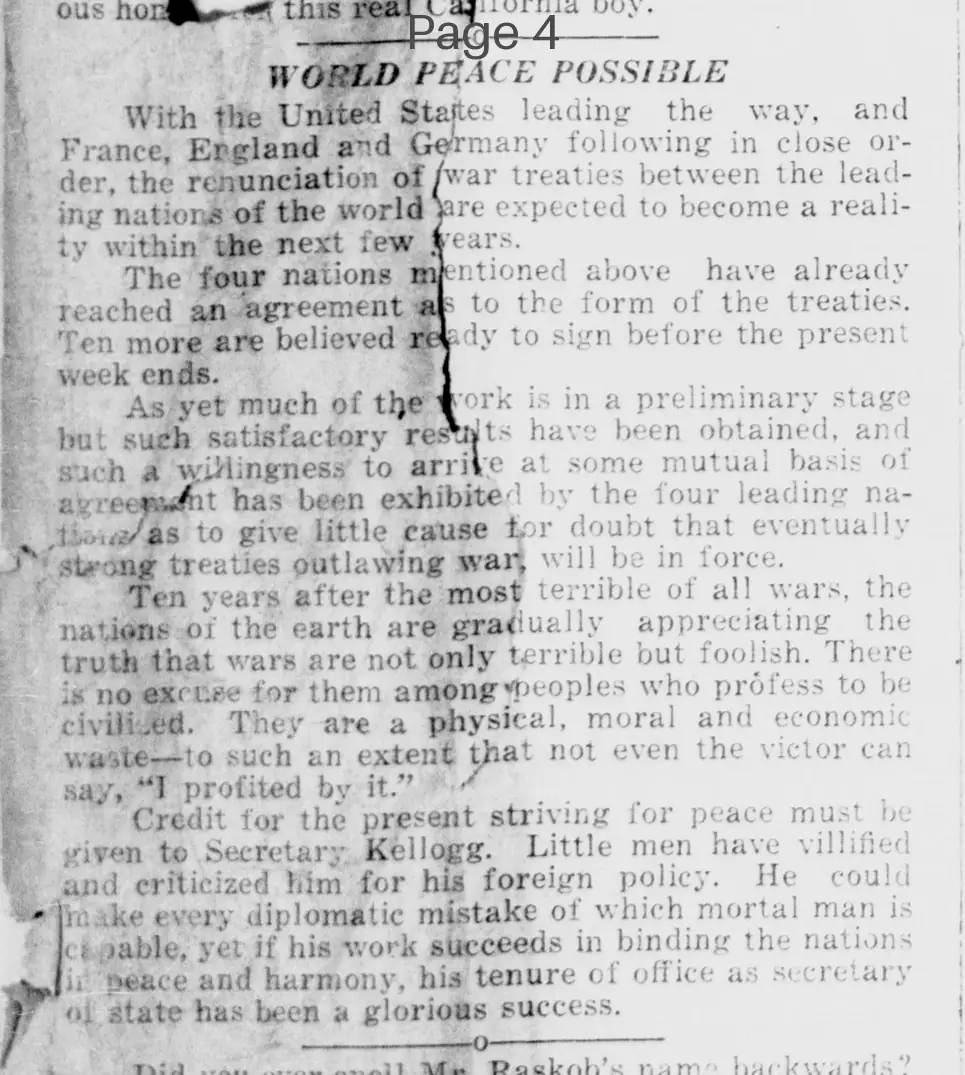
WORLD PEACE POSSIBLE
With the United States leading the way, and France, England and Germany following in close order, the renunciation of war treaties between the leading nations of the world are expected to become a reality within the next few years.
The four nations mentioned above have already reached an agreement as to the form of the treaties.
Ten more are believed ready to sign before the present week ends.
As yet much of the work is in a preliminary stage but such satisfactory results have been obtained, and such a willingness to arrive at some mutual basis of agreement has been exhibited by the four leading nations as to give little cause for doubt that eventually strong treaties outlawing war, will be in force.
Ten years after the most terrible of all wars, the nations of the earth are gradually appreciating the truth that wars are not only terrible but foolish. There is no excuse for them among peoples who profess to be civilized. They are a physical, moral and economic waste—to such an extent that not even the victor can say, I profited by it."
Credit for the present striving for peace must be given to Secretary Kellogg. Little men have villified and criticized him for his foreign policy. He could make every diplomatic mistake of which mortal man is capable, yet if his work succeeds in binding the nations in peace and harmony, his tenure of office as secretary of state has been a glorious success.
With the United States leading the way, and France, England and Germany following in close order, the renunciation of war treaties between the leading nations of the world are expected to become a reality within the next few years.
The four nations mentioned above have already reached an agreement as to the form of the treaties.
Ten more are believed ready to sign before the present week ends.
As yet much of the work is in a preliminary stage but such satisfactory results have been obtained, and such a willingness to arrive at some mutual basis of agreement has been exhibited by the four leading nations as to give little cause for doubt that eventually strong treaties outlawing war, will be in force.
Ten years after the most terrible of all wars, the nations of the earth are gradually appreciating the truth that wars are not only terrible but foolish. There is no excuse for them among peoples who profess to be civilized. They are a physical, moral and economic waste—to such an extent that not even the victor can say, I profited by it."
Credit for the present striving for peace must be given to Secretary Kellogg. Little men have villified and criticized him for his foreign policy. He could make every diplomatic mistake of which mortal man is capable, yet if his work succeeds in binding the nations in peace and harmony, his tenure of office as secretary of state has been a glorious success.
What sub-type of article is it?
War Or Peace
Foreign Affairs
What keywords are associated?
World Peace
War Renunciation
Peace Treaties
Kellogg
International Diplomacy
What entities or persons were involved?
United States
France
England
Germany
Secretary Kellogg
Editorial Details
Primary Topic
Renunciation Of War Treaties Among Leading Nations
Stance / Tone
Optimistic Support For International Peace
Key Figures
United States
France
England
Germany
Secretary Kellogg
Key Arguments
Leading Nations Expected To Sign War Renunciation Treaties Soon
Us Leading With France, England, Germany Following
Ten More Nations Ready To Sign This Week
Work In Preliminary Stage But Promising
Wars Are Terrible, Foolish, And Wasteful Even For Victors
Credit To Secretary Kellogg For Peace Efforts Despite Criticism