Thank you for visiting SNEWPapers!
Sign up free
Richmond Enquirer
Richmond, Richmond County, Virginia
What is this article about?
Narrative of Wm. Bartley's 1817 kidnapping from Newcastle County, Delaware, by Joshua Trusty and Absalom Caulk, who sold him into slavery in North Carolina. Bartley escaped, was acquitted in Virginia court, and returned home. Addresses Maryland legislature on man-stealing; a remedial bill is before the house.
Clipping
OCR Quality
Full Text
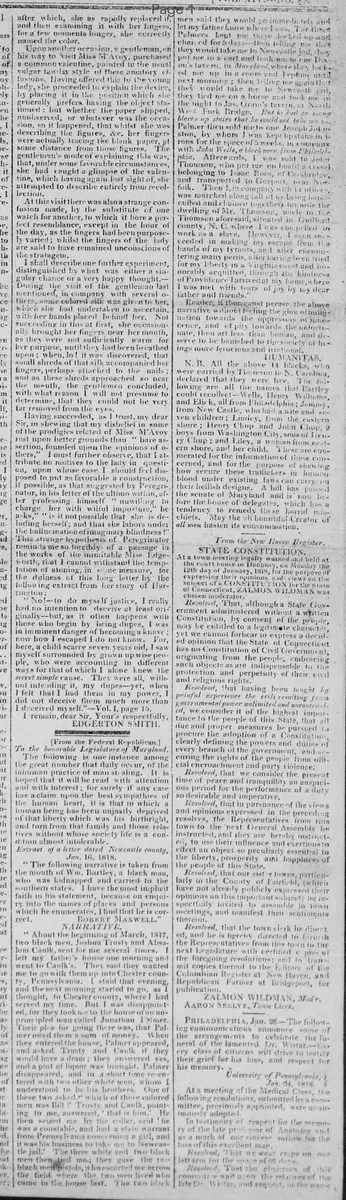
To the honorable Legislature of Maryland.
The following is one instance among the great number that daily occur, of the inhuman practice of man stealing. It is hoped that it will be read with attention and with interest; for surely if any case has a claim upon the best sympathies of the human heart, it is that in which a human being has been unjustly deprived of that liberty which was his birthright, and torn from that family and those relatives without whose society life is a condition almost intolerable.
Extract of a letter dated Newcastle county, Jan. 16, 1818.
"The following narrative is taken from the mouth of Wm. Bartley, a black man, who was kidnapped and carried to the southern states. I have the most implicit faith in his statement, because on enquiry into the names of places and persons which he enumerates, I find that he is correct.
ROBERT MAXWELL."
NARRATIVE.
"About the beginning of March, 1817, two black men, Joshua Trusty and Absalom Caulk, sent for me several times. I left my father's house one morning and went to Caulk's. They said they wanted me to go with them up into Chester county, Pennsylvania. I staid that evening, and the next morning started to go, as I thought, to Chester county, where I had served my time. But I was disappointed, for they took me to the house of an unprincipled man called Jonathan Palmer. Their object for going there was, that Palmer owed them a sum of money. When they entered the house, Palmer appeared, and asked Trusty and Caulk if they would have a dram; they answered yes, and a pint of liquor was brought. Palmer disappeared, and in a short time re-entered with two other white men, whom I understood to be his brothers. One of these two asked 'which of those colored men was Bill?' Trusty and Caulk, pointing to me, answered, 'that is him.' He then seized me by the collar, said 'he was a constable, and had a state warrant from Pennsylvania concerning a girl, and it was his business to take me to Newcastle jail.' The three white and two black men then tied me; they gave the two black men pistols, who escorted me across the field where the two men lived who came in the house last. The two black men said they would go immediately and let my father know where I was. The three Palmers kept me there locked up and chained for 5 days—then telling me that they would take me to Newcastle jail, they put me in a cart and took me to one Dixon's tavern, in Maryland, where they locked me up in a room and kept me until next morning: then telling me again that they would take me to Newcastle jail, they tied me on a horse and took me in the night to Jas. Graun's tavern, at North West Fork Bridge. But he had so many blacks up stairs that he could not take me. Palmer then sold me to one Joseph Johnston, by whom I was kept upstairs in irons for the space of 5 weeks, in company with John Wells, a black man, from Philadelphia. Afterwards, I was sold to John Thomson, who put me on board a vessel belonging to Isaac Ross, of Cambridge, and transported to Gosport, near Norfolk. Then I, in company with 13 others, (all of us being hand-cuffed and chained together) was marched along towards the dwelling of Mr. Thomson, late of the Thomson aforesaid, situated in Guilford county, N. C. where I was compelled to work as a slave. However, I soon succeeded in making my escape from the bands of my tyrants, and after encountering many perils, after having been tried for my liberty in a Virginia court and honorably acquitted, through the kindness of Providence I arrived at my home, where I was met with tears of joy by my dear father and friends."
Reader, if thou canst peruse the above narrative without feeling the glow of indignation towards the oppressors of innocence, and of pity towards the unfortunate, then art less than human, and deserve to be banished to the society of beings more ferocious and irrational.
HUMANITAS.
N. B. All the above 14 blacks, who were carried by Thomson to N. Carolina, declared that they were free. The following are all the names that Bartley could recollect—Wells, Henry Williams, and Ellick, all from Philadelphia: Jemmy, from New Castle, who had a wife and seven children; Lindey, from the eastern shore; Henry Chup and John Chup, 2 boys from Washington City, sons of Henry Chup: and Liley, a woman from eastern shore, and her child. These are enumerated for the information of those concerned, and for the purpose of showing how secure these traffickers in human blood under existing laws can carry on their hellish designs." A bill has passed the senate of Maryland and is now before the house of delegates, which has a tendency to remedy these horrid mischiefs. May the all bountiful Creator of all men hasten its consummation.
What sub-type of article is it?
What keywords are associated?
What entities or persons were involved?
Where did it happen?
Domestic News Details
Primary Location
Newcastle County
Event Date
About The Beginning Of March, 1817
Key Persons
Outcome
bartley escaped from slavery in guilford county, n. c., was tried for his liberty in a virginia court and honorably acquitted, and returned home. thirteen other free blacks were sold into slavery in n. carolina. a bill to remedy man-stealing has passed the maryland senate and is before the house.
Event Details
Wm. Bartley was lured from his father's house in Newcastle county by Joshua Trusty and Absalom Caulk, who took him to Jonathan Palmer's house. Palmer and his brothers seized Bartley under false pretense of a warrant, chained him for 5 days, then transported him to Maryland taverns, sold him to Joseph Johnston who held him in irons for 5 weeks with John Wells, then to John Thomson who shipped him via Isaac Ross's vessel to Gosport near Norfolk, and marched with 13 others to Thomson's in Guilford county, N. C., to work as a slave. All 14 declared they were free.