Thank you for visiting SNEWPapers!
Sign up free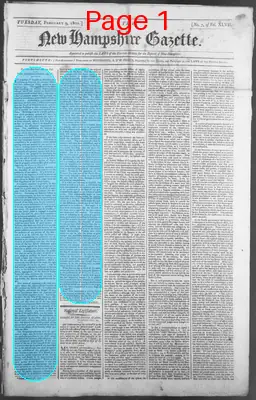
Editorial
February 9, 1802
The New Hampshire Gazette
Portsmouth, Rockingham County, New Hampshire
What is this article about?
This editorial opposes proposals to abolish the internal revenue (excise on distilled spirits), arguing it would impair public faith pledged to debt repayment and is unwise amid potential war with Barbary States. It criticizes the President's suggestion as reckless and damaging to national credit.
Clipping
OCR Quality
98%
Excellent
Full Text
From the New-York Evening Post.
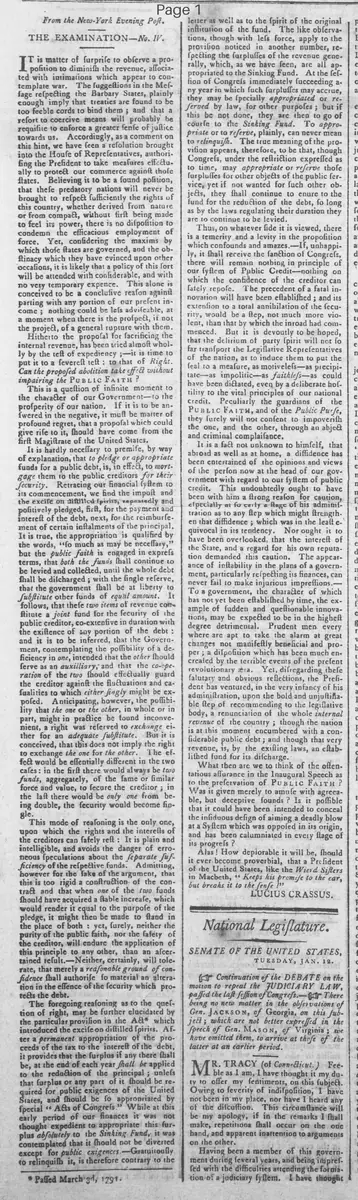
THE EXAMINATION-No. IV.
It is matter of surprise to observe a proposition to diminish the revenue, associated with intimations which appear to contemplate war. The suggestions in the Message respecting the Barbary States, plainly enough imply that treaties are found to be too feeble cords to bind them; and that a resort to coercive means will probably be requisite to enforce a greater sense of justice towards us. Accordingly, as a comment on this hint, we have seen a resolution brought into the House of Representatives, authorizing the President to take measures effectually to protect our commerce against those states. Believing it to be a sound position, that these predatory nations will never be brought to respect sufficiently the rights of this country, whether derived from nature or from compact, without first being made to feel its power, there is no disposition to condemn the efficacious employment of force. Yet, considering the maxims by which those states are governed, and the obstinacy which they have evinced upon other occasions, it is likely that a policy of this sort will be attended with considerable, and with no very temporary expense. This alone is conceived to be a conclusive reason against parting with any portion of our present income; nothing could be less advisable, at a moment when there is the prospect, if not the project, of a general rupture with them.
Hitherto the proposal for sacrificing the internal revenue, has been tried almost wholly by the test of expediency; it is time to put it to a severest test: to that of Right. Can the proposed abolition take effect without impairing the Public Faith?
This is a question of infinite moment to the character of our Government-to the prosperity of our nation. If it is to be answered in the negative, it must be matter of profound regret, that a proposal which could give rise to it, should have come from the first Magistrate of the United States.
It is hardly necessary to premise, by way of explanation, that to pledge or appropriate funds for a public debt, is, in effect, to mortgage them to the public creditors for their security. Retracing our financial system to its commencement, we find the impost and the excise on distilled spirits, repeatedly and positively pledged, first, for the payment and interest of the debt, next, for the reimbursement of certain installments of the principal. It is true, the appropriation is qualified by the words, "so much as may be necessary," but the public faith is engaged in express terms, that both the funds shall continue to be levied and collected, until the whole debt shall be discharged; with the single reserve, that the government shall be at liberty to substitute other funds of equal amount. It follows, that these two items of revenue constitute a joint fund for the security of the public creditor, co-extensive in duration with the existence of any portion of the debt: and it is to be inferred, that the Government, contemplating the possibility of a deficiency in one, intended that the other should serve as an auxiliary; and that the co-operation of the two should effectually guard the creditor against the fluctuations and casualties to which either singly might be exposed. Anticipating, however, the possibility that the one or the other, in whole or in part, might in practice be found inconvenient, a right was reserved to exchange either for an adequate substitute. But it is conceived, that this does not imply the right to exchange the one for the other. The effect would be essentially different in the two cases: in the first there would always be two funds, aggregately, of the same or similar force and value, to secure the creditor: in the last there would be only one from being double, the security would become single.
This mode of reasoning is the only one, upon which the rights and the interests of the creditors can safely rest: It is plain and intelligible, and avoids the danger of erroneous speculations about the separate sufficiency of the respective funds. Admitting, however for the sake of the argument, that this is too rigid a construction-of the contract and that when one of the two funds should have acquired a stable increase, which would render it equal to the purpose of the pledge, it might then be made to stand in the place of both: yet, surely, neither the purity of the public faith, nor the safety of the creditor, will endure the application of this principle to any other, than an ascertained result.-Neither, certainly, will tolerate, that merely a reasonable ground of confidence shall authorize so material an alteration in the essence of the security which protects the debt.
The foregoing reasoning as to the question of right, may be further elucidated by the particular provision in the Act* which introduced the excise on distilled spirits. After a permanent appropriation of the proceeds of the tax to the interest of the debt, it provides that the surplus if any there shall be, at the end of each year shall be applied to the reduction of the principal; unless that surplus or any part of it should be required for public exigencies of the United States, and should be so appropriated by special "Acts of Congress." While at this early period of our finances it was not thought expedient to appropriate this surplus absolutely to the Sinking Fund, it was contemplated that it should not be diverted except for public exigencies. -Gratuitously to relinquish it, is therefore contrary to the letter as well as to the spirit of the original institution of the fund. The like observations, though with less force, apply to the provision noticed in another number, respecting the surpluses of the revenue generally, which, as we have seen, are all appropriated to the Sinking Fund. At the session of Congress immediately succeeding any year in which such surpluses may accrue, they may be specially appropriated or reserved by law, for other purposes; but if this be not done, they are then to go of course to the Sinking Fund. To appropriate or to reserve, plainly, can never mean to relinquish. The true meaning of the provision appears, therefore, to be that, though Congress, under the restriction expressed as to time, may appropriate or reserve those surpluses for other objects of the public service, yet if not wanted for such other objects, they shall continue to enure to the fund for the reduction of the debt, so long as by the laws regulating their duration they are to continue to be levied.
Thus, on whatever side it is viewed, there is a temerity and a levity in the proposition which confounds and amazes.--If, unfortunately, it shall receive the sanction of Congress, there will remain nothing in principle of our system of Public Credit-nothing on which the confidence of the creditor can safely repose. The precedent of a fatal innovation will have been established: and its extension to a total annihilation of the security, would be a step, not much more violent, than that by which the inroad had commenced. But it is devoutly to be hoped, that the delirium of party spirit will not so far transport the Legislative Representatives of the nation, as to induce them to put the seal to a measure, as motiveless-as precipitate-as impolitic-as faithless-as could have been dictated, even by a deliberate hostility to the vital principles of our national credit. Peculiarly the guardians of the Public Faith, and of the Public Purse, they surely will not consent to impoverish the one, and the other, through an abject and criminal complaisance.
It is a fact not unknown to himself. that abroad as well as at home, a diffidence has been entertained of the opinions and views of the person now at the head of our government with regard to our system of public credit. This undoubtedly ought to have been with him a strong reason for caution, especially at so early a stage of his administration as to any step which might strengthen that diffidence; which was in the least equivocal in its tendency. Nor ought it to have been overlooked. that the interest of the State, and a regard for his own reputation demanded this caution. The appearance of instability in the plans of a government, particularly respecting its finances, can never fail to make injurious impressions.- To a government, the character of which has not yet been established by time, the example of sudden and questionable innovations, may be expected to be in the highest degree detrimental. Prudent men everywhere are apt to take the alarm at great changes not manifestly beneficial and proper; a disposition which has been much increased by the terrible events of the present revolutionary era. Yet, disregarding these salutary and obvious reflections, the President has ventured, in the very infancy of his administration, upon the bold and unjustifiable step of recommending to the legislative body, a renunciation of the whole internal revenue of the country; though the nation is at this moment encumbered with a considerable public debt; and though that very revenue, is, by the existing laws, an established fund for its discharge.
What then are we to think of the ostentatious assurance in the Inaugural Speech as to the preservation of Public Faith? Was it given merely to amuse with agreeable, but deceptive sounds? Is it possible that it could have been intended to conceal the insidious design of aiming a deadly blow at a System which was opposed in its origin, and has been calumniated in every stage of its progress?
Alas! How deplorable it will be, should it ever become proverbial, that a President of the United States, like the Weird Sisters in Macbeth, "Keeps his promise to the ear, but breaks it to the sense!"
LUCIUS CRASSUS.
* Passed March 3d, 1791.
THE EXAMINATION-No. IV.
It is matter of surprise to observe a proposition to diminish the revenue, associated with intimations which appear to contemplate war. The suggestions in the Message respecting the Barbary States, plainly enough imply that treaties are found to be too feeble cords to bind them; and that a resort to coercive means will probably be requisite to enforce a greater sense of justice towards us. Accordingly, as a comment on this hint, we have seen a resolution brought into the House of Representatives, authorizing the President to take measures effectually to protect our commerce against those states. Believing it to be a sound position, that these predatory nations will never be brought to respect sufficiently the rights of this country, whether derived from nature or from compact, without first being made to feel its power, there is no disposition to condemn the efficacious employment of force. Yet, considering the maxims by which those states are governed, and the obstinacy which they have evinced upon other occasions, it is likely that a policy of this sort will be attended with considerable, and with no very temporary expense. This alone is conceived to be a conclusive reason against parting with any portion of our present income; nothing could be less advisable, at a moment when there is the prospect, if not the project, of a general rupture with them.
Hitherto the proposal for sacrificing the internal revenue, has been tried almost wholly by the test of expediency; it is time to put it to a severest test: to that of Right. Can the proposed abolition take effect without impairing the Public Faith?
This is a question of infinite moment to the character of our Government-to the prosperity of our nation. If it is to be answered in the negative, it must be matter of profound regret, that a proposal which could give rise to it, should have come from the first Magistrate of the United States.
It is hardly necessary to premise, by way of explanation, that to pledge or appropriate funds for a public debt, is, in effect, to mortgage them to the public creditors for their security. Retracing our financial system to its commencement, we find the impost and the excise on distilled spirits, repeatedly and positively pledged, first, for the payment and interest of the debt, next, for the reimbursement of certain installments of the principal. It is true, the appropriation is qualified by the words, "so much as may be necessary," but the public faith is engaged in express terms, that both the funds shall continue to be levied and collected, until the whole debt shall be discharged; with the single reserve, that the government shall be at liberty to substitute other funds of equal amount. It follows, that these two items of revenue constitute a joint fund for the security of the public creditor, co-extensive in duration with the existence of any portion of the debt: and it is to be inferred, that the Government, contemplating the possibility of a deficiency in one, intended that the other should serve as an auxiliary; and that the co-operation of the two should effectually guard the creditor against the fluctuations and casualties to which either singly might be exposed. Anticipating, however, the possibility that the one or the other, in whole or in part, might in practice be found inconvenient, a right was reserved to exchange either for an adequate substitute. But it is conceived, that this does not imply the right to exchange the one for the other. The effect would be essentially different in the two cases: in the first there would always be two funds, aggregately, of the same or similar force and value, to secure the creditor: in the last there would be only one from being double, the security would become single.
This mode of reasoning is the only one, upon which the rights and the interests of the creditors can safely rest: It is plain and intelligible, and avoids the danger of erroneous speculations about the separate sufficiency of the respective funds. Admitting, however for the sake of the argument, that this is too rigid a construction-of the contract and that when one of the two funds should have acquired a stable increase, which would render it equal to the purpose of the pledge, it might then be made to stand in the place of both: yet, surely, neither the purity of the public faith, nor the safety of the creditor, will endure the application of this principle to any other, than an ascertained result.-Neither, certainly, will tolerate, that merely a reasonable ground of confidence shall authorize so material an alteration in the essence of the security which protects the debt.
The foregoing reasoning as to the question of right, may be further elucidated by the particular provision in the Act* which introduced the excise on distilled spirits. After a permanent appropriation of the proceeds of the tax to the interest of the debt, it provides that the surplus if any there shall be, at the end of each year shall be applied to the reduction of the principal; unless that surplus or any part of it should be required for public exigencies of the United States, and should be so appropriated by special "Acts of Congress." While at this early period of our finances it was not thought expedient to appropriate this surplus absolutely to the Sinking Fund, it was contemplated that it should not be diverted except for public exigencies. -Gratuitously to relinquish it, is therefore contrary to the letter as well as to the spirit of the original institution of the fund. The like observations, though with less force, apply to the provision noticed in another number, respecting the surpluses of the revenue generally, which, as we have seen, are all appropriated to the Sinking Fund. At the session of Congress immediately succeeding any year in which such surpluses may accrue, they may be specially appropriated or reserved by law, for other purposes; but if this be not done, they are then to go of course to the Sinking Fund. To appropriate or to reserve, plainly, can never mean to relinquish. The true meaning of the provision appears, therefore, to be that, though Congress, under the restriction expressed as to time, may appropriate or reserve those surpluses for other objects of the public service, yet if not wanted for such other objects, they shall continue to enure to the fund for the reduction of the debt, so long as by the laws regulating their duration they are to continue to be levied.
Thus, on whatever side it is viewed, there is a temerity and a levity in the proposition which confounds and amazes.--If, unfortunately, it shall receive the sanction of Congress, there will remain nothing in principle of our system of Public Credit-nothing on which the confidence of the creditor can safely repose. The precedent of a fatal innovation will have been established: and its extension to a total annihilation of the security, would be a step, not much more violent, than that by which the inroad had commenced. But it is devoutly to be hoped, that the delirium of party spirit will not so far transport the Legislative Representatives of the nation, as to induce them to put the seal to a measure, as motiveless-as precipitate-as impolitic-as faithless-as could have been dictated, even by a deliberate hostility to the vital principles of our national credit. Peculiarly the guardians of the Public Faith, and of the Public Purse, they surely will not consent to impoverish the one, and the other, through an abject and criminal complaisance.
It is a fact not unknown to himself. that abroad as well as at home, a diffidence has been entertained of the opinions and views of the person now at the head of our government with regard to our system of public credit. This undoubtedly ought to have been with him a strong reason for caution, especially at so early a stage of his administration as to any step which might strengthen that diffidence; which was in the least equivocal in its tendency. Nor ought it to have been overlooked. that the interest of the State, and a regard for his own reputation demanded this caution. The appearance of instability in the plans of a government, particularly respecting its finances, can never fail to make injurious impressions.- To a government, the character of which has not yet been established by time, the example of sudden and questionable innovations, may be expected to be in the highest degree detrimental. Prudent men everywhere are apt to take the alarm at great changes not manifestly beneficial and proper; a disposition which has been much increased by the terrible events of the present revolutionary era. Yet, disregarding these salutary and obvious reflections, the President has ventured, in the very infancy of his administration, upon the bold and unjustifiable step of recommending to the legislative body, a renunciation of the whole internal revenue of the country; though the nation is at this moment encumbered with a considerable public debt; and though that very revenue, is, by the existing laws, an established fund for its discharge.
What then are we to think of the ostentatious assurance in the Inaugural Speech as to the preservation of Public Faith? Was it given merely to amuse with agreeable, but deceptive sounds? Is it possible that it could have been intended to conceal the insidious design of aiming a deadly blow at a System which was opposed in its origin, and has been calumniated in every stage of its progress?
Alas! How deplorable it will be, should it ever become proverbial, that a President of the United States, like the Weird Sisters in Macbeth, "Keeps his promise to the ear, but breaks it to the sense!"
LUCIUS CRASSUS.
* Passed March 3d, 1791.
What sub-type of article is it?
Economic Policy
Foreign Affairs
Constitutional
What keywords are associated?
Internal Revenue
Public Faith
Excise Tax
Public Debt
Barbary States
National Credit
Revenue Abolition
What entities or persons were involved?
President Of The United States
Barbary States
Public Creditors
Congress
House Of Representatives
Lucius Crassus
Editorial Details
Primary Topic
Opposition To Abolishing Internal Revenue Amid Barbary Threats And Public Debt Obligations
Stance / Tone
Strongly Critical Of President's Revenue Reduction Proposal As Faithless And Imprudent
Key Figures
President Of The United States
Barbary States
Public Creditors
Congress
House Of Representatives
Lucius Crassus
Key Arguments
Diminishing Revenue Is Unwise With Potential War Against Barbary States Requiring Expense.
Abolishing Excise Impairs Public Faith Pledged To Debt Repayment Via Impost And Excise As Joint Funds.
Substitution Of One Fund For Another Reduces Security From Double To Single.
Surpluses From Excise Are For Debt Reduction Unless Needed For Exigencies By Special Acts.
President's Proposal Shows Instability, Damaging National Credit And Reputation.
Inaugural Assurances On Public Faith Contradict The Revenue Renunciation Suggestion.