Thank you for visiting SNEWPapers!
Sign up free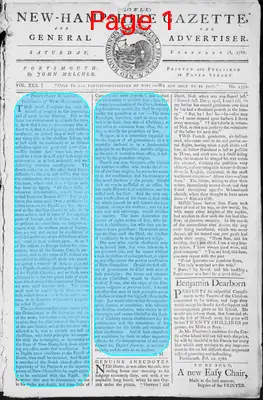
Editorial
February 18, 1786
Fowle's New Hampshire Gazette And General Advertiser
Portsmouth, Rockingham County, New Hampshire
What is this article about?
This editorial interprets the term 'Protestant' in the New-Hampshire constitution as excluding from public office sects like Papists or those prioritizing foreign religious authority over state sovereignty, while protecting all Christians under law. It condemns Deists and non-Christians from holding office, viewing them as threats to the republic's Christian foundations.
Clipping
OCR Quality
98%
Excellent
Full Text
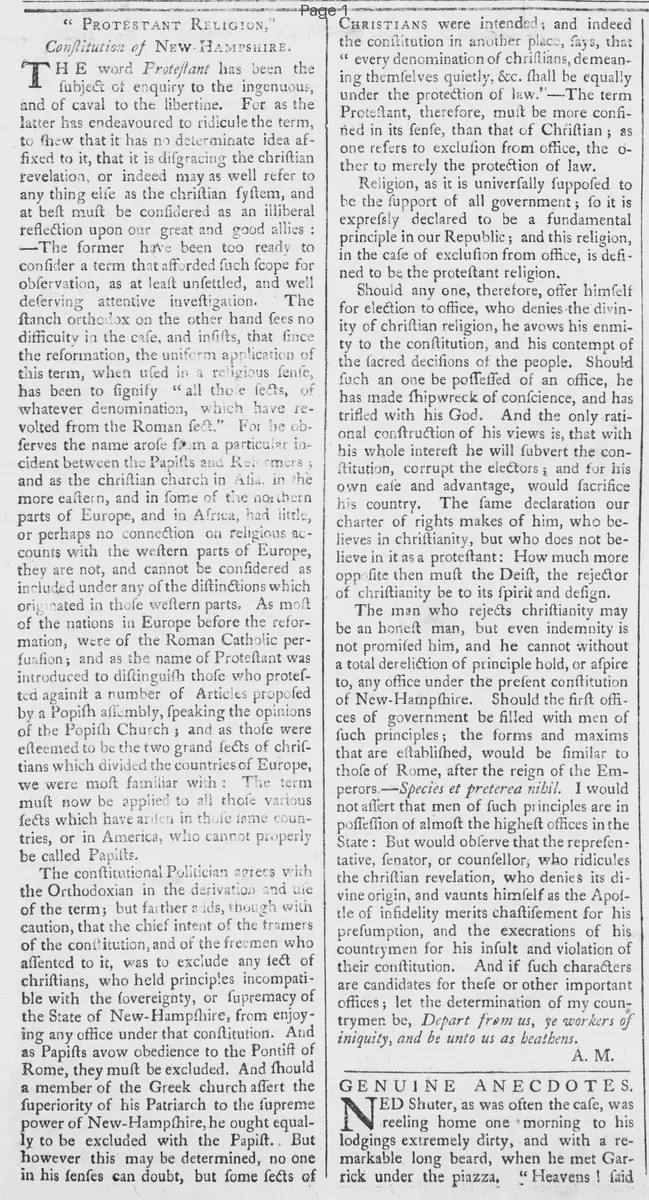
PROTESTANT RELIGION,
Constitution of New-Hampshire:
The word Protestant has been the subject of enquiry to the ingenuous, and of cavil to the libertine. For as the latter has endeavoured to ridicule the term, to shew that it has no determinate idea affixed to it, that it is disgracing the christian revelation, or indeed may as well refer to any thing else as the christian system, and at best must be considered as an illiberal reflection upon our great and good allies: The former have been too ready to consider a term that afforded such scope for observation, as at least unsettled, and well deserving attentive investigation. The staunch orthodox on the other hand sees no difficulty in the case, and insists, that since the reformation, the uniform application of this term, when used in a religious sense, has been to signify "all those sects, of whatever denomination, which have revolted from the Roman sect." For he observes the name arose from a particular incident between the Papists and Reformers; and as the christian church in Asia, in the more eastern, and in some of the northern parts of Europe, and in Africa, had little, or perhaps no connection on religious accounts with the western parts of Europe, they are not, and cannot be considered as included under any of the distinctions which originated in those western parts. As most of the nations in Europe before the reformation, were of the Roman Catholic persuasion; and as the name of Protestant was introduced to distinguish those who protested against a number of Articles proposed by a Popish assembly, speaking the opinions of the Popish Church; and as those were esteemed to be the two grand sects of christians which divided the countries of Europe, we were most familiar with: The term must now be applied to all those various sects which have arisen in those same countries, or in America, who cannot properly be called Papists.
The constitutional Politician agrees with the Orthodoxian in the derivation and use of the term; but farther adds, though with caution, that the chief intent of the framers of the constitution, and of the freemen who assented to it, was to exclude any sect of christians, who held principles incompatible with the sovereignty, or supremacy of the State of New-Hampshire, from enjoying any office under that constitution. And as Papists avow obedience to the Pontiff of Rome, they must be excluded. And should a member of the Greek church assert the superiority of his Patriarch to the supreme power of New-Hampshire, he ought equally to be excluded with the Papist. But however this may be determined, no one in his senses can doubt, but some sects of CHRISTIANS were intended: and indeed the constitution in another place, says, that every denomination of christians, demeaning themselves quietly, &c. shall be equally under the protection of law.--The term Protestant, therefore, must be more confined in its sense, than that of Christian; as one refers to exclusion from office, the other to merely the protection of law.
Religion, as it is universally supposed to be the support of all government; so it is expressly declared to be a fundamental principle in our Republic; and this religion, in the case of exclusion from office, is defined to be the protestant religion. Should any one, therefore, offer himself for election to office, who denies the divinity of christian religion, he avows his enmity to the constitution, and his contempt of the sacred decisions of the people. Should such an one be possessed of an office, he has made shipwreck of conscience, and has trifled with his God. And the only rational construction of his views is, that with his whole interest he will subvert the constitution, corrupt the electors; and for his own ease and advantage, would sacrifice his country. The same declaration our charter of rights makes of him, who believes in christianity, but who does not believe in it as a protestant: How much more opposite then must the Deist, the rejector of christianity be to its spirit and design. The man who rejects christianity may be an honest man, but even indemnity is not promised him, and he cannot without a total dereliction of principle hold, or aspire to, any office under the present constitution of New-Hampshire. Should the first offices of government be filled with men of such principles; the forms and maxims that are established, would be similar to those of Rome, after the reign of the Emperors.--Species et preterea nihil. I would not assert that men of such principles are in possession of almost the highest offices in the State: But would observe that the representative, senator, or counsellor; who ridicules the christian revelation, who denies its divine origin, and vaunts himself as the Apostle of infidelity merits chastisement for his presumption, and the execrations of his countrymen for his insult and violation of their constitution. And if such characters are candidates for these or other important offices; let the determination of my countrymen be, Depart from us, ye workers of iniquity, and be unto us as heathens,
A. M.
Constitution of New-Hampshire:
The word Protestant has been the subject of enquiry to the ingenuous, and of cavil to the libertine. For as the latter has endeavoured to ridicule the term, to shew that it has no determinate idea affixed to it, that it is disgracing the christian revelation, or indeed may as well refer to any thing else as the christian system, and at best must be considered as an illiberal reflection upon our great and good allies: The former have been too ready to consider a term that afforded such scope for observation, as at least unsettled, and well deserving attentive investigation. The staunch orthodox on the other hand sees no difficulty in the case, and insists, that since the reformation, the uniform application of this term, when used in a religious sense, has been to signify "all those sects, of whatever denomination, which have revolted from the Roman sect." For he observes the name arose from a particular incident between the Papists and Reformers; and as the christian church in Asia, in the more eastern, and in some of the northern parts of Europe, and in Africa, had little, or perhaps no connection on religious accounts with the western parts of Europe, they are not, and cannot be considered as included under any of the distinctions which originated in those western parts. As most of the nations in Europe before the reformation, were of the Roman Catholic persuasion; and as the name of Protestant was introduced to distinguish those who protested against a number of Articles proposed by a Popish assembly, speaking the opinions of the Popish Church; and as those were esteemed to be the two grand sects of christians which divided the countries of Europe, we were most familiar with: The term must now be applied to all those various sects which have arisen in those same countries, or in America, who cannot properly be called Papists.
The constitutional Politician agrees with the Orthodoxian in the derivation and use of the term; but farther adds, though with caution, that the chief intent of the framers of the constitution, and of the freemen who assented to it, was to exclude any sect of christians, who held principles incompatible with the sovereignty, or supremacy of the State of New-Hampshire, from enjoying any office under that constitution. And as Papists avow obedience to the Pontiff of Rome, they must be excluded. And should a member of the Greek church assert the superiority of his Patriarch to the supreme power of New-Hampshire, he ought equally to be excluded with the Papist. But however this may be determined, no one in his senses can doubt, but some sects of CHRISTIANS were intended: and indeed the constitution in another place, says, that every denomination of christians, demeaning themselves quietly, &c. shall be equally under the protection of law.--The term Protestant, therefore, must be more confined in its sense, than that of Christian; as one refers to exclusion from office, the other to merely the protection of law.
Religion, as it is universally supposed to be the support of all government; so it is expressly declared to be a fundamental principle in our Republic; and this religion, in the case of exclusion from office, is defined to be the protestant religion. Should any one, therefore, offer himself for election to office, who denies the divinity of christian religion, he avows his enmity to the constitution, and his contempt of the sacred decisions of the people. Should such an one be possessed of an office, he has made shipwreck of conscience, and has trifled with his God. And the only rational construction of his views is, that with his whole interest he will subvert the constitution, corrupt the electors; and for his own ease and advantage, would sacrifice his country. The same declaration our charter of rights makes of him, who believes in christianity, but who does not believe in it as a protestant: How much more opposite then must the Deist, the rejector of christianity be to its spirit and design. The man who rejects christianity may be an honest man, but even indemnity is not promised him, and he cannot without a total dereliction of principle hold, or aspire to, any office under the present constitution of New-Hampshire. Should the first offices of government be filled with men of such principles; the forms and maxims that are established, would be similar to those of Rome, after the reign of the Emperors.--Species et preterea nihil. I would not assert that men of such principles are in possession of almost the highest offices in the State: But would observe that the representative, senator, or counsellor; who ridicules the christian revelation, who denies its divine origin, and vaunts himself as the Apostle of infidelity merits chastisement for his presumption, and the execrations of his countrymen for his insult and violation of their constitution. And if such characters are candidates for these or other important offices; let the determination of my countrymen be, Depart from us, ye workers of iniquity, and be unto us as heathens,
A. M.
What sub-type of article is it?
Constitutional
Moral Or Religious
What keywords are associated?
Protestant Religion
New Hampshire Constitution
Office Exclusion
Papists
Deists
Christian Sects
State Sovereignty
Religious Orthodoxy
What entities or persons were involved?
Constitution Of New Hampshire
Papists
Pontiff Of Rome
Greek Church
Deists
Orthodoxian
Constitutional Politician
Editorial Details
Primary Topic
Interpretation Of Protestant Religion In New Hampshire Constitution For Office Eligibility
Stance / Tone
Orthodox Defense Of Excluding Non Protestants And Deists From Public Office
Key Figures
Constitution Of New Hampshire
Papists
Pontiff Of Rome
Greek Church
Deists
Orthodoxian
Constitutional Politician
Key Arguments
Protestant Refers To Sects Revolted From Roman Catholicism Since The Reformation
Constitution Excludes Sects Incompatible With State Sovereignty, Like Papists Owing Allegiance To Rome
Protestant Is Narrower Than Christian: Excludes From Office But Protects All Christians Under Law
Denying Divinity Of Christianity Shows Enmity To Constitution And Threat To Republic
Deists And Non Christians Cannot Hold Office Without Violating Principles
Such Officials Would Subvert Government Like Post Emperor Rome
Ridicule Candidates Who Deny Christian Revelation; Treat As Heathens