Thank you for visiting SNEWPapers!
Sign up free
Story
December 8, 1859
The Penny Press
Cincinnati, Hamilton County, Ohio
What is this article about?
John Brown's final conversations in Charlestown jail: with John Moore on slavery and his elderly slave; with jailer on disposing of his body by cremation and urn; and expressing cheerfulness before execution on Dec. 2, 1859.
Clipping
OCR Quality
95%
Excellent
Full Text
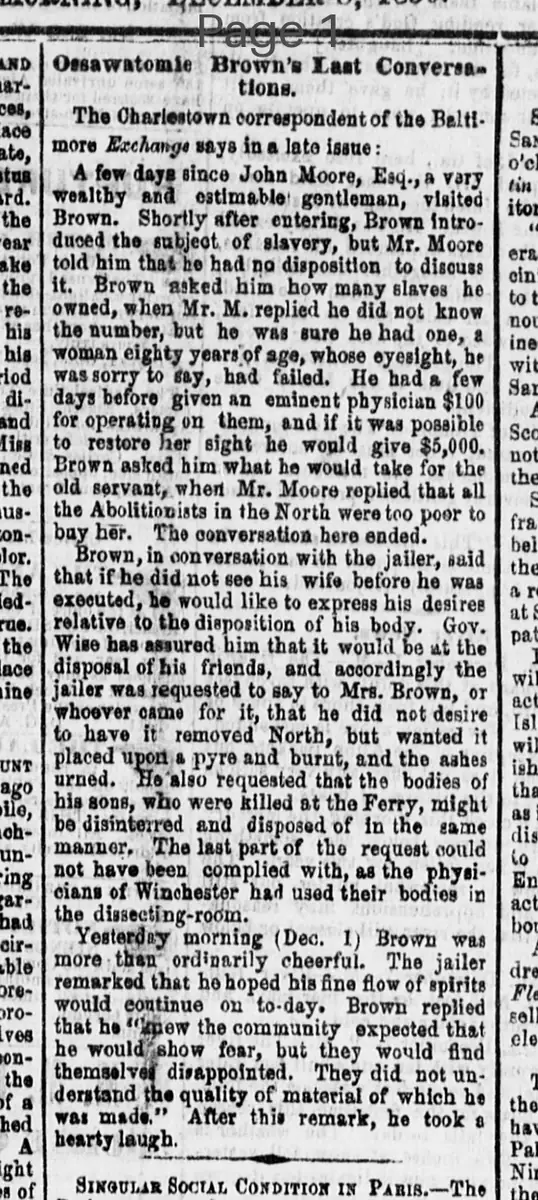
Osawatomie Brown's Last Conversations.
The Charlestown correspondent of the Baltimore Exchange says in a late issue:
A few days since John Moore, Esq., a very wealthy and estimable gentleman, visited Brown. Shortly after entering, Brown introduced the subject of slavery, but Mr. Moore told him that he had no disposition to discuss it. Brown asked him how many slaves he owned, when Mr. M. replied he did not know the number, but he was sure he had one, a woman eighty years of age, whose eyesight, he was sorry to say, had failed. He had a few days before given an eminent physician $100 for operating on them, and if it was possible to restore her sight he would give $5,000. Brown asked him what he would take for the old servant, when Mr. Moore replied that all the Abolitionists in the North were too poor to buy her. The conversation here ended.
Brown, in conversation with the jailer, said that if he did not see his wife before he was executed, he would like to express his desires relative to the disposition of his body. Gov. Wise has assured him that it would be at the disposal of his friends, and accordingly the jailer was requested to say to Mrs. Brown, or whoever came for it, that he did not desire to have it removed North, but wanted it placed upon a pyre and burnt, and the ashes urned. He also requested that the bodies of his sons, who were killed at the Ferry, might be disinterred and disposed of in the same manner. The last part of the request could not have been complied with, as the physicians of Winchester had used their bodies in the dissecting-room.
Yesterday morning (Dec. 1) Brown was more than ordinarily cheerful. The jailer remarked that he hoped his fine flow of spirits would continue on to-day. Brown replied that he "knew the community expected that he would show fear, but they would find themselves disappointed. They did not understand the quality of material of which he was made." After this remark, he took a hearty laugh.
The Charlestown correspondent of the Baltimore Exchange says in a late issue:
A few days since John Moore, Esq., a very wealthy and estimable gentleman, visited Brown. Shortly after entering, Brown introduced the subject of slavery, but Mr. Moore told him that he had no disposition to discuss it. Brown asked him how many slaves he owned, when Mr. M. replied he did not know the number, but he was sure he had one, a woman eighty years of age, whose eyesight, he was sorry to say, had failed. He had a few days before given an eminent physician $100 for operating on them, and if it was possible to restore her sight he would give $5,000. Brown asked him what he would take for the old servant, when Mr. Moore replied that all the Abolitionists in the North were too poor to buy her. The conversation here ended.
Brown, in conversation with the jailer, said that if he did not see his wife before he was executed, he would like to express his desires relative to the disposition of his body. Gov. Wise has assured him that it would be at the disposal of his friends, and accordingly the jailer was requested to say to Mrs. Brown, or whoever came for it, that he did not desire to have it removed North, but wanted it placed upon a pyre and burnt, and the ashes urned. He also requested that the bodies of his sons, who were killed at the Ferry, might be disinterred and disposed of in the same manner. The last part of the request could not have been complied with, as the physicians of Winchester had used their bodies in the dissecting-room.
Yesterday morning (Dec. 1) Brown was more than ordinarily cheerful. The jailer remarked that he hoped his fine flow of spirits would continue on to-day. Brown replied that he "knew the community expected that he would show fear, but they would find themselves disappointed. They did not understand the quality of material of which he was made." After this remark, he took a hearty laugh.
What sub-type of article is it?
Biography
Historical Event
What themes does it cover?
Bravery Heroism
Moral Virtue
What keywords are associated?
John Brown
Abolitionist
Slavery
Execution
Body Disposition
Charlestown Jail
What entities or persons were involved?
Osawatomie Brown
John Moore
Jailer
Gov. Wise
Mrs. Brown
Where did it happen?
Charlestown
Story Details
Key Persons
Osawatomie Brown
John Moore
Jailer
Gov. Wise
Mrs. Brown
Location
Charlestown
Event Date
Dec. 1
Story Details
John Brown discusses slavery with visitor John Moore, requests cremation of his body and sons' bodies in conversation with jailer, and expresses cheerful defiance of expected fear before execution.