Thank you for visiting SNEWPapers!
Sign up free
Story
September 20, 1954
Trainman News
Indianapolis, Marion County, Indiana
What is this article about?
Article discusses peacetime benefits of atomic science in agriculture, including fertilizer efficiency, plant mutation for disease resistance, animal nutrition studies, and food preservation through radiation, with examples from 1952-1953 experiments.
Clipping
OCR Quality
99%
Excellent
Full Text
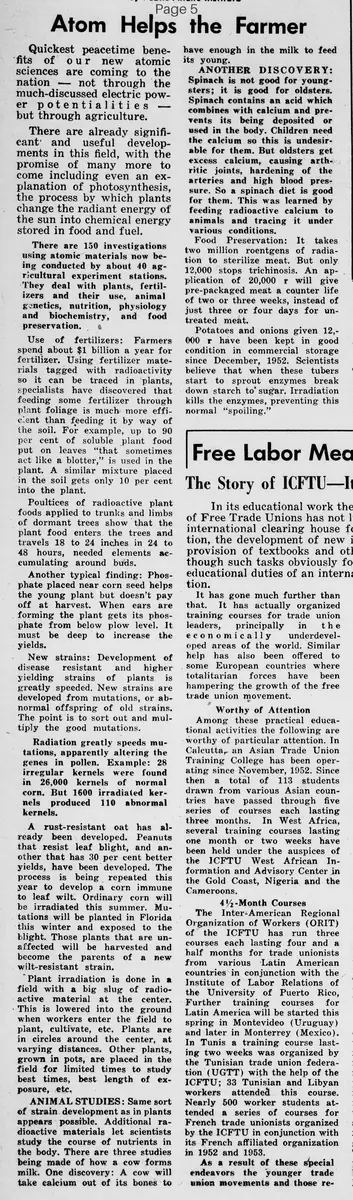
Atom Helps the Farmer
Quickest peacetime benefits of our new atomic sciences are coming to the nation -- not through the much-discussed electric power potentialities but through agriculture.
There are already significant and useful developments in this field, with the promise of many more to come including even an explanation of photosynthesis, the process by which plants change the radiant energy of the sun into chemical energy stored in food and fuel.
There are 150 investigations using atomic materials now being conducted by about 40 agricultural experiment stations. They deal with plants, fertilizers and their use, animal genetics, nutrition, physiology and biochemistry, and food preservation.
Use of fertilizers: Farmers spend about $1 billion a year for fertilizer. Using fertilizer materials tagged with radioactivity so it can be traced in plants, specialists have discovered that feeding some fertilizer through plant foliage is much more efficient than feeding it by way of the soil. For example, up to 90 per cent of soluble plant food put on leaves that sometimes act like a blotter, is used in the plant. A similar mixture placed in the soil gets only 10 per cent into the plant.
Poultices of radioactive plant foods applied to trunks and limbs of dormant trees show that the plant food enters the trees and travels 18 to 24 inches in 24 to 48 hours, needed elements accumulating around buds.
Another typical finding: Phosphate placed near corn seed helps the young plant but doesn't pay off at harvest. When ears are forming the plant gets its phosphate from below plow level. It must be deep to increase the yields.
New strains: Development of disease resistant and higher yielding strains of plants is greatly speeded. New strains are developed from mutations, or abnormal offspring of old strains. The point is to sort out and multiply the good mutations.
Radiation greatly speeds mutations, apparently altering the genes in pollen. Example: 28 irregular kernels were found in 26,000 kernels of normal corn. But 1600 irradiated kernels produced 110 abnormal kernels.
A rust-resistant oat has already been developed. Peanuts that resist leaf blight, and another that has 30 per cent better yields, have been developed. The process is being repeated this year to develop a corn immune to leaf wilt. Ordinary corn will be irradiated this summer. Mutations will be planted in Florida this winter and exposed to the blight. Those plants that are unaffected will be harvested and become the parents of a new wilt-resistant strain.
Plant irradiation is done in a field with a big slug of radioactive material at the center. This is lowered into the ground when workers enter the field to plant, cultivate, etc. Plants are in circles around the center at varying distances. Other plants, grown in pots, are placed in the field for limited times to study best times, best length of exposure, etc.
ANIMAL STUDIES: Same sort of strain development as in plants appears possible. Additional radioactive materials let scientists study the course of nutrients in the body. There are three studies being made of how a cow forms milk. One discovery: A cow will take calcium out of its bones to have enough in the milk to feed its young.
ANOTHER DISCOVERY: Spinach is not good for youngsters; it is good for oldsters. Spinach contains an acid which combines with calcium and prevents its being deposited or used in the body. Children need the calcium so this is undesirable for them. But oldsters get excess calcium, causing arthritic joints, hardening of the arteries and high blood pressure. So a spinach diet is good for them. This was learned by feeding radioactive calcium to animals and tracing it under various conditions.
Food Preservation: It takes two million roentgens of radiation to sterilize meat. But only 12,000 stops trichinosis. An application of 20,000 r will give pre-packaged meat a counter life of two or three weeks, instead of just three or four days for untreated meat.
Potatoes and onions given 12,000 r have been kept in good condition in commercial storage since December 1952. Scientists believe that when these tubers start to sprout enzymes break down starch to sugar. Irradiation kills the enzymes, preventing this normal spoiling.
Quickest peacetime benefits of our new atomic sciences are coming to the nation -- not through the much-discussed electric power potentialities but through agriculture.
There are already significant and useful developments in this field, with the promise of many more to come including even an explanation of photosynthesis, the process by which plants change the radiant energy of the sun into chemical energy stored in food and fuel.
There are 150 investigations using atomic materials now being conducted by about 40 agricultural experiment stations. They deal with plants, fertilizers and their use, animal genetics, nutrition, physiology and biochemistry, and food preservation.
Use of fertilizers: Farmers spend about $1 billion a year for fertilizer. Using fertilizer materials tagged with radioactivity so it can be traced in plants, specialists have discovered that feeding some fertilizer through plant foliage is much more efficient than feeding it by way of the soil. For example, up to 90 per cent of soluble plant food put on leaves that sometimes act like a blotter, is used in the plant. A similar mixture placed in the soil gets only 10 per cent into the plant.
Poultices of radioactive plant foods applied to trunks and limbs of dormant trees show that the plant food enters the trees and travels 18 to 24 inches in 24 to 48 hours, needed elements accumulating around buds.
Another typical finding: Phosphate placed near corn seed helps the young plant but doesn't pay off at harvest. When ears are forming the plant gets its phosphate from below plow level. It must be deep to increase the yields.
New strains: Development of disease resistant and higher yielding strains of plants is greatly speeded. New strains are developed from mutations, or abnormal offspring of old strains. The point is to sort out and multiply the good mutations.
Radiation greatly speeds mutations, apparently altering the genes in pollen. Example: 28 irregular kernels were found in 26,000 kernels of normal corn. But 1600 irradiated kernels produced 110 abnormal kernels.
A rust-resistant oat has already been developed. Peanuts that resist leaf blight, and another that has 30 per cent better yields, have been developed. The process is being repeated this year to develop a corn immune to leaf wilt. Ordinary corn will be irradiated this summer. Mutations will be planted in Florida this winter and exposed to the blight. Those plants that are unaffected will be harvested and become the parents of a new wilt-resistant strain.
Plant irradiation is done in a field with a big slug of radioactive material at the center. This is lowered into the ground when workers enter the field to plant, cultivate, etc. Plants are in circles around the center at varying distances. Other plants, grown in pots, are placed in the field for limited times to study best times, best length of exposure, etc.
ANIMAL STUDIES: Same sort of strain development as in plants appears possible. Additional radioactive materials let scientists study the course of nutrients in the body. There are three studies being made of how a cow forms milk. One discovery: A cow will take calcium out of its bones to have enough in the milk to feed its young.
ANOTHER DISCOVERY: Spinach is not good for youngsters; it is good for oldsters. Spinach contains an acid which combines with calcium and prevents its being deposited or used in the body. Children need the calcium so this is undesirable for them. But oldsters get excess calcium, causing arthritic joints, hardening of the arteries and high blood pressure. So a spinach diet is good for them. This was learned by feeding radioactive calcium to animals and tracing it under various conditions.
Food Preservation: It takes two million roentgens of radiation to sterilize meat. But only 12,000 stops trichinosis. An application of 20,000 r will give pre-packaged meat a counter life of two or three weeks, instead of just three or four days for untreated meat.
Potatoes and onions given 12,000 r have been kept in good condition in commercial storage since December 1952. Scientists believe that when these tubers start to sprout enzymes break down starch to sugar. Irradiation kills the enzymes, preventing this normal spoiling.
What sub-type of article is it?
Curiosity
What themes does it cover?
Triumph
Exploration
What keywords are associated?
Atomic Agriculture
Radioactive Fertilizers
Plant Mutations
Disease Resistant Crops
Animal Nutrition
Food Preservation
Radiation Benefits
Story Details
Event Date
1952 1953
Story Details
Atomic science aids agriculture through radioactive tracers for efficient fertilizer use, radiation-induced mutations for disease-resistant crops like rust-resistant oats and blight-resistant peanuts, animal nutrition insights such as cow milk production and spinach's age-specific benefits, and radiation for food preservation extending shelf life of meat, potatoes, and onions.