Thank you for visiting SNEWPapers!
Sign up free
The National Era
Washington, District Of Columbia
What is this article about?
Report on U.S. Congressional proceedings in the Thirty-Second Congress, First Session, from July 8 to 12, 1852. Senate handled petitions, bills on land, railroads, pensions, and steam vessel safety. House debated Post Office amendments, Collins steamer appropriations, and Deficiency bill, with votes on mail contracts and postage rates.
Clipping
OCR Quality
Full Text
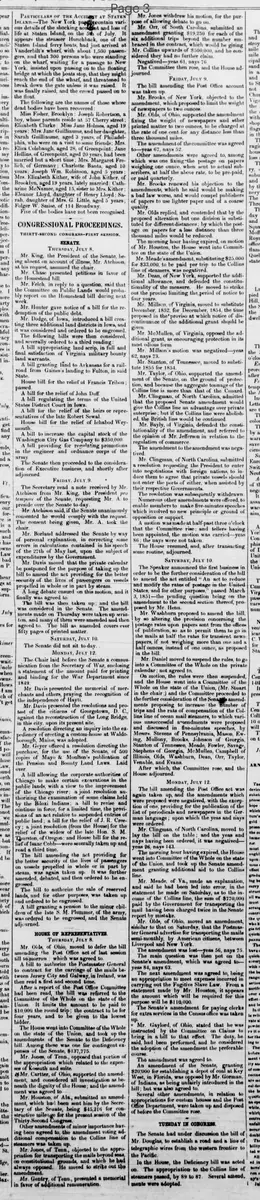
THIRTY-SECOND CONGRESS—FIRST SESSION.
SENATE.
Thursday, July 8.
Mr. King, the President of the Senate, being absent on account of illness, Mr. Atchison, at his request, assumed the chair.
Mr. Chase presented petitions in favor of the Homestead bill.
Mr. Felch, in reply to a question, said that the Committee on Public Lands would probably report on the Homestead bill during next week.
Mr. Hunter gave notice of a bill for the redemption of the public debt.
Mr. Dodge, of Iowa, introduced a bill creating three additional land districts in Iowa, and it was considered and ordered to be engrossed.
The following bills were then considered, and severally ordered to a third reading:
A bill appropriating land scrip, in full and final satisfaction of Virginia military bounty land warrants.
A bill granting land to Arkansas for a railroad from Gaines's landing to Fulton, in said State.
House bill for the relief of Francis Tribou; passed.
A bill for the relief of John Duf.
A bill regulating the terms of the United States District Court in Iowa.
A bill for the relief of the heirs or representatives of the late Robert Sewall.
House bill for the relief of Ichabod Weymouth.
A bill to increase the capital stock of the Washington City Gas Company to $350,000.
A bill providing for regulating promotions in the engineer and ordnance corps of the army.
The Senate then proceeded to the consideration of Executive business, and shortly after adjourned.
Friday, July 9.
The Secretary read a note received by Mr. Atchison from Mr. King, the President pro tempore of the Senate, requesting Mr. A. to preside over the Senate to-day.
Mr. Atchison said, if the Senate unanimously consented he would comply with the request.
The consent being given, Mr. A. took the chair.
Mr. Borland addressed the Senate by way of personal explanation, in correcting some errors in calculations contained in his speech of the 27th of May last, upon the subject of expenditures by the Government.
Mr. Davis moved that the private calendar be postponed for the purpose of taking up the bill to amend the act providing for the better security of the lives of passengers on vessels propelled in whole or in part by steam.
A long debate ensued on this motion, and it finally was agreed to.
The bill was then taken up; and the bill was considered in the Senate. The amendments made on Thursday were taken up seriatim, and many of them were amended and then agreed to. The bill as amended covers over fifty pages of printed matter.
Saturday, July 10.
The Senate did not sit to-day.
Monday, July 12.
The Chair laid before the Senate a communication from the Secretary of War, enclosing a statement of the amount paid for printing and binding for the War Department since 1849.
Mr. Davis presented the memorial of merchants and others, praying the recognition of the independence of Hayti.
Mr. Davis presented the resolutions and protest of the citizens of Georgetown, D. C., against the reconstruction of the Long Bridge, in this city, upon its present site.
A resolution directing an inquiry into the expediency of erecting a custom-house at Waldoborough, Maine, was adopted.
Mr. Geyer offered a resolution directing the purchase, for the use of the Senate, of 500 copies of Mayo & Moulton's publication of the Pension and Bounty Land Laws. Laid over.
A bill allowing the corporate authorities of Chicago to make certain excavations in the public lands, with a view to the improvement of the Chicago river; a joint resolution authorizing the examination of some claims held by the Biloxi Indians; a bill to revise and continue in force, for a limited time, the provisions of an act relative to suspended entries of public land; a bill for the relief of J. R. Creecy; a joint resolution (from the House) for the relief of the widow of the late Hon. S. M. Thurston, of Oregon; and House bill for the relief of Isaac Cobb—were severally taken up and read a third time.
The bill amending the act providing for the better security of the lives of passengers on vessels propelled in whole or in part by steam, was again taken up. It was further amended, debated, and then ordered to be engrossed.
The bill to authorize the sale of reserved lands, and for other purposes, was taken up and ordered to be engrossed.
A bill granting a pension to the minor children of the late S. M. Plummer, of the army, was ordered to be engrossed, and the Senate adjourned.
HOUSE OF REPRESENTATIVES.
Thursday, July 8.
Mr. Olds, of Ohio, moved to defer the bill amending the Post Office act of last session till to-morrow; which was agreed to.
A bill to authorize the Postmaster General to contract for the carriage of the mails between Jersey City and Galway, in Ireland, was then read a first and second time.
After a report of the Post Office Committee had been read, the bill was referred to the Committee of the Whole on the state of the Union. It limits the amount to be paid to $10,000 the round trip; the contract to be for four years, and to be given to the lowest bidder.
The House went into Committee of the Whole on the state of the Union, and took up the amendments of the Senate to the Deficiency bill. Among these was one for contingent expenses of the Senate, $137,775.
Mr. Jones, of Tenn., opposed that portion of the appropriation which related to the expenses of Kossuth and suite.
Mr. Cartter, of Ohio, supported the amendment, and considered all investigation as beneath the dignity of the House: and the amendment was agreed to.
Mr. Houston, of Ala., submitted an amendment, which had been sent him by the Secretary of the Senate, being $45,316 for constructive mileage for the present session of the Thirty-Second Congress.
Other amendments of minor importance having been agreed to, the amendment voting additional compensation to the Collins line of steamers was taken up.
Mr. Jones, of Tenn., objected to the appropriation for transporting the mails beyond seas, on constitutional grounds, and which he had always opposed. He moved to strike out the amendment.
Mr. Gentry, of Tenn., presented a memorial in favor of additional remuneration.
Mr. Jones withdrew his motion, for the purpose of allowing debate to go on.
Mr. Orr, of South Carolina, submitted an amendment granting $19,250 for each of the six additional trips beyond the number embraced in the contract, which would be giving Mr. Collins upwards of $500,000, and he considered they had no further claim.
Negatived—yeas 61, nays 76.
The Committee then rose, and the House adjourned.
Friday, July 9.
The bill amending the Post Office act was taken up.
Mr. Brooks, of New York, objected to the amendment, which proposed to limit the weight of newspapers to two ounces.
Mr. Olds, of Ohio, supported the amendment fixing the weight of newspapers and other printed matter to two ounces, to be charged at the rate of one cent for any distance less than three thousand miles.
The amendment of the committee was agreed to—yeas 67, nays 52.
Other amendments were agreed to, among which was one fixing the postage on papers weighing one ounce, when sent to actual subscribers, at half the above rate, to be pre-paid, or paid quarterly.
Mr. Brooks renewed his objection to the amendments, which he said would be making a bad law worse, and would compel publishers of papers to use lighter paper and of a coarse quality.
Mr. Olds replied, and contended that by the proposed alteration but one division is substituted for different distances: by which the postage on papers for a less distance than three thousand miles would be reduced.
The morning hour having expired, on motion of Mr. Houston, the House went into Committee on the state of the Union.
Mr. Meade's amendment, substituting $25,000 for $33,000, to be paid per trip to the Collins line of steamers, was negatived.
Mr. Dean, of New York, supported the additional allowance, and defended the constitutionality of the measure. He moved to strike out the proviso limiting the period of notice to four years.
Mr. Millson, of Virginia, moved to substitute December, 1852, for December, 1854, the time proposed in the proviso at which notice of discontinuance of the additional grant should be given.
Mr. McMullen, of Virginia, opposed the additional grant, as encouraging protection in its most odious form.
Mr. Millson's motion was negatived—yeas 62, nays 73.
Mr. Stanton, of Tennessee, moved to substitute 1855 for 1854.
Mr. Taylor, of Ohio, supported the amendment of the Senate, on the ground of protection, and because the aggregate tonnage of the Collins line is more than that of the Cunard.
Mr. Clingman, of North Carolina, admitted that the proposed Senate amendment would give the Collins line an advantage over private enterprise; but if the Collins line were abolished, the British line would be continued.
Mr. Bayly, of Virginia, defended the constitutionality of the amendment, and referred to the opinion of Mr. Jefferson in relation to the regulation of commerce.
The amendment to the amendment was negatived.
Mr. Clingman, of North Carolina, submitted a resolution requesting the President to enter into negotiations with foreign nations, to induce them to agree that private vessels should not enter the ports of either, when assisted by their respective Governments.
The resolution was subsequently withdrawn.
Numerous other amendments were offered, to enable members to make five-minutes speeches, which involved no new principle or ground of opposition or support.
A motion was made at half-past three o'clock that the Committee rise; and tellers having been appointed, the motion was carried—yeas 86; the nays were not taken.
The House resumed, and, after transacting some routine, adjourned.
Saturday, July 10.
The Speaker announced the first business in order to be the further consideration of the bill to amend the act entitled "An act to reduce and modify the rates of postage in the United States, and for other purposes," passed March 3, 1851—the pending question being on the amendment to the second section thereof, proposed by Mr. Henn.
Mr. Washburn proposed to amend the bill, by so altering the provision concerning the postage rates upon papers sent from the offices of publication, so as to permit them to go in the mails at half the rates for transient newspapers, if not weighing more than one and a half ounces, instead of one ounce, as proposed in the bill.
Mr. Daniel moved to suspend the rules, to go into a Committee of the Whole on the private calendar: not agreed to.
On motion, the rules were then suspended, and the House went into a Committee of the Whole on the state of the Union, (Mr. Stuart in the chair:) and the Committee proceeded to the further consideration of the Senate's amendments proposing to increase the number of trips and the rate of compensation of the Collins line of ocean mail steamers, to which various unsuccessful amendments were proposed and discussed in five-minutes speeches, by Messrs. Stevens of Pennsylvania, Mason, Ewing, Mullony, Brooks, Johnson of Georgia, Stanton of Tennessee, Meade, Fowler, Savage, Stephens of Georgia, McMullen, Campbell of Illinois, Olds, Washburn, Dean, Orr, Taylor, Venable, and Evans.
After which, the Committee rose, and the House adjourned.
Monday, July 12.
The bill amending the Post Office act was again taken up, and the amendments which were proposed were negatived, with the exception of one, providing for the publication of the list of periodicals and newspapers in the German language; upon which the yeas and nays were ordered.
Mr. Clingman, of North Carolina, moved to lay the bill on the table; and the yeas and nays having been ordered, it was negatived—yeas 26, nays 143.
The morning hour having expired, the House went into Committee of the Whole on the state of the Union, and took up the Senate amendment granting additional aid to the Collins line.
Mr. Meade, of Va., made an explanation and said he had been led into error, in the statement he made on Saturday, as to the income of the Collins line, the sum of $770,000 paid by the Government for transporting the mail having been charged twice in the Senate report by mistake.
Mr. Olds, of Ohio, moved an amendment, similar to that on Saturday, that the Postmaster General advertise for transporting the mail semi-monthly, by American citizens, between Liverpool and New York.
The amendment was lost—yeas 56, nays 75.
The main question was then put on the Senate's amendment, which was agreed to—yeas 84, nays 63.
The next amendment was agreed to, being an appropriation to meet expenses incurred in carrying out the Fugitive Slave Law. From a statement made by Mr. Houston, it appears the amount which will be required for this purpose will be $110,000.
The Senate's amendment for paying clerks for extra services in the Census office was taken up.
Mr. Gaylord, of Ohio, stated that he was instructed "by the Committee on Claims to bring in a bill to that effect. The duty, he said, had been performed, and he considered the adoption of the amendment the preferable course.
The amendment was agreed to.
An amendment of the Senate, granting $20,000 for establishing a depot of coal at Key West, in Florida, was opposed by Mr. Gorman, of Indiana, as being unfairly introduced in the bill; but was also agreed to.
Several other amendments, in relation to appropriations for custom houses and the Post Office Department, were taken up and disposed of before the Committee rose.
TUESDAY IN CONGRESS.
The Senate had under discussion the bill of Mr. Douglas, to establish a road and a line of telegraphic wires from the western frontier to the Pacific.
In the House, the Deficiency bill was acted on. The appropriation to the Collins line of steamers passed, by 89 to 87. Several amendments were adopted.
What sub-type of article is it?
What keywords are associated?
What entities or persons were involved?
Where did it happen?
Domestic News Details
Primary Location
Washington, D.C.
Event Date
July 8 12, 1852
Key Persons
Outcome
bills considered, amended, passed, or ordered engrossed; debates on post office amendments, collins line appropriations (passed 84-63 yeas), steam vessel safety bill amended; deficiency bill amendments agreed including $110,000 for fugitive slave law.
Event Details
Senate sessions on July 8, 9, 12: Petitions for Homestead bill, notices, introductions of land and railroad bills, considerations of relief and appropriation bills, executive business, personal explanations, debates on steam vessel safety bill. House sessions on July 8, 9, 10, 12: Deferrals, introductions of mail carriage bills to Ireland, committee reports, debates on Deficiency bill amendments including Senate contingents, Kossuth expenses, Collins steamer pay (additional trips and compensation debated and passed), Post Office act amendments on newspaper weights and rates, motions to table or strike.