Thank you for visiting SNEWPapers!
Sign up free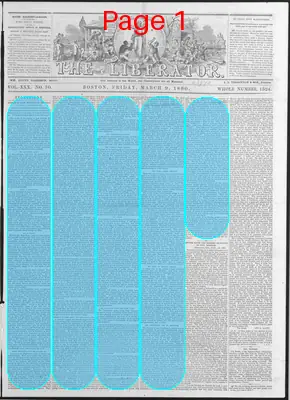
The Liberator
Boston, Suffolk County, Massachusetts
What is this article about?
William H. Seward's speech in the U.S. Senate on February 29 defends the Republican party's anti-slavery policy for territories, counters Southern disunion threats, emphasizes national unity, liberty, and the Constitution's enduring strength amid political tensions over Kansas admission.
Clipping
OCR Quality
Full Text
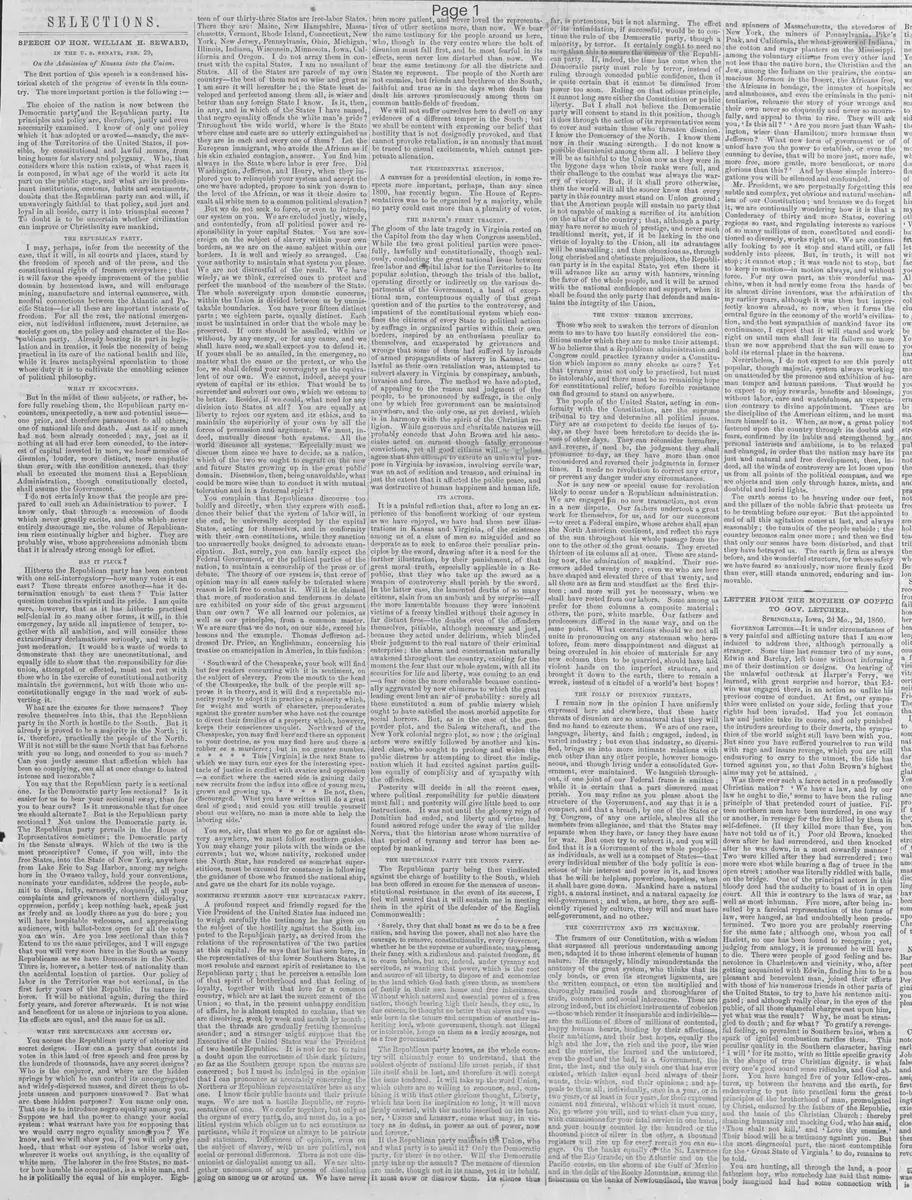
SPEECH OF HON. WILLIAM H. SEWARD,
IN THE U. S. SENATE, FEB. 29,
On the Admission of Kansas into the Union.
The first portion of this speech is a condensed historical sketch of the progress of events in this country. The more important portion is the following :—
The choice of the nation is now between the Democratic party and the Republican party. Its principles and policy are, therefore, justly and even necessarily examined. I know of only one policy which it has adopted or avowed—namely, the saving of the Territories of the United States, if possible, by constitutional and lawful means, from being homes for slavery and polygamy. Who, that considers where this nation exists, of what races it is composed, in what age of the world it acts its part on the public stage, and what are its predominant institutions, customs, habits and sentiments, doubts that the Republican party can and will, if unwaveringly faithful to that policy, and just and loyal in all beside, carry it into triumphal success?
To doubt is to be uncertain whether civilization can improve or Christianity save mankind.
THE REPUBLICAN PARTY.
I may, perhaps, infer from the necessity of the case, that it will, in all courts and places, stand by the freedom of speech and of the press, and the constitutional rights of freemen everywhere; that it will favor the speedy improvement of the public domain by homestead laws, and will encourage mining, manufacture and internal commerce, with needful connections between the Atlantic and Pacific States—for all these are important interests of freedom. For all the rest, the national emergencies, not individual influences, must determine, as society goes on, the policy and character of the Republican party. Already bearing its part in legislation and in treaties, it feels the necessity of being practical in its care of the national health and life, while it leaves metaphysical speculation to those whose duty it is to cultivate the ennobling science of political philosophy.
WHAT IT ENCOUNTERS.
But in the midst of these subjects, or rather, before fully reaching them, the Republican party encounters, unexpectedly, a new and potential issue—one prior, and therefore paramount to all others, one of national life and death. Just as if so much had not been already conceded; nay, just as if nothing at all had ever been conceded, to the interest of capital invested in men, we hear menaces of disunion, louder, more distinct, more emphatic than ever, with the condition annexed, that they shall be executed the moment that a Republican Administration, though constitutionally elected, shall assume the Government.
I do not certainly know that the people are prepared to call such an Administration to power. I know only, that through a succession of floods which never greatly excite, and ebbs which never entirely discourage me, the volume of Republicanism rises continually higher and higher. They are probably wise, whose apprehensions admonish them that it is already strong enough for effect.
HAS IT PLUCK?
Hitherto the Republican party has been content with one self-interrogatory—how many votes it can cast? These threats enforce another—has it determination enough to cast them ? This latter question touches its spirit and its pride. I am quite sure, however, that as it has hitherto practised self-denial in so many other forms, it will, in this emergency, lay aside all impatience of temper, together with all ambition, and will consider these extraordinary declamations seriously, and with a just moderation. It would be a waste of words to demonstrate that they are unconstitutional, and equally idle to show that the responsibility for disunion, attempted or effected, must not rest with those who in the exercise of constitutional authority maintain the government, but with those who unconstitutionally engage in the mad work of subverting it.
What are the excuses for these menaces? They resolve themselves into this, that the Republican party in the North is hostile to the South. But it already is proved to be a majority in the North: it is, therefore, practically the people of the North. Will it not still be the same North that has forborne with you so long, and conceded to you so much? Can you justly assume that affection which has been so complying, can all at once change to hatred intense and inexorable?
You say that the Republican party is a sectional one. Is the Democratic party less sectional? Is it easier for us to bear your sectional sway, than for you to bear ours? Is it unreasonable that for once we should alternate? But is the Republican party sectional? Not unless the Democratic party is. The Republican party prevails in the House of Representatives sometimes; the Democratic party in the Senate always. Which of the two is the most proscriptive? Come, if you will, into the free States, into the State of New York, anywhere from Lake Erie to Sag Harbor, among my neighbors in the Owasco valley, hold your conventions, nominate your candidates, address the people, submit to them, fully, earnestly, eloquently, all your complaints and grievances of northern disloyalty, oppression, perfidy; keep nothing back, speak just as freely and as loudly there as you do here; you will have hospitable welcomes, and appreciating audiences, with ballot-boxes open for all the votes you can win. Are you less sectional than this?
Extend to us the same privileges, and I will engage that you will very soon have in the South as many Republicans as we have Democrats in the North.
There is, however, a better test of nationality than the accidental location of parties. Our policy of labor in the Territories was not sectional, in the first forty years of the Republic. Its nature inheres. It will be national again, during the third forty years, and forever afterwards. It is not wise and beneficent for us alone or injurious to you alone. Its effects are equal, and the same for us all.
WHAT THE REPUBLICANS ARE ACCUSED OF.
You accuse the Republican party of ulterior and secret designs. How can a party that counts its votes in this land of free speech and free press by the hundreds of thousands, have any secret designs? Who is the conjuror, and where are the hidden springs by which he can control its uncongregated and widely-dispersed masses, and direct them to objects unseen and purposes unavowed? But what are these hidden purposes? You name only one. That one is to introduce negro equality among you.
Suppose we had the power to change your social system: what warrant have you for supposing that we would carry negro equality among you? We know, and we will show you, if you will only give heed, that what our system of labor works out, wherever it works out anything, is the equality of white men. The laborer in the free States, no matter how humble his occupation, is a white man, and he is politically the equal of his employer. Eighteen of our thirty-three States are free-labor States. There they are: Maine, New Hampshire, Massachusetts, Vermont, Rhode Island, Connecticut, New York, New Jersey, Pennsylvania, Ohio, Michigan, Illinois, Indiana, Wisconsin, Minnesota, Iowa, California and Oregon. I do not array them in contrast with the capital States. I am no assailant of States. All of the States are parcels of my own country—the best of them not so wise and great as I am sure it will hereafter be; the State least developed and perfected among them all, is wiser and better than any foreign State I know. Is it, then, in any, and in which of the States I have named, that negro equality offends the white man's pride? Throughout the wide world, where is the State where class and caste are so utterly extinguished as they are in each and every one of them? Let the European immigrant, who avoids the African as if his skin exhaled contagion, answer. You find him always in the State where labor is ever free. Did Washington, Jefferson, and Henry, when they implored you to relinquish your system and accept the one we have adopted, propose to sink you down to the level of the African, or was it their desire to exalt all white men to a common political elevation?
But we do not seek to force, or even to intrude, our system on you. We are excluded justly, wisely, and contentedly, from all political power and responsibility in your capital States. You are sovereign on the subject of slavery within your own borders, as we are on the same subject within our borders. It is well and wisely so arranged. Use your authority to maintain what system you please. We are not distrustful of the result. We have wisely, as we think, exercised ours to protect and perfect the manhood of the members of the State. The whole sovereignty upon domestic concerns, within the Union is divided between us by unmistakable boundaries. You have your fifteen distinct parts; we eighteen parts, equally distinct. Each must be maintained in order that the whole may be preserved. If ours should be assailed, within or without, by any enemy, or for any cause, and we shall have need, we shall expect you to defend it. If yours shall be so assailed, in the emergency, no matter what the cause or the pretext, or who the foe, we shall defend your sovereignty as the equivalent of our own. We cannot, indeed, accept your system of capital or its ethics. That would be to surrender and subvert our own, which we esteem to be better. Besides, if we could, what need for any division into States at all? You are equally at liberty to reject our system and its ethics, and to maintain the superiority of your own by all the forces of persuasion and argument. We must, indeed, mutually discuss both systems. All the world discusses all systems. Especially must we discuss them since we have to decide, as a nation, which of the two we ought to engraft on the new and future States growing up in the great public domain. Discussion, then, being unavoidable, what could be more wise than to conduct it with mutual toleration and in a fraternal spirit?
You complain that Republicans discourse too boldly and directly, when they express with confidence their belief that the system of labor will, in the end, be universally accepted by the capital States, acting for themselves, and in conformity with their own constitutions, while they sanction too unreservedly books designed to advocate emancipation. But, surely, you can hardly expect the Federal Government, or the political parties of the nation, to maintain a censorship of the press or of debate. The theory of our system is, that error of opinion may in all cases safely be tolerated where reason is left free to combat it. Will it be claimed that more of moderation and tenderness in debate are exhibited on your side of the great argument than our own? We all learned our polemics, as well as our principles, from a common master. We are sure that we do not, on our side, exceed his lessons and the example. Thomas Jefferson addressed Dr. Price, an Englishman, concerning his treatise on emancipation in America, in this fashion:
Southward of the Chesapeake, your book will find but few readers concurring with it in sentiment, on the subject of slavery. From the mouth to the head of the Chesapeake, the bulk of the people will approve it in theory, and it will find a respectable minority ready to adopt it in practice; a minority which, for weight and worth of character, preponderates against the greater number who have not the courage to divest their families of a property which, however, keeps their consciences unquiet. Northward of the Chesapeake, you may find here and there an opponent to your doctrine, as you may find here and there a robber or a murderer; but in no greater number.
This [Virginia] is the next State to which we may turn our eyes for the interesting spectacle of justice in conflict with avarice and oppression —a conflict where the sacred side is gaining daily new recruits from the influx into office of young men, grown and growing up. * * * * Be not, then, discouraged. What you have written will do a great deal of good; and could you still trouble yourself about our welfare, no man is more able to help the laboring side.'
You see, sir, that when we go for or against slavery anywhere, we must follow southern guides. You may change your pilots with the winds or the currents; but we, whose nativity, reckoned under the North Star, has rendered us somewhat superstitious, must be excused for constancy in following the guidance of those who framed the national ship, and gave us the chart for its noble voyage.
SOMETHING FURTHER ABOUT THE REPUBLICAN PARTY.
A profound respect and friendly regard for the Vice President of the United States has induced me to weigh carefully the testimony he has given on the subject of the hostility against the South imputed to the Republican party, as derived from the relations of the representatives of the two parties at this capital. He says that he has seen here, in the representatives of the lower Southern States, a most resolute and earnest spirit of resistance to the Republican party ; that he perceives a sensible loss of that spirit of brotherhood and that feeling of loyalty, together with that love for a common country, which are at last the surest cement of the Union; so that, in the present unhappy condition of affairs, he is almost tempted to exclaim, that we are dissolving, week by week and month by month; that the threads are gradually fretting themselves asunder; and a stranger might suppose that the Executive of the United States was the President of two hostile Republics. It is not for me to raise a doubt upon the correctness of this dark picture, so far as the Southern groups upon the canvas are concerned; but I must be indulged in the opinion that I can pronounce as accurately concerning the Northern or Republican representatives here as any one. I know their public haunts and their private ways. We are not a hostile Republic, or representatives of one. We confer together, but only as the organs of every party do, and must do, in a political system which obliges us to act sometimes as partisans, while it requires us always to be patriots and statesmen. Differences of opinion, even on the subject of slavery, with us are political, not social or personal differences. There is not one disunionist or disloyalist among us all. We are altogether unconscious of any process of dissolution going on among us or around us. We have never been more patient, and never loved the representatives of other sections more, than now. We bear the same testimony for the people around us here, who, though in the very centre where the bolt of disunion must fall first, and be most fearful in its effects, seem never less disturbed than now. We bear the same testimony for all the districts and States we represent. The people of the North are not enemies, but friends and brethren of the South, faithful and true as in the days when death has dealt his arrows promiscuously among them on common battle-fields of freedom.
We will not suffer ourselves here to dwell on any evidences of a different temper in the South; but we shall be content with expressing our belief that hostility that is not designedly provoked, and that cannot provoke retaliation, is an anomaly that must be traced to casual excitements, which cannot perpetuate alienation.
THE PRESIDENTIAL ELECTION.
A canvass for a presidential election, in some respects more important, perhaps, than any since 1800, has recently begun. The House of Representatives was to be organized by a majority, while no party could cast more than a plurality of votes.
THE HARPER'S FERRY TRAGEDY.
The gloom of the late tragedy in Virginia rested on the Capitol from the day when Congress assembled. While the two great political parties were peacefully, lawfully and constitutionally, though zealously, conducting the great national issue between free labor and capital labor for the Territories to its popular solution, through the trials of the ballot, operating directly or indirectly on the various departments of the Government, a band of exceptional men, contemptuous equally of that great question and of the parties to the controversy, and impatient of the constitutional system which confines the citizens of every State to political action by suffrage in organized parties within their own borders, inspired by an enthusiasm peculiar to themselves, and exasperated by grievances and wrongs that some of them had suffered by inroads of armed propagandists of slavery in Kansas, unlawful as their own retaliation was, attempted to subvert slavery in Virginia by conspiracy, ambush, invasion and force. The method we have adopted, of appealing to the reason and judgment of the people, to be pronounced by suffrage, is the only one by which free government can be maintained anywhere, and the only one, as yet devised, which is in harmony with the spirit of the Christian religion. While generous and charitable natures will probably concede that John Brown and his associates acted on earnest though fatally erroneous convictions, yet all good citizens will nevertheless agree that this attempt to execute an unlawful purpose in Virginia by invasion, involving servile war, was an act of sedition and treason, and criminal in just the extent that it affected the public peace, and was destructive of human happiness and human life.
ITS ACTORS.
It is a painful reflection that, after so long an experience of the beneficent working of our system as we have enjoyed, we have had these new illustrations in Kansas and Virginia, of the existence among us of a class of men so misguided and so desperate as to seek to enforce their peculiar principles by the sword, drawing after it a need for the further illustration, by their punishment, of that great moral truth, especially applicable in a Republic, that they who take up the sword as a weapon of controversy shall perish by the sword.
In the latter case, the lamented deaths of so many citizens, slain from an ambush and by surprise—all the more lamentable because they were innocent victims of a frenzy kindled without their agency in far distant fires—the deaths even of the offenders themselves, pitiable, although necessary and just, because they acted under delirium, which blinded their judgment to the real nature of their criminal enterprise; the alarm and consternation naturally awakened throughout the country, exciting for the moment the fear that our whole system, with all its securities for life and liberty, was coming to an end —a fear none the more endurable because continually aggravated by new chimeras to which the great leading event lent an air of probability : surely all these constituted a sum of public misery which ought to have satisfied the most morbid appetite for social horrors. But, as in the case of the gunpowder plot, and the Salem witchcraft, and the New York colonial negro plot, so now ; the original actors were swiftly followed by another and kindred class, who sought to prolong and widen the public distress by attempting to direct the indignation which it had excited against parties guiltless equally of complicity and of sympathy with the offenders.
Posterity will decide in all the recent cases, where political responsibility for public disasters must fall; and posterity will give little heed to our instructions. It was not until the gloomy reign of Domitian had ended, and liberty and virtue had found assured refuge under the sway of the milder Nerva, that the historian arose whose narrative of that period of tyranny and terror has been accepted by mankind.
THE REPUBLICAN PARTY THE UNION PARTY.
The Republican party being thus vindicated against the charge of hostility to the South, which has been offered in excuse for the menaces of unconstitutional resistance in the event of its success, I feel well assured that it will sustain me in meeting them in the spirit of the defender of the English Commonwealth:
Surely, they that shall boast as we do to be a free nation, and having the power, shall not also have the courage, to remove, constitutionally, every Governor, whether he be the supreme or subordinate, may please their fancy with a ridiculous and painted freedom, fit to cozen babies, but are, indeed, under tyranny and servitude. as wanting that power. which is the root and source of all liberty, to dispose of and economize in the land which God hath given them, as members of family in their own home and free inheritance. Without which natural and essential power of a free nation, though bearing high their heads, they can, in due esteem, be thought no better than slaves and vassals born in the tenure and occupation of another inheriting lord, whose government, though not illegal or intolerable, hangs on them as a lordly scourge, not as a free government.
The Republican party knows, as the whole country will ultimately come to understand, that the noblest objects of national life must perish, if that life itself shall be lost, and therefore it will accept the issue tendered. It will take up the word Union, which others are so willing to renounce, and, combining it with that other glorious thought, Liberty, which has been its inspiration so long, it will move firmly onward, with the motto inscribed on its banner, UNION and LIBERTY, come what may, in victory as in defeat, in power as out of power, now and forever.
If the Republican party maintain the Union, who and what party is to assail it? Only the Democratic party, for there is no other. Will the Democratic party take up the assault? The menaces of disunion are made, though not in its name, yet in its behalf. It must avow or disavow them. Its silence thus far, is portentous, but is not alarming. The effect of its intimidation, if successful, would be to continue the rule of the Democratic party, though a minority, by terror. It certainly ought to need no more than this to secure the success of the Republican party. If, indeed, the time has come when the Democratic party must rule by terror, instead of ruling through conceded public confidence, then it is quite certain that it cannot be dismissed from power too soon. Ruling on that odious principle, it cannot long save either the Constitution or public liberty. But I shall not believe the Democratic party will consent to stand in this position, though it does through the action of its representatives seem to cover and sustain those who threaten disunion. I know the Democracy of the North. I know them now in their waning strength. I do not know a possible disunionist among them all. I believe they will be as faithful to the Union now as they were in the bygone days when their ranks were full, and their challenge to the combat was always the war-cry of victory. But, if it shall prove otherwise, then the world will all the sooner know that every party in this country must stand on Union ground; that the American people will sustain no party that is not capable of making a sacrifice of its ambition on the altar of the country; that, although a party may have never so much of prestige, and never such traditional merit, yet, if it be lacking in the one virtue of loyalty to the Union, all its advantages will be unavailing; and then obnoxious as, through long cherished and obstinate prejudices, the Republican party is in the capital State, yet even there it will advance like an army with banners, winning the favor of the whole people, and it will be armed with the national confidence and support, when it shall be found the only party that defends and maintains the integrity of the Union.
THE UNION TERROR EXCITORS.
Those who seek to awaken the terrors of disunion seem to me to have too hastily considered the conditions under which they are to make their attempt. Who believes that a Republican administration and Congress could practice tyranny under a Constitution which imposes so many checks as ours? Yet that tyranny must not only be practised, but must be intolerable, and there must be no remaining hope for constitutional relief, before forcible resistance can find ground to stand on anywhere.
The people of the United States, acting in conformity with the Constitution, are the supreme tribunal to try and determine all political issues. They are as competent to decide the issues of to-day, as they have been heretofore to decide the issues of other days. They can reconsider hereafter, and reverse, if need be, the judgment they shall pronounce to-day, as they have more than once reconsidered and reversed their judgments in former times. It needs no revolution to correct any error, or prevent any danger under any circumstances.
Nor is any new or special cause for revolution likely to occur under a Republican administration. We are engaged in no new transaction, not even in a new dispute. Our fathers undertook a great work for themselves, for us, and for our successors —to erect a Federal empire, whose arches shall span the North American continent, and reflect the rays of the sun throughout his whole passage from the one to the other of the great oceans. They erected thirteen of its columns all at once. These are standing now, the admiration of mankind. Their successors added twenty more; even we who are here have shaped and elevated three of that twenty, and all these are as firm and steadfast as the first thirteen; and more will yet be necessary, when we shall have rested from our labors. Some among us prefer for these columns a composite material; others, the pure, white marble. Our fathers and predecessors differed in the same way, and on the same point. What execrations should we not all unite in pronouncing on any statesman who heretofore, from mere disappointment and disgust at being overruled in his choice of materials for any new column then to be quarried, should have laid violent hands on the imperfect structure, and brought it down to the earth, there to remain a wreck, instead of a citadel of a world's best hopes!
THE FOLLY OF DISUNION THREATS.
I remain now in the opinion I have uniformly expressed here and elsewhere, that these hasty threats of disunion are so unnatural that they will find no hand to execute them. We are of one race, language, liberty, and faith; engaged, indeed, in varied industry; but even that industry, so diversified, brings us into more intimate relations with each other than any other people, however homogeneous, and though living under a consolidated Government, ever maintained. We languish throughout, if one joint of our Federal frame is smitten; while it is certain that a part dissevered must perish. You may refine as you please about the structure of the Government, and say that it is a compact, and that a breach, by one of the States or by Congress, of any one article, absolves all the members from allegiance, and that the States may separate when they have, or fancy they have cause for war. But once try to subvert it, and you will find that it is a Government of the whole people— as individuals, as well as a compact of States—that every individual member of the body politic is conscious of his interest and power in it, and knows that he will be helpless, powerless, hopeless, when it shall have gone down. Mankind have a natural right, a natural instinct, and a natural capacity for self-government; and when, as here, they are sufficiently ripened by culture, they will and must have self-government, and no other.
THE CONSTITUTION AND ITS MECHANISM.
The framers of our Constitution, with a wisdom that surpassed all previous understanding among men, adapted it to these inherent elements of human nature. He strangely, blindly misunderstands the anatomy of the great system, who thinks that its only bonds, or even its strongest ligaments, are the written compact, or even the multiplied and thoroughly ramified roads and thoroughfares of trade, commerce and social intercourse. These are strong indeed, but its chiefest instruments of cohesion -those-which render it inseparable and indivisible- are the millions of fibers of millions of contented, happy human hearts, binding by their affections, their ambitions, and their best hopes, equally the high and the low, the rich and the poor, the wise and the unwise, the learned and the untutored, even the good and the bad, to a Government, the first, the last, and the only such one that has ever existed, which takes equal heed always of their wants, their wishes, and their opinions; and appeals to them all, individually, once in a year, or in two years, or at least in four years, for their expressed consent and renewal, without which it must cease.
No, go where you will, and to what class you may, with commissions for your fatal service in one hand, and your bounty counted by the hundred or the thousand pieces of silver in the other, a thousand registers will rise up for every recruit you can engage. On the banks equally of the St. Lawrence and of the Rio Grande, on the Atlantic and on the Pacific coasts, on the shores of the Gulf of Mexico and in the dells of the Rocky Mountains, among the fishermen on the banks of Newfoundland, the spinners of Massachusetts, the stevedores of New York, the miners of Pennsylvania, Pike's Peak, and California, the wheat-growers of Indiana, the cotton and sugar planters on the Mississippi, among the voluntary citizens from every other land not less than the native born, the Christian and the Jew, among the Indians on the prairies, the contumacious Mormon in the Desert, the Africans free, the Africans in bondage, the inmates of hospitals and almshouses, and even the criminals in the penitentiaries, rehearse the story of your wrongs and their own never so eloquently and never so mournfully, and appeal to them to rise. They will ask you, 'Is this all?' Are you more just than Washington, wiser than Hamilton; more humane than Jefferson? What new form of government or of union have you the power to establish, or even the cunning to devise, that will be more just, more safe, more free, more gentle, more beneficent, or more glorious than this?' And by these simple interrogations you will be silenced and confounded.
Mr. President, we are perpetually forgetting this subtle and complex, yet obvious and natural mechanism of our Constitution; and because we do forget it, we are continually wondering how it is that a Confederacy of thirty and more States, covering regions so vast, and regulating interests so various of so many millions of men, constituted and conditioned so diversely, works right on. We are continually looking to see it stop and stand still, or fall suddenly into pieces. But, in truth, it will not stop; it cannot stop; it was made not to stop, but to keep in motion—in motion always, and without force. For my own part, as this wonderful machine, when it had newly come from the hands of its almost divine inventors, was the admiration of my earlier years, although it was then but imperfectly known abroad, so now, when it forms the central figure in the economy of the world's civilization, and the best sympathies of mankind favor its continuance, I expect that it will stand and work right on until men shall fear its failure no more than we now apprehend that the sun will cease to hold its eternal place in the heavens.
Nevertheless, I do not expect to see this purely popular, though majestic, system always working on unattended by the presence and exhibition of human temper and human passions. That would be to expect to enjoy rewards, benefits and blessings, without labor, care and watchfulness, an expectation contrary to divine appointment. These are the discipline of the American citizen, and he must inure himself to it. When, as now, a great policy fastened upon the country through its doubts and fears, confirmed by its habits and strengthened by personal interests and ambitions, is to be relaxed and changed, in order that the nation may have its just and natural and free development, then, indeed, all the winds of controversy are let loose upon us from all points of the political compass, and we see objects and men only through hazes, mists, and doubtful and lurid lights.
The earth seems to be heaving under our feet, and the pillars of the noble fabric that protects us to be trembling before our eyes. But the appointed end of all this agitation comes at last, and always seasonably; the tumults of the people subside; the country becomes calm once more; and then we find that only our senses have been disturbed, and that they have betrayed us. The earth is firm as always before, and the wonderful structure, for whose safety we have feared so anxiously, now more firmly fixed than ever, still stands unmoved, enduring and immovable.
What sub-type of article is it?
What themes does it cover?
What keywords are associated?
What entities or persons were involved?
Where did it happen?
Story Details
Key Persons
Location
U. S. Senate
Event Date
Feb. 29
Story Details
Seward defends Republican anti-slavery policy in territories, refutes accusations of sectionalism and secret designs for negro equality, condemns disunion threats as unconstitutional, praises constitutional mechanisms for unity, and condemns John Brown's raid as treasonous while upholding constitutional debate over slavery.