Thank you for visiting SNEWPapers!
Sign up free
Editorial
October 4, 1802
The National Intelligencer And Washington Advertiser
Washington, District Of Columbia
What is this article about?
The Republican Committee of Pennsylvania urges Republicans to support candidates in the upcoming election, reviews Federalist abuses during their 'reign of terror,' celebrates Republican victories since 1799 including repeal of the Judiciary Act, and calls for vigilance against ongoing Federalist opposition, especially endorsing re-election of Governor McLean.
Clipping
OCR Quality
98%
Excellent
Full Text
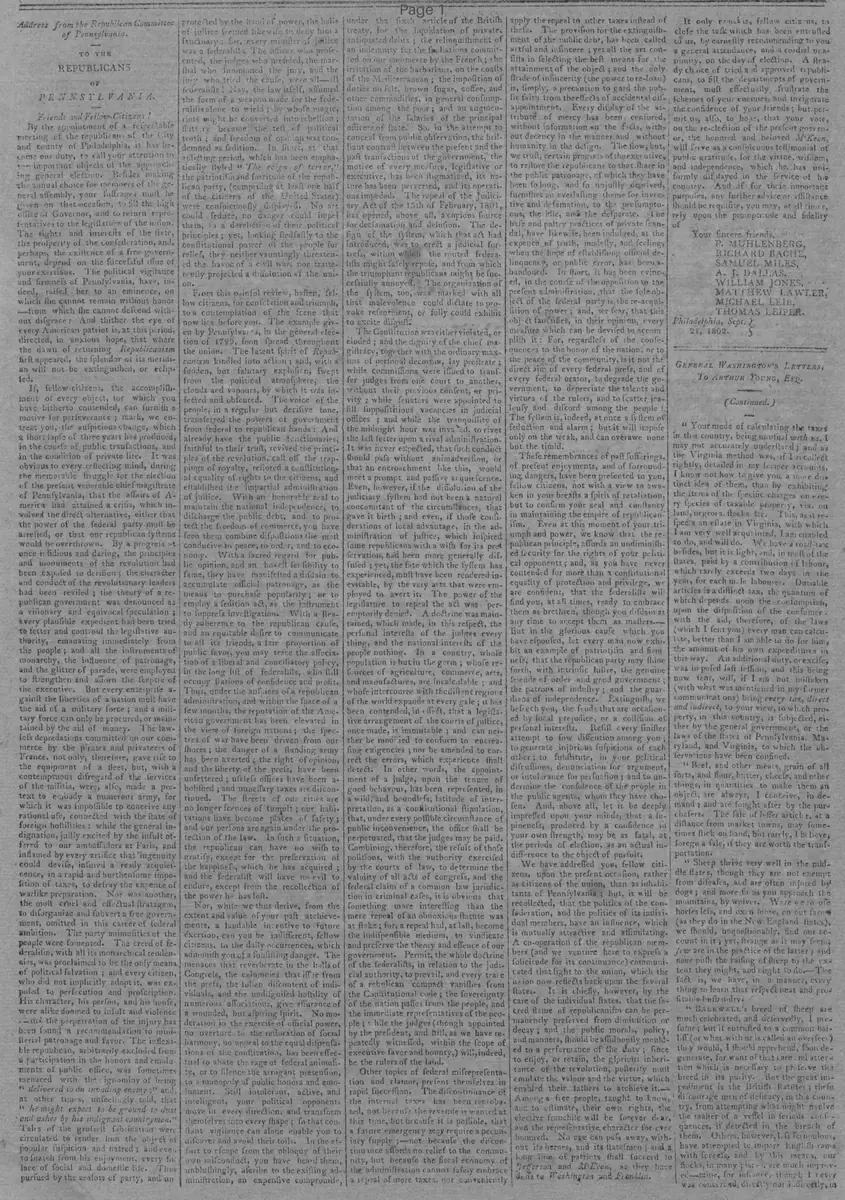
Address from the Republican Committee of Pennsylvania.
TO THE REPUBLICANS OF PENNSYLVANIA.
Friends and Fellow-Citizens!
By the appointment of a respectable meeting of the republicans of the City and county of Philadelphia, it has become our duty, to call your attention to some important objects of the approaching general election. Besides making the annual choice for members of the general assembly, your suffrages must be given on that occasion, to fill the high office of Governor, and to return representatives to the legislature of the union. The rights and interests of the state, the prosperity of the confederation, and, perhaps, the existence of a free government, depend on the successful issue of your exertions. The political vigilance and firmness of Pennsylvania, have, indeed, raised her to an eminence, on which she cannot remain without honor, from which she cannot descend without disgrace: And thither the eye of every American patriot is, at this period, directed, in anxious hope, that where the dawn of returning Republicanism first appeared, the splendor of its meridian will not be extinguished, or eclipsed.
If, fellow-citizens, the accomplishment of every object, for which you have hitherto contended, can furnish a motive for perseverance; mark, we entreat you, the auspicious change, which a short lapse of three years has produced, in the course of public transactions, and in the condition of private life. It was obvious to every reflecting mind, during the memorable struggle for the election of the present venerable chief magistrate of Pennsylvania, that the affairs of America had attained a crisis, which involved the direct alternative, either that the power of the federal party must be arrested, or that our republican systems would be overthrown. By a progress at once insidious and daring, the principles and monuments of the revolution had been exposed to derision; the character and conduct of the revolutionary leaders had been reviled; the theory of a republican government was denounced as a visionary and equivocal speculation; every plausible expedient had been tried to fetter and control the legislative authority, emanating immediately from the people; and all the instruments of monarchy, the influence of patronage, and the glitter of parade, were employed to strengthen and adorn the sceptre of the executive. But every enterprise against the liberties of a nation must have the aid of a military force; and a military force can only be procured, or maintained by the aid of money. The lawless depredations committed on our commerce by the pirates and privateers of France, not only, therefore, gave rise to the equipment of a fleet, but, with a contemptuous disregard of the services of the militia, were, also, made a pretext to embody a numerous army, for which it was impossible to conceive any rational use, connected with the state of foreign hostilities: while the general indignation, justly excited by the insult offered to our ambassadors at Paris, and inflamed by every artifice that ingenuity could devise, insured a ready acquiescence, in a rapid and burdensome imposition of taxes, to defray the expense of warlike preparation. Nor was another, the most cruel and effectual stratagem, to disorganize and subvert a free government, omitted in this career of federal ambition. The party animosities of the people were fomented. The creed of federalism, with all its monarchical tendencies, was proclaimed to be the only means of political salvation; and every citizen, who did not implicitly adopt it, was exposed to persecution and proscription. His character, his person, and his house, were alike doomed to insult and violence --and the perpetration of the injury has been found a recommendation to ministerial patronage and favor. The inflexible republican, arbitrarily excluded from a participation in the honors and emoluments of public office, was sometimes menaced with the ignominy of being "delivered to an invading enemy;" and, at other times, unfeelingly told, that "he might expect to be ground to dust and ashes by his indignant countrymen." Tales of the grossest fabrication were circulated to render him the object of popular suspicion and hatred; and every source of social and domestic life. Thus pursued by the zealots of party, and unprotected by the brand of power, the halls of justice seemed likewise to deny him a sanctuary; for, every minister of justice was a federalist: The officer who prosecuted, the judges who presided, the marshal who summoned the jury, and the jury who tried the cause, were all federalists! Nay, the law itself, assumed the form of a weapon made for the federalists alone to wield; by whose magic, riots might be converted into rebellion; its try became the test of political truth; and freedom of opinion was condemned as sedition. In short, at that alarming period, which has been emphatically styled "The reign of terror," the patriotism and fortitude of the republican party, (comprising at least one half of the citizens of the United States) were conspicuously displayed. No art could seduce, no danger could impel them, to a dereliction of their political principles; yet, looking steadfastly to the constitutional power of the people for relief, they neither vauntingly threatened the havoc of a civil war, nor traitorously projected a dissolution of the union.
From this painful review, hasten, fellow citizens, for consolation and triumph, to a contemplation of the scene that now lies before you. The example given by Pennsylvania, in the general election of 1799, soon spread throughout the union. The latent spirit of Republicanism kindled into action; and, with a sudden, but salutary explosion, swept from the political atmosphere, the clouds and vapours, by which it was infected and obscured. The voice of the people, in a regular but decisive tone, transferred the powers of government from federal to republican hands: And already have the public functionaries, faithful to their trust, revived the principles of the revolution, cast off the trappings of royalty, restored a constitutional equality of rights to the citizens, and established the impartial administration of justice. With an honorable zeal to maintain the national independence, to discharge the public debt, and to protect the freedom of commerce, you have seen them combine dispositions the most conducive to peace, to order, and to economy. With a sacred regard for public opinion, and an honest sensibility to fame, they have manifested a disdain to accumulate official patronage, as the means to purchase popularity; or to employ a sedition act, as the instrument to suppress investigation. With a steady adherence to the republican cause, and an equitable desire to communicate to all its friends, a fair proportion of public favor, you may trace the association of a liberal and conciliatory policy, in the long list of federalists, who still occupy stations of confidence and profit. Thus, under the auspices of a republican administration, and within the space of a few months, the reputation of the American government has been elevated in the view of foreign nations; the spectres of war have been driven from our shores; the danger of a standing army has been averted; the right of opinion, and the liberty of the press, have been unfettered; useless offices have been abolished; and unnecessary taxes are discontinued. The streets of our cities are no longer scenes of tumult; our habitations have become places of safety; and our persons are again under the protection of the law. In such a situation, the republican can have no wish to gratify, except for the preservation of the happiness, which he has acquired; and the federalist will have no evil to endure, except from the recollection of the power he has lost.
Nor, while we thus derive, from the extent and value of your past achievements, a laudable incentive to future exertion, can you be indifferent, fellow citizens, to the daily occurrences, which admonish you of a subsiding danger. The menaces that reverberate in the halls of Congress, the calumnies that issue from the press, the sullen discontent of individuals, and the undisguised hostility of numerous associations, give assurance of a wounded, but aspiring spirit. No moderation in the exercise of official power, no overture to the restoration of social harmony, no appeal to the equal dispensations of the constitution, has been effectual to abate the rage of federal animosity, or to silence the arrogant pretension, to a monopoly of public honors and emolument. Still intolerant, active, and intelligent, your political opponents move in every direction, and transform themselves into every shape; so that constant vigilance can alone enable you to discover and avoid their toils. In the effort to escape from the obloquy of their own misconduct, you have heard them, unblushingly, ascribe to the existing administration, an expensive compromise, under the 6th article of the British treaty, for the liquidation of private, antiquated debts; the relinquishment of an indemnity for the spoliations committed on our commerce by the French; the irritation of the barbarians, on the coasts of the Mediterranean: the imposition of duties on salt, brown sugar, coffee, and other commodities, in general consumption among the poor; and an augmentation of the salaries of the principal officers of state. So, in the attempt to conceal from public observation, the brilliant contrast between the present and the past transactions of the government, the motive of every measure, legislative or executive, has been stigmatized, its nature has been perverted, and its operations impeded. The repeal of the Judiciary Act of the 13th of February, 1801, has opened, above all, a copious source for declamation and delusion. The design of the system, which that act had introduced, was to erect a judicial fortress, within which the routed federalists might safely repose, and from which the triumphant republicans might be successfully annoyed. The organization of the system, too, was marked with all that malevolence could dictate to provoke resentment, or folly could exhibit to excite disgust:
The Constitution was either violated, or eluded; and the dignity of the chief magistracy, together with the ordinary maxims of personal decorum, lay prostrate; while commissions were issued to transfer judges from one court to another, without their previous consent, or privity; while enactors were appointed to fill supposititious vacancies in judicial offices; and while the tranquillity of the midnight hour was invaded, to rivet the last fetter upon a rival administration. It was never expected, that such conduct should pass without animadversion, or that an encroachment like this, would meet a prompt and passive acquiescence. Even, however, if the dissolution of the judiciary system had not been a natural concomitant of the circumstances, that gave it birth; and even, if those considerations of local advantage, in the administration of justice, which inspired some republicans with a wish for its preservation, had been more generally diffused; yet, the fate which the system has experienced, must have been rendered inevitable, by the very arts that were employed to avert it. The power of the legislature to repeal the act was peremptorily denied. A doctrine was maintained, which made, in this respect, the personal interests of the judges everything, and the national interests of the people nothing. In a country, whose population is but in the germ; whose resources of agriculture, commerce, arts, and manufactures, are incalculable; and whose intercourse with the distant regions of the world expands at every gale; it has been contended, in effect, that a legislative arrangement of the courts of justice, once made, is immutable; and can neither be modified to conform to increasing exigencies; nor be amended to correct the errors, which experience shall detect. In other words, the appointment of a judge, upon the tenure of good behaviour, has been represented, in a wild, and boundless, latitude of interpretation, as a constitutional stipulation, that, under every possible circumstance of public inconvenience, the office shall be perpetuated, that the judges may be paid. Combining, therefore, the result of those positions, with the authority exercised by the courts of law, to determine the validity of all acts of congress, and the federal claim of a common law jurisdiction in criminal cases, it is obvious that something more interesting than the mere repeal of an obnoxious statute was at stake; for, a repeal had, at last, become the indispensable medium, to vindicate and preserve the theory and essence of our government. Permit the whole doctrine of the federalists, in relation to the judicial authority, to prevail, and every trace of a republican compact vanishes from the Constitutional code; the sovereignty of the nation passes from the people, and the immediate representatives of the people; while the judges (though appointed by the president, and still, as we have repeatedly witnessed, within the scope of executive favor and bounty,) will, indeed, be the rulers of the land.
Other topics of federal misrepresentation and clamor, present themselves in rapid succession. The discontinuance of the internal taxes has been remonstrated, not because the revenue is wanted at this time, but because it is possible, that a future emergency may require a pecuniary supply; --not because the discontinuance affords no relief to the community, but because the fiscal economy of the administration cannot at once embrace a repeal of more taxes, nor conveniently apply the repeal to other taxes instead of these. The provision for the extinguishment of the public debt, has been called artful and insincere; yet all the art consists in electing the best means for the attainment of the object; and the only shade of insincerity (the power to re-loan) is, simply, a precaution to guard the public faith from the effects of accidental disappointment. Every display of the attribute of mercy has been censured, without information on the facts, without decency in the manner and without humanity in the design. The slow, but, we trust, certain progress of the executive, to restore the republicans to that share in the public patronage, of which they have been so long, and so unjustly deprived, furnishes an everlasting theme for invective and defamation, to the presumptuous, the idle, and the desperate. The base and paltry practices of private scandal, have likewise, been indulged, at the expense of truth, modesty, and feeling, when the shape of establishing official delinquency, or public error, has been abandoned. In short, it has been evinced, in the course of the opposition to the present administration, that the sole object of the federal party is the re-acquisition of power: and, we fear, that this object sanctifies, in their opinion, every measure which can be devised to accomplish it: For, regardless of the consequences to the honor of the nation, or to the peace of the community, is it not the direct aim of every federal press, and of every federal orator, to degrade the government, to depreciate the talents and virtues of the rulers, and to scatter jealousy and discord among the people? The system is, indeed, at once a system of seduction and alarm; but it will impose only on the weak, and can overawe none but the timid.
These remembrances of past sufferings, of present enjoyments, and of surrounding dangers, have been presented to you, fellow citizens, not with a view to awaken in your breasts a spirit of retaliation, but to confirm your zeal and constancy in maintaining the empire of republicanism. Even at this moment of your triumph and power, we know that the republican principle, affords an undiminished security for the rights of your political opponents; and, as you have never contended for more than a constitutional equality of protection and privilege, we are confident, that the federalists will find you, at all times, ready to embrace them as brethren, though you disdain at any time to accept them as masters.-- But in the glorious cause which you have espoused, let every man now exhibit an example of patriotism and firmness; that the republican party may shine forth, with intrinsic lustre, the genuine friends of order and good government; the patrons of industry; and the guardians of independence. Extinguish, we beseech you, the feuds that are occasioned by local prejudice, or a collision of personal interests. Resist every insidious attempt to sow dissension among you; to generate injurious suspicions of each other; to substitute, in your political discussions, denunciation for argument, or intolerance for persuasion; and to undermine the confidence of the people in the public agents, whom they have chosen. And, above all, let it be deeply impressed upon your minds, that a supineness, produced by a confidence in your own strength, may be as fatal, at the periods of election, as an actual indifference to the object of pursuit.
We have addressed you, fellow citizens, upon the present occasion, rather as citizens of the union, than as inhabitants of Pennsylvania; but, it will be recollected, that the politics of the confederation, and the politics of its individual members, have an influence, which is mutually attractive and assimilating. A co-operation of the republican members (and we venture here to express a solicitude for its continuance) communicated that light to the union, which the union now reflects back upon the several states. It is chiefly, however, by the care of the individual states, that the sacred flame of republicanism can be permanently preserved from diminution or decay; and the public morals, policy, and manners, should be assiduously moulded to a performance of the duty; since to enjoy, or retain, the glorious inheritance of the revolution, posterity must emulate the valour and the virtue, which enabled their fathers to achieve it.-- Among a free people, taught to know, and to estimate, their own rights, the elective franchise will be forever dear, and the representative character for ever hallowed. No age can pass away, without its heroes, and its statesmen; and a long line of patriots shall succeed to Jefferson and M'Lean, as they have done to Washington and Franklin.
It only remains, fellow citizens, to close the task which has been entrusted to us, by earnestly recommending to you a general attendance, and a cordial unanimity, on the day of election. A steady choice of tried and approved republicans, to fill the departments of government, must effectually frustrate the schemes of your enemies, and invigorate the confidence of your friends; but permit us, also, to hope, that your vote, on the re-election of the present governor, the honored and beloved M'Lean, will serve as a conspicuous testimonial of public gratitude, for the virtue, wisdom, and independence, which he has uniformly displayed in the service of his country. And if for these important purposes, any further advice or assistance should be requisite, you may, at all times, rely upon the promptitude and fidelity of
Your sincere friends,
P. MUHLENBERG,
RICHARD BACHE
SAMUEL MILES,
A. J. DALLAS.
WILLIAM JONES.
MATTHEW LAWLER,
MICHAEL LEIR,
THOMAS LEIPER.
Philadelphia, Sept. 21, 1802.
TO THE REPUBLICANS OF PENNSYLVANIA.
Friends and Fellow-Citizens!
By the appointment of a respectable meeting of the republicans of the City and county of Philadelphia, it has become our duty, to call your attention to some important objects of the approaching general election. Besides making the annual choice for members of the general assembly, your suffrages must be given on that occasion, to fill the high office of Governor, and to return representatives to the legislature of the union. The rights and interests of the state, the prosperity of the confederation, and, perhaps, the existence of a free government, depend on the successful issue of your exertions. The political vigilance and firmness of Pennsylvania, have, indeed, raised her to an eminence, on which she cannot remain without honor, from which she cannot descend without disgrace: And thither the eye of every American patriot is, at this period, directed, in anxious hope, that where the dawn of returning Republicanism first appeared, the splendor of its meridian will not be extinguished, or eclipsed.
If, fellow-citizens, the accomplishment of every object, for which you have hitherto contended, can furnish a motive for perseverance; mark, we entreat you, the auspicious change, which a short lapse of three years has produced, in the course of public transactions, and in the condition of private life. It was obvious to every reflecting mind, during the memorable struggle for the election of the present venerable chief magistrate of Pennsylvania, that the affairs of America had attained a crisis, which involved the direct alternative, either that the power of the federal party must be arrested, or that our republican systems would be overthrown. By a progress at once insidious and daring, the principles and monuments of the revolution had been exposed to derision; the character and conduct of the revolutionary leaders had been reviled; the theory of a republican government was denounced as a visionary and equivocal speculation; every plausible expedient had been tried to fetter and control the legislative authority, emanating immediately from the people; and all the instruments of monarchy, the influence of patronage, and the glitter of parade, were employed to strengthen and adorn the sceptre of the executive. But every enterprise against the liberties of a nation must have the aid of a military force; and a military force can only be procured, or maintained by the aid of money. The lawless depredations committed on our commerce by the pirates and privateers of France, not only, therefore, gave rise to the equipment of a fleet, but, with a contemptuous disregard of the services of the militia, were, also, made a pretext to embody a numerous army, for which it was impossible to conceive any rational use, connected with the state of foreign hostilities: while the general indignation, justly excited by the insult offered to our ambassadors at Paris, and inflamed by every artifice that ingenuity could devise, insured a ready acquiescence, in a rapid and burdensome imposition of taxes, to defray the expense of warlike preparation. Nor was another, the most cruel and effectual stratagem, to disorganize and subvert a free government, omitted in this career of federal ambition. The party animosities of the people were fomented. The creed of federalism, with all its monarchical tendencies, was proclaimed to be the only means of political salvation; and every citizen, who did not implicitly adopt it, was exposed to persecution and proscription. His character, his person, and his house, were alike doomed to insult and violence --and the perpetration of the injury has been found a recommendation to ministerial patronage and favor. The inflexible republican, arbitrarily excluded from a participation in the honors and emoluments of public office, was sometimes menaced with the ignominy of being "delivered to an invading enemy;" and, at other times, unfeelingly told, that "he might expect to be ground to dust and ashes by his indignant countrymen." Tales of the grossest fabrication were circulated to render him the object of popular suspicion and hatred; and every source of social and domestic life. Thus pursued by the zealots of party, and unprotected by the brand of power, the halls of justice seemed likewise to deny him a sanctuary; for, every minister of justice was a federalist: The officer who prosecuted, the judges who presided, the marshal who summoned the jury, and the jury who tried the cause, were all federalists! Nay, the law itself, assumed the form of a weapon made for the federalists alone to wield; by whose magic, riots might be converted into rebellion; its try became the test of political truth; and freedom of opinion was condemned as sedition. In short, at that alarming period, which has been emphatically styled "The reign of terror," the patriotism and fortitude of the republican party, (comprising at least one half of the citizens of the United States) were conspicuously displayed. No art could seduce, no danger could impel them, to a dereliction of their political principles; yet, looking steadfastly to the constitutional power of the people for relief, they neither vauntingly threatened the havoc of a civil war, nor traitorously projected a dissolution of the union.
From this painful review, hasten, fellow citizens, for consolation and triumph, to a contemplation of the scene that now lies before you. The example given by Pennsylvania, in the general election of 1799, soon spread throughout the union. The latent spirit of Republicanism kindled into action; and, with a sudden, but salutary explosion, swept from the political atmosphere, the clouds and vapours, by which it was infected and obscured. The voice of the people, in a regular but decisive tone, transferred the powers of government from federal to republican hands: And already have the public functionaries, faithful to their trust, revived the principles of the revolution, cast off the trappings of royalty, restored a constitutional equality of rights to the citizens, and established the impartial administration of justice. With an honorable zeal to maintain the national independence, to discharge the public debt, and to protect the freedom of commerce, you have seen them combine dispositions the most conducive to peace, to order, and to economy. With a sacred regard for public opinion, and an honest sensibility to fame, they have manifested a disdain to accumulate official patronage, as the means to purchase popularity; or to employ a sedition act, as the instrument to suppress investigation. With a steady adherence to the republican cause, and an equitable desire to communicate to all its friends, a fair proportion of public favor, you may trace the association of a liberal and conciliatory policy, in the long list of federalists, who still occupy stations of confidence and profit. Thus, under the auspices of a republican administration, and within the space of a few months, the reputation of the American government has been elevated in the view of foreign nations; the spectres of war have been driven from our shores; the danger of a standing army has been averted; the right of opinion, and the liberty of the press, have been unfettered; useless offices have been abolished; and unnecessary taxes are discontinued. The streets of our cities are no longer scenes of tumult; our habitations have become places of safety; and our persons are again under the protection of the law. In such a situation, the republican can have no wish to gratify, except for the preservation of the happiness, which he has acquired; and the federalist will have no evil to endure, except from the recollection of the power he has lost.
Nor, while we thus derive, from the extent and value of your past achievements, a laudable incentive to future exertion, can you be indifferent, fellow citizens, to the daily occurrences, which admonish you of a subsiding danger. The menaces that reverberate in the halls of Congress, the calumnies that issue from the press, the sullen discontent of individuals, and the undisguised hostility of numerous associations, give assurance of a wounded, but aspiring spirit. No moderation in the exercise of official power, no overture to the restoration of social harmony, no appeal to the equal dispensations of the constitution, has been effectual to abate the rage of federal animosity, or to silence the arrogant pretension, to a monopoly of public honors and emolument. Still intolerant, active, and intelligent, your political opponents move in every direction, and transform themselves into every shape; so that constant vigilance can alone enable you to discover and avoid their toils. In the effort to escape from the obloquy of their own misconduct, you have heard them, unblushingly, ascribe to the existing administration, an expensive compromise, under the 6th article of the British treaty, for the liquidation of private, antiquated debts; the relinquishment of an indemnity for the spoliations committed on our commerce by the French; the irritation of the barbarians, on the coasts of the Mediterranean: the imposition of duties on salt, brown sugar, coffee, and other commodities, in general consumption among the poor; and an augmentation of the salaries of the principal officers of state. So, in the attempt to conceal from public observation, the brilliant contrast between the present and the past transactions of the government, the motive of every measure, legislative or executive, has been stigmatized, its nature has been perverted, and its operations impeded. The repeal of the Judiciary Act of the 13th of February, 1801, has opened, above all, a copious source for declamation and delusion. The design of the system, which that act had introduced, was to erect a judicial fortress, within which the routed federalists might safely repose, and from which the triumphant republicans might be successfully annoyed. The organization of the system, too, was marked with all that malevolence could dictate to provoke resentment, or folly could exhibit to excite disgust:
The Constitution was either violated, or eluded; and the dignity of the chief magistracy, together with the ordinary maxims of personal decorum, lay prostrate; while commissions were issued to transfer judges from one court to another, without their previous consent, or privity; while enactors were appointed to fill supposititious vacancies in judicial offices; and while the tranquillity of the midnight hour was invaded, to rivet the last fetter upon a rival administration. It was never expected, that such conduct should pass without animadversion, or that an encroachment like this, would meet a prompt and passive acquiescence. Even, however, if the dissolution of the judiciary system had not been a natural concomitant of the circumstances, that gave it birth; and even, if those considerations of local advantage, in the administration of justice, which inspired some republicans with a wish for its preservation, had been more generally diffused; yet, the fate which the system has experienced, must have been rendered inevitable, by the very arts that were employed to avert it. The power of the legislature to repeal the act was peremptorily denied. A doctrine was maintained, which made, in this respect, the personal interests of the judges everything, and the national interests of the people nothing. In a country, whose population is but in the germ; whose resources of agriculture, commerce, arts, and manufactures, are incalculable; and whose intercourse with the distant regions of the world expands at every gale; it has been contended, in effect, that a legislative arrangement of the courts of justice, once made, is immutable; and can neither be modified to conform to increasing exigencies; nor be amended to correct the errors, which experience shall detect. In other words, the appointment of a judge, upon the tenure of good behaviour, has been represented, in a wild, and boundless, latitude of interpretation, as a constitutional stipulation, that, under every possible circumstance of public inconvenience, the office shall be perpetuated, that the judges may be paid. Combining, therefore, the result of those positions, with the authority exercised by the courts of law, to determine the validity of all acts of congress, and the federal claim of a common law jurisdiction in criminal cases, it is obvious that something more interesting than the mere repeal of an obnoxious statute was at stake; for, a repeal had, at last, become the indispensable medium, to vindicate and preserve the theory and essence of our government. Permit the whole doctrine of the federalists, in relation to the judicial authority, to prevail, and every trace of a republican compact vanishes from the Constitutional code; the sovereignty of the nation passes from the people, and the immediate representatives of the people; while the judges (though appointed by the president, and still, as we have repeatedly witnessed, within the scope of executive favor and bounty,) will, indeed, be the rulers of the land.
Other topics of federal misrepresentation and clamor, present themselves in rapid succession. The discontinuance of the internal taxes has been remonstrated, not because the revenue is wanted at this time, but because it is possible, that a future emergency may require a pecuniary supply; --not because the discontinuance affords no relief to the community, but because the fiscal economy of the administration cannot at once embrace a repeal of more taxes, nor conveniently apply the repeal to other taxes instead of these. The provision for the extinguishment of the public debt, has been called artful and insincere; yet all the art consists in electing the best means for the attainment of the object; and the only shade of insincerity (the power to re-loan) is, simply, a precaution to guard the public faith from the effects of accidental disappointment. Every display of the attribute of mercy has been censured, without information on the facts, without decency in the manner and without humanity in the design. The slow, but, we trust, certain progress of the executive, to restore the republicans to that share in the public patronage, of which they have been so long, and so unjustly deprived, furnishes an everlasting theme for invective and defamation, to the presumptuous, the idle, and the desperate. The base and paltry practices of private scandal, have likewise, been indulged, at the expense of truth, modesty, and feeling, when the shape of establishing official delinquency, or public error, has been abandoned. In short, it has been evinced, in the course of the opposition to the present administration, that the sole object of the federal party is the re-acquisition of power: and, we fear, that this object sanctifies, in their opinion, every measure which can be devised to accomplish it: For, regardless of the consequences to the honor of the nation, or to the peace of the community, is it not the direct aim of every federal press, and of every federal orator, to degrade the government, to depreciate the talents and virtues of the rulers, and to scatter jealousy and discord among the people? The system is, indeed, at once a system of seduction and alarm; but it will impose only on the weak, and can overawe none but the timid.
These remembrances of past sufferings, of present enjoyments, and of surrounding dangers, have been presented to you, fellow citizens, not with a view to awaken in your breasts a spirit of retaliation, but to confirm your zeal and constancy in maintaining the empire of republicanism. Even at this moment of your triumph and power, we know that the republican principle, affords an undiminished security for the rights of your political opponents; and, as you have never contended for more than a constitutional equality of protection and privilege, we are confident, that the federalists will find you, at all times, ready to embrace them as brethren, though you disdain at any time to accept them as masters.-- But in the glorious cause which you have espoused, let every man now exhibit an example of patriotism and firmness; that the republican party may shine forth, with intrinsic lustre, the genuine friends of order and good government; the patrons of industry; and the guardians of independence. Extinguish, we beseech you, the feuds that are occasioned by local prejudice, or a collision of personal interests. Resist every insidious attempt to sow dissension among you; to generate injurious suspicions of each other; to substitute, in your political discussions, denunciation for argument, or intolerance for persuasion; and to undermine the confidence of the people in the public agents, whom they have chosen. And, above all, let it be deeply impressed upon your minds, that a supineness, produced by a confidence in your own strength, may be as fatal, at the periods of election, as an actual indifference to the object of pursuit.
We have addressed you, fellow citizens, upon the present occasion, rather as citizens of the union, than as inhabitants of Pennsylvania; but, it will be recollected, that the politics of the confederation, and the politics of its individual members, have an influence, which is mutually attractive and assimilating. A co-operation of the republican members (and we venture here to express a solicitude for its continuance) communicated that light to the union, which the union now reflects back upon the several states. It is chiefly, however, by the care of the individual states, that the sacred flame of republicanism can be permanently preserved from diminution or decay; and the public morals, policy, and manners, should be assiduously moulded to a performance of the duty; since to enjoy, or retain, the glorious inheritance of the revolution, posterity must emulate the valour and the virtue, which enabled their fathers to achieve it.-- Among a free people, taught to know, and to estimate, their own rights, the elective franchise will be forever dear, and the representative character for ever hallowed. No age can pass away, without its heroes, and its statesmen; and a long line of patriots shall succeed to Jefferson and M'Lean, as they have done to Washington and Franklin.
It only remains, fellow citizens, to close the task which has been entrusted to us, by earnestly recommending to you a general attendance, and a cordial unanimity, on the day of election. A steady choice of tried and approved republicans, to fill the departments of government, must effectually frustrate the schemes of your enemies, and invigorate the confidence of your friends; but permit us, also, to hope, that your vote, on the re-election of the present governor, the honored and beloved M'Lean, will serve as a conspicuous testimonial of public gratitude, for the virtue, wisdom, and independence, which he has uniformly displayed in the service of his country. And if for these important purposes, any further advice or assistance should be requisite, you may, at all times, rely upon the promptitude and fidelity of
Your sincere friends,
P. MUHLENBERG,
RICHARD BACHE
SAMUEL MILES,
A. J. DALLAS.
WILLIAM JONES.
MATTHEW LAWLER,
MICHAEL LEIR,
THOMAS LEIPER.
Philadelphia, Sept. 21, 1802.
What sub-type of article is it?
Partisan Politics
Constitutional
Legal Reform
What keywords are associated?
Republican Election
Pennsylvania Politics
Federalist Opposition
Judiciary Repeal
Political Vigilance
Governor Mclean
What entities or persons were involved?
Governor M'lean
Thomas Jefferson
Federal Party
Republican Party
Congress
Judiciary Act Of 1801
Editorial Details
Primary Topic
Urging Republican Unity And Support For Governor Mclean In Pennsylvania Election
Stance / Tone
Strongly Pro Republican, Critical Of Federalism, Exhortatory For Vigilance
Key Figures
Governor M'lean
Thomas Jefferson
Federal Party
Republican Party
Congress
Judiciary Act Of 1801
Key Arguments
Federalists Imposed Monarchical Tendencies And Persecuted Republicans During 'Reign Of Terror'
Republican Election Of 1799 Led To Restoration Of Revolutionary Principles And Peace
Repeal Of Judiciary Act Necessary To Prevent Judicial Overreach And Preserve Republican Government
Current Administration Has Reduced Taxes, Abolished Useless Offices, And Promoted Economy
Federalists Continue Misrepresentations To Regain Power, Requiring Constant Vigilance
Republicans Should Unite Without Retaliation And Support Proven Candidates