Thank you for visiting SNEWPapers!
Sign up free
Domestic News
June 20, 1836
Alexandria Gazette
Alexandria, Alexandria County, District Of Columbia
What is this article about?
An editorial debates recognizing Texas independence from Mexico and potential annexation to the US, arguing for recognition on principles similar to other republics and eventual incorporation to prevent instability, but not immediately by Congress.
Clipping
OCR Quality
88%
Good
Full Text
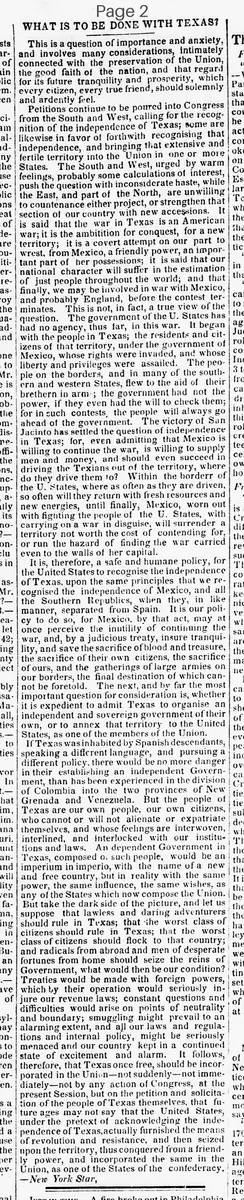
WHAT IS TO BE DONE WITH TEXAS?
This is a question of importance and anxiety, and involves many considerations, intimately connected with the preservation of the Union, the good faith of the nation, and that regard for its future tranquility and prosperity, which every citizen, every true friend, should solemnly and ardently feel.
Petitions continue to be poured into Congress from the South and West, calling for the recognition of the independence of Texas; some are likewise in favor of forthwith recognising that independence, and bringing that extensive and fertile territory into the Union in one or more States. The South and West, urged by warm feelings, probably some calculations of interest, push the question with inconsiderate haste, while the East and part of the North, are unwilling to countenance either project, or strengthen that section of our country with new accessions. It is said that the war in Texas is an American war; it is the ambition for conquest, for a new territory; it is a covert attempt on our part to wrest, from Mexico, a friendly power, an important part of her possessions; it is said that our national character will suffer in the estimation of just people throughout the world; and that finally, we may be involved in war with Mexico, and probably England, before the contest terminates. This is not, in fact, a true view of the question. The government of the U. States has had no agency, thus far, in this war. It began with the people in Texas; the residents and citizens of that territory, under the government of Mexico, whose rights were invaded, and whose liberty and privileges were assailed. The people on the borders, and in many of the southern and western States, flew to the aid of their brethren in arms; the government had not the power, if they even had the will to check them; for in such contests, the people will always go ahead of the government. The victory of San Jacinto has settled the question of independence in Texas; for, even admitting that Mexico is willing to continue the war, is willing to supply men and money, and should even succeed in driving the Texans out of the territory, where do they drive them to? Within the borders of the U. States, where as often as they are driven, so often will they return with fresh resources and new energies, until finally, Mexico, worn out with fighting the people of the U. States, with carrying on a war in disguise, will surrender a territory not worth the cost of contending for, or run the hazard of finding the war carried even to the walls of her capital.
It is, therefore, a safe and humane policy, for the United States to recognise the independence of Texas, upon the same principles that we recognised the independence of Mexico, and all the Southern Republics, when they, in like manner, separated from Spain. It is our policy to do so, for Mexico, by that act, may at once perceive the inutility of continuing the war, and, by a judicious treaty, insure tranquility, and save the sacrifice of blood and treasure, the sacrifice of their own citizens, the sacrifice of ours, and the gatherings of large armies on our borders, the final destination of which cannot be foretold. The next, and by far the most important question for consideration is, whether it is expedient to admit Texas to organise an independent and sovereign government of their own, or to annex that territory to the United States, as one of the members of the Union.
If Texas was inhabited by Spanish descendants, speaking a different language, and pursuing a different policy, there would be no more danger in their establishing an independent Government, than has been experienced in the division of Colombia into the two provinces of New Grenada and Venezuela. But the people of Texas are our own people, our own citizens, who cannot or will not alienate or expatriate themselves, and whose feelings are interwoven, interlined, and interlocked with our institutions and laws. An independent Government in Texas, composed of such people, would be an imperium in imperio, with the name of a new and free country, but in reality with the same power, the same influence, the same wishes, as any of the States which now compose the Union.
But take the dark side of the picture, and let us suppose that lawless and daring adventurers should rule in Texas; that the worst class of citizens should flock to that country; and radicals from abroad and men of desperate fortunes from home should seize the reins of Government, what would then be our condition? Treaties would be made with foreign powers, which by their operation would seriously injure our revenue laws; constant questions and difficulties would arise on points of neutrality and boundary; smuggling might prevail to an alarming extent, and all our laws and regulations and internal policy, might be seriously menaced and our country kept in a continued state of excitement and alarm. It follows, therefore, that Texas once free, should be incorporated in the Union - not suddenly - not immediately - not by any action of Congress, at the present Session, but on the petition and solicitation of the people of Texas themselves, that future ages may not say that the United States, under the pretext of acknowledging the independence of Texas, actually furnished the means of revolution and resistance, and then seized upon the territory, thus conquered from a friendly power, and incorporated the same in the Union, as one of the States of the confederacy.
- New York Star
This is a question of importance and anxiety, and involves many considerations, intimately connected with the preservation of the Union, the good faith of the nation, and that regard for its future tranquility and prosperity, which every citizen, every true friend, should solemnly and ardently feel.
Petitions continue to be poured into Congress from the South and West, calling for the recognition of the independence of Texas; some are likewise in favor of forthwith recognising that independence, and bringing that extensive and fertile territory into the Union in one or more States. The South and West, urged by warm feelings, probably some calculations of interest, push the question with inconsiderate haste, while the East and part of the North, are unwilling to countenance either project, or strengthen that section of our country with new accessions. It is said that the war in Texas is an American war; it is the ambition for conquest, for a new territory; it is a covert attempt on our part to wrest, from Mexico, a friendly power, an important part of her possessions; it is said that our national character will suffer in the estimation of just people throughout the world; and that finally, we may be involved in war with Mexico, and probably England, before the contest terminates. This is not, in fact, a true view of the question. The government of the U. States has had no agency, thus far, in this war. It began with the people in Texas; the residents and citizens of that territory, under the government of Mexico, whose rights were invaded, and whose liberty and privileges were assailed. The people on the borders, and in many of the southern and western States, flew to the aid of their brethren in arms; the government had not the power, if they even had the will to check them; for in such contests, the people will always go ahead of the government. The victory of San Jacinto has settled the question of independence in Texas; for, even admitting that Mexico is willing to continue the war, is willing to supply men and money, and should even succeed in driving the Texans out of the territory, where do they drive them to? Within the borders of the U. States, where as often as they are driven, so often will they return with fresh resources and new energies, until finally, Mexico, worn out with fighting the people of the U. States, with carrying on a war in disguise, will surrender a territory not worth the cost of contending for, or run the hazard of finding the war carried even to the walls of her capital.
It is, therefore, a safe and humane policy, for the United States to recognise the independence of Texas, upon the same principles that we recognised the independence of Mexico, and all the Southern Republics, when they, in like manner, separated from Spain. It is our policy to do so, for Mexico, by that act, may at once perceive the inutility of continuing the war, and, by a judicious treaty, insure tranquility, and save the sacrifice of blood and treasure, the sacrifice of their own citizens, the sacrifice of ours, and the gatherings of large armies on our borders, the final destination of which cannot be foretold. The next, and by far the most important question for consideration is, whether it is expedient to admit Texas to organise an independent and sovereign government of their own, or to annex that territory to the United States, as one of the members of the Union.
If Texas was inhabited by Spanish descendants, speaking a different language, and pursuing a different policy, there would be no more danger in their establishing an independent Government, than has been experienced in the division of Colombia into the two provinces of New Grenada and Venezuela. But the people of Texas are our own people, our own citizens, who cannot or will not alienate or expatriate themselves, and whose feelings are interwoven, interlined, and interlocked with our institutions and laws. An independent Government in Texas, composed of such people, would be an imperium in imperio, with the name of a new and free country, but in reality with the same power, the same influence, the same wishes, as any of the States which now compose the Union.
But take the dark side of the picture, and let us suppose that lawless and daring adventurers should rule in Texas; that the worst class of citizens should flock to that country; and radicals from abroad and men of desperate fortunes from home should seize the reins of Government, what would then be our condition? Treaties would be made with foreign powers, which by their operation would seriously injure our revenue laws; constant questions and difficulties would arise on points of neutrality and boundary; smuggling might prevail to an alarming extent, and all our laws and regulations and internal policy, might be seriously menaced and our country kept in a continued state of excitement and alarm. It follows, therefore, that Texas once free, should be incorporated in the Union - not suddenly - not immediately - not by any action of Congress, at the present Session, but on the petition and solicitation of the people of Texas themselves, that future ages may not say that the United States, under the pretext of acknowledging the independence of Texas, actually furnished the means of revolution and resistance, and then seized upon the territory, thus conquered from a friendly power, and incorporated the same in the Union, as one of the States of the confederacy.
- New York Star
What sub-type of article is it?
Politics
What keywords are associated?
Texas Independence
Annexation Debate
Us Mexico Relations
Congress Petitions
San Jacinto Victory
Where did it happen?
Texas
Domestic News Details
Primary Location
Texas
Event Details
Editorial argues for US recognition of Texas independence following San Jacinto victory, similar to recognition of other republics from Spain, to end war humanely; debates annexation versus independent government, favoring eventual incorporation on Texas petition to avoid perceptions of conquest and prevent instability from adventurers.