Thank you for visiting SNEWPapers!
Sign up free
The New York Journal, And Daily Patriotic Register
New York, New York County, New York
What is this article about?
An anti-Federalist essay critiquing the proposed U.S. Constitution, arguing against its centralization of power, lack of unanimity in the convention, threats to liberty including taxation without representation, senate structure, militia control, and amendment difficulties. Warns of despotism and civil war if adopted, praises confederation.
Merged-components note: Sequential reading orders and continuous text flow indicate these are parts of the same long editorial on the proposed constitution.
Clipping
OCR Quality
Full Text
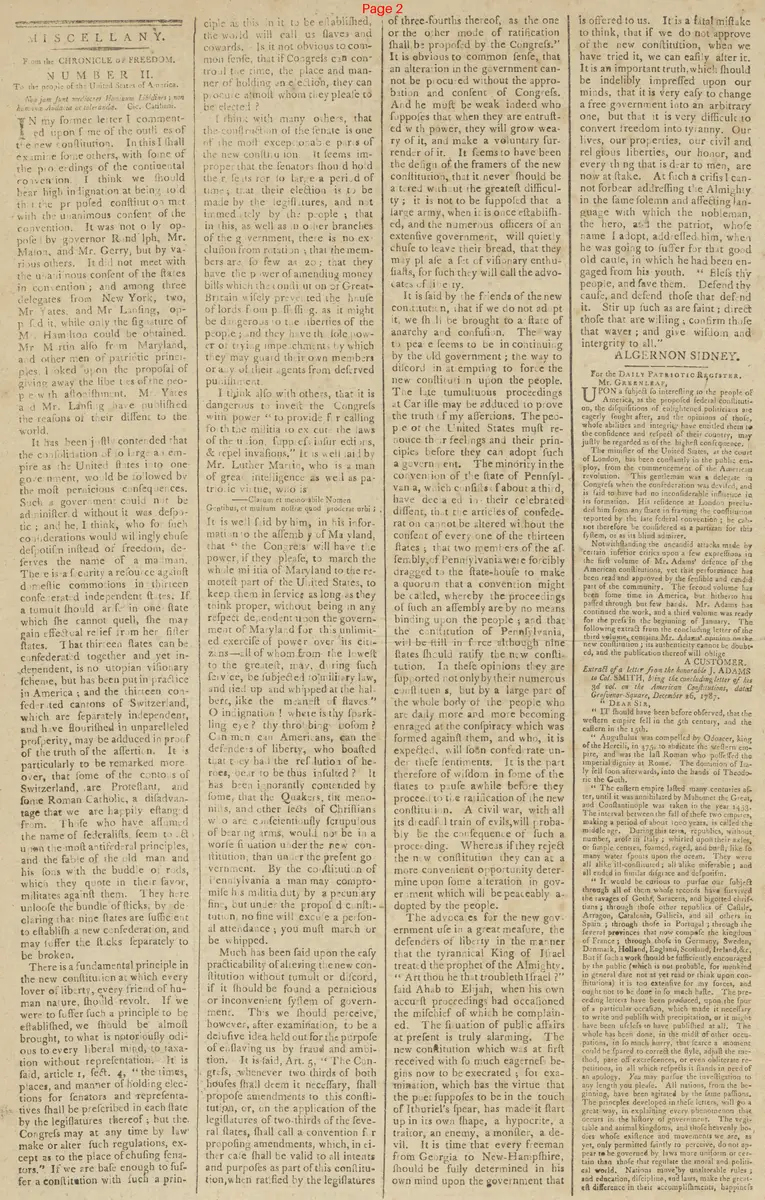
From the CHRONICLE OF FREEDOM.
NUMBER II.
To the people of the United States of America.
Non jam sunt mediocres Hominum Libidines; non
hum inc Auda ia ac toleranda. Cic. Catilin.
In my former letter I commented
upon some of the outlines of
the new constitution. In this I shall
examine some others, with some of
the proceedings of the continental
convention. I think we should
bear high indignation at being told
that the proposed constitution met
with the unanimous consent of the
convention. It was not only opposed
by governor Randolph, Mr.
Mason, and Mr. Gerry, but by various
others. It did not meet with
the unanimous consent of the states
in convention; and among three
dele gates from New York, two,
Mr. Yates and Mr. Lansing, opposed
it, while only the signature of
Mr. Hamilton could be obtained.
Mr. Martin also from Maryland,
and other men of patriotic principles,
looked upon the proposal of
giving away the liberties of the people
with astonishment. Mr. Yates
and Mr. Lansing have published
the reasons of their dissent to the
world.
It has been justly contended that
the consolidation of our large empire
as the United States into one
government, would be followed by
the most pernicious consequences.
Such a government could not be
administered without it was despotic;
and he, I think, who for such
considerations would willingly choose
despotism instead of freedom, deserves
the name of a madman.
There is a security a resource against
domestic commotions in thirteen
confederated independent states. If
a tumult should arise in one state
which she cannot quell, she may
gain effectual relief from her sister
states. That thirteen states can be
confederated together and yet independent,
is no utopian visionary
scheme, but has been put in practice
in America; and the thirteen confederated
cantons of Switzerland,
which are separately independent,
and have flourished in unparalleled
prosperity, may be adduced in proof
of the truth of the assertion. It is
particularly to be remarked moreover, that some of the cantons of
Switzerland, are Protestant, and
some Roman Catholic, a disadvantage that we are happily estranged
from. Those who have assumed
the name of federalists, seem to act
upon the most antifederal principles,
and the fable of the old man and
his sons with the bundle of rods,
which they quote in their favor,
militates against them. They here
unloose the bundle of sticks, by declaring that nine states are sufficient
to establish a new confederation, and
may suffer the sticks separately to
be broken.
There is a fundamental principle in
the new constitution at which every
lover of liberty, every friend of human
nature, should revolt. If we
were to suffer such a principle to be
established, we should be almost
brought, to what is notoriously odious
to every liberal mind, to taxation
without representation. It is
said, article I, sect. 4, "the times,
places, and manner of holding elections
for senators and representatives
shall be prescribed in each state
by the legislatures thereof; but the
Congress may at any time by law
make or alter such regulations, except
as to the place of choosing Senators."
If we are base enough to suffer
a constitution with such a principle
as this in it to be established,
the world will call us slaves and
cowards. Is it not obvious to common
sense, that if Congress can control
the time, the place and manner
of holding an election, they can
procure a most whom they please to
be elected?
I think with many others, that
the constitution of the senate is one
of the most exceptionable parts of
the new constitution it seems improper
that the senators should hold
their seats for so large a period of
time; that their election is to be
made by the legislatures, and not
immediately by the people; that
in this, as well as in other branches
of the government, there is no exclusion
from rotation: that the members
are so few as 24; that they
have the power of amending money
bills which the constitution of Great-
Britain wisely prevented the house
of lords from passing, as it might
be dangerous to the liberties of the
people; and they have the sole power
of trying impeachment, by which
they may guard their own members
or any of their agents from deserved
punishment
I think also with others, that it is
dangerous to invest the Congress
with power "to provide for calling
forth the militia to execute the laws
of the union, suppress insurrections,
& repel invasions." It is well said by
Mr. Luther Martin, who is a man
of great intelligence as well as patriotic
virtue, who is
Clarum et venerabile Nomen
Gentibus, et multum nostrae quod prodidit urbis
It is well said by him, in his information
to the assembly of Maryland,
that "the Congress will have the
power, if they please, to march the
whole militia of Maryland to the remotest
part of the United States, to
keep them in service as long as they
think proper, without being in any
respect dependent upon the government
of Maryland for this unlimited
exercise of power over its citizens-all
of whom from the lowest
to the greatest, may, during such
service, be subjected to military law.
and tied up and whipped at the halberd,
like the meanest of slaves."
O indignation! where is thy sparkling
eye? thy throbbing bosom?
Can man can Americans, can the
defenders of liberty, who boasted
that they had the resolution of heroes,
bear to be thus insulted? It
has been ignorantly contended by
some, that the Quakers, the mennonites,
and other sects of Christians
who are conscientiously scrupulous
of bearing arms, would not be in a
worse situation under the new constitution,
than under the present government.
By the constitution of
Pennsylvania a man may compromise
his militia duty by a pecuniary
fine, but under the proposed constitution,
no fine will excuse a personal
attendance; you must march or
be whipped.
Much has been said upon the easy
practicability of altering the new constitution
without tumult or discord.
if it should be found a pernicious
or inconvenient system of government.
This we should perceive,
however, after examination, to be a
delusive idea held out for the purpose
of enslaving us by fraud and ambition.
It is said, Art. 5, The Congress,
whenever two thirds of both
houses shall deem it necessary, shall
propose amendments to this constitution,
or, on the application of the
legislatures of two-thirds of the several
states, shall call a convention for
proposing amendments, which, in either
case shall be valid to all intents
and purposes as part of this constitution,
when ratified by the legislatures
of three-fourths thereof. as the one
or the other mode of ratification
shall,be proposed by the Congress."
It is obvious to common sense, that
an alteration in the government cannot
be procured without the approbation
and consent of Congress.
And he must be weak indeed who
supposes that when they are entrusted
with power, they will grow weary
of it, and make a voluntary surrender
of it. It seems to have been
the design of the framers of the new
constitution, that it never should be
altered without the greatest difficulty;
it is not to be supposed that a
large army, when it is once established,
and the numerous officers of an
extensive government, will quietly
choose to leave their bread, that they
may place a set of visionary enthusiasts,
for such they will call the advocates
of liberty.
It is said by the friends of the new
constitution, that if we do not adopt
it, we shall be brought to a state of
anarchy and confusion. The way
to peace seems to be in continuing
by the old government; the way to
discord in attempting to force the
new constitution upon the people.
The late tumultuous proceedings
at Carlisle may be adduced to prove
the truth of my assertions. The people
of the United States must renounce
their feelings and their principles
before they can adopt such
a government. The minority in the
convention of the state of Pennsylvania,
which consists fabout a third.
have declared in their celebrated
dissent, that the articles of confederation
cannot be altered without the
consent of every one of the thirteen
states: that two members of the assembly,
of Pennsylvania were forcibly
dragged to the state-house to make
a quorum that a convention might
be called, whereby the proceedings
of such an assembly are by no means
binding upon the people; and that
the constitution of Pennsylvania,
will be still in force although nine
states should ratify the new constitution.
In these opinions they are
supported not only by their numerous
constituents, but by a large part
of the whole body of the people who
are daily more and more becoming
enraged at the conspiracy which was
formed against them, and who, it is
expected, will soon confederate under
these sentiments. It is the part
therefore of wisdom in some of the
states to pause awhile before they
proceed to the ratification of the new
constitution.A civil war, with all
its dreadful train of evils, will probably
be the consequence of such a
proceeding. Whereas if they reject
the new constitution they can at a
more convenient opportunity determine
upon some alteration in government
which will be peaceably adopted
by the people.
The advocates for the new government
use in a great measure, the
defenders of liberty in the manner
that the tyrannical King of Israel
treated the prophet of the Almighty.
"Art thou he that troubleth Israel?"
said Ahab to Elijah, when his own
accursed proceedings had occasioned
the mischief of which he complained.
The situation of public affairs
at present is truly alarming. The
new constitution which was at first
received with so much eagerness begins
now to be execrated; for examination,
which has the virtue that
the poet supposes to be in the touch
of Ithuriel's spear, has made it start
up in its own shape, a hypocrite, a
traitor, an enemy, a monster, a devil.
It is time that every freeman
from Georgia to New-Hampshire.
should be fully determined in his
own mind upon the government that
is offered to us. It is a fatal mistake
to think, that if we do not approve
of the new constitution, when we
have tried it, we can easily alter it.
It is an important truth, which should
be indelibly impressed upon our
minds. that it is very easy to change
a free government into an arbitrary
one, but that it is very difficult to
convert freedom into tyranny. Our
lives, our properties, our civil and
religious liberties, our honor, and
every thing that is dear to men, are
now at stake. At such a crisis I cannot
forbear addressing the Almighty
in the same solemn and affecting language
with which the nobleman.
the hero, ar the patriot, whose
name I adopt, addressed him, when
he was going to suffer for that good
old cause, in which he had been engaged
from his youth. Bless thy
people, and save them. Defend thy
cause, and defend those that defend
it. Stir up such as are faint; direct
those that are willing; confirm those
that waver; and give wisdom and
integrity to all."
ALGERNON SIDNEY.
What sub-type of article is it?
What keywords are associated?
What entities or persons were involved?
Editorial Details
Primary Topic
Opposition To The Proposed U.S. Constitution And Federal Consolidation
Stance / Tone
Strongly Anti Federalist, Warning Of Despotism And Loss Of Liberty
Key Figures
Key Arguments