Thank you for visiting SNEWPapers!
Sign up free
University Missourian
Columbia, Boone County, Missouri
What is this article about?
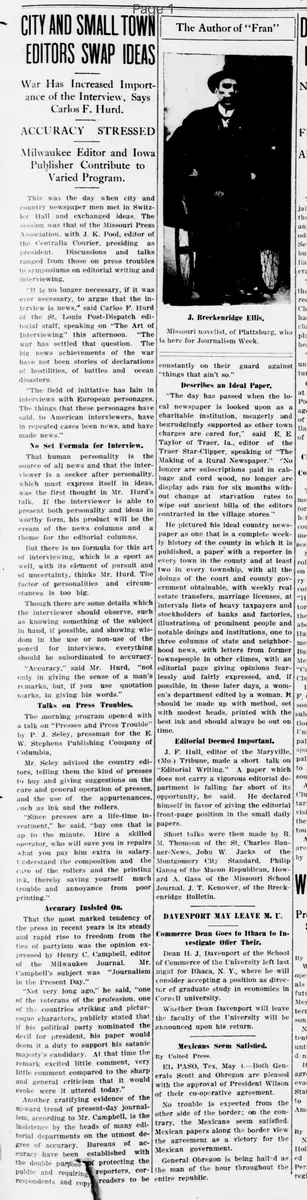
Missouri Press Association meeting in Switzler Hall features discussions on interviewing by Carlos F. Hurd, press troubles by P. J. Seley, journalism trends by Henry C. Campbell, rural newspapers by E. E. Taylor, and editorial writing by J. F. Hull, emphasizing accuracy and independence.
Merged-components note: Merged two spatially adjacent parts of the same article covering the Missouri Press Association session talks.
Clipping
OCR Quality
Full Text
EDITORS SWAP IDEAS
War Has Increased Importance of the Interview, Says Carlos F. Hurd.
ACCURACY STRESSED
Milwaukee Editor and Iowa Publisher Contribute to Varied Program.
This was the day when city and country newspaper men met in Switzler Hall and exchanged ideas. The session was that of the Missouri Press Association, with J. K. Pool, editor of the Centralia Courier, presiding as president.
Discussions and talks ranged from those on press troubles to symposiums on editorial writing and interviewing.
"It is no longer necessary, if it was ever necessary, to argue that the interview is news," said Carlos F. Hurd of the St. Louis Post-Dispatch editorial staff, speaking on "The Art of Interviewing" this afternoon.
"The war has settled that question. The big news achievements of the war have not been stories of declarations of hostilities, of battles and ocean disasters.
"The field of initiative has lain in interviews with European personages. The things that these personages have said, to American interviewers, have in repeated cases been news, and have made news."
No Set Formula for Interview.
That human personality is the source of all news and that the interviewer is a seeker after personality, which must express itself in ideas, was the first thought in Mr. Hurd's talk. If the interviewer is able to present both personality and ideas in worthy form, his product will be the cream of the news columns and a theme for the editorial columns.
But there is no formula for this art of interviewing, which is a sport as well, with its element of pursuit and of uncertainty, thinks Mr. Hurd. The factor of personalities and circumstances is too big.
Though there are some details which the interviewer should observe, such as knowing something of the subject in hand, if possible, and showing wisdom in the use or non-use of the pencil for interviews, everything should be subordinated to accuracy.
"Accuracy," said Mr. Hurd, "not only in giving the sense of a man's remarks, but, if you use quotation marks, in giving his words."
Talks on Press Troubles.
The morning program opened with a talk on "Presses and Press Trouble" by P. J. Seley, pressman for the E. W. Stephens Publishing Company of Columbia.
Mr. Seley advised the country editors, telling them the kind of presses to buy and giving suggestions on the care and general operation of presses, and the use of the appurtenances, such as ink and the rollers.
"Since presses are a life-time investment," he said, "buy one that is up to the minute. Hire a skilled operator, who will save you in repairs what you pay him extra in salary. Understand the composition and the care of the rollers and the printing ink, thereby saving yourself much trouble and annoyance from poor printing."
Accuracy Insisted On.
That the most marked tendency of the press in recent years is its steady and rapid rise to freedom from the ties of partvism was the opinion expressed by Henry C. Campbell, editor of the Milwaukee Journal.
Mr. Campbell's subject was "Journalism in the Present Day."
"Not very long ago," he said, "one of the veterans of the profession, one of the country's striking and picturesque characters, publicly stated that if his political party nominated the devil for president, his paper would deem it a duty to support his satanic majesty's candidacy. At that time the remark excited little comment, very little comment compared to the sharp and general criticism that it would evoke were it uttered today."
Another gratifying evidence of the upward trend of present-day journalism, according to Mr. Campbell, is the insistence by the heads of many editorial departments on the utmost degree of accuracy.
Bureaus of accuracy have been established with the double purpose of protecting the public and requiring reporters, correspondents and copy readers to be constantly on their guard against "things that ain't so."
Describes an Ideal Paper.
"The day has passed when the local newspaper is looked upon as a charitable institution, meagerly and begrudgingly supported as other town charges are cared for," said E. E. Taylor of Traer, Ia., editor of the Traer Star-Clipper, speaking of "The Making of a Rural Newspaper." "No longer are subscriptions paid in cabbage and cord wood, no longer are display ads run for six months without change at starvation rates to wipe out ancient bills of the editors contracted in the village stores."
He pictured his ideal country newspaper as one that is a complete weekly history of the county in which it is published, a paper with a reporter in every town in the county and at least two in every township, with all the doings of the court and county government obtainable, with weekly real estate transfers, marriage licenses, at intervals lists of heavy taxpayers and stockholders of banks and factories, illustrations of prominent people and notable doings and institutions, one to three columns of state and neighborhood news, with letters from former townspeople in other climes, with an editorial page giving opinions fearlessly and fairly expressed, and, if possible, in these later days, a woman's department edited by a woman. It should be made up with method, set with modest heads, printed with the best ink and should always be out on time.
Editorial Deemed Important.
J. F. Hull, editor of the Maryville (Mo.) Tribune, made a short talk on "Editorial Writing."
A paper which does not carry a vigorous editorial department is falling far short of its opportunity, he said.
He declared himself in favor of giving the editorial front-page position in the small daily papers.
Short talks were then made by R. M. Thomson of the St. Charles Banner-News, John W. Jacks of the Montgomery City Standard, Philip Gansz of the Macon Republican, Howard A. Gass of the Missouri School Journal, J. T. Kenower of the Breckenridge Bulletin.
What sub-type of article is it?
What themes does it cover?
What keywords are associated?
What entities or persons were involved?
Where did it happen?
Story Details
Key Persons
Location
Switzler Hall, Missouri
Story Details
Editors from city and small towns meet at Missouri Press Association session to discuss interviewing, press maintenance, journalism's rise to independence and accuracy, ideal rural newspapers, and editorial writing.