Thank you for visiting SNEWPapers!
Sign up free
Gazette Of The United States And Daily Evening Advertiser
Philadelphia, Philadelphia County, Pennsylvania
What is this article about?
In the British House of Commons on February 26, William Wilberforce moved to renew a 1792 resolution abolishing the slave trade to the West Indies after January 1, 1796. He cited moral, civilizational, and practical arguments against the trade. Opponents like Dundas and Barham argued for delay due to colonial interests and war. The motion was defeated 78-61.
Merged-components note: These two components continue the same article on the British House of Commons debate regarding the slave trade, with sequential reading orders across pages.
Clippings
1 of 2
OCR Quality
Full Text
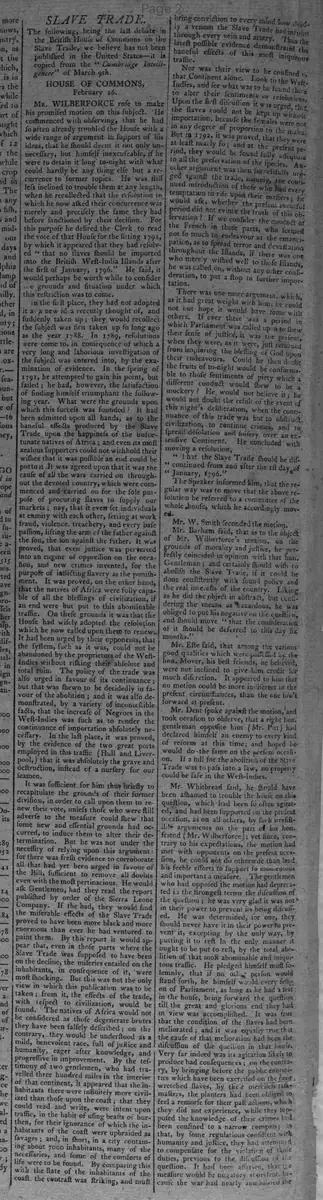
HOUSE OF COMMONS,
February 26.
Mr. WILBERFORCE rose to make his promised motion on this subject. He commenced with observing, that he had so often already troubled the House with a wide range of argument in support of his ideas, that he should deem it not only unnecessary, but himself inexcusable, if he were to detain it long to-night with what could hardly be any thing else but a recurrence to former topics. He was still less inclined to trouble them at any length, when he recollected that the resolution to which he now asked their concurrence was merely and precisely the same they had before sanctioned by their decision. For this purpose he desired the Clerk to read the vote of that House for the sitting 1792, by which it appeared that they had resolved "that no slaves should be imported into the British West-India Islands after the first of January, 1796." He said, it would perhaps be worth while to consider the grounds and situation under which this restriction was to come.
In the first place, they had not adopted it as a new idea recently thought of, and suddenly taken up; they would recollect the subject was first taken up so long ago as the year 1788. In 1789, resolutions were come to, in consequence of which a very long and laborious investigation of the subject was entered into, by the examination of evidence. In the spring of 1791, he attempted to gain his point, but failed; he had, however, the satisfaction of finding himself triumphant the following year. What were the grounds upon which this success was founded? It had been admitted upon all hands, as to the baneful effects produced by the Slave Trade upon the happiness of the unfortunate natives of Africa; and even its most zealous supporters could not withhold their wishes that it was possible an end could be put to it. It was agreed upon that it was the cause of all the wars carried on throughout the devoted country, which were commenced and carried on for the sole purpose of procuring slaves to supply our markets; nay, that it even set individuals at enmity with each other, setting at work fraud, violence, treachery, and every base passion, lifting the arm of the father against the son, the son against the father. It was proved, that even justice was perverted into an engine of oppression on the occasion, and new crimes invented, for the purpose of inflicting slavery as the punishment. It was proved, on the other hand, that the natives of Africa were fully capable of all the blessings of civilization, if an end were but put to this abominable traffic. On these grounds it was that the House had wisely adopted the resolution which he now called upon them to renew.
It had been urged by their opponents, that the system, such as it was, could not be abandoned by the proprietors of the West-Indies without risking their absolute and total ruin. The policy of the trade was also urged in favour of its continuance; but that was shown to be decidedly in favour of the abolition; and it was also demonstrated, by a variety of incontestable facts, that the increase of Negroes in the West-Indies was such as to render the continuance of importation absolutely necessary. In the last place, it was proved, by the evidence of the two great ports employed in this traffic (Hull and Liverpool,) that it was absolutely the grave and destruction, instead of a nursery for our seamen.
It was sufficient for him thus briefly to recapitulate the grounds of their former division, in order to call upon them to renew their vote, unless those who were still adverse to the measure could show that some new and essential grounds had occurred, to induce them to alter their determination. But he was not under the necessity of relying upon this argument: for there was fresh evidence to corroborate all that had yet been urged in favour of the Bill, sufficient to remove all doubts even with the most pertinacious. He would ask Gentlemen, had they read the report published by order of the Sierra Leone Company. If they had, they would find the miserable effects of the Slave Trade proved to have been more black and more enormous than ever he had ventured to paint them. By this report it would appear that, even in those parts where the Slave Trade was supposed to have been on the decline, the miseries entailed on the inhabitants, in consequence of it, were most shocking. But this was not the only view in which this publication was to be taken; from it, the effects of the trade, with respect to civilization, would be found. The natives of Africa would not be considered as those degenerate brutes they have been falsely described; on the contrary, they would be understood as a mild, benevolent race, full of justice and humanity, eager after knowledge, and progressive in improvement. By the testimony of two gentlemen, who had travelled three hundred miles in the interior of that continent, it appeared that the inhabitants there were infinitely more civilized than those upon the coast; that they could read and write, were intent upon traffic, in the habit of using beasts of burden, for their ignorance of which the inhabitants of the coast were upbraided as savages; and, in short, in a city containing about 7000 inhabitants, many of the necessaries, and some of the comforts of life were to be found. By comparing this with the state of the inhabitants of the coast, the contrast was striking, and must bring conviction to every mind how deadly a venom the Slave Trade had infused through every vein and artery. Thus the latest possible evidence demonstrated the baneful effects of this most iniquitous traffic.
Nor was their view to be confined to that Continent alone. Look to the West-Indies, and see what was to be found there to alter their sentiments or resolutions. Upon the first discussion it was urged, that the slaves could not be kept up without importation, because the females were not in any degree of proportion to the males. But in 1792, it was proved, that they were at least nearly so; and at the present period, they would be found fully adequate to all the preservation of the species. Another argument was then successfully urged against the trade, namely, the continued introduction of those who had every temptation to rise upon their masters; he would ask, whether the present eventful period did not evince the truth of this observation? If we consider the conduct of the French in those parts, who seemed not so much to endeavour at the emancipation, as to spread terror and devastation throughout the Islands, if there was one who merely wished well to those Islands, he was called on, without any other consideration, to put a stop to further importation.
There was one more argument, which, as it had great weight with him, he could not but hope it would have some with others. If ever there was a period in which Parliament was called upon to show their sense of justice, it was the present, when they were, as it were, just returned from imploring the blessing of God upon their endeavours. Could he then doubt the fruits of to-night would be conformable to those sentiments of piety which a different conduct would show to be a mockery? He would not believe it; he would not doubt the result of the event of this night's deliberation, when the continuance of this trade was but to obstruct civilization, to continue crimes, and to spread desolation and misery over an extensive Continent. He concluded with moving a resolution,
"That the Slave Trade should be discontinued from and after the 1st day of January, 1796."
The Speaker informed him, that the regular way was to move that the above resolution be referred to a committee of the whole house, which he accordingly moved.
Mr. W. Smith seconded the motion.
Mr. Barham said, that as to the object of Mr. Wilberforce's motion, on the grounds of morality and justice, he perfectly coincided in opinion with that hon. Gentleman; and certainly should wish to abolish the Slave Trade, if it could be done consistently with sound policy and the real interests of the country. Liking as he did the object in abstract, but considering the means as hazardous, he was obliged to put his negative on the question, and should move "that the consideration of it should be deferred to this day six months."
Mr. Fox said, that among the various good qualities which were possessed by the hon. Mover, his best friends, he believed, were not inclined to give him credit for much discretion. It appeared to him that no motion could be more indiscreet in the present circumstances, than the one brought forward at present.
Mr. Dent spoke against the motion, and took occasion to observe, that a right hon. gentleman opposite him (Mr. Pitt) had declared himself an enemy to every kind of reform at this time; and hoped he would do the same on the present occasion. If a bill for the abolition of the Slave Trade was to pass into a law, no property could be safe in the West-Indies.
Mr. Whitbread said. he should have been ashamed to trouble the house on this question, which had been so often agitated, and had been supported on the present occasion, as on all others, by such irresistible arguments on the part of his hon. friend (Mr. Wilberforce); yet since, contrary to his expectations, the motion had met with opponents on the present occasion, he could not do otherwise than lend his feeble efforts to support so momentous and important a measure. The gentlemen who had opposed the motion had deprecated in the strongest terms the discussion of the question; he was very glad it was not in their power to prevent its being discussed. He was determined, for one, they should never have it in their power to prevent it, excepting by the only way, by putting it to rest in the only manner it ought to be put to rest, by the total abolition of that most abominable and iniquitous traffic. He pledged himself most solemnly, that if no other person would stand forth, he himself would every session of Parliament. as long as he had a seat in the house, bring forward the question till the great and glorious end they had in view was accomplished. 'It was true that the condition of the slaves had been meliorated; and it was equally true that the cause of that melioration had been the discussion of the question in that house. Very far indeed was its agitation likely to produce bad consequences; on the contrary, by bringing before the public enormities which have been exercised on the poor, wretched slaves, by their merciless task masters, the planters had been obliged to feel a remorse for their past actions, which they did not experience, while they supposed the knowledge of their crimes had been confined to a narrow compass; so that, by some regulations consistent with humanity and justice, they had attempted to compensate for the violation of those duties, previous to the discussion of the question. It had been asserted, that the measure would be nugatory at present. be- cause the war had nearly annihilated the
It is difficult; if this were true, as he hoped it was, one natural consideration offered itself instantaneously to the mind. Every person, without distinction of party, during a war, looked forward to peace; but how must the joy, which every one would experience in the re-establishment of that by so happy an event, all the horrors of peace, be damped by the rejection, in Africa would be renewed; that all the devastation and iniquity, exercised on the unfortunate inhabitants of that devoted country, would be reinstated in full vigor.
It should be considered, the power of the Almighty Disposer of all things was not merely confined to Europe, but that his Omnipotence and Goodness spread itself equally over Asia and Africa; and that if this country did not wipe out the foul stain unequalled by any which the human mind could picture to itself. It had been recommended to the house to wait till the Lords had made their communications to the house on the subject; he was not surprised that this should be recommended by the friends to the Slave Trade; for if they were to wait till that distant period, he would not say when, for no period could be assigned at which any reasonable expectations, from the conduct of the Lords, could be formed that they would finish their examination of the business, he was afraid no good end could be answered. He had a statement in his hand, extracted from the Journals of the Lords, by which it appeared that in three years they had devoted only fourteen days to the examination of this most important subject. The House of Commons, he hoped, were not so lost to all sense of shame as the Lords appeared to be—
Mr. Whitbread was here called to order. He repeated his words, and was again called to order.]
He then proceeded: that he wished it were possible to refute, by facts, the statement he held in his hand, and, consistently with the forms, he must say, that if he should find in the Journals of the Lords, that in the first year of their consideration on the subject, they had employed only six days, and examined only seven witnesses; that in the next Session they had employed five days, and examined other seven witnesses; and in the third Session, had employed three days, and examined two witnesses; he should say that it would in the highest degree be disgraceful to them.
There was no way, he said, of forcing the Lords to do justice to the question, unless they were called on by the house of Commons by repeated discussions. The house of Lords were afraid of entering into it, because they knew—Mr. Whitbread was again called to order.
The Speaker said, he was sure the hon. gentleman would be convinced of the impropriety of such language.
Mr. Whitbread said, he was very sorry to mention with disapprobation, any branch of the Legislature; and though he should not repeat his words, no favourable inference could be drawn from their conduct.
Alderman Newnham said he would oppose the motion then, as he probably might not be in the house in the course of another session, when the subject should come to be discussed again. The delay which had been given to it by the Lords was highly to their honor; and he wished they had negatived the question all at once. The promoters of the business did not at first say that they wanted an abolition, but meant as if they said, "We will coax you on to it." He could not tell what advantages the hon. mover proposed to himself in the other world, by persisting in this plan of abolition; but on his part, he was certain that it was injurious both to the slaves themselves in the West Indies, and to the Africans who should happen to be seized and carried thither; for they were all at present better off than the poor of this country.
Mr. W. Smith, said, that one very strange and novel assertion had been made by the last speaker, who was perhaps the only gentleman who could not give it a direct negative. His memory must have failed him, as much as the memory of another person had of late failed him, or he must have recollected, that from the beginning it was explicitly avowed, that the total abolition was the object of the hon. mover and his supporters. He could account for the confusion, however; because he had observed, that every person on the opposite side had argued on the supposition of immediate emancipation, and applied those arguments to the abolition. As to the melioration in the condition of slaves, it was a remarkable proof of the good effects of this discussion, because if gentlemen would look to the code of the West India laws previous to the discussion, they would find that there was but one spirit in them all; that instead of being for the slaves, they were all against them; but that the humane and wise provisions in that code bore date nearly with the first discussion of the question in the house.
Mr. Fox said, that the importance of the question before them, which he felt more strongly than almost any question to which he had applied his faculties, would not permit him to give a mere silent vote on the present occasion. He must always oppose, with every argument in his power, every notion of attempting to restrain the exercise of vicious powers by regulation without abolition; and till must he be of opinion, that regulating injustice, and legalizing murder, would, be doing the most disgraceful act of which the Legislature could be guilty, was abandoning the principles of morality and justice, the only proper foundations of every good Government. The assertion that murder itself might be regulated, and not prohibited, if any good could be supposed to result from it, he absolutely denied to be just: for no speculative moral advantage resulting from any relation to society, in any code whatever, could justify a legislature in countenancing so horrid a crime as murder, so subversive of every principle of morality and humanity. It was well known that there were nations of Cannibals who fed on human flesh. would the hon. gentleman think himself justified; because he thought if he purchased men and sold them to those Cannibals for the horrid purpose, that fewer were likely to be destroyed? or would any man, with the proper feelings of humanity, think himself justified in making such a purchase, or venture to recommend it to a legislature to give their sanction to such a measure? The speculative advantage would be infinitely overbalanced by the destruction of every moral principle. If the slave trade were abolished by the house one of the greatest evils would be destroyed, by removing the moral guilt of a Legislature sanctioning a traffic which violated every principle of humanity and justice. He was very happy to see, that no person defended the trade itself on the present occasion; but even the opposers of the motion allowed it to be proper on principles of morality and justice. The mover of the amendment had stated his object to be the same, but had differed as to the time and means of attaining the object. It had been asked, why interfere with the Lords? Notwithstanding he wished to speak with respect of that branch of the legislature, yet he could not help adverting to the Statement of their conduct.
They might have their reasons, which he should not attempt to investigate; but it was matter of surprise, that at the latter end of the first session, in which this business had been before them, they had employed more time, than in any subsequent session, on the consideration of it. In that they had employed six days, in the next five, and in the third session three; if they meant to go on in the same proportion, he should wish to know what fraction of a day they would employ in the next session. It had been said, that it was expected the House would come to their senses by the year 1796; this idea of the House thinking themselves mad, and expecting to recover their senses at a given time, was the most singular species of insanity that he ever recollected. There might be a sense, however, put upon it, which he should wish to have considered, whether it were fair and honourable. A great number of petitions lay on the table of the House, from every part of England, in favour of the Abolition. Was it meant then merely to get rid of these petitions without ever meaning to perform the engagements entered into? He hoped and trusted no such thing.
If, however, the House rejected the motion, such an interpretation was by no means improbable; and he knew no argument more serious, and particularly when applied to a public body, which like a Legislature, depended on public opinion; it was particularly incumbent on such a body to preserve a fair character and estimation in the public mind. One argument of the Hon. Mover had not been answered, respecting the state of the islands, and the probability of the French arming the blacks; if we meant to oppose them with success, similar means must be adopted, and that could not be effected but by inspiring confidence, through humanity and benevolence. Every new importation was an importation of so much weakness, so much rebellion, so much revolt; so many enemies who were roused to revenge insults and injuries, fresh in their memory, before they could have any conception of the good treatment they might experience. It had been said, that the Negroes were happier than our own poor; it would then be better, if it were true, to send some of our own subjects there; particularly as the Negroes did not seem to have a taste for the happiness so much boasted!—
He concluded with observing, that even if we failed of the good effects to be expected from the measure, one great point would be gained—we should wipe away the disgrace of encouraging so horrible a traffic; and pressing, in several strong points of view, the consideration of the honor of the Legislature and the country, as involved in the decision of the question; as mankind were usually led by the authority of example and assumed a character from the character of their Legislators.
Mr. Secretary Dundas rose to oppose the motion. He said, that in the outset of the business he had the good or ill fortune, he did not know which to call it, to disagree in opinion with both parties. Those who supported the proposition, and those who opposed it, had each of them gone into the extreme.— The one party had advanced, that if you did not immediately abolish the Slave Trade, you struck at the root of justice, you revolted humanity, and you gave countenance to the most detestable tyranny and oppression. On the other hand, it was said, that if you do abolish the Slave Trade, you will be guilty of the greatest injustice to the West-India Planters—you would ruin their property, and bring destruction on the whole Colonies and those who are materially interested in them. For his own part, the Right Hon. Gentleman said, he had steered a middle course. Viewing the question in a calm, cool and deliberate manner, he had from the first been of opinion. that an abolition of the Slave Trade would turn out ultimately for the benefit and advantage of the West India Islands, provided it could be done in a gradual and progressive manner, by such degrees, and, at such time, as should give the proprietors of lands and Negroes in them, the necessary opportunities of making due preparation, and accommodating themselves to their situation, in the best possible manner that to each should seem best.
Mr. Pitt, differing, as he said he did with his Right Honorable Friend in many points in the present subject of debate it gave him the most sincere satisfaction to hear him declare in the open and unequivocal manner he had done, that he was thoroughly convinced the abolition of the Slave Trade would ultimately be best the Colonies whenever it could be brought forward in a gradual way. He could wish he was as well satisfied of the conviction of the minds of those persons for whom, and for whose interests, his Right Honourable. Friend had so eminently exerted himself, His Right Hon. Friend grounded his argument on three heads, which he recapitulated as stated above. The first, he said, he was enabled to controvert in the most positive manner. His Right Hon. Friend stated, "that the war had so far suspended the slave Trade, as to prevent the Plan- ters from obtaining the importation of the necessary number of fresh Negroes, as should enable them to keep up their stock after the importation ceased." Whereas he knew the reverse was the case, and though the time had been short before the war broke out, he had accounts of the numbers they had im- ported, which indubitably proved that they had imported greater numbers in that time than they had ever done upon an average in the same space of time passed by the resolution, and had therefore had all the benefit which it was intended by the resolution to give them. He combated the other arguments of the Right Hon. Secretary, particularly that of the danger which might result from the French Emissaries instilling into the minds of the negroes in the British islands that the Legislature were more atten- tive to the interests of their negroes in Africa than to theirs. He said, that even allowing this might be the case, yet the actual importation of new ne- groes into the Colonies, was pregnant with infinitely greater danger; as he would much rather have to contend a- gainst the weight of opinions than he would against that of actual force, it be- ing allowed on all hands, that new im- ported negroes were the enemies most to be dreaded of any that could be intro- duced into the Colonies, should there be any danger or likelihood of a revolt against their masters. The British, co- lonies, he allowed, were in a very. criti- cal situation—so much so, as to cause in his mind the greatest anxiety; and yet this very anxiety only confirmed him after every consideration and reflection on the subject, in that opinion which he had held from the beginning of the business. viz. that an immediate Abolition would be the best and safest step which could now be taken.
Sir William Young spoke against the motion.
Mr. Grey hoped, that as he had taken up their time by speaking to the subject in debate, they would indulge him with their attention to a few observations he had to make to some expressions which had fallen from an Honourable Member in the course of the debate and which were in some degree of a personal nature to himself. The Hon. Member had said, that Confiscation and Rapine had taken place in the conquered Islands, and might produce the worst consequences to our own. He could undertake to say, that no general confiscation had taken place, except in places which were taken by assault, which he believed, by the laws of nations, was considered the property of the captors. Persons in- trusted might have exceeded their pow- ers but the Commanders had never coun- tenanced them. If there were any one in that House who had any charge to bring forward, he wished they would do it, and he could answer that it would be fairly met.
Mr. Barham explained—that in what he stated, he did not mean any disrespect to the commanders on the expedition, but that he thought only as such general reports had gone abroad, it would be for their interest that some investigation should take place.
Mr. Wilberforce, in very few words, concluded the debate. and proved, by accounts, the assertion of Mr. Pitt, that the Planters had actually imported a greater number of Negroes since 1792, when the Resolution passed. fixed the time of the abolition to 1796, than they had ever before done on an average in the same space of time as is by that resolution allowed them.
On a division the motion of Mr. Wilberforce was negatived, the number being For the amendment postponing it for six months -78 Against it .61 Majority for the support of the Slave Trade 17.
What sub-type of article is it?
What keywords are associated?
What entities or persons were involved?
Where did it happen?
Foreign News Details
Primary Location
British West India Islands
Event Date
February 26
Key Persons
Outcome
motion negatived: 78 for amendment to postpone for six months, 61 against, majority of 17 for supporting the slave trade.
Event Details
William Wilberforce moved to renew the 1792 resolution prohibiting slave imports to the British West-India Islands after January 1, 1796, arguing its moral necessity, civilizing effects in Africa, sufficiency of existing slave populations, and risks from new imports amid French threats. Opponents, including Dundas and Barham, favored gradual abolition to protect colonial interests and cited war impacts. Pitt supported immediate abolition for safety. Debate included criticisms of House of Lords' delays and defenses of trade's regulation. The motion was defeated.