Thank you for visiting SNEWPapers!
Sign up free
Literary
June 27, 1887
The Memphis Appeal
Memphis, Shelby County, Tennessee
What is this article about?
This essay excerpt argues that future historical judgment will view Napoleon Bonaparte as an enlightened and liberal ruler given the turbulent times and Europe's political conditions. It critiques biased Anglo-Saxon perspectives and highlights recognition of his legislative contributions.
Clipping
OCR Quality
98%
Excellent
Full Text
The Probable Ultimate Verdict on Napoleon.
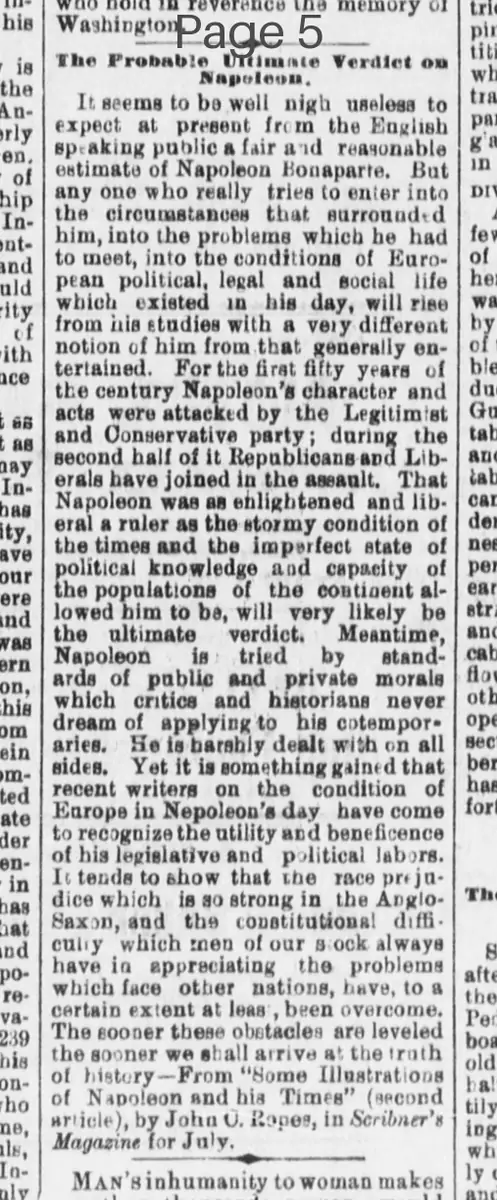
It seems to be well nigh useless to expect at present from the English speaking public a fair and reasonable estimate of Napoleon Bonaparte. But any one who really tries to enter into the circumstances that surrounded him, into the problems which he had to meet, into the conditions of European political, legal and social life which existed in his day, will rise from his studies with a very different notion of him from that generally entertained. For the first fifty years of the century Napoleon's character and acts were attacked by the Legitimist and Conservative party; during the second half of it Republicans and Liberals have joined in the assault. That Napoleon was as enlightened and liberal a ruler as the stormy condition of the times and the imperfect state of political knowledge and capacity of the populations of the continent allowed him to be, will very likely be the ultimate verdict. Meantime Napoleon is tried by standards of public and private morals which critics and historians never dream of applying to his contemporaries. He is harshly dealt with on all sides. Yet it is something gained that recent writers on the condition of Europe in Napoleon's day have come to recognize the utility and beneficence of his legislative and political labors. It tends to show that the race prejudice which is so strong in the Anglo-Saxon, and the constitutional difficulty which men of our stock always have in appreciating the problems which face other nations, have, to a certain extent at least, been overcome. The sooner these obstacles are leveled the sooner we shall arrive at the truth of history--From "Some Illustrations of Napoleon and His Times" (second article), by John O. Ropes, in Scribner's Magazine for July.
It seems to be well nigh useless to expect at present from the English speaking public a fair and reasonable estimate of Napoleon Bonaparte. But any one who really tries to enter into the circumstances that surrounded him, into the problems which he had to meet, into the conditions of European political, legal and social life which existed in his day, will rise from his studies with a very different notion of him from that generally entertained. For the first fifty years of the century Napoleon's character and acts were attacked by the Legitimist and Conservative party; during the second half of it Republicans and Liberals have joined in the assault. That Napoleon was as enlightened and liberal a ruler as the stormy condition of the times and the imperfect state of political knowledge and capacity of the populations of the continent allowed him to be, will very likely be the ultimate verdict. Meantime Napoleon is tried by standards of public and private morals which critics and historians never dream of applying to his contemporaries. He is harshly dealt with on all sides. Yet it is something gained that recent writers on the condition of Europe in Napoleon's day have come to recognize the utility and beneficence of his legislative and political labors. It tends to show that the race prejudice which is so strong in the Anglo-Saxon, and the constitutional difficulty which men of our stock always have in appreciating the problems which face other nations, have, to a certain extent at least, been overcome. The sooner these obstacles are leveled the sooner we shall arrive at the truth of history--From "Some Illustrations of Napoleon and His Times" (second article), by John O. Ropes, in Scribner's Magazine for July.
What sub-type of article is it?
Essay
What themes does it cover?
Political
What keywords are associated?
Napoleon Bonaparte
Historical Verdict
European Politics
Liberal Ruler
Anglo Saxon Bias
What entities or persons were involved?
By John O. Ropes
Literary Details
Title
The Probable Ultimate Verdict On Napoleon.
Author
By John O. Ropes
Subject
Assessment Of Napoleon Bonaparte's Legacy
Key Lines
That Napoleon Was As Enlightened And Liberal A Ruler As The Stormy Condition Of The Times And The Imperfect State Of Political Knowledge And Capacity Of The Populations Of The Continent Allowed Him To Be, Will Very Likely Be The Ultimate Verdict.