Thank you for visiting SNEWPapers!
Sign up free
Arkansas State Press
Little Rock, Pulaski County, Arkansas
What is this article about?
A conference in Washington DC, called by the NAACP, saw 25 organizations adopt a five-point civil rights agenda for the 80th Congress special session: permanent FEPC, poll tax abolition, anti-lynching measures, ending interstate segregation, and DP act revisions. Urged Truman to ban federal discrimination via executive order.
Clipping
OCR Quality
Full Text
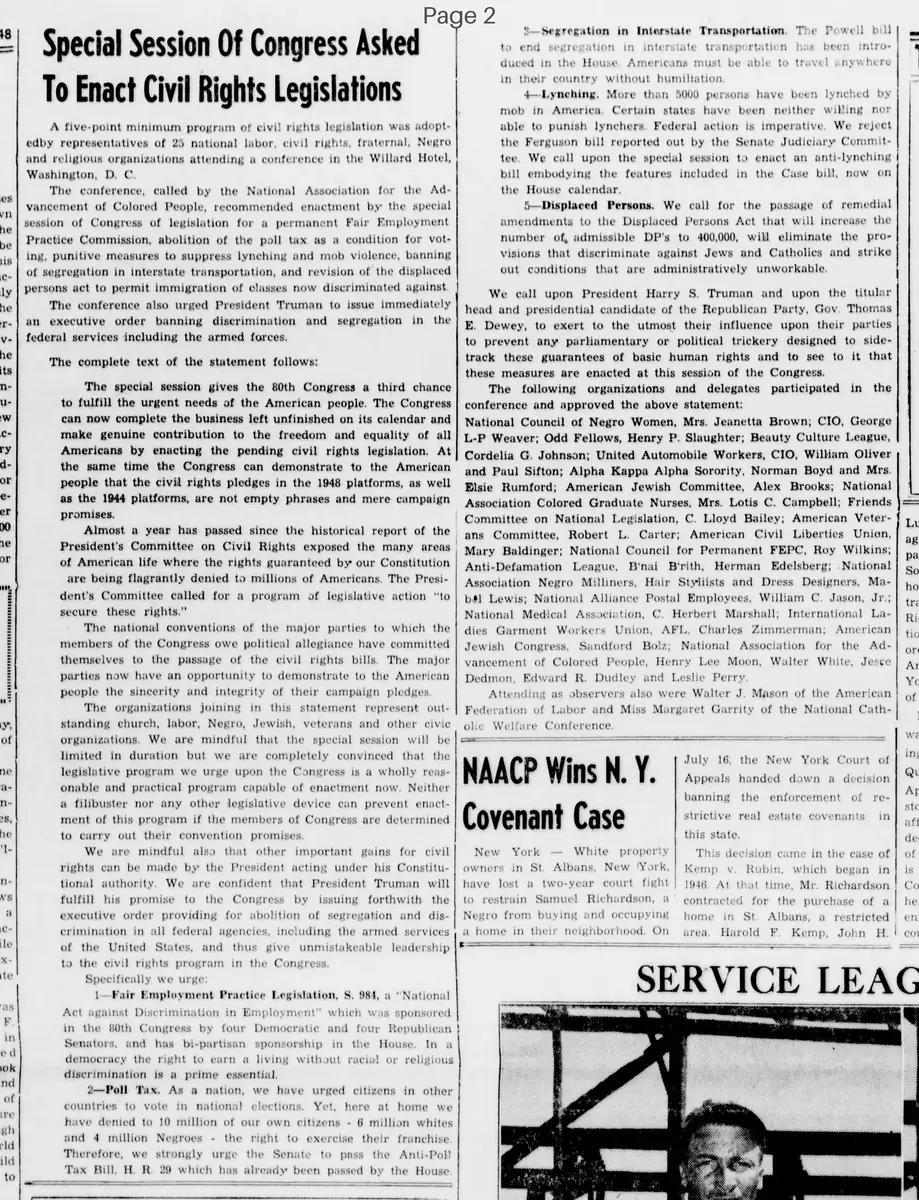
A five-point minimum program of civil rights legislation was adopted by representatives of 25 national labor, civil rights, fraternal, Negro and religious organizations attending a conference in the Willard Hotel, Washington, D. C.
The conference, called by the National Association for the Advancement of Colored People, recommended enactment by the special session of Congress of legislation for a permanent Fair Employment Practice Commission, abolition of the poll tax as a condition for voting, punitive measures to suppress lynching and mob violence, banning of segregation in interstate transportation, and revision of the displaced persons act to permit immigration of classes now discriminated against.
The conference also urged President Truman to issue immediately an executive order banning discrimination and segregation in the federal services including the armed forces.
The complete text of the statement follows:
The special session gives the 80th Congress a third chance to fulfill the urgent needs of the American people. The Congress can now complete the business left unfinished on its calendar and make genuine contribution to the freedom and equality of all Americans by enacting the pending civil rights legislation. At the same time the Congress can demonstrate to the American people that the civil rights pledges in the 1948 platforms, as well as the 1944 platforms, are not empty phrases and mere campaign promises.
Almost a year has passed since the historical report of the President's Committee on Civil Rights exposed the many areas of American life where the rights guaranteed by our Constitution are being flagrantly denied to millions of Americans. The President's Committee called for a program of legislative action 'to secure these rights.'
The national conventions of the major parties to which the members of the Congress owe political allegiance have committed themselves to the passage of the civil rights bills. The major parties now have an opportunity to demonstrate to the American people the sincerity and integrity of their campaign pledges.
The organizations joining in this statement represent outstanding church, labor, Negro, Jewish, veterans and other civic organizations. We are mindful that the special session will be limited in duration but we are completely convinced that the legislative program we urge upon the Congress is a wholly reasonable and practical program capable of enactment now. Neither a filibuster nor any other legislative device can prevent enactment of this program if the members of Congress are determined to carry out their convention promises.
We are mindful also that other important gains for civil rights can be made by the President acting under his Constitutional authority. We are confident that President Truman will fulfill his promise to the Congress by issuing forthwith the executive order providing for abolition of segregation and discrimination in all federal agencies, including the armed services of the United States, and thus give unmistakable leadership to the civil rights program in the Congress.
Specifically we urge:
1-Fair Employment Practice Legislation, S. 984, a 'National Act against Discrimination in Employment' which was sponsored in the 80th Congress by four Democratic and four Republican Senators, and has bi-partisan sponsorship in the House. In a democracy the right to earn a living without racial or religious discrimination is a prime essential.
2-Poll Tax. As a nation, we have urged citizens in other countries to vote in national elections. Yet, here at home we have denied to 10 million of our own citizens - 6 million whites and 4 million Negroes - the right to exercise their franchise. Therefore, we strongly urge the Senate to pass the Anti-Poll Tax Bill, H. R. 29 which has already been passed by the House.
3-Segregation in Interstate Transportation. The Powell bill to end segregation in interstate transportation has been introduced in the House. Americans must be able to travel anywhere in their country without humiliation.
4-Lynching. More than 5,000 persons have been lynched by mob in America. Certain states have been neither willing nor able to punish lynchers. Federal action is imperative. We reject the Ferguson bill reported out by the Senate Judiciary Committee. We call upon the special session to enact an anti-lynching bill embodying the features included in the Case bill, now on the House calendar.
5-Displaced Persons. We call for the passage of remedial amendments to the Displaced Persons Act that will increase the number of admissible DP's to 400,000, will eliminate the provisions that discriminate against Jews and Catholics and strike out conditions that are administratively unworkable.
We call upon President Harry S. Truman and upon the titular head and presidential candidate of the Republican Party, Gov. Thomas E. Dewey, to exert to the utmost their influence upon their parties to prevent any parliamentary or political trickery designed to side-track these guarantees of basic human rights and to see to it that these measures are enacted at this session of the Congress.
The following organizations and delegates participated in the conference and approved the above statement:
National Council of Negro Women, Mrs. Jeanetta Brown; CIO, George L. P. Weaver; Odd Fellows, Henry P. Slaughter; Beauty Culture League, Cordelia G. Johnson; United Automobile Workers, CIO, William Oliver and Paul Sifton; Alpha Kappa Alpha Sorority, Norman Boyd and Mrs. Elsie Rumford; American Jewish Committee, Alex Brooks; National Association Colored Graduate Nurses, Mrs. Lotis C. Campbell; Friends Committee on National Legislation, C. Lloyd Bailey; American Veterans Committee, Robert L. Carter; American Civil Liberties Union, Mary Baldinger; National Council for Permanent FEPC, Roy Wilkins; Anti-Defamation League, B'nai B'rith, Herman Edelsberg; National Association Negro Milliners, Hair Stylists and Dress Designers, Mabel Lewis; National Alliance Postal Employees, William C. Jason, Jr.; National Medical Association, C. Herbert Marshall; International Ladies Garment Workers Union, AFL, Charles Zimmerman; American Jewish Congress, Sanford Bolz; National Association for the Advancement of Colored People, Henry Lee Moon, Walter White, Jesse Dedmon, Edward R. Dudley and Leslie Perry.
Attending as observers also were Walter J. Mason of the American Federation of Labor and Miss Margaret Garrity of the National Catholic Welfare Conference.
What sub-type of article is it?
What themes does it cover?
What keywords are associated?
What entities or persons were involved?
Where did it happen?
Story Details
Key Persons
Location
Willard Hotel, Washington, D. C.
Story Details
Representatives of 25 organizations at a conference called by the NAACP adopted a five-point civil rights program urging the special session of the 80th Congress to enact permanent FEPC, abolish poll tax, suppress lynching and mob violence, ban segregation in interstate transportation, and revise the displaced persons act. They also urged President Truman to issue an executive order banning discrimination and segregation in federal services including the armed forces.