Thank you for visiting SNEWPapers!
Sign up free
Kentucky Gazette And General Advertiser
Lexington, Fayette County, Kentucky
What is this article about?
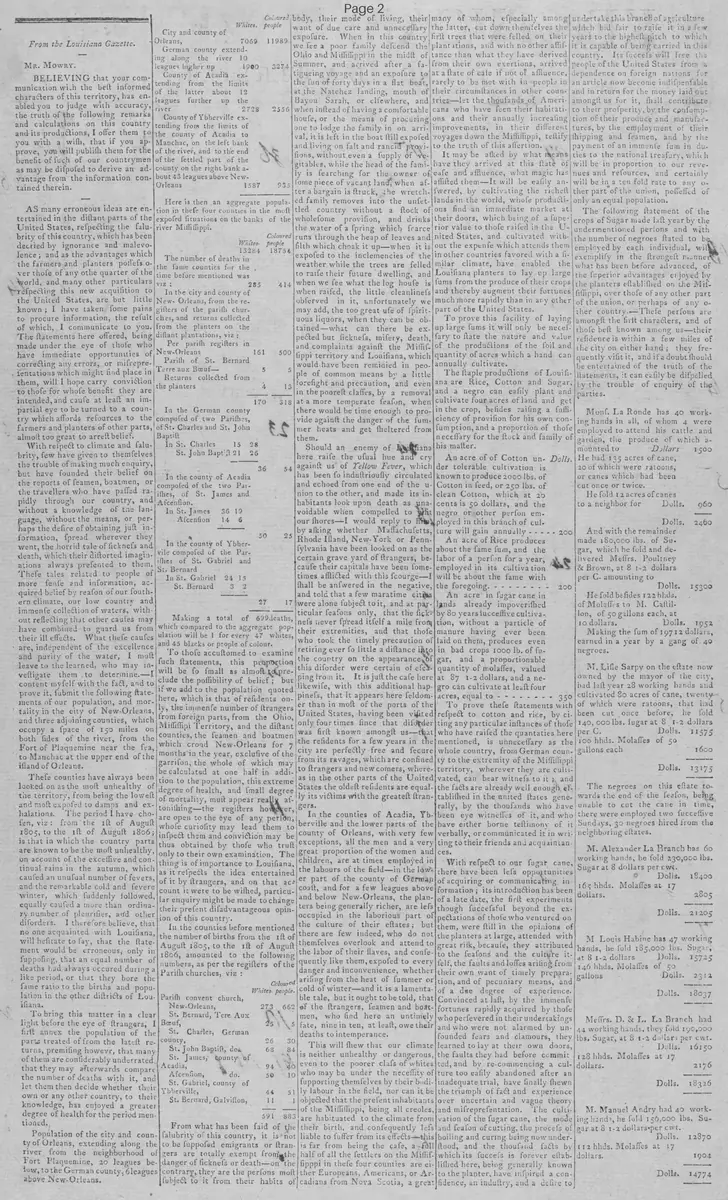
A letter in the Louisiana Gazette refutes myths about Louisiana's unhealthiness, citing 1805-1806 population (32,038), low mortality (699 deaths, ratio 1:46), births data, and highlights agricultural prosperity from cotton, rice, and sugar crops, with examples of high yields from small slave gangs.
Merged-components note: This is a single long article on the salubrity, population, births, deaths, and agricultural advantages (especially sugar production) of the Louisiana Territory, continued across pages 2 and 3. The table provides the birth statistics referenced in the text, and the page 3 section continues the examples of sugar yields. Unified label to domestic_news as it pertains to U.S. territory conditions for American readers.
Clippings
1 of 2
OCR Quality
Full Text
MR. MOWRY.
BELIEVING that your communication with the best informed characters of this territory, has enabled you to judge with accuracy the truth of the following remarks and calculations on this country and its productions, I offer them to you with a wish, that if you approve, you will publish them for the benefit of such of our countrymen as may be disposed to derive an advantage from the information contained therein.
AS many erroneous ideas are entertained in the distant parts of the United States, respecting the salubrity of this country, which has been decried by ignorance and malevolence; and as the advantages which the farmers and planters possess over those of any other quarter of the world, and many other particulars respecting this new acquisition to the United States, are but little known; I have taken some pains to procure information, the result of which, I communicate to you.
The statements here offered, being made under the eye of those who have immediate opportunities of correcting any errors, or misrepresentations which might find place in them, will I hope carry conviction to those for whose benefit they are intended, and cause at least an impartial eye to be turned to a country which affords resources to the farmers and planters of other parts, almost too great to arrest belief.
With respect to climate and salubrity, few have given to themselves the trouble of making much enquiry, but have founded their belief on the reports of seamen, boatmen, or the travellers who have passed rapidly through our country, and without a knowledge of the language, without the means, or perhaps the desire of obtaining just information, spread wherever they went, the horrid tale of sickness and death, which their distorted imaginations always presented to them.
These tales related to people of more sense and information, acquired belief by reason of our southern climate, our low country and immense collection of waters, without reflecting that other causes may have combined to guard us from their ill effects. What these causes are, independent of the excellence and purity of the water, I must leave to the learned, who may investigate them to determine. I content myself with the fact, and to prove it, submit the following statements of our population, and mortality in the city of New-Orleans, and three adjoining counties, which occupy a space of 150 miles on both sides of the river, from the Fort of Plaquemine near the sea, to Manchac at the upper end of the island of Orleans.
These counties have always been looked on as the most unhealthy of the territory, from being the lowest and most exposed to damps and exhalations. The period I have chosen, viz: from the 1st of August 1805, to the 1st of August 1806; is that in which the country parts are known to be the most unhealthy, on account of the excessive and continual rains in the autumn, which caused an unusual number of fevers, and the remarkable cold and severe winter, which suddenly followed, equally caused a more than ordinary number of pleurifies, and other disorders. I therefore believe, that no one acquainted with Louisiana, will hesitate to say, that the statement would be erroneous, only in supposing, that an equal number of deaths had always occurred during a like period, or that they bore the same ratio to the births and population in the other districts of Louisiana.
To bring this matter in a clear light before the eye of strangers, I first annex the population of the parts treated of from the latest returns, premising however, that many of them are considerably underrated, that they may afterwards compare the number of deaths with it, and let them then decide whether their own or any other country, to their knowledge, has enjoyed a greater degree of health for the period mentioned.
Population of the city and county of Orleans, extending along the river from the neighborhood of Fort Plaquemine, 20 leagues below, to the German county, 6 leagues above New-Orleans.
County of Iberville extending from the limits of the county of Acadia to Manchac, on the left bank of the river, and to the end of the settled part of the county on the right bank about 43 leagues above New-Orleans 1587 935
Here is then an aggregate population in these four counties in the most exposed situations on the banks of the river Mississippi.
Coloured Whites. people 13284 18754
The number of deaths in the same counties for the time before mentioned was viz: 285 414
In the city and county of New-Orleans, from the registers of the parish churches, and returns collected from the planters on the distant plantations, viz:
Per parish registers in New-Orleans 161 500
Parish of St. Bernard Terre aux Boeuf- 5 5
Returns collected from the planters A 13
170 318
In the German county composed of two Parishes, of St. Charles and St. John Baptist
In St. Charles 15 28
St. John Bapt 21 26
36 54
In the county of Acadia composed of the two Parishes, of St. James and Ascension.
In St. James 36 19
Ascension 14 6
50 25
In the county of Iberville composed of the Parishes of St. Gabriel and St. Bernard
In St. Gabriel 24.15
St. Bernard 3 2
27 17
Making a total of 699 deaths, which compared to the aggregate population will be 1 for every 47 whites, and 45 blacks or people of colour.
To those accustomed to examine such statements, this proportion will be so small as almost to preclude the possibility of belief; but if we add to the population quoted here, which is that of residents only, the immense number of strangers from foreign parts, from the Ohio, Mississippi Territory, and the distant counties, the seamen and boatmen which crowd New-Orleans for 7 months in the year, exclusive of the garrison, the whole of which may be calculated at one half in addition to the population, this extreme degree of health, and small degree of mortality, must appear really astonishing-the registers however, are open to the eye of any person, whose curiosity may lead them to inspect them and conviction may be thus obtained by those who trust only to their own examination. The thing is of importance to Louisiana, as it respects the idea entertained of it by strangers, and on that account it were to be wished, particular enquiry might be made to change their present disadvantageous opinion of this country.
In the counties before mentioned the number of births from the 1st of August 1805, to the 1st of August 1806, amounted to the following numbers, as per the registers of the Parish churches, viz:
| Parish convent church, New-Orleans, St. Bernard, Terre Aux. Boeuf, St. Charles, German county, St. John Baptif, do. St. James, county of Acadia, Ascension, do. St. Gabriel, county of Iberville, St. Bernard, Galveston, | Whites. people. 273 662 25 5 26 30 68 84 94 40 50 10 44 51 1 591 883 |
From what has been said of the salubrity of this country, it is not to be supposed emigrants or strangers are totally exempt from the danger of sickness or death-on the contrary, they are the persons most subject to it from their habits of body, their mode of living, their want of due care and unnecessary exposure. When in this country we see a poor family descend the Ohio and Mississippi in the midst of Summer, and arrived after a fatiguing voyage and an exposure to the sun of forty days in a flat boat, at the Natchez landing, mouth of Bavou Sarah, or elsewhere, and when instead of having a comfortable house, or the means of procuring one to lodge the family in on arrival, it is left in the boat still exposed and living on salt and rancid provisions, without even a supply of vegetables, while the head of the family is searching for the owner of some piece of vacant land, when after a bargain is struck, the wretched family removes into the unsettled country without a stock of wholesome provision, and drinks the water of a spring which scarce runs through the heap of leaves and filth which choke it up--when it is exposed to the inclemencies of the weather while the trees are felled to raise their future dwelling, and when we see what the log house is when raised, the little cleanliness observed in it, unfortunately we may add, the too great use of spirituous liquors, when they can be obtained-what can there be expected but sickness, misery, death, and complaints against the Mississippi territory and Louisiana, which would have been remedied in people of common means by a little foresight and precaution, and even in the poorest classes, by a removal at a more temperate season, when there would be time enough to provide against the danger of the summer heats and get sheltered from them.
Should an enemy of Louisiana here raise the usual hue and cry against us of Yellow Fever, which has been so industriously circulated and echoed from one end of the union to the other, and made its inhabitants look upon death as unavoidable when compelled to visit our shores-I would reply to him, by asking whether Massachusetts, Rhode Island, New-York or Pennsylvania have been looked on as the certain grave yard of strangers, because their capitals have been sometimes afflicted with this scourge-I shall be answered in the negative, and told that a few maritime cities were alone subject to it, and at particular seasons only, that the sickness never spread itself a mile from their extremities, and that those who took the timely precaution of retiring ever so little a distance into the country on the appearance of this disorder were certain of escaping from it. It is just the case here likewise, with this additional happiness, that it appears here seldomer than in most of the ports of the United States, having been visited only four times since that disorder was first known amongst us-that the residents for a few years in the city are perfectly free and secure from its ravages, which are confined to strangers and new comers, whereas in the other parts of the United States the oldest residents are equally its victims with the greatest strangers.
In the counties of Acadia, Iberville and the lower parts of the county of Orleans, with very few exceptions, all the men and a very great proportion of the women and children, are at times employed in the labours of the field-in the lower part of the county of German coast, and for a few leagues above and below New-Orleans, the planters being generally richer, are less occupied in the laborious part of the culture of their estates; but there are few indeed, who do not themselves overlook and attend to the labor of their slaves, and consequently like them, exposed to every danger and inconvenience, whether arising from the heat of summer or cold of winter-and it is a lamentable tale, but it ought to be told, that of the strangers, seamen and boatmen, who find here an untimely fate, nine in ten, at least, owe their deaths to intemperance.
This will shew that our climate is neither unhealthy or dangerous, even to the poorer class of whites who may be under the necessity of supporting themselves by their bodily labour in the field, nor can it be objected that the present inhabitants of the Mississippi, being all creoles, are habituated to the climate from their birth, and consequently less liable to suffer from its effects-this is far from being the case, a full half of all the settlers on the Mississippi in these four counties are either Europeans, Americans, or Arcadians from Nova Scotia, a great many of whom, especially among the latter, cut down themselves the first trees that were felled on their plantations, and with no other assistance than what they have derived from their own exertions, arrived at a state of ease if not of affluence, rarely to be met with in people in their circumstances in other countries-let the thousands of Americans who have seen their habitations and their annually increasing improvements, in their different voyages down the Mississippi, testify to the truth of this assertion.
It may be asked by what means have they arrived at this state of ease and affluence, what magic has assisted them-It will be easily answered, by cultivating the richest lands in the world, whose productions find an immediate market at their doors, which being of a superior value to those raised in the United States, and cultivated without the expense which attends them in other countries favored with a similar climate, have enabled the Louisiana planters to lay up large sums from the produce of their crops and thereby augment their fortunes much more rapidly than in any other part of the United States.
To prove this facility of laying up large sums it will only be necessary to state the nature and value of the productions of the soil and quantity of acres which a hand can annually cultivate.
The staple productions of Louisiana are Rice, Cotton and Sugar. and a negro can easily plant and cultivate four acres of land and get in the crop, besides raising a sufficiency of provision for his own consumption, and a proportion of those necessary for the stock and family of his master.
An acre of Cotton under tolerable cultivation is known to produce 2000 lbs. of Cotton in seed, or 250 lbs. of clean Cotton, which at 20 cents is 50 dollars, and the negro or other person employed in this branch of culture will gain annually --200
An acre of Rice produces about the same sum, and the labor of a person for a year, employed in its cultivation will be about the same with the foregoing. - - - - - 200
An acre in sugar cane in lands already impoverished by 50 years successive cultivation, without a particle of manure having ever been laid on them, produces even in bad crops 1000 lb. of sugar, and a proportionable quantity of molasses, valued at 87 1-2 dollars, and a negro can cultivate at least four acres, equal to - - - - - - - - 350
To prove these statements with respect to cotton and rice, by citing any particular instances of those who have raised the quantities here mentioned, is unnecessary as the whole country, from German county to the extremity of the Mississippi territory, wherever they are cultivated, can bear witness to it ; and the facts are already well enough established in the united states generally, by the thousands who have been eye witnesses of it, and who have either borne testimony of it verbally, or communicated it in writing to their friends and acquaintances.
With respect to our sugar cane, there have been less opportunities of acquiring or communicating information; its introduction has been of a late date, the first experiments though successful beyond the expectations of those who ventured on them, were still in the opinions of the planters at large, attended with great risk, because, they attributed to the seasons and the culture itself, the faults and losses arising from their own want of timely preparation, and of pecuniary means, and of a due degree of experience.
Convinced at last, by the immense fortunes rapidly acquired by those who persevered in their undertakings and who were not alarmed by unfounded fears and clamours, they learned to lay at their own doors, the faults they had before committed, and by re-commencing a culture too easily abandoned after an inadequate trial, have finally shewn the triumph of fact and experience over uncertain and vague theory and misrepresentation. The cultivation of the sugar cane, the mode and season of cutting, the process of boiling and curing being now understood, and the thousand facts by which its success is forever established here, being generally known to the planter, have inspired a confidence, an industry, and a desire to undertake this branch of agriculture which bid fair to raise it in a few years to the highest pitch to which it is capable of being carried in this country. Its success will free the people of the United States from a dependence on foreign nations for an article now become indispensable and in return for the money laid out amongst us for it, shall contribute to their prosperity, by the consumption of their produce and manufactures, by the employment of their shipping and seamen, and by the payment of an immense sum in duties to the national treasury, which will be in proportion to our revenues and resources, and certainly will be in a ten fold rate to any other part of the union, possessed of only an equal population.
The following statement of the crops of Sugar made last year by the undermentioned persons and with the number of negroes stated to be employed by each individual, will exemplify in the strongest manner what has been before advanced, of the superior advantages enjoyed by the planters established on the Mississippi, over those of any other part of the union, or perhaps of any other country.--These persons are amongst the first characters, and of those best known among us-their residence is within a few miles of the city on either hand; they frequently visit it, and if a doubt should be entertained of the truth of the statements, it can easily be dispelled by the trouble of enquiry of the parties.
Monf. La Ronde has 40 working hands in all, of whom 4 were employed to attend his cattle and garden, the produce of which amounted to Dollars 1500
He had 135 acres of cane, 20 of which were ratoons, or canes which had been cut once or twice.
He sold 12 acres of canes to a neighbor for Dolls. 960
Dolls. 2460
And with the remainder made 180,000 lbs. of Sugar, which he sold and delivered Messrs. Poultney & Brown, at 8 1-2 dollars per C. amounting to Dolls. 15300
He sold besides 122 hhds. of Molasses to M. Castillon, of 50 gallons each, at 10 dollars. Dolls. 1952
Making the sum of 19712 dollars, earned in a year by a gang of 40 negroes.
M. Lacle Sarpy on the estate now owned by the mayor of the city, had last year 28 working hands and cultivated 80 acres of cane, twenty of which were ratoons, that had been cut once before, he sold 140,000 lbs. sugar at 8 1-2 dollars per C. Dolls. 11575
100 hhds. Molasses of 50 gallons each 1600
Dolls. 13175
The negroes on this estate towards the end of the season, being unable to cut the cane in time, there were employed two successive Sundays, 30 negroes hired from the neighboring estates.
M. Alexander La Branch has 60 working hands, he sold 230,000 lbs. Sugar at 8 dollars per cwt. Dolls. 18400
165 hhds. Molasses at 17 dollars. 2805
Dolls. 21205
M. Louis Robin has 47 working hands, he sold 185,000 lbs. Sugar, at 8 1-2 dollars Dolls. 15725
146 hhds. Molasses of 50 gallons Dolls. 2312
Dolls. 18037
Messrs. D. & L. La Branch had 44 working hands, they sold 190,000 lbs. Sugar, at 8 1-2 dollars per cwt. Dolls. 16150
128 hhds. Molasses at 17 dollars. 2176
Dolls. 18326
M. Manuel Andry had 40 working hands, he sold 156,000 lbs. Sugar at 8 1-2 dollars per cwt. Dolls. 12870
112 hhds. Molasses at 17 dollars. 1904
Dolls. 14774
M. Jacques Fortier had 4 working hands, and hired during the time of grinding ten more, he sold 255,000 lbs. Sugar at 8 dollars per cwt.
Dollars. 20,400
150 hhds. Molasses at 17 dollars
2,550
Dollars. 22,950
Mr. Eugene Fortier had 45 working hands, he sold 173,000 lbs. Sugar at 8 dollars per cwt.
Dollars. 13,840
150 hhds. Molasses at 17 dollars
2,550
Dollars. 16,790
M. Norbert Fortier had 42 working hands, he sold 158,000 lbs. Sugar at 8 dollars per cwt.
Dollars. 12,640
130 hhds. Molasses at 16 dollars
2,080
Dollars. 14,720
M. Adelard Fortier had 48 working hands, he sold 180,000 lbs. Sugar at 8 dollars per cwt.
Dollars. 14,400
142 hhds. Molasses at 17 dollars
2,414
Dollars. 16,814
M. Pifero has 45 working hands, he sold to Cavelier and Sons 220,000 lbs. Sugar, at 8 dollars per cwt.
Dollars. 17,600
160 casks Molasses
2,560
Dollars. 20,160
M. Deftrehan had 40 working hands, and when his cane was ready to cut he bought 10 new negroes he sold to Mr. John Morgan 222,000 lbs. Sugar.
Dollars. 17,760
160 casks molasses
2,560
Dollars. 20,320
And it is well known that he has made an equal crop for four or five successive years.
The quantity of sugar above mentioned, is that which was sold by the planters independent of which each of them retained a sufficiency for family purposes, and for the use of their negroes.
It will not I presume be objected that many other planters who have as many slaves, have not done quite as much; it answers my object, to point out what can be effected by attention, and a knowledge of one's business. I could cite some instances of planters, who, with fewer hands, have proportionally done much more; but as they are few in number, I think it would be as improper to found a calculation on their extraordinary exertions as on the remissness, supineness, or ignorance of those whose success has not answered the general expectation.
As a convincing proof, with what ease the cultivation of the cane, and process of sugar making is followed in Louisiana, I shall mention a circumstance, that will I know, never be believed by any Jamaica or St. Domingo planter, who has not seen it, which is--that the cultivation of the cane, and process of sugar making, has been attended with extraordinary success by many persons not possessed of more than 20 negroes, and in some cases not more than 12.
This will excite a smile of ridicule on the faces of those who hold it to be impossible to manage a sugar plantation with less than 150 working hands.--There is not a sugar plantation in Louisiana possessed of 150 slaves, of all ages and sizes, yet they make as much with their small gangs, as the nabobs of the islands, with four times their number; and were they certain as in the Islands of having time sufficient to cut their cane, in the interval between the first white frosts which ripen, and the hard ones which destroy them, their revenue would be doubled, as they can plant and cultivate more than they can afterwards cut and secure. This is owing to the facility of ploughing their lands and not being under the necessity of digging trenches to plant their cane in, as in Jamaica, and elsewhere. The same number of negroes required to plant, tend, and boil the produce of two hundred acres of land in cane, would scarce be sufficient in a year to dig the holes to plant it in Jamaica.
What sub-type of article is it?
What keywords are associated?
What entities or persons were involved?
Where did it happen?
Domestic News Details
Primary Location
Louisiana (New Orleans And Counties Of Orleans, German, Acadia, Iberville)
Event Date
1st Of August 1805 To 1st Of August 1806
Key Persons
Outcome
699 deaths in aggregate population of 32,038 (whites 18,754, coloured 13,284); ratio 1 death per 47 whites and 45 coloured; low mortality despite transient population; high agricultural profits from sugar, cotton, rice.
Event Details
Letter defends Louisiana's salubrity against myths, provides population, mortality, and birth statistics for specified counties and period; explains causes of stranger illnesses; details yields and profits from cotton (200 dollars per hand), rice (200 dollars), sugar (350 dollars per hand on 4 acres); lists specific planters' sugar and molasses sales totaling thousands of dollars with 20-60 slaves.