Thank you for visiting SNEWPapers!
Sign up free
The Madisonian
Washington, District Of Columbia
What is this article about?
A meeting in Rochester on August 19 supported President John Tyler's policies, including vetoes of tariff and bank bills. Resolutions praised his constitutional stance, and a central committee was appointed. Speakers addressed the crowd, emphasizing Tyler's honesty and opposition to party excesses.
Clipping
OCR Quality
Full Text
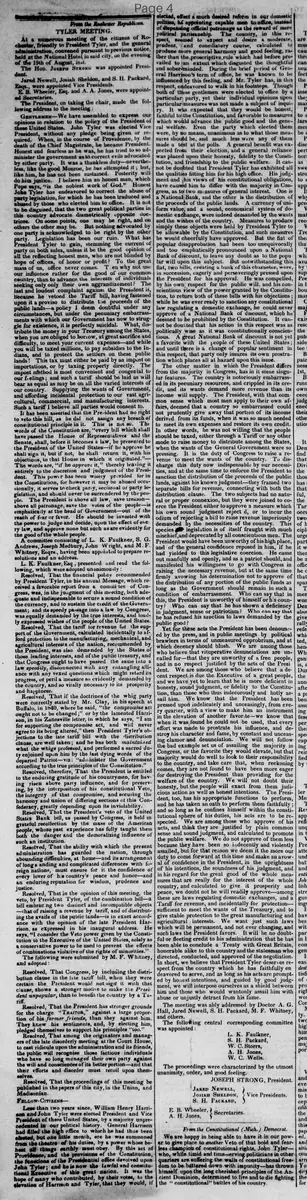
TYLER MEETING.
At a numerous meeting of the citizens of Rochester, friendly to President Tyler, and the general administration, convened pursuant to previous notice, held at the National Hotel in said city, on the evening of the 19th of August, inst.
The Hon. Joseph Strong was appointed President.
Jared Newell, Josiah Sheldon, and S. H. Packard, Esqs., were appointed Vice Presidents.
E. B. Wheeler, Esq. and A. A. Jones, were appointed Secretaries.
The President, on taking the chair, made the following address to the meeting:
Gentlemen--We have assembled to express our opinions in relation to the policy of the President of these United States. John Tyler was elected Vice President, without any pledge being given or required. When, in the course of Providence, by the death of the Chief Magistrate, he became President. Honest and fearless as he was, he has tried to so administer the government as to correct evils advocated by either party. It was a thankless duty-nevertheless, like the good Monroe, he has attempted it; but, like him, he has not been sustained. Posterity will do him justice. I believe him an honest man, which Pope says, "is the noblest work of God." Honest party legislation, for which he has been traduced and abused by those who elected him to office. John Tyler has endeavored to correct the abuse of party legislation. It is not to be disguised, that the two great political parties in this country advocate diametrically opposite doctrines. On some points, one may be right, and on others the other may be. But nothing advocated by one party is acknowledged to be right by the other party. Legislation has been our ruin. What has President Tyler to gain, stemming the current of party on both sides, unless it be the good opinion of all the reflecting honest men, who are not blinded by hope of offices, of honor or profit? To the great mass of us office never comes. Then why not use our influence rather for the good of our common country, than to advance the interests of individuals seeking only their own aggrandizement? The last and loudest complaint against the President is, because he vetoed the Tariff bill, having fastened upon it a proviso to distribute the proceeds of the public lands-a policy I deem doubtful under any circumstances, but under the pecuniary embarrassments with which our Government has now to struggle for existence, it is perfectly suicidal. What, distribute the money in your Treasury among the States, when you are obliged to borrow, at great sacrifice and difficulty, to meet your current expenses and while you will be taxed millions, to pay subsidies to the Indians, and to protect the settlers on these public lands! This tax must either be paid by an impost on importations, or by taxing property directly. The impost method is most convenient and congenial to bear as equal as may be on all the varied interests of our country. Supplying the wants of Government, and affording incidental protection to our vast agricultural, commercial, and manufacturing interests. Such a tariff I believe all parties would consent to. It has been asserted that the President had no right to veto this bill, as he did not assign any breach of constitutional principle in it. This is not so. The words of the Constitution are, "every bill which shall have passed the House of Representatives and the Senate, shall, before it becomes a law, be presented to the President of the United States-if he approve he shall sign it, but if not, he shall return it, with his objections, to that House in which it originated." The words are, "if he approve it," thereby leaving it entirely to the discretion and judgment of the President. This power has been wisely provided for in the Constitution, for however it may be abused occasionally, it serves to check party, sectional or party legislation, and should never be surrendered by the people. The President is above all law, save treason-above all patronage, save the votes of the people-is emphatically at the head of Government-out of the reach of fear or favor. He should be invested with the power to judge and decide, upon the effect of every law, and approve none but such as are evidently for the good of the whole people.
A committee consisting of L. K. Faulkner, S. G. Andrews, Joseph Medbury, John Wright, and M. F. Whitney, Esqrs., having been appointed to prepare resolutions and an address.
L. K. Faulkner, Esq., presented and read the following, which were adopted unanimously:
Resolved, That the financial policy recommended by President Tyler, in his annual Message, which received a favorable report from a committee of Congress, was, in the judgment of this meeting, both adequate and indispensable to secure a sound condition of the currency, and to sustain the credit of the Government; and its speedy passage into a law by Congress, was equally demanded by the true interests, and loudly expressed wishes of the people of the United States.
Resolved, That the tariff for revenue for the support of the Government, calculated incidentally to afford protection to the manufacturing, mechanical, and agricultural interests of the nation, recommended by the President, was also demanded by the States of those leading interests, and of the public treasury, and that Congress ought to have passed the same into a law speedily, disconnected with any entangling alliance with any vexed questions which might retard its progress, or peril a measure so evidently demanded by the country, and so vitally necessary to its prosperity and happiness.
Resolved, That if the doctrines of the whig party were correctly stated by Mr. Clay, in his speech at Buffalo, in 1840,"where he said, "the compromise act ought not to be changed;" or by the lamented Harrison, in his Zanesville letter, in which he says, "I am for supporting the compromise act, and will never agree to its being altered," then President Tyler's objections to the late tariff bill with the distribution clause, are well taken; and he has both maintained what the whigs professed, and performed a sacred duty enjoined upon him by the last dying words of the departed Patriot-viz: "administer the Government according to the true principles of the Constitution."
Resolved, therefore, That the President is entitled to the enduring gratitude of his countrymen, for having risen above party influence, and for preserving, by the interposition of his constitutional Veto, the integrity of that compromise, and securing the harmony and union of differing sections of this Confederacy, greatly depending upon its inviolability.
Resolved, That the President's veto of the United States Bank bill, as passed by Congress, is held in grateful recollection by the mass of the American people, whose past experience has fully taught them both the danger and the demoralizing influence of such an institution.
Resolved, That the ability with which the present administration has guarded the nation, through abounding difficulties, at home-and its arrangement of long standing and complicated differences with foreign nations, must ensure for it the confidence of every lover of his country's peace and honor-and an enduring reputation for wisdom, prudence and justice.
Resolved, That in the opinion of this meeting, the veto, by President Tyler, of the combination bill-a bill embracing two distinct and incompatible objects--that of raising a revenue by tariff, and of distributing the avails of the public lands--is in exact accordance with the opinion of the late President Harrison, as expressed in his inaugural address. He says, "I consider the Veto power given by the Constitution to the Executive of the United States, solely as a conservative power to be used to prevent the effects of combinations violative of the rights of minorities."
The following were submitted by M. F. Whitney, and adopted:
Resolved, That Congress, by including the distribution clause in the late tariff bill, when they were certain the President would not sign it with that clause, shows a stronger motive to make the President unpopular, than to benefit the country by a Tariff.
Resolved, That the President has stronger grounds for the charge "Traitor," against a large proportion of his former friends, than they against him. They knew his sentiments, and, by electing him, pledged themselves to support his principles too.
Resolved, That among the originators and managers of the late disorderly meeting at the Court House, to cast ridicule upon the administration and its friends, the public will recognise those factious individuals who have so long managed their own party against the will and consciences of its better portion-and that their efforts and disorder must recoil upon themselves.
Resolved, That the proceedings of this meeting be published in the papers of this city, in the Union, and Madisonian.
Fellow-Citizens-
Less than two years since, William Henry Harrison and John Tyler were elected President and Vice President of these United States, by a majority unprecedented in our political history. General Harrison had filled the high office to which he had thus been elevated, but one little month, ere he was summoned from the theatre of his duties, by a power whose behest all things earthly must obey. By this act of Providence, and the provisions of the Constitution, the functions of the Presidential office devolved upon John Tyler; and he is now the lawful and constitutional Executive of this great nation. It was the hope of many who contributed, by their votes, to the elevation of Harrison and Tyler, that they would, if elected, effect a much desired reform in our domestic politics, by appointing capable men to office, instead of dispensing official patronage as the reward of mere political partisanship. The country, in this respect, seemed to expect and desire a moderate, prudent, and conciliatory course, calculated to produce more general harmony and good feeling, rather than the proscriptive rule which had before prevailed to an extent which disgusted the thoughtful and sober-minded. During the brief period of General Harrison's term of office, he was known to be influenced by this feeling, and Mr. Tyler has, in this respect, endeavored to walk in his footsteps. Though both of these gentlemen were elected to office by a particular party, yet their individual opinions upon particular measures was not made a subject of inquiry. It was expected that they would be honest, faithful to the Constitution, and favorable to measures which would advance the public good and the general welfare. Even the party which elected them were, by no means, unanimous as to what those measures should be, and much less were any of them made a test at the polls. A general benefit was expected from their election, and a general reliance was placed upon their honesty, fidelity to the Constitution, and friendship to the public welfare. It cannot be doubted that President Tyler has exhibited all the qualities fitting him for his high office. His judgment and his views of his constitutional obligations, have caused him to differ with the majority in Congress, as to two measures of general interest. One is a National Bank, and the other is the distribution of the proceeds of the public lands. A currency of uniform value, and a sound, economical system of domestic exchange, were indeed demanded by the wants and the wishes of the country. Measures to produce simply these objects were held by President Tyler to be allowable by the Constitution, and such measures he would cheerfully have approved. But the fiat of popular disapprobation had been too unequivocally and too emphatically pronounced upon a National Bank of discount, to leave any doubt as to the popular will upon this subject. But notwithstanding this fiat, two bills, creating a bank of this character, were, in succession, eagerly and perseveringly pressed upon the President for his approval. He was compelled, by his own respect for the public will, and his conscientious view of the power granted by the Constitution, to return both of these bills with his objections; while he was ever ready to sanction any constitutional law regulating a domestic exchange, he could never approve of a National Bank of discount, which he deemed to be prohibited by the Constitution. It cannot be doubted that his action in this respect was as politically wise as it was constitutionally conscientious. A great National Bank of discount is not yet a favorite with the people of these United States; and until there is a change of popular sentiment in this respect, that party only insures its own prostration which places all at hazard upon this issue. The other matter in which the President differs from the majority in Congress, has in it some singular features. The country is notoriously embarrassed in its pecuniary resources, and crippled in its credit, and its wants demand more revenue than its income will supply. The President, with that common sense which most men apply to their own affairs, deemed that a country so embarrassed could not prudently give away that portion of its income derived from its funds, when it was so much needed to meet its own expenses and restore its own credit. In other words, he was not willing that the people should be taxed, either through a Tariff or any other mode to raise money to distribute among the States, when the wants of the General Government were so pressing. It is the duty of Congress to raise a revenue to meet the wants of the country. To discharge this duty now indispensable by our necessities, and at the same time to enforce the President to sanction the distribution of the proceeds of the public lands, against his known judgment-they framed two separate bills for revenue, connecting with both the distribution clause. The two subjects had no natural or proper connexion, but they were joined to coerce the President either to approve a measure which his own sound judgment rejected, or to incur the odium of rejecting a bill to raise revenue imperiously demanded by the necessities of the country. This species of legislation is of itself fraught with much mischief, and deprecated by all conscientious men. The President would have been unworthy of his high place, and of the general confidence reposed in him, if he had yielded to this legislative coercion. He came out manfully and openly, and as a patriot should, and manifested his willingness to go with Congress in raising the necessary revenue, but at the same time firmly avowing his determination not to approve of the distribution of any portion of the public funds as long as the Government should remain in such a condition of embarrassment. Who can say that in this, the President is unworthy of himself or his country? Who can say that he has shown a deficiency in judgment, sense or patriotism? Who can say that he has refused his sanction to laws demanded by the public good? Yet for these acts the President has been denounced by the press, and in public meetings by political brawlers in terms of unmeasured opprobrium, and at which decency should blush. We are among those who believe that vituperative denunciations are uncalled for -that they are unworthy of a free people, and in no respect justified by the acts of the President. We are among those who believe that a decent respect is due the Executive of a great people, and we have yet to learn that he is more deficient in honesty, sound judgment, or fidelity to the Constitution, than those who thus indecorously and hotly assail him. We know that the President has been pressed upon indelicately and unceasingly, from every quarter, with a view to make him an instrument in the elevation of another favorite-we know that when it was found he could not be used, that every effort was made to prostrate his influence, and destroy his character and fame, by constant and unceasing clamor and denunciation. We will not follow the bad example set us of assailing the majority in Congress, or the favorite they would elevate, but that majority would do well to look to their responsibility to the country, and take care that, when reckoning comes, they are not found to have been more eager for destroying the President than providing for the welfare of the country. We will not doubt their honesty, but the people will exact from them judicious action as well as honest intentions. The President, too, has his appropriate functions to perform, and he has taken an oath to perform them faithfully; and so long as he confines himself within the constitutional sphere of his duties, his acts are to be respected. We are among those who approve of his acts, and think they are justified by plain common sense and sound judgment, and calculated to promote the public welfare. We do not approve of them less because they have been so indecently and violently assailed, but for that reason we deem it the more our duty to come forward at this time and make an avowal of confidence in the President, in the uprightness of his intentions, the soundness of his judgment, and in his regard for the great good of the whole. Measures that are really for the interest of the whole country, and calculated to give it prosperity and peace, we doubt not he will readily approve—among these are laws regulating domestic exchanges, and a Tariff for revenue, and incidentally for protection-sufficient to meet the wants of the Treasury, and to give stable protection to the great manufacturing and agricultural interests. We want just such laws which will be permanent, and not ever changing, and such laws the President favors. It will be no doubtful or fleeting credit to his administration that he has been able to conclude a Treaty with Great Britain, honorable alike to this country and the statesman who directed, conducted, and approved of the negotiation. In short, we believe that President Tyler deserves respect from the country which he has faithfully endeavored to serve, and as long as his acts are prompted by honest intentions, and guided by good judgment, we will interpose ourselves as a shield between him and those who would wantonly assail him with abuse or unjustly detract from his fame.
The meeting was ably addressed by Doctor A. G. Hall, Jared Newell, S. H. Packard, M. F. Whitney, and others.
The following central corresponding committee was appointed:
L. K. Faulkner,
S. H. Packard,
W. C. Storrs,
A. H. Jones,
W. C. Wells.
The proceedings were characterized by the utmost unanimity, order, and good feeling.
JOSEPH STRONG, President.
Jared Newell,
Josiah Sheldon,
Vice Presidents.
S. H. Packard,
E. B. Wheeler, Secretaries.
A. H. Jones,
From the Constitutional (Mich.) Democrat.
We are happy in being able to have it in our power to give place to another Veto of that bold and fearless champion of constitutional rights, John Tyler-- who, while timid and time-serving politicians in other quarters are suffering the walls of constitutional freedom to be battered down with impunity--has thrown himself upon the long cherished principles of the Ancient Dominion, determined to live and to die fighting the "constitutional" battles of his country.
What sub-type of article is it?
What keywords are associated?
What entities or persons were involved?
Where did it happen?
Domestic News Details
Primary Location
Rochester
Event Date
Evening Of The 19th Of August, Inst.
Key Persons
Outcome
resolutions adopted unanimously supporting tyler's vetoes and policies; central corresponding committee appointed; proceedings published in local papers.
Event Details
Citizens of Rochester held a meeting at the National Hotel to support President Tyler and his administration. Joseph Strong gave an opening address defending Tyler's vetoes of the tariff bill with distribution clause and the United States Bank bill. A committee presented resolutions praising Tyler's financial policy, tariff recommendations, adherence to the compromise act, and foreign affairs handling. Additional resolutions criticized Congress and opponents. An address was read supporting Tyler's constitutional actions. Speakers included Doctor A. G. Hall and others. The meeting ended with unanimity and order.