Thank you for visiting SNEWPapers!
Sign up free
Editorial
September 22, 1865
The Daily Phoenix
Columbia, Richland County, South Carolina
What is this article about?
This 1865 South Carolina editorial uses a Cassandra analogy to discuss ignored prophecies, then advocates for a poll tax (capitation) over property tax to fund the state post-Civil War, praising its democratic equality and role in civilizing freedmen. It critiques the ongoing Constitutional Convention for overreaching reforms amid debates on representation.
Clipping
OCR Quality
98%
Excellent
Full Text
COLUMBIA:
Friday Morning, Sept. 22, 1865.
Do Omnibus Rebus, &c.
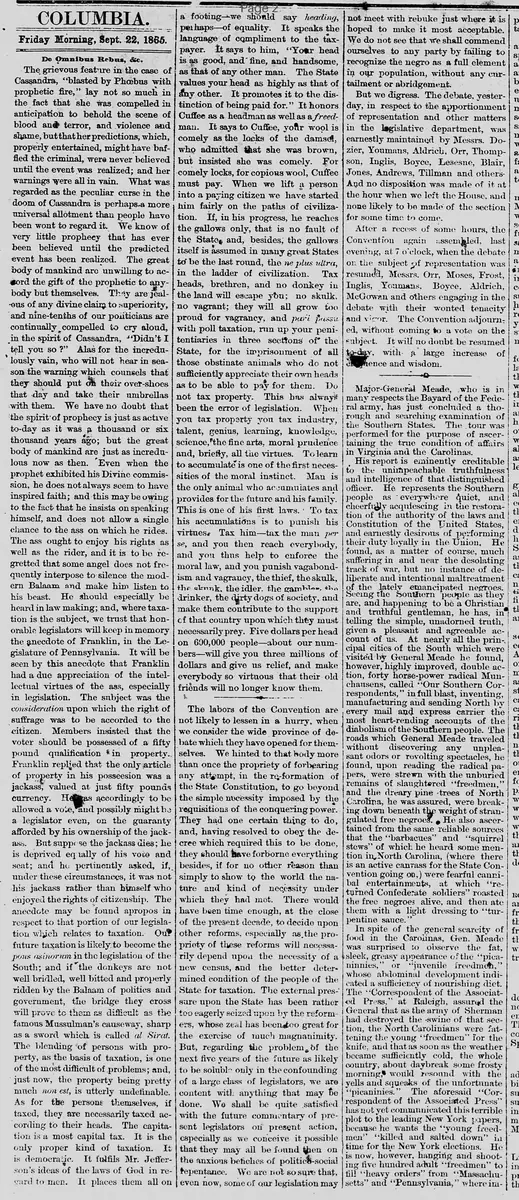
The grievous feature in the case of Cassandra, "blasted by Phœbus with prophetic fire," lay not so much in the fact that she was compelled in anticipation to behold the scene of blood and terror, and violence and shame, but that her predictions, which, properly entertained, might have baffled the criminal, were never believed until the event was realized; and her warnings were all in vain. What was regarded as the peculiar curse in the doom of Cassandra is perhaps a more universal allotment than people have been wont to regard it. We know of very little prophecy that has ever been believed until the predicted event has been realized. The great body of mankind are unwilling to accord the gift of the prophetic to anybody but themselves. They are jealous of any divine claim to superiority, and nine-tenths of our politicians are continually compelled to cry aloud, in the spirit of Cassandra, "Didn't I tell you so?" Alas for the incredulously vain, who will not hear in season the warning which counsels that they should put on their overshoes that day and take their umbrellas with them. We have no doubt that the spirit of prophecy is just as active to-day as it was a thousand or six thousand years ago; but the great body of mankind are just as incredulous now as then. Even when the prophet exhibited his Divine commission, he does not always seem to have inspired faith; and this may be owing to the fact that he insists on speaking himself, and does not allow a single chance to the ass on which he rides. The ass ought to enjoy his rights as well as the rider, and it is to be regretted that some angel does not frequently interpose to silence the modern Balaam and make him listen to his beast. He should especially be heard in law making; and, where taxation is the subject, we trust that honorable legislators will keep in memory the anecdote of Franklin, in the Legislature of Pennsylvania. It will be seen by this anecdote that Franklin had a due appreciation of the intellectual virtues of the ass, especially in legislation. The subject was the consideration upon which the right of suffrage was to be accorded to the citizen. Members insisted that the voter should be possessed of a fifty pound qualification in property. Franklin replied that the only article of property in his possession was a jackass, valued at just fifty pounds currency. He was accordingly to be allowed a vote, and possibly might be a legislator even, on the guaranty afforded by his ownership of the jackass. But suppose the jackass dies; he is deprived equally of his vote and seat; and he pertinently asked, if, under these circumstances, it was not his jackass rather than himself who enjoyed the rights of citizenship. The anecdote may be found apropos in respect to that portion of our legislation which relates to taxation. Our future taxation is likely to become the pons asinorum in the legislation of the South; and if the donkeys are not well bridled, well bitted and properly ridden by the Balaam of politics and government, the bridge they cross will prove to them as difficult as the famous Mussulman's causeway, sharp as a sword which is called al Sirat. The blending of persons with property, as the basis of taxation, is one of the most difficult of problems; and, just now, the property being pretty much non est, is utterly indefinable. As for the persons themselves, if taxed, they are necessarily taxed according to their heads. The capitation is a most capital tax. It is the only proper kind of taxation. It is democratic. It fulfils Mr. Jefferson's ideas of the laws of God in regard to men. It places them all on a footing—we should say heading, perhaps—of equality. It speaks the language of compliment to the tax-payer. It says to him, "Your head is as good, and fine, and handsome, as that of any other man. The State values your head as highly as that of any other. It promotes it to the distinction of being paid for." It honors Cuffee as a headman as well as a freedman. It says to Cuffee, your wool is comely as the locks of the damsel, who admitted that she was brown, but insisted she was comely. For comely locks, for copious wool, Cuffee must pay. When we lift a person into a paying citizen we have started him fairly on the paths of civilization. If, in his progress, he reaches the gallows only, that is no fault of the State, and, besides, the gallows itself is assumed in many great States to be the last round, the ne plus ultra, in the ladder of civilization. Tax heads, brethren, and no donkey in the land will escape you; no skulk, no vagrant; they will all grow too proud for vagrancy, and puri passa with poll taxation, run up your penitentiaries in three sections of the State, for the imprisonment of all those obstinate animals who do not sufficiently appreciate their own heads as to be able to pay for them. Do not tax property. This has always been the error of legislation. When you tax property you tax industry, talent, genius, learning, knowledge, science, the fine arts, moral prudence and, briefly, all the virtues. To learn to accumulate is one of the first necessities of the moral instinct. Man is the only animal who accumulates and provides for the future and his family. This is one of his first laws. To tax his accumulations is to punish his virtues. Tax him—tax the man per se, and you then reach everybody, and you thus help to enforce the moral law, and you punish vagabondism and vagrancy, the thief, the skulk, the skunk, the idler, the gambler, the drinker, the dirty dogs of society, and make them contribute to the support of that country upon which they must necessarily prey. Five dollars per head on 600,000 people—about our numbers—will give you three millions of dollars and give us relief, and make everybody so virtuous that their old friends will no longer know them.
The labors of the Convention are not likely to lessen in a hurry, when we consider the wide province of debate which they have opened for themselves. We hinted to that body more than once the propriety of forbearing any attempt, in the re-formation of the State Constitution, to go beyond the simple necessity imposed by the requisitions of the conquering power. They had one certain thing to do, and, having resolved to obey the decree which required this to be done, they should have forborne everything besides, if for no other reason than simply to show to the world the nature and kind of necessity under which they had mot. There would have been time enough, at the close of the present decade, to decide upon other reforms, especially as the propriety of these reforms will necessarily depend upon the necessity of a new census, and the better determined condition of the people of the State for taxation. The external pressure upon the State has been rather too eagerly seized upon by the reformers, whose zeal has been too great for the exercise of much magnanimity. But, regarding the problem of the next five years of the future as likely to be soluble only in the confounding of a large class of legislators, we are content with anything that may be done. We shall be quite satisfied with the future commentary of present legislators on present action, especially as we conceive it possible that they may all be found then on the anxious benches of political-social repentance. We are not so sure that even now, some of our legislation may not meet with rebuke just where it is hoped to make it most acceptable. We do not see that we shall commend ourselves to any party by failing to recognize the negro as a full element in our population, without any curtailment or abridgment. But we digress. The debate, yesterday, in respect to the apportionment of representation and other matters in the legislative department, was earnestly maintained by Messrs. Dozier, Youmans, Aldrich, Orr, Thompson, Inglis, Boyce, Lesesne, Blair, Jones, Andrews, Tillman and others; and no disposition was made of it at the hour when we left the House, and none likely to be made of the section for some time to come. After a recess of some hours, the Convention again assembled last evening, at 7 o'clock, when the debate on the subject of representation was resumed, Messrs. Orr, Moses, Frost, Inglis, Youmans, Boyce, Aldrich, McGowan and others engaging in the debate with their wonted tenacity and vigor. The Convention adjourned without coming to a vote on the subject. It will no doubt be resumed to-day, with a large increase of erence and wisdom.
Friday Morning, Sept. 22, 1865.
Do Omnibus Rebus, &c.
The grievous feature in the case of Cassandra, "blasted by Phœbus with prophetic fire," lay not so much in the fact that she was compelled in anticipation to behold the scene of blood and terror, and violence and shame, but that her predictions, which, properly entertained, might have baffled the criminal, were never believed until the event was realized; and her warnings were all in vain. What was regarded as the peculiar curse in the doom of Cassandra is perhaps a more universal allotment than people have been wont to regard it. We know of very little prophecy that has ever been believed until the predicted event has been realized. The great body of mankind are unwilling to accord the gift of the prophetic to anybody but themselves. They are jealous of any divine claim to superiority, and nine-tenths of our politicians are continually compelled to cry aloud, in the spirit of Cassandra, "Didn't I tell you so?" Alas for the incredulously vain, who will not hear in season the warning which counsels that they should put on their overshoes that day and take their umbrellas with them. We have no doubt that the spirit of prophecy is just as active to-day as it was a thousand or six thousand years ago; but the great body of mankind are just as incredulous now as then. Even when the prophet exhibited his Divine commission, he does not always seem to have inspired faith; and this may be owing to the fact that he insists on speaking himself, and does not allow a single chance to the ass on which he rides. The ass ought to enjoy his rights as well as the rider, and it is to be regretted that some angel does not frequently interpose to silence the modern Balaam and make him listen to his beast. He should especially be heard in law making; and, where taxation is the subject, we trust that honorable legislators will keep in memory the anecdote of Franklin, in the Legislature of Pennsylvania. It will be seen by this anecdote that Franklin had a due appreciation of the intellectual virtues of the ass, especially in legislation. The subject was the consideration upon which the right of suffrage was to be accorded to the citizen. Members insisted that the voter should be possessed of a fifty pound qualification in property. Franklin replied that the only article of property in his possession was a jackass, valued at just fifty pounds currency. He was accordingly to be allowed a vote, and possibly might be a legislator even, on the guaranty afforded by his ownership of the jackass. But suppose the jackass dies; he is deprived equally of his vote and seat; and he pertinently asked, if, under these circumstances, it was not his jackass rather than himself who enjoyed the rights of citizenship. The anecdote may be found apropos in respect to that portion of our legislation which relates to taxation. Our future taxation is likely to become the pons asinorum in the legislation of the South; and if the donkeys are not well bridled, well bitted and properly ridden by the Balaam of politics and government, the bridge they cross will prove to them as difficult as the famous Mussulman's causeway, sharp as a sword which is called al Sirat. The blending of persons with property, as the basis of taxation, is one of the most difficult of problems; and, just now, the property being pretty much non est, is utterly indefinable. As for the persons themselves, if taxed, they are necessarily taxed according to their heads. The capitation is a most capital tax. It is the only proper kind of taxation. It is democratic. It fulfils Mr. Jefferson's ideas of the laws of God in regard to men. It places them all on a footing—we should say heading, perhaps—of equality. It speaks the language of compliment to the tax-payer. It says to him, "Your head is as good, and fine, and handsome, as that of any other man. The State values your head as highly as that of any other. It promotes it to the distinction of being paid for." It honors Cuffee as a headman as well as a freedman. It says to Cuffee, your wool is comely as the locks of the damsel, who admitted that she was brown, but insisted she was comely. For comely locks, for copious wool, Cuffee must pay. When we lift a person into a paying citizen we have started him fairly on the paths of civilization. If, in his progress, he reaches the gallows only, that is no fault of the State, and, besides, the gallows itself is assumed in many great States to be the last round, the ne plus ultra, in the ladder of civilization. Tax heads, brethren, and no donkey in the land will escape you; no skulk, no vagrant; they will all grow too proud for vagrancy, and puri passa with poll taxation, run up your penitentiaries in three sections of the State, for the imprisonment of all those obstinate animals who do not sufficiently appreciate their own heads as to be able to pay for them. Do not tax property. This has always been the error of legislation. When you tax property you tax industry, talent, genius, learning, knowledge, science, the fine arts, moral prudence and, briefly, all the virtues. To learn to accumulate is one of the first necessities of the moral instinct. Man is the only animal who accumulates and provides for the future and his family. This is one of his first laws. To tax his accumulations is to punish his virtues. Tax him—tax the man per se, and you then reach everybody, and you thus help to enforce the moral law, and you punish vagabondism and vagrancy, the thief, the skulk, the skunk, the idler, the gambler, the drinker, the dirty dogs of society, and make them contribute to the support of that country upon which they must necessarily prey. Five dollars per head on 600,000 people—about our numbers—will give you three millions of dollars and give us relief, and make everybody so virtuous that their old friends will no longer know them.
The labors of the Convention are not likely to lessen in a hurry, when we consider the wide province of debate which they have opened for themselves. We hinted to that body more than once the propriety of forbearing any attempt, in the re-formation of the State Constitution, to go beyond the simple necessity imposed by the requisitions of the conquering power. They had one certain thing to do, and, having resolved to obey the decree which required this to be done, they should have forborne everything besides, if for no other reason than simply to show to the world the nature and kind of necessity under which they had mot. There would have been time enough, at the close of the present decade, to decide upon other reforms, especially as the propriety of these reforms will necessarily depend upon the necessity of a new census, and the better determined condition of the people of the State for taxation. The external pressure upon the State has been rather too eagerly seized upon by the reformers, whose zeal has been too great for the exercise of much magnanimity. But, regarding the problem of the next five years of the future as likely to be soluble only in the confounding of a large class of legislators, we are content with anything that may be done. We shall be quite satisfied with the future commentary of present legislators on present action, especially as we conceive it possible that they may all be found then on the anxious benches of political-social repentance. We are not so sure that even now, some of our legislation may not meet with rebuke just where it is hoped to make it most acceptable. We do not see that we shall commend ourselves to any party by failing to recognize the negro as a full element in our population, without any curtailment or abridgment. But we digress. The debate, yesterday, in respect to the apportionment of representation and other matters in the legislative department, was earnestly maintained by Messrs. Dozier, Youmans, Aldrich, Orr, Thompson, Inglis, Boyce, Lesesne, Blair, Jones, Andrews, Tillman and others; and no disposition was made of it at the hour when we left the House, and none likely to be made of the section for some time to come. After a recess of some hours, the Convention again assembled last evening, at 7 o'clock, when the debate on the subject of representation was resumed, Messrs. Orr, Moses, Frost, Inglis, Youmans, Boyce, Aldrich, McGowan and others engaging in the debate with their wonted tenacity and vigor. The Convention adjourned without coming to a vote on the subject. It will no doubt be resumed to-day, with a large increase of erence and wisdom.
What sub-type of article is it?
Economic Policy
Constitutional
Social Reform
What keywords are associated?
Poll Tax
Capitation Tax
Constitutional Convention
South Carolina Reconstruction
Freedmen Taxation
Representation Apportionment
Post Civil War Taxation
What entities or persons were involved?
Benjamin Franklin
Thomas Jefferson
Cuffee (Freedman)
Messrs. Dozier, Youmans, Aldrich, Orr, Thompson, Inglis, Boyce, Lesesne, Blair, Jones, Andrews, Tillman, Moses, Frost, Mcgowan
Editorial Details
Primary Topic
Advocacy For Poll Tax And Critique Of Constitutional Convention
Stance / Tone
Satirical Advocacy For Capitation Tax And Cautious Critique Of Reforms
Key Figures
Benjamin Franklin
Thomas Jefferson
Cuffee (Freedman)
Messrs. Dozier, Youmans, Aldrich, Orr, Thompson, Inglis, Boyce, Lesesne, Blair, Jones, Andrews, Tillman, Moses, Frost, Mcgowan
Key Arguments
Prophecies Are Ignored Until Fulfilled, Like Cassandra's Curse.
Advocate Poll Tax (Capitation) As Democratic And Equalizing, Taxing Heads Rather Than Property.
Property Tax Punishes Virtues Like Industry And Accumulation.
Poll Tax Civilizes Freedmen And Punishes Vagrants, Thieves, Etc.
Convention Should Limit Reforms To Necessities Imposed By Union, Avoid Overreach.
Debates On Representation Ongoing, Involving Key Figures.