Thank you for visiting SNEWPapers!
Sign up free
Norfolk Gazette And Publick Ledger
Norfolk, Virginia
What is this article about?
Detailed account from a Spanish officer of the Battle of Sornosa on October 31, where General Blake's army faced a reinforced enemy attack near Durango. After nine hours of fierce fighting, the Spanish forces retreated in good order to Bilbao.
Clipping
OCR Quality
Full Text
Private communications from an officer of rank in the Spanish army.
Valmaseda, Nov. 2.
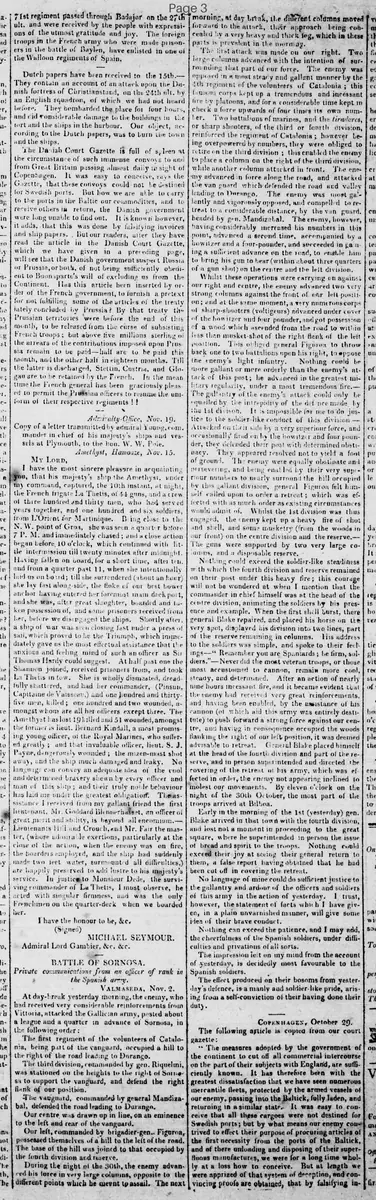
At day-break yesterday morning, the enemy, who had received very considerable reinforcements from Vittoria, attacked the Gallician army, posted about a league and a quarter in advance of Sornosa, in the following order:
The first regiment of the volunteers of Catalonia, being part of the vanguard, occupied a hill to the right of the road leading to Durango.
The third division, commanded by gen. Riquelmi, was stationed on the heights to the right of Sornosa to support the vanguard, and defend the right flank of our position.
The vanguard, commanded by general Mandizabal, defended the road leading to Durango.
Our centre was drawn up in line, on an eminence to the left and rear of the vanguard.
Our left, commanded by brigadier-gen. Figueroa, possessed themselves of a hill to the left of the road. The base of the hill was joined to that occupied by the fourth division and reserve.
7
During the night of the 30th, the enemy advanced his force in very large columns, opposite to the different points which he meant to assail. The next morning, at day break, the different columns moved forward to the attack, their approach being concealed by a very heavy and thick fog, which in these parts is prevalent in the morning.
The first attack was made on our right. Two large columns advanced with the intention of surrounding that part of our force. The enemy was opposed in a most steady and gallant manner by the 4th regiment of the volunteers of Catalonia; this furious corps kept up a tremendous and incessant fire by platoons, and for a considerable time kept in check a force upwards of four times its own number. Two battalions of marines, and the tiradores, or sharp shooters, of the third or fourth division, reinforced the regiment of Catalonia; however being overpowered by numbers, they were obliged to retire on the third division; this enabled the enemy to place a column on the right of the third division, while another column attacked in front. The enemy advanced in force along the road, and attacked the van guard which defended the road and valley leading to Durango. The enemy was most gallantly and vigorously opposed, and compelled to retreat to a considerable distance, by the van guard, headed by gen. Mandizabal. The enemy, however, having considerably increased his numbers in this point, advanced a second time, accompanied by a howitzer and a four-pounder, and succeeded in gaining a sufficient advance on the road, to enable him to bring his gun to bear (within about three quarters of a gun shot) on the centre and the left division.
Whilst these operations were carrying on against our right and centre, the enemy advanced two very strong columns against the front of our left position; and at the same moment, a very numerous corps of sharp-shooters (voltigeurs) advanced under cover of the howitzer and four pounder, and got possession of a wood which ascended from the road to within less than musket-shot of the right flank of the left position. This obliged general Figueroa to throw back one or two battalions upon his right, to oppose the enemy's light infantry. Nothing could be more gallant or more orderly than the enemy's attack of this post; he advanced in the greatest military regularity, under a most tremendous fire.—The gallantry of the enemy's attack could only be equalled by the intrepidity of the defence made by the 1st division. It is impossible for me to do justice to the soldier-like conduct of this division—Attacked on their side by a very superior force, and occasionally fired on by the howitzer and four pounder, they defended their post with determined obstinacy. They appeared resolved not to yield a foot of ground. The enemy were equally obstinate and persevering, and being enabled by their very superior numbers to nearly surround the hill occupied by this gallant division, general Figueroa felt himself called upon to order a retreat; which was effected with as much order as existing circumstances would admit of. Whilst the 1st division was thus engaged, the enemy kept up a heavy fire of shot and shell, and some musketry (from the woods in our front) on the centre division and the reserve.—The guns were supported by two very large columns, and a disposable reserve.
Nothing could exceed the soldier-like steadiness with which the fourth division and reserve remained on their post under this heavy fire; this courage will not be wondered at when I mention that the commander in chief himself was at the head of the centre division, animating the soldiers by his presence and example. When the first shell burst, there general Blake repaired, and placed his horse on the very spot, displayed his division into two lines, part of the reserve remaining in columns. His address to the soldiers was simple, and spoke to their feelings—"Remember you are Spaniards; be firm, soldiers."—Never did the most veteran troops, or those most accustomed to cannon, remain more cool, steady, and determined. After an action of nearly nine hours incessant fire, and it became evident that the enemy had received very great reinforcements, and having been enabled, by the assistance of his cannon (of which aid this army was entirely destitute) to push forward a strong force against our centre, and having in consequence occupied the woods flanking the right of our left position, it was deemed advisable to retreat. General Blake placed himself at the head of the fourth division and part of the reserve, and in person superintended and directed the covering of the retreat of his army, which was effected in order, the enemy not appearing inclined to molest our movements. By eleven o'clock on the night of the 30th October, the most part of the troops arrived at Bilbao.
Early in the morning of the 1st (yesterday) gen. Blake arrived in that town with the fourth division, and lost not a moment in proceeding to the great square, where he superintended in person the issue of bread and spirit to the troops. Nothing could exceed their joy at seeing their general return to them, a false report having obtained that he had been cut off in covering the retreat.
No language of mine could do sufficient justice to the gallantry and ardour of the officers and soldiers of this army in the action of yesterday. I trust, however, the statement of facts which I have given, in a plain unvarnished manner, will give some idea of their brave conduct.
Nothing can exceed the patience, and I may add the cheerfulness of the Spanish soldiers, under difficulties and privations of all sorts.
The impression left on my mind from the account of yesterday, is decidedly most favourable to the Spanish soldiers.
The effect produced on their bosoms from yesterday's defence, is a manly and soldier-like pride, arising from a self-conviction of their having done their duty.
What sub-type of article is it?
What keywords are associated?
What entities or persons were involved?
Where did it happen?
Foreign News Details
Primary Location
Sornosa
Event Date
30th 31st October
Key Persons
Outcome
spanish army retreated in good order to bilbao after nine hours of fighting; no specific casualties reported; enemy did not pursue.
Event Details
The enemy attacked the Gallician army near Sornosa at daybreak on October 31 after reinforcements from Vittoria. Spanish forces under General Blake defended positions along the road to Durango against superior numbers and artillery, holding for nine hours before retreating to Bilbao.