Thank you for visiting SNEWPapers!
Sign up free
Montgomery County Sentinel
Rockville, Gaithersburg, Montgomery County, Maryland
What is this article about?
The National Gallery of Art in Washington, D.C., opens as Andrew Mellon's posthumous gift to the nation, featuring priceless paintings and sculptures in a modern, welcoming space. Directed by David Finley, it aims to foster art appreciation, with affordable publications available.
Clipping
OCR Quality
Full Text
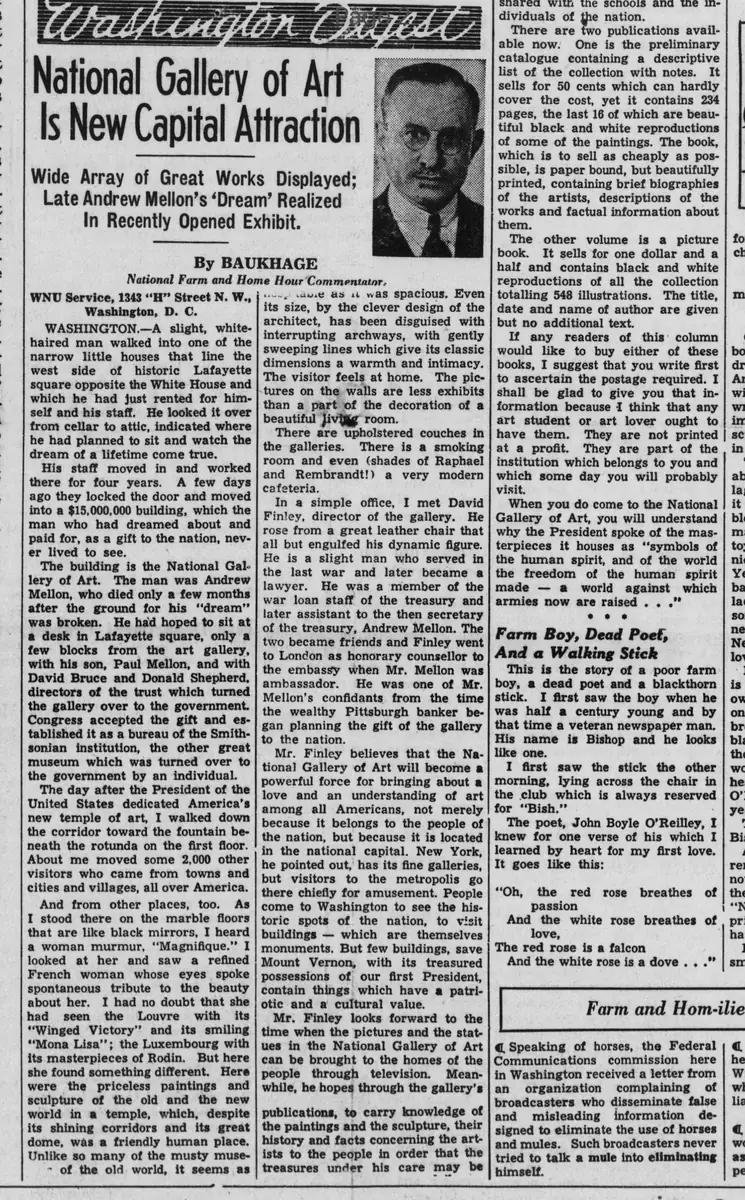
Is New Capital Attraction
Wide Array of Great Works Displayed:
Late Andrew Mellon's 'Dream' Realized
In Recently Opened Exhibit.
By BAUKHAGE
National Farm and Home Hour Commentator.
WNU Service, 1343 "H" Street N. W.
Washington, D. C.
WASHINGTON.-A slight, white-haired man walked into one of the narrow little houses that line the west side of historic Lafayette square opposite the White House and which he had just rented for himself and his staff. He looked it over from cellar to attic. indicated where he had planned to sit and watch the dream of a lifetime come true.
His staff moved in and worked there for four years. A few days ago they locked the door and moved into a $15,000,000 building. which the man who had dreamed about and paid for, as a gift to the nation, never lived to see.
The building is the National Gallery of Art. The man was Andrew Mellon, who died only a few months after the ground for his "dream" was broken. He had hoped to sit at a desk in Lafayette square, only a few blocks from the art gallery. with his son. Paul Mellon. and with David Bruce and Donald Shepherd, directors of the trust which turned the gallery over to the government.
Congress accepted the gift and established it as a bureau of the Smithsonian institution, the other great museum which was turned over to the government by an individual.
The day after the President of the United States dedicated America's new temple of art. I walked down the corridor toward the fountain beneath the rotunda on the first floor.
About me moved some 2,000 other visitors who came from towns and cities and villages, all over America. And from other places, too. As I stood there on the marble floors that are like black mirrors, I heard a woman murmur, "Magnifique." I looked at her and saw a refined French woman whose eyes spoke spontaneous tribute to the beauty about her. I had no doubt that she had seen the Louvre with its "Winged Victory" and its smiling "Mona Lisa"; the Luxembourg with its masterpieces of Rodin. But here she found something different. Here were the priceless paintings and sculpture of the old and the new world in a temple. which, despite its shining corridors and its great dome, was a friendly human place.
Unlike so many of the musty museums of the old world, it seems as tame as it was spacious. Even its size, by the clever design of the architect, has been disguised with interrupting archways, with gently sweeping lines which give its classic dimensions a warmth and intimacy.
The visitor feels at home. The pictures on the walls are less exhibits than a part of the decoration of a beautiful living room.
There are upholstered couches in the galleries. There is a smoking room and even (shades of Raphael and Rembrandt!) a very modern cafeteria.
In a simple office, I met David Finley. director of the gallery. He rose from a great leather chair that all but engulfed his dynamic figure.
He is a slight man who served in the last war and later became a lawyer. He was a member of the war loan staff of the treasury and later assistant to the then secretary of the treasury. Andrew Mellon. The two became friends and Finley went to London as honorary counsellor to the embassy when Mr. Mellon was ambassador. He was one of Mr. Mellon's confidants from the time the wealthy Pittsburgh banker began planning the gift of the gallery to the nation.
Mr. Finley believes that the National Gallery of Art will become a powerful force for bringing about a love and an understanding of art among all Americans, not merely because it belongs to the people of the nation, but because it is located in the national capital. New York, he pointed out, has its fine galleries, but visitors to the metropolis go there chiefly for amusement. People come to Washington to see the historic spots of the nation, to visit buildings - which are themselves monuments. But few buildings, save Mount Vernon, with its treasured possessions of our first President, contain things which have a patriotic and a cultural value.
Mr. Finley looks forward to the time when the pictures and the statues in the National Gallery of Art can be brought to the homes of the people through television. Meanwhile, he hopes through the gallery's publications, to carry knowledge of the paintings and the sculpture, their history and facts concerning the artists to the people in order that the treasures under his care may be
There are two publications available now. One is the preliminary catalogue containing a descriptive list of the collection with notes. It sells for 50 cents which can hardly cover the cost, yet it contains 234 pages, the last 16 of which are beautiful black and white reproductions of some of the paintings. The book, which is to sell as cheaply as possible, is paper bound, but beautifully printed, containing brief biographies of the artists, descriptions of the works and factual information about them.
The other volume is a picture book. It sells for one dollar and a half and contains black and white reproductions of all the collection totalling 548 illustrations. The title, date and name of author are given but no additional text.
If any readers of this column would like to buy either of these books. I suggest that you write first to ascertain the postage required. I shall be glad to give you that information because I think that any art student or art lover ought to have them. They are not printed at a profit. They are part of the institution which belongs to you and which some day you will probably visit.
When you do come to the National Gallery of Art, you will understand why the President spoke of the masterpieces it houses as "symbols of the human spirit. and of the world the freedom of the human spirit made - a world against which armies now are raised.."
What sub-type of article is it?
What themes does it cover?
What keywords are associated?
What entities or persons were involved?
Where did it happen?
Story Details
Key Persons
Location
Washington, D.C.
Event Date
Recently Opened
Story Details
Andrew Mellon's dream of a national art gallery is realized after his death as a gift to the nation, housed in a new $15,000,000 building in Washington. The gallery, dedicated by the President, features masterpieces from old and new worlds in a welcoming space, directed by David Finley, who promotes art appreciation among Americans.