Thank you for visiting SNEWPapers!
Sign up free
Lynchburg Virginian
Lynchburg, Virginia
What is this article about?
The editorial responds to the Washington Chronicle's angry rebuttal, defending against accusations of misinformation on John C. Calhoun's report authorship, newspaper ownership rumors involving Robert Barnwell Rhett and others, and demands for evidence of congressional bribery by bank agents. It highlights the Chronicle's hypocrisy in similar practices against Henry Clay.
Merged-components note: Continuation of editorial critiquing the Washington Chronicle; second component picks up directly from the first.
Clippings
1 of 2
OCR Quality
Full Text
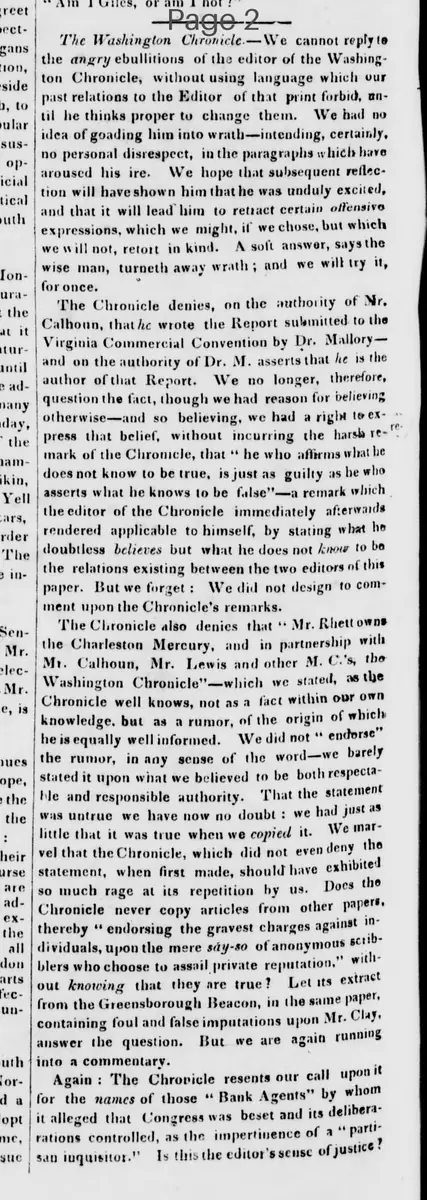
The Chronicle denies, on the authority of Mr. Calhoun, that he wrote the Report submitted to the Virginia Commercial Convention by Dr. Mallory—and on the authority of Dr. M. asserts that he is the author of that Report. We no longer, therefore, question the fact, though we had reason for believing otherwise—and so believing, we had a right to express that belief, without incurring the harsh remark of the Chronicle, that "he who affirms what he does not know to be true, is just as guilty as he who asserts what he knows to be false"—a remark which the editor of the Chronicle immediately afterwards rendered applicable to himself, by stating what he doubtless believes but what he does not know to be the relations existing between the two editors of this paper. But we forget: We did not design to comment upon the Chronicle's remarks.
The Chronicle also denies that "Mr. Rhett owns the Charleston Mercury, and in partnership with Mr. Calhoun, Mr. Lewis and other M. C.'s, the Washington Chronicle"—which we stated, as the Chronicle well knows, not as a fact within our own knowledge, but as a rumor, of the origin of which he is equally well informed. We did not "endorse" the rumor, in any sense of the word—we barely stated it upon what we believed to be both respectable and responsible authority. That the statement was untrue we have now no doubt: we had just as well have copied it from the Charleston Mercury itself, as from the source we did. We marvel that the Chronicle, which did not even deny the statement, when first made, should have exhibited so much rage at its repetition by us. Does the Chronicle never copy articles from other papers, thereby "endorsing the gravest charges against individuals, upon the mere say-so of anonymous scribblers who choose to assail private reputation," without knowing that they are true? Let its extract from the Greensborough Beacon, in the same paper, containing foul and false imputations upon Mr. Clay, answer the question. But we are again running into a commentary.
Again: The Chronicle resents our call upon it for the names of those "Bank Agents" by whom it alleged that Congress was beset and its deliberations controlled, as the impertinence of a "partisan inquisitor." Is thus the editor's sense of justice?
He impliedly charges Congress with bribery and corruption—and when called upon to specify the agents of this nefarious proceeding, whom, if true, he should, as a sentinel upon the spot, have exposed, without a call from any source, he demurs to our "right" to make the demand—and reads us a lecture upon "propriety," and all that sort of thing. Why, the old proverb goes, that "a cat may look upon a king," and we really see no great presumption in asking a man who deals out such grave charges of corruption, to specify the criminals. Certainly we shall exercise that right, whenever we please, whether it belongs to us or not. And, by the way, if we be not mistaken, the editor of the Chronicle himself, but the other day, said, that he had understood that Mr. Clay had uttered a certain sentiment in reference to Abolition, which, for the purpose of rendering more conspicuous, he printed in large capitals, and stated it in such a manner as to convey the impression that there was not a doubt that he had uttered it—and then forsooth, asked Mr. Clay, if it was not true? Upon this hint, doubtless, the echoes of the Chronicle in the South will proceed to speak—and it will not be long before this innuendo of the Chronicle, which, from the very manner in which it is stated, it evidently does not "know to be true," will be positively ascribed to Mr. Clay, and the fact of his having made it, sworn to, if an oath be necessary to verify the fact! Surely a gentleman so punctilious and scrupulous in protecting his own feelings and rights, should have some little regard for those of others. At least, when censuring others, he should be certain that he is not exposed to the full force of his own censures.
But we suppose the editor of the Chronicle wrote with the thermometer at 100°; and so we leave the matter—by no means desirous to disturb our heretofore amicable personal relations, but leaving that matter entirely with himself.
What sub-type of article is it?
What keywords are associated?
What entities or persons were involved?
Editorial Details
Primary Topic
Dispute With Washington Chronicle Over Rumors And Accusations
Stance / Tone
Defensive And Conciliatory With Critiques Of Hypocrisy
Key Figures
Key Arguments