Thank you for visiting SNEWPapers!
Sign up free
Glasgow Weekly Times
Glasgow, Howard County, Missouri
What is this article about?
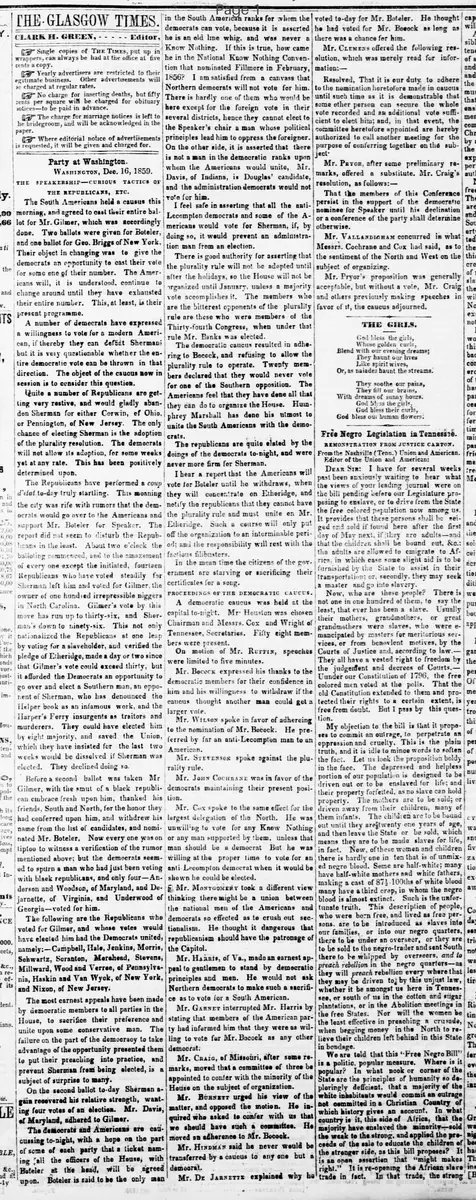
Detailed report from Washington on December 16, 1859, covering the contentious U.S. House speakership election, including Republican vote switches to Gilmer, Democratic caucus proceedings, and failed attempts at unity among parties to block Sherman.
Merged-components note: Continuation of the same article on the Congressional speakership contest.
Clipping
OCR Quality
Full Text
Washington, Dec. 16, 1859.
THE SPEAKERSHIP--CURIOUS TACTICS OF
THE REPUBLICANS, ETC.
The South Americans held a caucus this
morning, and agreed to cast their entire ballot for Mr. Gilmer, which was accordingly
done. Two ballots were given for Boteler,
and one ballot for Geo. Briggs of New York.
Their object in changing was to give the
democrats an opportunity to cast their vote
for some one of their number. The Amer-
ican will, it is understood, continue to
change around until they have exhausted
their entire number. This, at least, is their
present programme.
A number of democrats have expressed
a willingness to vote for a modern Ameri-
can, if thereby they can defeat Sherman;
but it is very questionable whether the entire democratic vote can be thrown in that
direction. The object of the caucus now in
session is to consider this question.
Quite a number of Republicans are getting very restive, and would gladly abandon Sherman for either Corwin, of Ohio
or Pennington, of New Jersey. The only
chance of electing Sherman is the adoption
of the plurality resolution. The democrats
will not allow its adoption, for some weeks
yet at any rate. This has been positively
determined upon.
The Republicans have performed a coup
d'état to-day truly startling. This morning
the city was rife with rumors that the dem-
ocrats would go over to the Americans and
support Mr. Boteler for Speaker. The
report did not seem to disturb the Repub-
licans in the least. About two o'clock the
balloting commenced, and to the amazement
of every one except the initiated, fourteen
Republicans who have voted steadily for
Sherman left him and voted for Gilmer, the
owner of one hundred irrepressible nigger
in North Carolina. Gilmer's vote by this
move has run up to thirty-six, and Sher-
man's down to ninety-six. This not only
nationalized the Republicans at one leap
by voting for a slaveholder, and verified the
pledge of Etheridge, made a day or two since
that Gilmer's vote could exceed thirty, but
it afforded the Democrats an opportunity to
go over and elect a Southern man, an oppo-
nent of Sherman, who has denounced the
Helper book as an infamous work, and the
Harper's Ferry insurgents as traitors and
murderers. They could have elected him
by eight majority, and saved the Union,
which they have insisted for the last two
weeks would be dissolved if Sherman was
elected. They declined doing so.
Before a second ballot was taken Mr.
Gilmer, with the smut of a black republi-
can embrace fresh upon him, thanked his
friends, South and North, for the honor they
had conferred upon him, and withdrew his
name from the list of candidates, and nominated Mr. Boteler. Now every one was on
tiptoe to witness a verification of the rumor
mentioned above; but the democrats seemed to spurn a man who had just been voting
with black republicans, and only four--Anderson and Woodson, of Maryland, and De-
Jarnette, of Virginia, and Underwood of
Georgia--voted for him.
The following are the Republicans who
voted for Gilmer, and whose votes would
have elected him had the Democrats united
namely:--Campbell, Hale, Jenkins, Morris
Schwartz, Scranton, Moorhead, Stevens,
Millward, Wood and Verree, of Pennsylvania, Haskin and Van Wyck, of New York,
and Nixon, of New Jersey:
The most earnest appeals have been made
by democratic members to all parties in the
House, to sacrifice their preference and
unite upon some conservative man. The
failure on the part of the democracy to take
advantage of the opportunity presented them
to put their preaching into practice, and
prevent Sherman from being elected, is a
subject of surprise to many.
On the second ballot to-day Sherman again recovered his relative strength, wanting four votes of an election. Mr. Davis,
of Maryland, adhered to Gilmer.
The democrats and Americans are caucussing to-night, with a hope on the part
of some of each party that a ticket embracing all the officers of the House, with
Boteler at the head, will be agreed
upon. Boteler is said to be the only man
in the South American ranks for whom the
democrats can vote, because it is asserted
he is an old line whig, and was never a
Know Nothing. If this is true, how came
he in the National Know Nothing Conven-
tion that nominated Fillmore in February,
1856? I am satisfied from a canvass that
Northern democrats will not vote for him.
There is hardly one of them who would be
here except for the foreign vote in their
several districts, hence they cannot elect to
the Speaker's chair a man whose political
principles lead him to oppress the foreigner.
On the other side, it is asserted that there
is not a man in the democratic ranks upon
whom the Americans would unite. Mr.
Davis, of Indiana, is Douglas' candidate,
and the administration democrats would not
vote for him.
I feel safe in asserting that all the anti-
Lecompton democrats and some of the A.
mericans would vote for Sherman, if, by
doing so, it would prevent an administra-
tion man from an election.
There is good authority for asserting that
the plurality rule will not be adopted until
after the holidays, so the House will not be
organized until January, unless a majority
vote accomplishes it. The members who
are the bitterest opponents of the plurality
rule are those who were members of the
Thirty-fourth Congress, when under that
rule Mr. Banks was elected
The democratic caucus resulted in adhering to Bocock, and refusing to allow the
plurality rule to operate. Twenty mem-
bers declared that they would never vote
for one of the Southern opposition. The
Americans feel that they have done all that
they can do to organize the House. Humphrey Marshall has done his utmost to
unite the South Americans with the demo-
crats.
The republicans are quite elated by the
doings of the democrats to-night, and were
never more firm for Sherman.
I hear a report that the Americans will
vote for Boteler until he withdraws, when
they will concentrate on Etheridge, and
notify the republicans that they cannot have
the plurality rule and must unite on Mr.
Etheridge. Such a course will only put
off the organization to an interminable period; and the responsibility will rest with the
factious filibusters.
in the mean time the citizens of the government are starving or sacrificing their
certificates for a song.
PROCEEDINGS OF THE DEMOCRATIC CAUCUS.
A democratic caucus was held at the
capital to-night. Mr. Houston was chosen
Chairman and Messrs. Cox and Wright of
Tennessee, Secretaries. Fifty eight members were present.
On motion of Mr. Burnet, speeches
were limited to five minutes.
Mr. Bocock expressed his thanks to the
democratic members for their confidence in
him and his willingness to withdraw if the
caucus thought another man could get a
larger vote.
Mr. Wilson spoke in favor of adhering
to the nomination of Mr. Bocock. He pre-
ferred by far an anti-Lecompton man to an
American.
Mr. Stevenson spoke against the plu-
rality rule.
Mr. John Cochrane was in favor of the
democrats maintaining their present posi-
tion.
Mr. Cox spoke to the same effect for the
largest delegation of the North. He was
unwilling to vote for any Know Nothing
or any man supported by them, unless that
man should be a democrat But he was
willing at the proper time to vote for an
anti-Lecompton democrat when it would be
shown he could be elected.
Mr. Montgomery took a different view
thinking there might be a union between
the national men of the Americans and
democrats so effected as to crush out sec-
tionalism. He thought it dangerous that
republicanism should have the patronage of
the Capitol.
Mr. Harris, of Va., made an earnest ap-
peal to gentlemen to stand by democratic
principles and men. He would not ask
Northern democrats to make such a sacrifi-
ce as to vote for a South American.
Mr. Garnett interrupted Mr. Harris by
stating that members of the American par-
ty had informed him that they were as wil-
ling to vote for Mr. Bocock as any other
democrat:
Mr. Craig, of Missouri, after some re-
marks, moved that a committee of three be
appointed to confer with the minority of the
House on the subject of organization.
Mr. Burnett urged his view of the
matter, and opposed the motion. He in-
quired who asked to confer with us that
we should have such a committee. He
moved an adherence to Mr. Bocock.
Mr. Hindman said he never would be
transferred by a caucus to any one but a
democrat.
Mr. De Jarnette explained why he
voted to-day for Mr. Boteler. He thought
he had voted for Mr. Bocock as long as
there was a chance for him.
Mr. Clemens offered the following res-
olution, which was merely read for infor-
mation:
Resolved, That it is our duty to adhere
to the nomination heretofore made in caucus
until such time as it is demonstrable that
some other person can secure the whole
vote recorded and an additional vote sufficient to elect him; and, in that event, the
committee heretofore appointed are hereby
authorized to call another meeting for the
purpose of conferring together on the sub-
ject.
Mr. Pryor, after some preliminary re-
marks, offered a substitute. Mr. Craig's
resolution, as follows:--
That the members of this Conference
persist in the support of the democratic
nominee for Speaker until his declination
or a conference of the party shall determine
otherwise.
Mr. Vallandigham concurred in what
Messrs. Cochrane and Cox had said, as to
the sentiment of the North and West on the
subject of organizing.
Mr. Pryor's proposition was generally
acceptable, but without a vote, Mr. Craig
and others previously making speeches in
favor of it, the caucus adjourned.
What sub-type of article is it?
What themes does it cover?
What keywords are associated?
What entities or persons were involved?
Where did it happen?
Story Details
Key Persons
Location
Washington
Event Date
Dec. 16, 1859
Story Details
Republicans switch votes to Gilmer to nationalize their image, allowing Democrats a chance to elect him but they decline; Gilmer withdraws for Boteler, who gets few votes; Democratic caucus adheres to Bocock and opposes plurality rule, prolonging the speakership deadlock.