Thank you for visiting SNEWPapers!
Sign up free
Washington Telegraph
Washington, Hempstead County, Arkansas
What is this article about?
Peter Pike's correspondence from New York, Aug. 6, 1851, describes a train trip from Boston with family scenes and a drunken passenger, a military court punishing a Catholic soldier for refusing Protestant worship (later disallowed), arrival of Hungarian army officers seeking asylum, Jenny Lind's impending departure, barber Phalon's success, and Jewish MP Solomon's refusal to take Christian oath in British Parliament.
Clipping
OCR Quality
Full Text
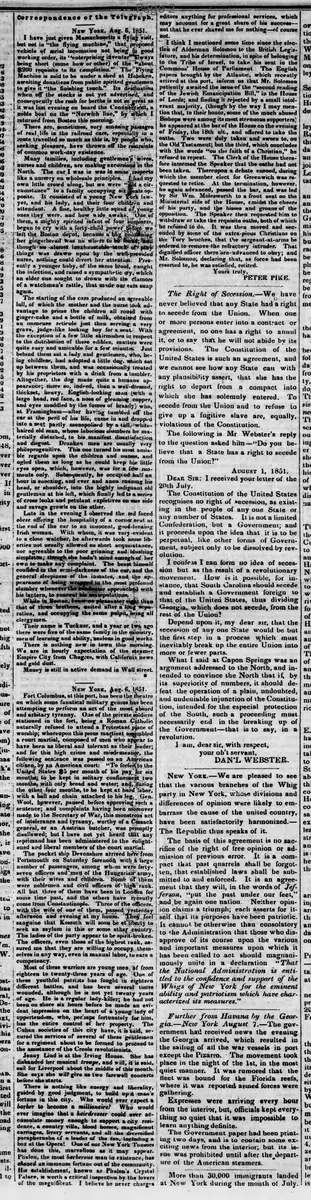
New York, Aug. 6, 1851.
I have just given Massachusetts a flying visit, but not in "the flying machine," that proposed vehicle of serial locomotion not being in good working order, its "enterprising inventor" always being short (some how or other) of the "about $200 requisite to its completion." The Flying Machine is said to be under a shed at Hoboken, awaiting donations from public spirited gentlemen to give it the finishing touch. Its destination when off the stocks is not yet advertised, and consequently the rush for berths is not so great as it was last evening on board the Connecticut, a noble boat on the "Norwich line," by which I returned from Boston this morning.
There are, sometimes, very amusing passages of real life in the railroad cars, especially in a route travelled so much as this is, by people who, seeking pleasure, have thrown off the restraints of common work-day existence.
Many families, including gentlemen's wives, nurses and children, are making excursions in the North. The car I was in was in some respects like a nursery on wholesale principles. I had my own little crowd along, but we were not a circumstance to a family occupying six seats opposite. It consisted of a young New York lawyer, and his lady, and their four children and attendant. A fine, healthy little squad of young ones they were, and how wide awake. One of them, a mighty spirited infant of four summers, began to cry with a forty-child power before we left the Boston depot, because a bag containing her gingerbread was nowhere to be found; and though an almost inexhaustible stock of play things was drawn upon by the well-provided nurse, nothing could divert her attention. Presently a younger baby, of the same brood, caught the infection, and raised a sympathetic cry, which an elder one sought to drown with the clamors of a watchman's rattle, that made our ears snap again.
The starting of the cars produced an agreeable lull, of which the mother and the nurse took advantage to prime the children all round with ginger-cake and a bottle of milk, obtained from an immense reticule just then serving a very grave, judge-like looking boy of a seat. With the exception of a few little skirmishes in respect to the distribution of these edibles, matters were quite easy and amicable for a few minutes. Just behind them sat a lady and gentleman, who, being childless, had adopted a little dog, which sat up between them, and was occasionally treated by his proprietors with a drink from a tumbler. Altogether, the dog made quite a humane appearance; more so, indeed, than a well-dressed, thickset, heavy, English-looking man (with a large head, red face, a nose of gleaming copper, and eyes muddled by the fumes of brandy) who, at Framingham—after having tumbled off the car at the peril of his life, came in and dropped into a seat partly monopolised by a tall, white-haired old man, whose laborious slumbers he materially disturbed, to his manifest dissatisfaction and disgust. Drunken men are usually very philoprogenitive. This one turned his most amiable regards upon the children and nurses, and ogled them as long as he could keep his little eyes open, which, however, was but a few moments only. Subsequently, he occupied half an hour in snoring, and ever and anon rubbing his head, or shoulder, into the highly indignant old gentleman at his left, which finally led to a series of cross looks and petulant expletives on one side and savage growls on the other.
Late in the evening I observed the red faced obese offering the hospitality of a corner seat at the end of the car to an innocent, good-looking Irish woman. With whom, it was very evident to a close watcher, he afterwards took some liberties not usually allowed on short acquaintance, nor agreeable to the poor grinning and blushing simpleton, though she hadn't mind enough of her own to make any complaint. The beast himself confided in the semi-darkness of the car, and the general sleepiness of the inmates, and the appearance of being wrapped in the most profound slumber whenever the conductor approached with his lantern, to conceal his manipulations.
While in Boston, I saw no pleasanter sight than that of three brothers, united after a long separation, and occupying the same pulpit, being all clergymen. Their name is Tucknor, and a year or two ago there were five of the same family in the ministry, men of learning and ability, zealous in good works.
There is nothing new in town this morning. We are in hourly expectation of the steamer Empire City from Chagres, with California news and gold dust.
Money is still in active demand in Wall street.
New York, Aug. 6, 1851.
Fort Columbus, at this port, has been the theatre on which some fanatical military genius has been attempting to perform an act of the most absurd and arbitrary tyranny. One of the private soldiers stationed in the fort, being a Roman Catholic naturally refused to attend a Protestant place of worship; whereupon this pious martinet assembled a court martial, composed of men who appear to have been as liberal and tolerant as their leader; and for this high crime and misdemeanor, the following sentence was passed on an American citizen, by an American court: "To forfeit to the United States $5 per month of his pay for six months; to be kept in solitary confinement two months, with only bread and water; and, during the other four months, to be kept at hard labor, with a ball and chain attached to his leg." Gen. Wool, however, paused before approving such a sentence; and complaints having been moreover made to the Secretary of War, this monstrous act of intolerance and tyranny, worthy of a Cossack general, or an Austrian butcher, was promptly disallowed; but I have not yet heard that any reprimand has been administered to the enlightened and liberal members of the court martial.
The packet ship Devonshire arrived here from Portsmouth on Saturday morning with a large number of passengers, among whom were forty-seven officers and men of the Hungarian army, with their wives and children. Some of them were noblemen and civil officers of high rank. All but three of them have been in London some time past, and the others have recently come from Constantinople. Three of the officers, with the wife of one of them, passed yesterday afternoon and evening at my house. They feel sanguine that Kossuth will soon be at liberty to seek an asylum in this or some other country. The ladies of the party appear to be spirit-broken. The officers, even those of the highest rank, assured me that they are willing to occupy themselves in any way, even in manual labor, to earn a competency.
Most of these warriors are young men; of from eighteen to twenty-three years of age. One of these youthful patriots has fought in eighteen different battles, and has been several times wounded, although he is not yet twenty years of age. He is a regular lady-killer; he had not been on shore six hours before he made an evident impression on the heart of a young lady of upper tender age, who, perhaps fortunately for him, has the entire control of her property.
The Cuban societies of this city have, it is said, secured the services of several of these gentlemen for a regiment about to be formed to proceed to the assistance of the Creole revolutionists.
Jenny Lind is at the Irving House. She has disbanded her musical troupe, and will, it is said, sail for Liverpool about the middle of this month. She says she will give us two farewell concerts before she starts.
There is nothing like energy and liberality, guided by good judgment, to build up a man's fortune in this city. Who would ever expect a barber to become a millionaire? Who would ever imagine that a hairdresser could ever accumulate money enough to support a city residence, a country villa, blood horses, magnificent carriages, livery servants, and all the diversified paraphernalia of a leader of the ton, including a box at the Opera! One of our New York Tonsors has done this, marvellous as it may appear. Phalon, the most barberous man in existence, has reaped an immense fortune out of the community. His Establishment, known as Phalon's Crystal Palace, is worth a critical inspection by the lovers of the magnificent. I believe he never charges editors anything for professional services, which may account for a great share of his success—not that he ever shaved me for nothing—of course not.
I think I mentioned some time since the election of Alderman Solomon to the British Legislature, and his determination, in spite of belonging to the Tribe of Israel, to take his seat in the Commons' House of Parliament. The English papers brought by the Atlantic, which recently arrived at this port, inform us that Mr. Solomon patiently awaited the issue of the "second reading of the Jewish Emancipation Bill," in the House of Lords; and finding it rejected by a small intolerant majority, (though by the way I may mention that, to their honor, some of the much abused Bishops were among its most strenuous supporters,) he appeared at the bar of the House on the evening of Friday, the 18th ult., and offered to take the oaths. Two were duly taken and sworn to, on the Old Testament; but the third, which concludes with the words "on the faith of a Christian," he refused to repeat. The Clerk of the House therefore informed the Speaker that the oaths had not been taken. Thereupon a debate ensued, during which the member elect for Greenwich was requested to retire. At the termination, however he again advanced, passed the bar, and was led by Sir Wm. Molesworth to a front seat on the Ministerial side of the House, amidst the cheers of his party, and the hisses and groans of the opposition. The Speaker then requested him to withdraw or take the requisite oaths, both of which he refused to do. It was then moved and seconded by some of the extra-pious Christians on the Tory benches, that the sergeant-at-arms be ordered to remove the refractory intruder. That dignified officer thereupon advanced to obey; and Mr. Solomon, declaring that, as force had been resorted to, he was satisfied, retired.
Yours truly,
PETER PIKE.
What sub-type of article is it?
What themes does it cover?
What keywords are associated?
What entities or persons were involved?
Letter to Editor Details
Author
Peter Pike
Recipient
Telegraph
Main Argument
reports various observations and news from new york, including travel anecdotes, religious intolerance in the military, hungarian exiles, celebrity updates, commercial success, and british political events involving jewish emancipation.
Notable Details