Thank you for visiting SNEWPapers!
Sign up free
The National Republican And Ohio Political Register
Cincinnati, Hamilton County, Ohio
What is this article about?
Ohio Legislature reports from Columbus detail Canal Commissioners' and Engineer Judge Bates' reports on routes; a bill for Scioto-Muskingum and Dayton-Cincinnati canals expected to pass, enabling construction start on July 4, 1825. Revenue Bill, revised for fairer taxation, advances to support canal funding. Unusual lobby presence noted.
Clipping
OCR Quality
Full Text
CINCINNATI:
TUESDAY, JANUARY 18. 1825.
OHIO LEGISLATURE.
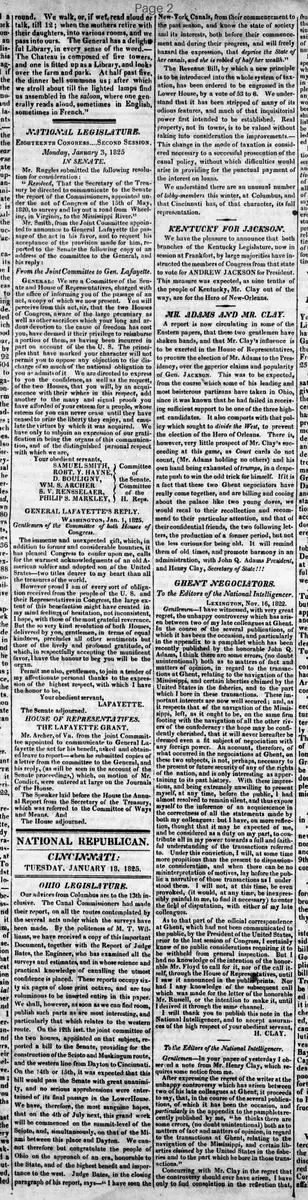
Our advices from Columbus are to the 13th inclusive. The Canal Commissioners had made their report, on all the routes contemplated by the several acts under which the surveys have been made. By the politeness of M. T. Williams, we have received a copy of this important Document, together with the Report of Judge Bates, the Engineer, who has examined all the surveys and estimates, and in whose science and practical knowledge of canalling the utmost confidence is placed. These reports occupy sixty six pages of close print octavo, and are too voluminous to be inserted entire in this paper. We shall, however, as soon as we can find room, publish such parts as are most interesting, and particularly that which relates to the western route. On the 12th inst. the joint committee of the two houses, appointed on that subject, reported a bill to the Senate, providing for the construction of the Scioto and Muskingum route, and the western line from Dayton to Cincinnati. On the 14th or 15th, it was expected that this bill would pass the Senate with great unanimity, and no serious apprehensions were entertained of its final passage in the Lower House. We have, therefore, the most sanguine hopes, that on the 4th of July next, this grand work will be commenced on the summit-level of the Scioto, and, simultaneously, on that of the Miami between this place and Dayton. We cannot therefore but congratulate the people of Ohio on the approach of an era, honorable to the State, and of the highest benefit and importance to the west. Judge Bates, in the closing paragraph of his report, says- "I have seen the New-York Canals, from their commencement to the past season, and know the state of society and its interests, both before their commencement and during their progress, and will freely hazard the expression, that deprive the State of her canals, and she is robbed of half her wealth."
The Revenue Bill, by which a new principle is to be introduced into the whole system of taxation, has been ordered to be engrossed in the Lower House, by a vote of 53 to 8. We understand that it has been stripped of many of its odious features, and much of that inquisitorial power first intended to be established. Real property, not in towns, is to be valued without taking into consideration the improvements.— This change in the mode of taxation is considered necessary to a successful prosecution of the canal policy, without which difficulties would arise in providing for the punctual payment of the interest on loans.
We understand there are an unusual number of lobby-members this winter, at Columbus, and that Cincinnati has, of that character, its full representation.
What sub-type of article is it?
What keywords are associated?
What entities or persons were involved?
Where did it happen?
Domestic News Details
Primary Location
Columbus, Ohio
Event Date
January 12 15, 1825
Key Persons
Outcome
canal bill expected to pass senate unanimously and lower house; construction to commence july 4, 1825 on scioto and miami routes. revenue bill passed lower house 53-8, revised for fairer taxation to fund canals.
Event Details
Canal Commissioners reported on routes surveyed; Judge Bates endorsed estimates. Joint committee reported bill to Senate for Scioto-Muskingum and Dayton-Cincinnati canals. Revenue Bill introduces new taxation principles, valuing rural real property without improvements, to support canal loans. Unusual lobby-members present, including from Cincinnati.