Thank you for visiting SNEWPapers!
Sign up free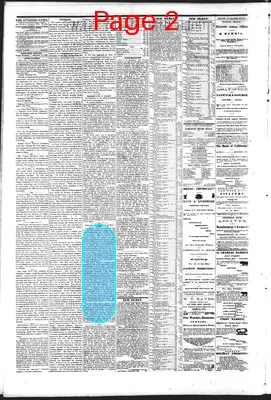
Editorial
December 8, 1865
Gold Hill Daily News
Gold Hill, Storey County, Nevada
What is this article about?
Editorial defends the constitutionality of the 1862/1863 Test Oath for members from rebel states, citing Chief Justice John Marshall's opinion in McCulloch v. Maryland that Congress can require additional oaths beyond the constitutional one, and labels opponents as insane.
Clipping
OCR Quality
98%
Excellent
Full Text
Chief Justice Marshall on Test Oaths.
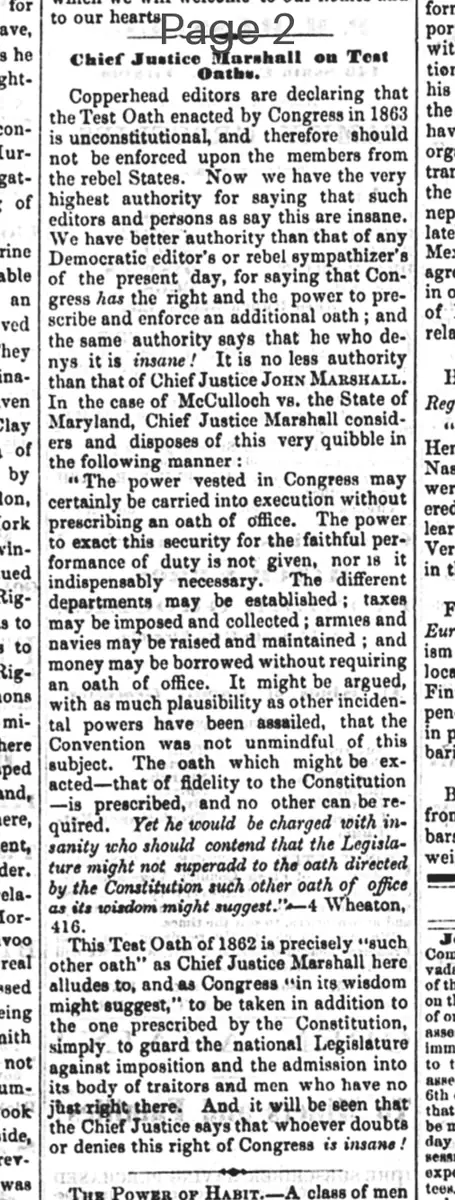
Copperhead editors are declaring that the Test Oath enacted by Congress in 1863 is unconstitutional, and therefore should not be enforced upon the members from the rebel States. Now we have the very highest authority for saying that such editors and persons as say this are insane. We have better authority than that of any Democratic editor's or rebel sympathizer's of the present day, for saying that Congress has the right and the power to prescribe and enforce an additional oath; and the same authority says that he who denies it is insane! It is no less authority than that of Chief Justice JOHN MARSHALL. In the case of McCulloch vs. the State of Maryland, Chief Justice Marshall considers and disposes of this very quibble in the following manner:
"The power vested in Congress may certainly be carried into execution without prescribing an oath of office. The power to exact this security for the faithful performance of duty is not given, nor is it indispensably necessary. The different departments may be established; taxes may be imposed and collected; armies and navies may be raised and maintained; and money may be borrowed without requiring an oath of office. It might be argued, with as much plausibility as other incidental powers have been assailed, that the Convention was not unmindful of this subject. The oath which might be exacted—that of fidelity to the Constitution—is prescribed, and no other can be required. Yet he would be charged with insanity who should contend that the Legislature might not superadd to the oath directed by the Constitution such other oath of office as its wisdom might suggest." 4 Wheaton, 416.
This Test Oath of 1862 is precisely "such other oath" as Chief Justice Marshall here alludes to, and as Congress "in its wisdom might suggest," to be taken in addition to the one prescribed by the Constitution, simply to guard the national Legislature against imposition and the admission into its body of traitors and men who have no just right there. And it will be seen that the Chief Justice says that whoever doubts or denies this right of Congress is insane!
Copperhead editors are declaring that the Test Oath enacted by Congress in 1863 is unconstitutional, and therefore should not be enforced upon the members from the rebel States. Now we have the very highest authority for saying that such editors and persons as say this are insane. We have better authority than that of any Democratic editor's or rebel sympathizer's of the present day, for saying that Congress has the right and the power to prescribe and enforce an additional oath; and the same authority says that he who denies it is insane! It is no less authority than that of Chief Justice JOHN MARSHALL. In the case of McCulloch vs. the State of Maryland, Chief Justice Marshall considers and disposes of this very quibble in the following manner:
"The power vested in Congress may certainly be carried into execution without prescribing an oath of office. The power to exact this security for the faithful performance of duty is not given, nor is it indispensably necessary. The different departments may be established; taxes may be imposed and collected; armies and navies may be raised and maintained; and money may be borrowed without requiring an oath of office. It might be argued, with as much plausibility as other incidental powers have been assailed, that the Convention was not unmindful of this subject. The oath which might be exacted—that of fidelity to the Constitution—is prescribed, and no other can be required. Yet he would be charged with insanity who should contend that the Legislature might not superadd to the oath directed by the Constitution such other oath of office as its wisdom might suggest." 4 Wheaton, 416.
This Test Oath of 1862 is precisely "such other oath" as Chief Justice Marshall here alludes to, and as Congress "in its wisdom might suggest," to be taken in addition to the one prescribed by the Constitution, simply to guard the national Legislature against imposition and the admission into its body of traitors and men who have no just right there. And it will be seen that the Chief Justice says that whoever doubts or denies this right of Congress is insane!
What sub-type of article is it?
Constitutional
Legal Reform
Partisan Politics
What keywords are associated?
Test Oath
Chief Justice Marshall
Mcculloch V Maryland
Congressional Power
Constitutional Oath
Rebel States
Copperhead Editors
Civil War Reconstruction
What entities or persons were involved?
Chief Justice John Marshall
Congress
Copperhead Editors
Rebel States
Democratic Editors
Rebel Sympathizers
Editorial Details
Primary Topic
Constitutionality Of Congressional Test Oaths For Rebel State Members
Stance / Tone
Strongly Pro Test Oath, Dismissive Of Opponents As Insane
Key Figures
Chief Justice John Marshall
Congress
Copperhead Editors
Rebel States
Democratic Editors
Rebel Sympathizers
Key Arguments
Congress Has The Right To Prescribe Additional Oaths Beyond The Constitutional One
Test Oath Of 1862/1863 Guards Against Traitors In The National Legislature
Denying Congress's Power To Require Such Oaths Is Insanity, Per Marshall
Marshall's Opinion In Mcculloch V. Maryland Supports Additional Oaths As Within Legislative Wisdom