Thank you for visiting SNEWPapers!
Sign up free
Gazette Of The United States
New York, New York County, New York
What is this article about?
Catullus responds to Aristides, defending claims that Thomas Jefferson opposed the U.S. Constitution's ratification and key fiscal measures like funding the public debt and establishing a national bank, citing historical letters, speeches from Virginia's convention, and Jefferson's advice on French debt transfer.
Merged-components note: These components form a single long letter to the editor signed 'CATULLUS', continued across multiple segments on page 2 and into page 3.
Clippings
1 of 2
OCR Quality
Full Text
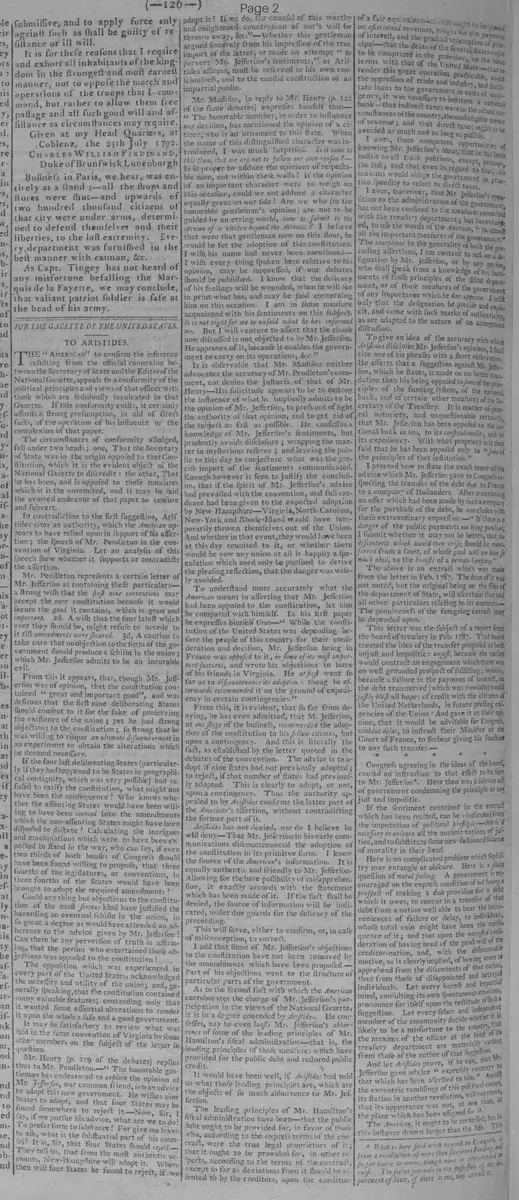
TO ARISTIDES.
The 'AMERICAN' to confirm the inference
resulting from the official connexion be-
tween the Secretary of State and the Editor of the
National Gazette, appeals to a conformity of the
political principles and views of that officer with
those which are sedulously inculcated in that
Gazette. If this conformity exists, it certainly
affords a strong presumption, in aid of direct
facts, of the operation of his influence or the
complexion of that paper.
The circumstances of conformity alleged,
fall under two heads; one, That the Secretary
of State was in the origin opposed to that Con-
stitution, which it is the evident object of the
National Gazette to discredit: the other, That
he has been, and is opposed to those measures
which it is the unremitted, and it may be said
the avowed endeavor of that paper to censure
and subvert.
In contradiction to the first suggestion, Aris-
tides cites an authority, which the American ap-
pears to have relied upon in support of his asse-
rtion; the speech of Mr. Pendleton in the con-
vention of Virginia. Let an analysis of this
speech show whether it supports or contradicts
the assertion.
Mr. Pendleton represents a certain letter of
Mr. Jefferson as containing these particulars—
a strong wish that the first nine conventions may
accept the new constitution because it would
secure the good it contains, which is great and
important. 2d. A wish that the four latest which
never they should be, might refuse to accede to
it till amendments were secured. 3d, A caution to
take care that no objection to the form of the go-
vernment should produce a schism in the union;
which Mr. Jefferson admits to be an incurable
evil.
From this it appears, that, though Mr. Jeff-
eron was of opinion, that the constitution con-
tained "great and important good", and was
desirous that the first nine deliberating States
should consent to it for the sake of preserving
the existence of the union; yet he had strong
objections to the constitution; so strong that he
was willing to risk an ultimate dismemberment in
an experiment to obtain the alterations which
he deemed necessary.
If the four last deliberating States (particu-
larly if they had happened to be States in geographi-
cal contiguity, which was very possible) had re-
fused to ratify the constitution, what might not
have been the consequence? who knows whe-
ther the assenting States would have been will-
ing to have been coerced into the amendments
which the non-assenting States might have been
disposed to dictate? Calculating the intrigues
and machinations which were to have been ex-
pected to stand in the way, who can say, if even
two thirds of both houses of Congress should
have been found willing to propose, that three
fourths of the legislatures, or conventions, in
three fourths of the States would have been
brought to adopt the required amendments?
Could any thing but objections to the consti-
tution of the most serious kind have justified the
hazarding an eventual schism in the union, in
so great a degree as would have attended an ad-
herence to the advice given by Mr. Jefferson?
Can there be any perversion of truth in affirm-
ing, that the person who entertained those ob-
jections was opposed to the constitution?
The opposition which was experienced in
every part of the United States, acknowledged
the necessity and utility of the union; and, ge-
nerally speaking, that the constitution contained
many valuable features; contending only that
it wanted some essential alterations to render
it upon the whole a safe and a good government.
It may be satisfactory to review what was
said in the same convention of Virginia by some
other members on the subject of the letter in
question.
Mr. Henry (p. 109 of the debates) replies
thus to Mr. Pendleton.—"The honorable gen-
tleman has endeavored to explain the opinion of
Mr. Jefferson, our common friend, into an advice
to adopt this new government. He wishes nine
States to adopt, and that four States may be
found somewhere to reject it.—Now, Sir, I
say, if we pursue his advice, what are we to do?
To prefer form to substance? For give me leave
to ask, what is the substantial part of his coun-
el? It is, Sir, that four States should reject.—
They tell us, that from the most authentic ac-
counts, New-Hampshire will adopt it. Where
then will four States be found to reject, if we
adopt it? If we do, the counsel of this worthy
and enlightened countryman of ours will be
thrown away, &c."—Whether this gentleman
argued sincerely from his impression of the true
import of the letter, or made an attempt "to
pervert Mr. Jefferson's sentiments," as Aris-
tides affirms, must be reserved to his own con-
sciousness, and to the candid construction of an
impartial public.
Mr. Madison, in reply to Mr. Henry (p. 122
of the same debates) expresses himself thus—
"The honorable member, in order to influence
our decision, has mentioned the opinion of a ci-
tizen, who is an ornament to this state. When
the name of this distinguished character was in-
troduced, I was much surprised. Is it come to
this then, that we are not to follow our own reason?—
Is it proper to adduce the opinions of respecta-
ble men, not within these walls? If the opinion
of an important character were to weigh on
this occasion, could we not adduce a character
equally great on our side? Are we who (in the
honorable gentleman's opinion) are not to be
guided by an erring world, now to submit to the
opinion of a citizen beyond the Atlantic? I believe
that were that gentleman now on this floor, he
would be for the adoption of this constitution.
I wish his name had never been mentioned—
I wish every thing spoken here relative to his
opinion, may be suppressed, if our debates
should be published. I know that the delicacy
of his feelings will be wounded, when he will see
in print what has, and may be said concerning
him on this occasion. I am in some measure
acquainted with his sentiments on this subject.
It is not right for me to unfold what he has informed
me. But I will venture to assert that the clause
now discussed is not objected to by Mr. Jefferson.
He approves of it, because it enables the govern-
ment to carry on its operations, &c."
It is observable that Mr. Madison neither
advocates the accuracy of Mr. Pendleton's com-
ment, nor denies the justness of that of Mr.
Henry—His solicitude appears to be to destroy
the influence of what he impliedly admits to be
the opinion of Mr. Jefferson, to press out of sight
the authority of that opinion, and to get rid of
the subject as fast as possible. He confesses a
knowledge of Mr. Jefferson's sentiments, but
prudently avoids disclosure; wrapping the mat-
ter in mysterious reserve; and leaving the pub-
lic to this day to conjecture what was the pre-
cise import of the sentiments communicated.
Enough however is seen to justify the conclusi-
on, that if the spirit of Mr. Jefferson's advice
had prevailed with the convention, and full cre-
dence had been given to the expected adoption
by New Hampshire—Virginia, North-Carolina,
New-York and Rhode-Island would have tem-
porarily thrown themselves out of the Union.
And whether in that event, they would have been
at this day reunited to it, or whether there
would be now any union at all is happily a pe-
culiation which need only be pursued to derive
the pleasing reflection, that the danger was wise-
ly avoided.
To understand more accurately what the
American meant in asserting that Mr. Jefferson
had been opposed to the constitution, let him
be compared with himself. In his first paper
he expresses himself thus—"While the consti-
tution of the United States was depending be-
fore the people of this country for their consi-
deration and decision, Mr. Jefferson being in
France was opposed to it, in some of its most impor-
tant features, and wrote his objections to some
of his friends in Virginia. He at first went so
far as to discountenance its adoption: though he af-
terwards recommended it on the ground of expedi-
ency in certain contingencies."
From this, it is evident. that so far from de-
nying, he has even admitted, that M. Jefferson,
at one stage of the business, recommended the adop-
tion of the constitution to his fellow citizens, but
upon a contingency. And this is literally the
fact, as established by the letter quoted in the
debates of the convention— The advice is to a-
dopt if nine states had not previously adopted;
to reject, if that number of states had previou-
ly adopted. This is clearly to adopt, or not,
upon a contingency. Thus the authority ap-
pealed to by Aristides confirms the latter part of
the American's assertion, without contradicting
the former part of it.
Aristides has not denied, nor do I believe he
will deny—That Mr. Jefferson in his early com-
munications discountenanced the adoption of
the constitution in its primitive form. I know
the source of the American's information. It is
equally authentic and friendly to Mr. Jefferson—
Allowing for the bare possibility of misapprehen-
sion, it exactly accords with the statement
which has been made of it. If the fact shall be
denied, the source of information will be indi-
cated, under due guards for the delicacy of the
proceeding.
This will serve, either to confirm, or, in case
of misconception, to correct.
I add that some of Mr. Jefferson's objections
to the constitution have not been removed by
the amendments which have been proposed—
Part of his objections went to the structure of
particular parts of the government.
As to the second fact with which the American
corroborates the charge of Mr. Jefferson's par-
ticipation in the views of the National Gazette,
it is in a degree conceded by Aristides. He con-
fesses, nay he even boasts Mr. Jefferson's abhor-
rence of some of the leading principles of Mr.
Hamilton's fiscal administration—that is, the
leading principles of those measures which have
provided for the public debt and restored public
credit.
It would have been well, if Aristides had told
us what those leading principles are, which are
the objects of so much abhorrence to Mr. Jef-
fer son.
The leading principles of Mr. Hamilton's
fiscal administration have been—that the public
debt ought to be provided for, in favor of those
who, according to the express terms of the con-
tract, were the true legal proprietors of it;
that it ought to be provided for, in other re-
spects, according to the terms of the contract,
except so far as deviations from it shou'd be as-
sented to by the creditors, upon the condition
of a fair equivalent—that it ought to be funded
on ascertained revenues, pledged for the payment
of interest, and the gradual redemption of prin-
cipal—that the debts of the several states ought
to be comprised in the provision, on the same
terms with that of the United States—that to
render this great operation practicable, avoid
the oppression of trade and industry, and facili-
tate loans to the government in cases of emer-
gency, it was necessary to institute a national
bank—that indirect taxes were in the actual cir-
cumstances of the country, the most eligible means
of revenue; and that direct taxes ought to be
avoided as much and as long as possible.
I aver, from competent opportunities of
knowing Mr. Jefferson's ideas, that he has been
hostile to all these positions, except, perhaps,
the last; and that even in regard to that, his
maxims would oblige the government in prac-
tice speedily to resort to direct taxes.
I aver, moreover, that Mr Jefferson's oppo-
sition to the administration of the government,
has not been confined to the measures connected
with the treasury department; but has extended,
to use the words of the American, "to almost
all the important measures of the government."
The exceptions to the generality of both the pre-
ceding assertions, I am content to rest on a des-
ignation by Mr. Jefferson, or by any person,
who shall speak from a knowledge of his senti-
ments of those principles of the fiscal depart-
ment, or of those measures of the government
of any importance which he does approve. I insist
only that the designation be precise and expli-
cit, and come with such marks of authenticity,
as are adapted to the nature of an anonymous
discussion.
To give an idea of the accuracy with which
Aristides discloses Mr. Jefferson's opinions, I shall
cite one of his phrases with a short observation.
He asserts that a suggestion against Mr. Jeffer-
son, which he states, is made on no better foun-
da tion than his being opposed to some of the prin-
ciples of the funding system, of the national
bank, and of certain other measures of the Se-
cretary of the Treasury. It is matter of gene-
ral notoriety, and unquestionable certainty,
that Mr. Jefferson has been opposed to the na-
tional bank in toto, to its constitutionality, and to
its expediency. With what propriety is it then
said that he has been opposed only to "some of
the principles of that institution."
I proceed now to state the exact tenor of the
advice which Mr. Jefferson gave to Congress re-
specting the transfer of the debt due to France
to a company of Hollanders. After mentioning
an offer which had been made by such a company
for the purchase of the debt, he concludes with
these extraordinary expressions—"If there is a
danger of the public payments not being punctual,
I submit whether it may not be better, that the
discontents which would then arise, should be trans-
ferred from a Court, of whose good will we have so
much need, to the breasts of a private Company.'
The above is an extract which was made
from the letter in Feb. 1792. The date of it was
not noted, but the original being on the files of
the department of State, will ascertain that and
all other particulars relating to its contents.—
The genuineness of the foregoing extract may
be depended upon.
This letter was the subject of a report from
the board of treasury in Feb. 1792. That board
treated the idea of the transfer proposed as both
unjust and impolitic: unjust, because the nation
would contract an engagement which there was
no well grounded prospect of fulfilling; impolitic,
because a failure in the payment of interest, on
the debt transferred (which was inevitable) would
justify blast all hopes of credit with the citizens of
the United Netherlands, in future pressing exi-
gencies of the Union: And gave it as their opi-
nion, that it would be advisable for Congress,
without delay, to instruct their Minister at the
Court of France, to forbear giving his sanction
to any such transfer.—
Congress agreeing in the ideas of the board,
caused an instruction to that effect to be sent
to Mr. Jefferson. Here then was a solemn act
of government condemning the principle as un-
just and impolitic.
If the sentiment contained in the extract
which has been recited, can be vindicated from
the imputation of political profligacy—then is it
necessary to unlearn all the ancient notions of ju-
tice, and to substitute some new-fashioned scheme
of morality in their stead.
Here is no complicated problem which ophi-
stry may entangle or obscure. Here is a plain
question of moral feeling. A government is en-
gaged in a debt which it owes, to concur in a transfer of that
debt from a nation well able to bear the incon-
veniences of failure or delay, to individuals,
whose total ruin might have been the conse-
quence of it; and that upon the interested consi-
deration of having need of the good-will of the
creditor-nation, and, with the dishonorable
motive, as is clearly implied, of having more to
apprehend from the discontents of that nation,
than from those of disappointed and betrayed
individuals. Let every honest and impartial
mind, consulting its own spontaneous emotions,
pronounce for itself upon the rectitude of such a
suggestion. Let every sober and independent
member of the community decide whether it is
likely to be a misfortune to the country, that
the maxims of the officer at the head of its
treasury department are materially variant
from those of the author of that suggestion.
And let Aristides prove, if he can, that Mr.
Jefferson gave advice "expressly contrary to
that which has been ascribed to him." Amidst
the eccentric ramblings of this political comet,
its station in another revolution, will not prove,
that its appearance was not, at one time, at
the place which has been assigned to it.
The American, it ought to be corrected, has in
this instance drawn larger than the life. This
from a recollection of more than five years standing, and
*What is here said with regard to Congress. is
in far liable to error, though none is apprehended.
The secret journals in the office of the de-
partment of State, if there is one, may correct us.
He has done by blending with the fact, the sudden, though natural comments of an honest indignation. But the original itself, in its true size and shape, without the help of the least exaggeration, is to the moral eye a deformed and hideous monster.
Say, Aristides! did the character to whom you are so partial, imitate, in this case, the sublime virtue of that venerable Athenian, whose name you have assumed—did he dissuade his countrymen from adopting a proposition, because tho' nothing could be more advantageous, nothing could be more unjust? Did he not rather advise them to do what was both disadvantageous and unjust? May he not, as a public man, discard all apprehension of ostracism, for being the superlatively just?
CATULLUS.
P. S. Some additional observations are reserved for another paper.
What sub-type of article is it?
What themes does it cover?
What keywords are associated?
What entities or persons were involved?
Letter to Editor Details
Author
Catullus
Recipient
Aristides
Main Argument
catullus defends the claim that jefferson opposed the u.s. constitution's adoption without amendments and key fiscal policies like debt funding and the national bank, citing his letters and convention speeches, and criticizes jefferson's advice on transferring french debt as unjust and impolitic.
Notable Details