Thank you for visiting SNEWPapers!
Sign up free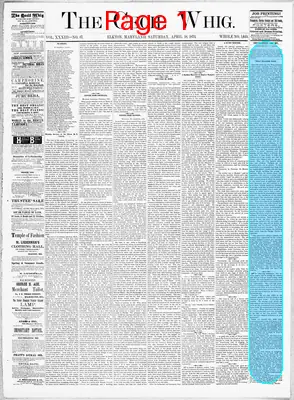
Editorial
April 18, 1874
The Cecil Whig
Elkton, Cecil County, Maryland
What is this article about?
Educational column by J. L. Hanna advocating for parental involvement in public schools. It outlines teachers' desires: interest in children's progress, respect for educators, regular attendance, and home discipline. Includes praise for calm teaching voices and a Chicago Teacher excerpt on parental responsibility.
Clipping

OCR Quality
95%
Excellent
Full Text
EDUCATIONAL COLUMN.
CONDUCTED BY J. L. HANNA.
The Educational column is conducted in the interest of teachers of public schools. Such facts concerning individual schools as are likely to interest the public. encourage pupils, or aid teachers in securing good discipline and progress, together with articles upon the subject of common school education, furnished by teachers, parents or others interested therein, will be published.
WHAT TEACHERS WANT
Some few weeks ago The Whig published a short article originally from a St. Louis paper, charging teachers with endeavoring to shift their legitimate work from their own shoulders to those of parents. So far as Cecil county is concerned we think the public school teachers are very generally innocent of this fault. Experience has taught them that it is almost useless to attempt it, as in very many cases the parents could not perform the work if they would, and would not if they could, and do not care very much whether it is done at all. But while we think that teachers are willing to do all they are employed to do, when they have a clear conception of what it is, we are aware that they frequently complain of the non-performance of something which they deem parental duty, and it is our object to say a word in explanation of what teachers do want. In the first place they ask that parents be not wholly indifferent to the progress of their children. If they are, the most conscientious child can reconcile very careless study with its sense of parental obligation. There are parents, who, if they send a boy to the field to hoe corn or potatoes, will exhibit a lively interest in the number of rows cultivated, and the manner in which it is done, while, if they send him to school they are entirely satisfied if he puts the time in. This may be complimentary, but it is not satisfactory. They ask that parents treat and speak of the teacher with entire respect and confidence at all times and in all places, or keep their children out of school. No one with common sense, no one with the instincts of a lady or gentleman, no one with a grain of christianity, honesty or decency in their composition could do otherwise. They ask that parents send their children to school regularly, that they abandon the idea that it is entirely their own affair if they choose to keep their children out of the school, and that the teacher is to blame if they do not go to school. They ask that parents govern their own children. Teachers are employed to teach, not to govern. To teach successfully it is necessary that those who are taught observe certain rules and regulations which facilitate the process of teaching When the teacher states these regulations, the pupil, if in proper subjection to parental authority, and obedient to that parental desire of which his presence in the school-room is significant, will at once commence. and will continue to observe them without neglect or hesitancy. If he fails to do this he should at once be returned to the parent, who is under obligation to reduce him to such a state of mind that he will be constrained to quietly submit to the regulations of the school. Our boasted free schools have come to be considered in some respects entirely too free. They have come to be considered as places into which the child, trained from infancy, by precept and example to vagabondism may be thrust, notwithstanding the fact that he will corrupt scores of comparatively innocent children, or that it will require the whole weight of the teacher's authority to keep the school from being utterly demoralized. Such should not be the case. Let the doors of the public schools be opened a little less wider, and advantages they offer will be doubly appreciated, and the benefit received from them will be greatly increased. To further illustrate the last request, the following short article from the Chicago Teacher, is appended:
" The practice of calling in parents, and holding them responsible for the conduct of their children in school, is a very beneficial one to the parents. It makes them thoughtful and provident. It educates them. It brings them to a realization of the fact that they have a duty in training and controlling the children whom they have ushered into the world; that they are bound to do more for them than to give them being, food, and bad example, and then leave them unwashed; that they cannot farm out such duties to teachers and other contractors. Then by all means call in the parents, and if a woman says. "I had to leave my washing to come to see about this misconduct of my son," mildly ask, a la Yankee, "Madam, which is of more importance to you, your son or your week's washing?" She will not dare to speak her honest mind, and say-"the washing."
An observing pedagogue, who recently spent a day in visiting our schools, said that he had not heard a sharp word spoken; that both teachers and pupils used the tones of voice which characterize pleasant conversation. This was high praise. When we mentally called the roll of those teachers with whose work we are familiar, to see who could claim membership in this particular class of worthies, we found some beyond the pale.
Teachers, did you ever reflect on the kind and amount of influence lying in the compass of your voices? If not, stop and consider. The average pupil spends, say seven years of two hundred days each, five hours per day, or a total of seven thousand hours, under the constant sound of a teacher's voice. What effect must the character of your tones have upon him, estimated in the light of this long period? Does this character demand endurance, or give enjoyment?
There are teachers who make every utterance redound to the well-being of the pupil; directing with quiet self-possession, instructing with cheerful zeal, commending wisely feeble but well-intended effort, inspiring the laggard and hesitating with enthusiasm, checking and rebuking whatever is mean and selfish with a protest that finds its power, not so much in what is said, as in how it is said.
There are teachers, too, who from morning till night, fret, snarl, yell, irritate and persecute. In every tone there is lurking a demon that arouses all the antagonism of the pupils, who send forth each his little imp to devise some fit retaliation for such torture. Like the sword of Damocles, threats seem poised in the air of the school-room, ready to be precipitated on each devoted head Imagine a child sitting, or wriggling under a galling fire of such frets and threats. trying to forget ball and top, and to plod his weary way through ab, eb. then imagine a child gladly laying aside the fun and frolic of play, to give himself up to the lead of a soul glowing with love, sympathy and enthusiasm, which, with words fitly spoken, teaches the hideousness of wrong, the beauty of goodness, and from this vantage ground imparts knowledge and educes wisdom. "Look on this picture and then on that," to see the two extremes. Between these extremes are all shades of coloring. Recalling the number of hours of school life, is it not obvious that a prodigious amount of pleasure and profit, or of misery and wrong, may result from the kind of voice habitual with the teacher? his age Teacher
CONDUCTED BY J. L. HANNA.
The Educational column is conducted in the interest of teachers of public schools. Such facts concerning individual schools as are likely to interest the public. encourage pupils, or aid teachers in securing good discipline and progress, together with articles upon the subject of common school education, furnished by teachers, parents or others interested therein, will be published.
WHAT TEACHERS WANT
Some few weeks ago The Whig published a short article originally from a St. Louis paper, charging teachers with endeavoring to shift their legitimate work from their own shoulders to those of parents. So far as Cecil county is concerned we think the public school teachers are very generally innocent of this fault. Experience has taught them that it is almost useless to attempt it, as in very many cases the parents could not perform the work if they would, and would not if they could, and do not care very much whether it is done at all. But while we think that teachers are willing to do all they are employed to do, when they have a clear conception of what it is, we are aware that they frequently complain of the non-performance of something which they deem parental duty, and it is our object to say a word in explanation of what teachers do want. In the first place they ask that parents be not wholly indifferent to the progress of their children. If they are, the most conscientious child can reconcile very careless study with its sense of parental obligation. There are parents, who, if they send a boy to the field to hoe corn or potatoes, will exhibit a lively interest in the number of rows cultivated, and the manner in which it is done, while, if they send him to school they are entirely satisfied if he puts the time in. This may be complimentary, but it is not satisfactory. They ask that parents treat and speak of the teacher with entire respect and confidence at all times and in all places, or keep their children out of school. No one with common sense, no one with the instincts of a lady or gentleman, no one with a grain of christianity, honesty or decency in their composition could do otherwise. They ask that parents send their children to school regularly, that they abandon the idea that it is entirely their own affair if they choose to keep their children out of the school, and that the teacher is to blame if they do not go to school. They ask that parents govern their own children. Teachers are employed to teach, not to govern. To teach successfully it is necessary that those who are taught observe certain rules and regulations which facilitate the process of teaching When the teacher states these regulations, the pupil, if in proper subjection to parental authority, and obedient to that parental desire of which his presence in the school-room is significant, will at once commence. and will continue to observe them without neglect or hesitancy. If he fails to do this he should at once be returned to the parent, who is under obligation to reduce him to such a state of mind that he will be constrained to quietly submit to the regulations of the school. Our boasted free schools have come to be considered in some respects entirely too free. They have come to be considered as places into which the child, trained from infancy, by precept and example to vagabondism may be thrust, notwithstanding the fact that he will corrupt scores of comparatively innocent children, or that it will require the whole weight of the teacher's authority to keep the school from being utterly demoralized. Such should not be the case. Let the doors of the public schools be opened a little less wider, and advantages they offer will be doubly appreciated, and the benefit received from them will be greatly increased. To further illustrate the last request, the following short article from the Chicago Teacher, is appended:
" The practice of calling in parents, and holding them responsible for the conduct of their children in school, is a very beneficial one to the parents. It makes them thoughtful and provident. It educates them. It brings them to a realization of the fact that they have a duty in training and controlling the children whom they have ushered into the world; that they are bound to do more for them than to give them being, food, and bad example, and then leave them unwashed; that they cannot farm out such duties to teachers and other contractors. Then by all means call in the parents, and if a woman says. "I had to leave my washing to come to see about this misconduct of my son," mildly ask, a la Yankee, "Madam, which is of more importance to you, your son or your week's washing?" She will not dare to speak her honest mind, and say-"the washing."
An observing pedagogue, who recently spent a day in visiting our schools, said that he had not heard a sharp word spoken; that both teachers and pupils used the tones of voice which characterize pleasant conversation. This was high praise. When we mentally called the roll of those teachers with whose work we are familiar, to see who could claim membership in this particular class of worthies, we found some beyond the pale.
Teachers, did you ever reflect on the kind and amount of influence lying in the compass of your voices? If not, stop and consider. The average pupil spends, say seven years of two hundred days each, five hours per day, or a total of seven thousand hours, under the constant sound of a teacher's voice. What effect must the character of your tones have upon him, estimated in the light of this long period? Does this character demand endurance, or give enjoyment?
There are teachers who make every utterance redound to the well-being of the pupil; directing with quiet self-possession, instructing with cheerful zeal, commending wisely feeble but well-intended effort, inspiring the laggard and hesitating with enthusiasm, checking and rebuking whatever is mean and selfish with a protest that finds its power, not so much in what is said, as in how it is said.
There are teachers, too, who from morning till night, fret, snarl, yell, irritate and persecute. In every tone there is lurking a demon that arouses all the antagonism of the pupils, who send forth each his little imp to devise some fit retaliation for such torture. Like the sword of Damocles, threats seem poised in the air of the school-room, ready to be precipitated on each devoted head Imagine a child sitting, or wriggling under a galling fire of such frets and threats. trying to forget ball and top, and to plod his weary way through ab, eb. then imagine a child gladly laying aside the fun and frolic of play, to give himself up to the lead of a soul glowing with love, sympathy and enthusiasm, which, with words fitly spoken, teaches the hideousness of wrong, the beauty of goodness, and from this vantage ground imparts knowledge and educes wisdom. "Look on this picture and then on that," to see the two extremes. Between these extremes are all shades of coloring. Recalling the number of hours of school life, is it not obvious that a prodigious amount of pleasure and profit, or of misery and wrong, may result from the kind of voice habitual with the teacher? his age Teacher
What sub-type of article is it?
Education
What keywords are associated?
Teacher Expectations
Parental Involvement
School Discipline
Public Education
Teacher Voice
Child Rearing
What entities or persons were involved?
J. L. Hanna
Cecil County Teachers
Parents
Pupils
St. Louis Paper
Chicago Teacher
Editorial Details
Primary Topic
What Teachers Want From Parents In Supporting Public School Education
Stance / Tone
Advocacy For Greater Parental Involvement And Teacher Authority
Key Figures
J. L. Hanna
Cecil County Teachers
Parents
Pupils
St. Louis Paper
Chicago Teacher
Key Arguments
Parents Should Show Interest In Children's School Progress Beyond Mere Attendance
Parents Must Respect And Speak Confidently Of Teachers
Children Should Attend School Regularly Without Parental Interference
Parents Are Responsible For Governing And Disciplining Their Children Before School
Public Schools Should Not Admit Undisciplined Children Who Disrupt Learning
Teachers' Voices Significantly Influence Pupils Over Thousands Of Hours
Calm, Positive Tones In Teaching Promote Enjoyment And Well Being
Harsh, Fretful Tones Cause Antagonism And Misery