Thank you for visiting SNEWPapers!
Sign up free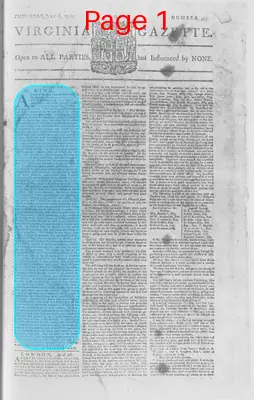
Letter to Editor
July 6, 1769
The Virginia Gazette
Williamsburg, Virginia
What is this article about?
In a 1769 letter to Mr. Rind, a Virginia colonist argues for non-importation of British goods that can be produced locally and the establishment of societies to encourage manufacturing, aiming to achieve economic self-sufficiency and resist British parliamentary oppression and taxes.
Clipping
OCR Quality
95%
Excellent
Full Text
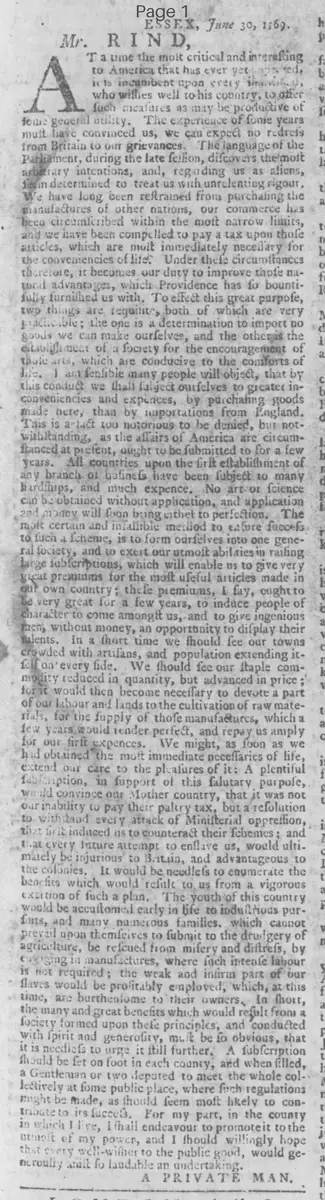
ESSEX, June 30, 1769.
Mr. RIND,
At a time the most critical and interesting to America that has ever yet happened, it is incumbent upon every man who wishes well to his country, to offer such measures as may be productive of the general utility. The experience of some years must have convinced us, we can expect no redress from Britain to our grievances. The language of the Parliament, during the late session, discovers the most arbitrary intentions, and, regarding us as aliens, they are determined to treat us with unrelenting rigour.
We have long been restrained from purchasing the manufactures of other nations, our commerce has been circumscribed within the most narrow limits, and we have been compelled to pay a tax upon those articles, which are most immediately necessary for the conveniences of life. Under these circumstances therefore, it becomes our duty to improve those natural advantages, which Providence has so bountifully furnished us with. To effect this great purpose, two things are requisite, both of which are very practicable: the one is a determination to import no goods we can make ourselves, and the other is the establishment of a society for the encouragement of those arts, which are conducive to the comforts of life. I am sensible many people will object, that by this conduct we shall subject ourselves to greater inconveniencies and expences, by purchasing goods made here, than by importations from England.
This is a fact too notorious to be denied, but notwithstanding, as the affairs of America are circumstanced at present, ought to be submitted to for a few years. All countries upon the first establishment of any branch of business have been subject to many hardships, and much expence. No art or science can be obtained without application, and application and money will soon bring either to perfection. The most certain and infallible method to ensure success to such a scheme, is to form ourselves into one general society, and to exert our utmost abilities in raising large subscriptions, which will enable us to give very great premiums for the most useful articles made in our own country: these premiums, I say, ought to be very great for a few years, to induce people of character to come amongst us, and to give ingenious men, without money, an opportunity to display their talents. In a short time we should see our towns crowded with artisans, and population extending itself on every side. We should see our staple commodity reduced in quantity, but advanced in price; for it would then become necessary to devote a part of our labour and lands to the cultivation of raw materials, for the supply of those manufactures, which a few years would render perfect, and repay us amply for our first expences. We might, as soon as we had obtained the most immediate necessaries of life, extend our care to the pleasures of it: A plentiful subscription, in support of this salutary purpose, would convince our Mother country, that it was not our inability to pay their paltry tax, but a resolution to withstand every attack of Ministerial oppression, that first induced us to counteract their schemes; and that every future attempt to enslave us, would ultimately be injurious to Britain, and advantageous to the colonies. It would be needless to enumerate the benefits which would result to us from a vigorous execution of such a plan. The youth of this country would be accustomed early in life to industrious pursuits, and many numerous families, which cannot prevail upon themselves to submit to the drudgery of agriculture, be rescued from misery and distress, by engaging in manufactures, where such intense labour is not required; the weak and infirm part of our slaves would be profitably employed, which, at this time, are burdensome to their owners. In short, the many and great benefits which would result from a society formed upon these principles, and conducted with spirit and generosity, must be so obvious, that it is needless to urge it any further. A subscription should be set on foot in each county, and when filled, a Gentleman or two deputed to meet the whole collectively at some public place, where such regulations might be made, as should seem most likely to contribute to its success. For my part, in the county in which I live, I shall endeavour to promote it to the utmost of my power, and I should willingly hope that every well-wisher to the public good, would generously assist so laudable an undertaking.
A PRIVATE MAN.
Mr. RIND,
At a time the most critical and interesting to America that has ever yet happened, it is incumbent upon every man who wishes well to his country, to offer such measures as may be productive of the general utility. The experience of some years must have convinced us, we can expect no redress from Britain to our grievances. The language of the Parliament, during the late session, discovers the most arbitrary intentions, and, regarding us as aliens, they are determined to treat us with unrelenting rigour.
We have long been restrained from purchasing the manufactures of other nations, our commerce has been circumscribed within the most narrow limits, and we have been compelled to pay a tax upon those articles, which are most immediately necessary for the conveniences of life. Under these circumstances therefore, it becomes our duty to improve those natural advantages, which Providence has so bountifully furnished us with. To effect this great purpose, two things are requisite, both of which are very practicable: the one is a determination to import no goods we can make ourselves, and the other is the establishment of a society for the encouragement of those arts, which are conducive to the comforts of life. I am sensible many people will object, that by this conduct we shall subject ourselves to greater inconveniencies and expences, by purchasing goods made here, than by importations from England.
This is a fact too notorious to be denied, but notwithstanding, as the affairs of America are circumstanced at present, ought to be submitted to for a few years. All countries upon the first establishment of any branch of business have been subject to many hardships, and much expence. No art or science can be obtained without application, and application and money will soon bring either to perfection. The most certain and infallible method to ensure success to such a scheme, is to form ourselves into one general society, and to exert our utmost abilities in raising large subscriptions, which will enable us to give very great premiums for the most useful articles made in our own country: these premiums, I say, ought to be very great for a few years, to induce people of character to come amongst us, and to give ingenious men, without money, an opportunity to display their talents. In a short time we should see our towns crowded with artisans, and population extending itself on every side. We should see our staple commodity reduced in quantity, but advanced in price; for it would then become necessary to devote a part of our labour and lands to the cultivation of raw materials, for the supply of those manufactures, which a few years would render perfect, and repay us amply for our first expences. We might, as soon as we had obtained the most immediate necessaries of life, extend our care to the pleasures of it: A plentiful subscription, in support of this salutary purpose, would convince our Mother country, that it was not our inability to pay their paltry tax, but a resolution to withstand every attack of Ministerial oppression, that first induced us to counteract their schemes; and that every future attempt to enslave us, would ultimately be injurious to Britain, and advantageous to the colonies. It would be needless to enumerate the benefits which would result to us from a vigorous execution of such a plan. The youth of this country would be accustomed early in life to industrious pursuits, and many numerous families, which cannot prevail upon themselves to submit to the drudgery of agriculture, be rescued from misery and distress, by engaging in manufactures, where such intense labour is not required; the weak and infirm part of our slaves would be profitably employed, which, at this time, are burdensome to their owners. In short, the many and great benefits which would result from a society formed upon these principles, and conducted with spirit and generosity, must be so obvious, that it is needless to urge it any further. A subscription should be set on foot in each county, and when filled, a Gentleman or two deputed to meet the whole collectively at some public place, where such regulations might be made, as should seem most likely to contribute to its success. For my part, in the county in which I live, I shall endeavour to promote it to the utmost of my power, and I should willingly hope that every well-wisher to the public good, would generously assist so laudable an undertaking.
A PRIVATE MAN.
What sub-type of article is it?
Persuasive
Political
What themes does it cover?
Economic Policy
Commerce Trade
Politics
What keywords are associated?
Non Importation
Manufacturing Society
British Oppression
Colonial Self Sufficiency
Subscriptions Premiums
Economic Resistance
What entities or persons were involved?
A Private Man.
Mr. Rind
Letter to Editor Details
Author
A Private Man.
Recipient
Mr. Rind
Main Argument
colonists should resolve to import no goods they can produce themselves and establish societies to encourage local manufacturing through subscriptions and premiums, enduring initial hardships to achieve self-sufficiency and resist british taxes and oppression.
Notable Details
Parliament's Arbitrary Intentions And Treatment Of Colonists As Aliens
Benefits To Youth, Families, And Infirm Slaves Through Manufacturing
Call For County Subscriptions And Collective Meetings To Regulate The Society