Thank you for visiting SNEWPapers!
Sign up free
Editorial
December 27, 1831
The Rhode Island Republican
Newport, Newport County, Rhode Island
What is this article about?
An editorial denounces a Connecticut Observer piece for impiously portraying imprisoned Georgia missionaries Worcester and Butler as 'prisoners of the Lord,' defends legal punishment regardless of clerical status, and warns against clerical attempts to excite sympathy through religious appeals.
Clipping
OCR Quality
95%
Excellent
Full Text
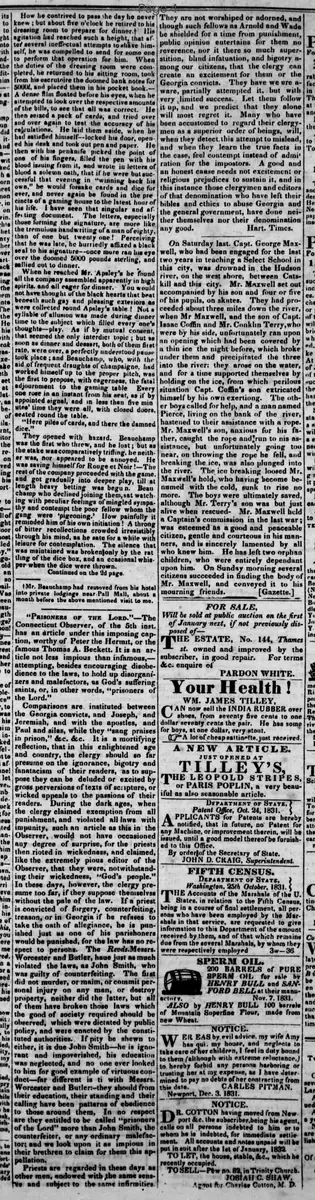
"Prisoners of The Lord." —The
Connecticut Observer, of the 5th inst.
has an article under this imposing cap-
tion, worthy of Peter the Hermit, or the
famous Thomas A. Beckett. It is an ar-
ticle not less impious than infamous,—
attempting, besides encouraging disobe-
dience to the laws, to hold up disorgani-
zers and malefactors, as God's suffering
saints, or, in other words, "prisoners of
the Lord."
Comparisons are instituted between
the Georgia convicts, and Joseph, and
Jeremiah, and with the apostles, and
Paul and Silas, while they "sang praises
in prison," &c. &c. It is a mortifying
reflection, that in this enlightened age
and country, the clergy should so far
presume on the ignorance, bigotry and
fanaticism of their readers, as to sup-
pose they can be deluded or excited by
gross perversions of texts of scripture, or
wicked appeals to the passions of their
readers. During the dark ages, when
the clergy claimed exemption from all
punishment, and violated all laws, with
impunity, such an article as this in the
Observer, would not have occasioned
any degree of surprise, for the priests
then rioted in wickedness, and claimed,
like the extremely pious editor of the
Observer, that they were, notwithstand-
ing their wickedness, "God's people."
In these days, however, the clergy pre-
sume too far, if they suppose themselves
without the pale of the law. If a priest
is convicted of forgery, counterfeiting,
treason, or in Georgia if he refuses to
take the oath of allegiance, he is pun-
ished just as one of his parishioners
would be punished, for the law has no re-
spect to persons. The Revds. Messrs.
Worcester and Butler, have just as much
violated the laws, as John Smith, who
was guilty of counterfeiting. The first
did not murder, or maim, or commit per-
sonal injury on any man, or destroy
property, neither did the latter, but all
of them have broken those laws which
the good of society required should be
observed, which were dictated by public
policy, and were enacted by the consti-
tuted authorities. If pity be shewn to
either, it is due John Smith—he is igno-
rant and impoverished, his education
was neglected, and no one ever looked
to him for good example of virtuous con-
duct—how different is it with Messrs.
Worcester and Butler:—they should from
their education, their standing and their
calling have been patterns of obedience
to those around them. In no respect
are they entitled to be called "prisoners
of the Lord" more than John Smith, the
counterfeiter, or any ordinary malefac-
tor; and we look upon it as impious in
their brethren to claim for them this ap-
pellation.
Priests are regarded in these days as
other men, endowed with the same sens-
ibility and subject to the same infirmities.
They are not worshiped or adored, and
though such fellows as Arnold and Wade
be shielded for a time from punishment,
public opinion entertains for them no
reverence, nor is there so much super-
stition, blind infatuation, and bigotry a-
mong our citizens, that the clergy can
create an excitement for them or the
Georgia convicts. They have we believe, partially attempted it, but with
very limited success. Let them follow
it up, and we predict that they alone
will most regret it. Many who have
been accustomed to regard their clergy-
men as a superior order of beings, will,
when they detect this attempt to mislead,
and when they learn the true facts in
the case, feel contempt instead of admi-
ration for the impostors. A good and
an honest cause needs not excitement or
religious prejudices to sustain it, and in
this instance those clergymen and editors
of that denomination who have left their
bibles and ethics to abuse Georgia and
the general government, have done nei-
ther themselves nor their denomination
any good.
Hard Times.
Connecticut Observer, of the 5th inst.
has an article under this imposing cap-
tion, worthy of Peter the Hermit, or the
famous Thomas A. Beckett. It is an ar-
ticle not less impious than infamous,—
attempting, besides encouraging disobe-
dience to the laws, to hold up disorgani-
zers and malefactors, as God's suffering
saints, or, in other words, "prisoners of
the Lord."
Comparisons are instituted between
the Georgia convicts, and Joseph, and
Jeremiah, and with the apostles, and
Paul and Silas, while they "sang praises
in prison," &c. &c. It is a mortifying
reflection, that in this enlightened age
and country, the clergy should so far
presume on the ignorance, bigotry and
fanaticism of their readers, as to sup-
pose they can be deluded or excited by
gross perversions of texts of scripture, or
wicked appeals to the passions of their
readers. During the dark ages, when
the clergy claimed exemption from all
punishment, and violated all laws, with
impunity, such an article as this in the
Observer, would not have occasioned
any degree of surprise, for the priests
then rioted in wickedness, and claimed,
like the extremely pious editor of the
Observer, that they were, notwithstand-
ing their wickedness, "God's people."
In these days, however, the clergy pre-
sume too far, if they suppose themselves
without the pale of the law. If a priest
is convicted of forgery, counterfeiting,
treason, or in Georgia if he refuses to
take the oath of allegiance, he is pun-
ished just as one of his parishioners
would be punished, for the law has no re-
spect to persons. The Revds. Messrs.
Worcester and Butler, have just as much
violated the laws, as John Smith, who
was guilty of counterfeiting. The first
did not murder, or maim, or commit per-
sonal injury on any man, or destroy
property, neither did the latter, but all
of them have broken those laws which
the good of society required should be
observed, which were dictated by public
policy, and were enacted by the consti-
tuted authorities. If pity be shewn to
either, it is due John Smith—he is igno-
rant and impoverished, his education
was neglected, and no one ever looked
to him for good example of virtuous con-
duct—how different is it with Messrs.
Worcester and Butler:—they should from
their education, their standing and their
calling have been patterns of obedience
to those around them. In no respect
are they entitled to be called "prisoners
of the Lord" more than John Smith, the
counterfeiter, or any ordinary malefac-
tor; and we look upon it as impious in
their brethren to claim for them this ap-
pellation.
Priests are regarded in these days as
other men, endowed with the same sens-
ibility and subject to the same infirmities.
They are not worshiped or adored, and
though such fellows as Arnold and Wade
be shielded for a time from punishment,
public opinion entertains for them no
reverence, nor is there so much super-
stition, blind infatuation, and bigotry a-
mong our citizens, that the clergy can
create an excitement for them or the
Georgia convicts. They have we believe, partially attempted it, but with
very limited success. Let them follow
it up, and we predict that they alone
will most regret it. Many who have
been accustomed to regard their clergy-
men as a superior order of beings, will,
when they detect this attempt to mislead,
and when they learn the true facts in
the case, feel contempt instead of admi-
ration for the impostors. A good and
an honest cause needs not excitement or
religious prejudices to sustain it, and in
this instance those clergymen and editors
of that denomination who have left their
bibles and ethics to abuse Georgia and
the general government, have done nei-
ther themselves nor their denomination
any good.
Hard Times.
What sub-type of article is it?
Moral Or Religious
Crime Or Punishment
Indian Affairs
What keywords are associated?
Clergy Criticism
Georgia Missionaries
Law Obedience
Impious Article
Prisoners Of The Lord
Connecticut Observer
Worcester Butler
What entities or persons were involved?
Connecticut Observer
Rev. Worcester
Rev. Butler
Georgia Convicts
John Smith
Editorial Details
Primary Topic
Criticism Of Clerical Defense Of Imprisoned Georgia Missionaries
Stance / Tone
Strongly Critical Of Impious Clerical Support For Law Breakers
Key Figures
Connecticut Observer
Rev. Worcester
Rev. Butler
Georgia Convicts
John Smith
Key Arguments
Observer's Article Is Impious And Infamous, Encouraging Disobedience To Laws
Clergy Presume On Ignorance To Pervert Scripture
Clergy Are Not Exempt From Punishment Like In Dark Ages
Worcester And Butler Violated Laws As Much As Any Counterfeiter
They Should Set Example Of Obedience Due To Their Position
Calling Them 'Prisoners Of The Lord' Is Impious
Public Opinion Will Turn To Contempt If Clergy Mislead
Good Cause Needs No Religious Prejudice To Sustain It