Thank you for visiting SNEWPapers!
Sign up free
Virginia Free Press
Charles Town, Jefferson County, West Virginia
What is this article about?
In the House of Commons, Mr. Aldam raised President Tyler's message to Congress criticizing British treatment of captured slaves in West Indies colonies and British involvement in slave trade to Brazil. Sir Robert Peel defended British policy, offering a commission to investigate and explaining abolition of apprenticeship, treaties with Spain, Brazil, and Portugal.
Clipping
OCR Quality
Full Text
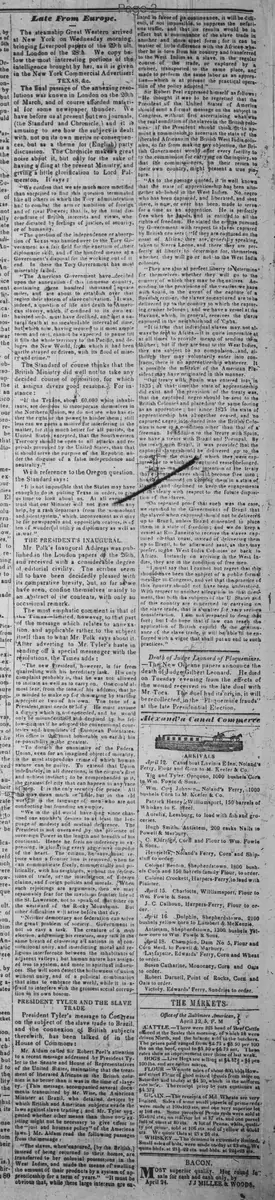
President Tyler's message to Congress on the subject of the slave trade to Brazil, and the connexion of British subjects therewith, has been talked of in the House of Commons:
Mr. Aldam called Sir Robert Peel's attention to a recent message addressed by President Tyler to the Senate and House of Representatives of the United States, insinuating that the treatment of liberated Africans in the British colonies is no better than it was in the time of slavery. [This message accompanied several documents transmitted by Mr. Wise, the American Minister at Brazil, who detailed devices by which British and American subjects evade the laws against slave trading; and Mr. Tyler suggested whether other means than those now existing might not be necessary to give effect to the "just and humane policy" of the American laws.] Mr. Aldam read the following passages from the message:
"The slaves, when captured, [by the British,] instead of being returned to their homes, are transferred to her colonial possessions in the West Indies, and made the means of swelling the amount of their products by a system of apprenticeship for a term of years." "It must be obvious that, while these large interests are enlisted in favor of its continuance, it will be difficult, if not impossible, to suppress the nefarious traffic, and that its results would be in effect but a continuance of the slave trade in another and more cruel form; for it can be matter of little difference with the African whether he is torn from his country and transferred to the West Indies as a slave, in the regular course of the trade, or captured by a cruiser, transported to the same place, and made to perform the same labor as an apprentice—which is at present the practical operation of the policy adopted "
Sir Robert Peel expressed himself as follows:
He thought it was to be regretted that the President of the United States of America should send a formal message on the subject to Congress, without first ascertaining what was the real condition of the slaves in the British colonies—If the President should think fit to appoint a commission to ascertain the state of the liberated Africans in the British West India colonies, so far from making any objection, the British Government would offer every facility to the commission for carrying on the inquiry, so that the commissioners, on their return to their own country, might present a true picture.
"As to the passage quoted, it is well known that the state of apprenticeship has been altogether abolished in the West Indies. No negro who has been captured, and liberated, and sent there, is now, or ever has been, made to serve, for a time as an apprentice. He is perfectly free when he lands, and is entitled to all the rights of freedom. He stated the course pursued by Government with respect to slaves captured by British cruisers; If they are captured on the coast of Africa, they are, generally speaking, taken to Sierra Leone, and there they are perfectly at liberty to determine for themselves whether they will go or not to the West India colonies.
"They are also at perfect liberty to determine for themselves whether they will go to the country of which they may be the natives. According to the provisions of the treaty we have with Spain, in the event of the capture of a Spanish cruiser, the slaves so captured are to be delivered up to the country to which the capturing cruiser belongs; and we have a vessel at the Havana, which, in general, receives the slaves captured in the neighborhood of Cuba.
"It is true that individual slaves may, not always be sent to Africa—it is quite impossible at all times to provide means of sending them thither; but if they are sent to the West Indies, they are subject to no compulsion, and, although they may voluntarily enter into contracts, there is no apprenticeship whatever. It is possible the mistake of the American President may have originated in this manner.
"Our treaty with Spain was entered into in 1835; at that time the state of apprenticeship did exist and the provision of the treaty was, that the captured negro should be sent to the British Colonies and placed on the same footing as an apprentice; but since 1835 the state of apprenticeship has altogether ceased, and no captured negro introduced into the British Colonies is now in a condition other than that of a freeman. In addition to the Treaty with Spain, we have a treaty with Brazil and Portugal. By the treaty with Brazil, it was provided that the captured slaves should be delivered up to the country on the coast of which they were captured or to which captured vessel belonged. The best intention of the treaty they capture slaves should become free men; but Brazil insisted on keeping them in a state of slavery, and declined to keep the engagements of the treaty with respect to the future disposition of the slaves.
On repeated proof that such was the case, we signified to the Government of Brazil that the slaves—when captured should not be delivered up to Brazil, unless Brazil consented to place them in a state of freedom; and we do keep a vessel at Rio Janeiro to receive the slaves captured on that coast, instead of 'delivering them up to Brazil, to be afterward sent, as they may prefer, to the West India Colonies or back to Africa. Instantly on arriving in the West Indies, they are in the condition of free men.
"I must say that I cannot but regret that this should have been the subject of a public formal message to Congress, and yet that the practice of this country should not have been understood. With respect to another allegation in that document, that both the subjects of the U States and of this country are concerned in carrying on the slave trade, that is a matter for very serious consideration. I am not prepared to deny that fact; but I do hope that if law can reach the application of British capital to the continuance of the slave trade, it will be able to be enforced with a vigor that shall put an end to such practices."
What sub-type of article is it?
What keywords are associated?
What entities or persons were involved?
Where did it happen?
Foreign News Details
Primary Location
London
Key Persons
Outcome
sir robert peel offers facility for a us commission to investigate treatment of liberated africans in british west india colonies; explains abolition of apprenticeship system and details on treaties with spain (1835), brazil, and portugal regarding captured slaves.
Event Details
In the House of Commons, Mr. Aldam highlights President Tyler's message to US Congress criticizing British handling of captured slaves sent to West Indies as apprentices and involvement of British subjects in slave trade to Brazil via documents from Mr. Wise. Tyler quotes suggest this perpetuates slavery in crueler form. Sir Robert Peel regrets the message without prior inquiry, defends current policy of full freedom for liberated Africans upon landing, no apprenticeship since abolition, and outlines procedures: captured on African coast to Sierra Leone for choice; Spanish captures to Havana vessel; Brazilian captures to Rio Janeiro vessel then optional to West Indies or Africa as freemen. Notes 1835 Spain treaty predates abolition; Brazil's non-compliance led to withholding slaves unless freed.