Thank you for visiting SNEWPapers!
Sign up free
Literary
April 13, 1873
The Cairo Bulletin
Cairo, Alexander County, Illinois
What is this article about?
In July 1870, near Bordeaux, France, elderly widow Eugenie Duclos learns her youngest son Jacques has been conscripted into the French army amid the Franco-Prussian War. The story depicts their rural life and her sorrow, recalling her other sons lost in prior conflicts.
Clipping
OCR Quality
95%
Excellent
Full Text
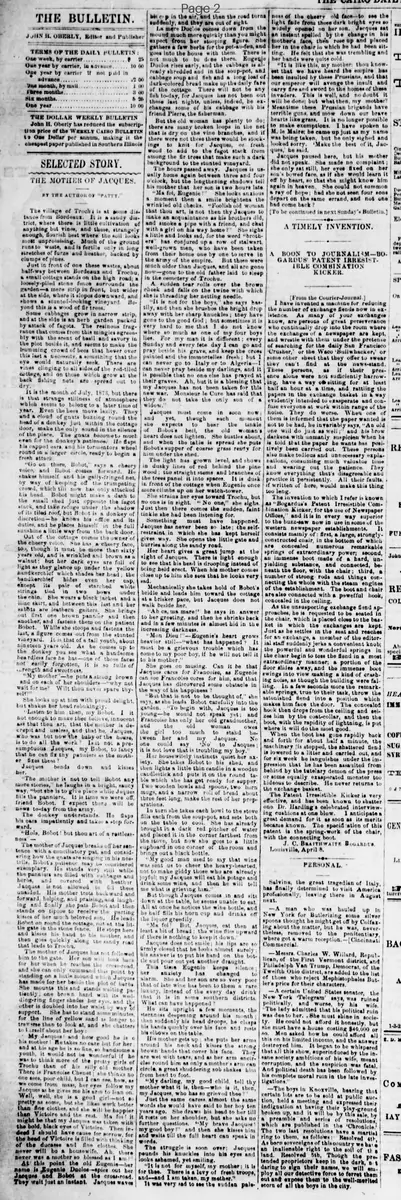
SELECTED STORY.
THE MOTHER OF JACQUES.
BY THE AUTHOR OF "PATTY."
The village of Trocha is at some distance from Bordeaux. It is a sandy district, where there is little cultivation of anything but vines, and these, strangely enough, flourish best where the soil looks most unpromising. Much of the ground runs to waste, and is fertile only in long stretches of furze and heather, backed by clumps of pines.
Just in front of one of these wastes, about half-way between Bordeaux and Trocha, a small cottage stands on the high road; a loosely-piled stone fence surrounds the garden—a mere strip in front, but wider at the side, where it slopes downward, and shows a stunted-looking vineyard. Beyond this is a wood of fir trees.
Some cabbages grow in a narrow strip, and at the side is an herb garden packed by a stack of fagots. The resinous fragrance that comes from this mingles agreeably with the scent of basil and savory in the plot beside it, and seems to make the humming crowd of bees that hover over this last a necessity, something that the eye would naturally seek. There are vines clinging to all sides of the red-tiled cottage, and on those which grow at the back fishing nets are spread out to dry.
It is the month of July, 1870, but there is that strange stillness of atmosphere which seems to belong to a later time of year. Even the bees move lazily. They and a cloud of gnats buzzing round the head of a donkey just within the cottage door, make the only sound in the silence of the place. The gnats become too much even for the donkey's patience. He flaps his capped ears, and his tormentors wheel round in a larger circle, ready to begin a fresh attack.
"Go on there, Bobot," says a cheery voice, and Bobot comes forward. He shakes himself and his gaily-fringed net by way of keeping off the trumpeting crowd, which till now has only attacked his head. Bobot might make a dash to the small shed just opposite the fagot stack, and take refuge under the shadow of its tiled roof, but Bobot is a donkey of discretion—he knows his office and its duties, and he places himself in the full sunshine a little way from the back door.
Out of the cottage comes the owner of the cheery voice. She has a cheery face, too, though it must be more than sixty years old, and is wrinkled and brown as a walnut; but her dark eyes are full of light as they glance up under the yellow bandkerchief which shades her head; the bandkerchief hides even her cap, except its pair of starched white strings tied in two bows under the chin. She wears a black jacket and a lilac skirt, and between this last and her sabots are leather gaiters. She brings out first one brown pannier and then another, and fastens them on the patient Bobot. While she stoops and fastens the last, a figure comes out from the stunted vineyard. It is that of a tall youth, about nineteen years old. As he comes up to the donkey you see what a handsome beardless face he has—one of those faces not easily forgotten, it is so full of strength and sweetness.
"My mother"—he puts a strong brown hand on each of her shoulders—"why not wait for me? Wilt thou never spare thyself?"
She looks up at him with proud delight, but shakes her head rebukingly.
"Listen to him then, my Bobot. Is it not enough to make thee believe, innocent as thou art, that the mother is decrepit and useless, and that he, Jacques, who was but now the baby of the house, is to do all the work? Is it not a presumptuous Jacques, my Bobot, to fancy that he can fix thy panniers as the mother fixes them?"
Jacques bends down and kisses her.
"The mother is not to tell Bobot any more stories," he laughs in a bright, saucy way, "but she is to give place while Jacques fills the panniers. It is time we were off, friend Bobot. I expect there will be news to-day from the army."
The donkey understands. He flaps his ears impatiently and takes a step forward.
"Holà, Bobot! but thou art of a restlessness!"
The mother of Jacques breaks off her sentence with a conciliatory pat, and considering how the gnats are singing in his nostrils, Bobot's patience may be considered exemplary. He stands very still while the panniers are filled with cabbages and herbs, and covered with heather. Jacques is not allowed to fill these unaided. His mother trots backward and forward, helping, and praising, and laughing, and finally she pats Bobot and then stands on tiptoe to receive the parting kisses of her much beloved son. He leads Bobot on round the cottage, out at the little gate in the stone fence. He stops here and kisses his hand to his mother, and then goes quickly along the sandy road that leads to Trocha.
The mother of Jacques has not followed him to the gate. Her son will look back for her when he reaches the cross-road, and she can only command this point by standing on a little mound which Jacques has made for her beside the plot of herbs. She mounts this and stands waiting patiently, one brown hand with its wedding-ring finger shades her eyes, and the other is doubled into her waist by way of support. She has to stand some minutes, for the line of yellow sand is longer to traverse than to look at, and she chatters to herself about her boy:
"My Jacques! and how good he is to his mother! He takes no care but for her. And at his age he is so fine, so handsome a youth, it would not be wonderful if he was to think more of the pretty girls of Trocha than of his silly old mother. There is Francoise Chenet; she thinks no one sees, poor child, but I can see, how, as we come from mass, her eyes follow my Jacques as he gives me his arm to lean on. Well, well, she is a good girl—not so pretty as some, but she likes work better than fine clothes, and she will be happier than Victoire and the rest. Ma foi! it might be that my Jacques was taken with the bold, black eyes of Victoire. Then indeed I should have cause for sorrow, for the head of Victoire is filled with thinking of the ducasse and fine clothes. She never will be a housewife. Ah, there never was a mother so blessed as I am!"
At this point the old Eugenie—her name is Eugenie Duclos—spies out her Jacques and Bobot at the cross-road. They wait just an instant. Jacques waves his cap in the air, and then the road turns suddenly, and they are out of sight.
La mere Duclos comes down from the mound much more quickly than you might expect from her stooping figure. She gathers a few herbs for the pot-au-feu, and goes into the house with them. There is not much to be done there. Eugenie Duclos rises early, and the cabbage is already shredded and in the soup-pot, and cabbage soup and fish and a long loaf of dark-colored bread make up the daily fare of the cottage. There will not be any fish to-day, for Jacques has not been out these last nights, unless, indeed, he exchanges some of his cabbage with his friend Pierre, the fisherman.
But the old woman has plenty to do; there are many broken loops in the net that is drying on the vine branches, and if there were not these there would be stockings to knit for Jacques, or fresh wood to add to the fagot stack from among the fir trees that make such a dark background to the stunted vineyard.
The hours passed away. Jacques is usually home again between three and four o'clock, but the lengthening shadows tell his mother that her son is two hours late.
"Ma foi, Eugenie!" She looks anxious a moment, then a smile brightens the wrinkled old cheeks. "Foolish old woman that thou art, is not then thy Jacques to make an acquaintance as his brothers did, and smoke a pipe with a friend, and chat with a girl on his way home?" She sighs a little and looks sad, for the word "brothers" has conjured up a row of stalwart, well-grown men, who have been taken from their home one by one to serve in the army of the empire. But these were much older than Jacques, and all are gone now—gone to the old father laid to sleep in the cemetery of Trocha.
A sudden tear rolls over the brown cheek and falls on the twine with which she is threading her netting needle.
"It is not for the boys," she says hastily, and then she brushes the bright drop away with her sharp knuckles; they have gone to the good God; but sometimes it is very hard to me that I do not know where so much as one of my four boys lies. For my man it is different; every Sunday and every fete day I can go and pray beside his grave, and keep the cross painted and the immortelles fresh; but I can never go to Italy or to Algeria—I can never pray beside my darlings, and it is possible that no one else has prayed at their graves. Ah, but it is a blessing that my Jacques has not been taken for this new war. Monsieur le Cure has said that they do not take the only son of a widow."
Jacques must come in soon now; and yet, though each moment she expects to hear the tinkle of Bobot's bell, the old woman's heart does not lighten. She bustles about, and when the table is spread she puts Bobot's supper of coarse grass ready for him under the shed.
The light has grown level, and shows in dusky lines of red behind the pine wood; the straight stems and branches of the trees panel it into spaces. It is dusk in front of the cottage when Eugenie once more climbs up on her watch-tower. She strains her eyes toward Trocha, but no one is in sight. "No one," she sighs.
Just then there comes the sudden, faint tinkle she had been listening for. Something must have happened. Jacques has never been so late; the self-restraint in which she has kept herself gives way. She opens the little gate and hurries along the sandy road.
Her heart gives a great jump at the sight of Jacques. There is light enough to see that his head is drooping instead of being held erect. When his mother comes close up to him she sees that he looks very sad.
Mechanically she takes hold of Bobot's bridle and leads him toward the cottage at a brisker pace, but Jacques does not walk beside her.
"Ah çà, ma mère!" he says in answer to her greeting, and then he shrinks back and in a few minutes is almost hid in the increasing darkness.
"Mon Dieu!"—Eugenie's heart grows heavier still—"what has happened? It must be a grievous trouble which has come to my poor boy, if he will not tell it to his mother."
She goes on musing. Can it be that Jacques cares for Francoise, as Eugenie can see Francoise cares for him, and that Jacques has discovered some obstacle in the way of his happiness?
"But that is not to be thought of," she says, as she leads Bobot carefully into the garden. "To begin with, Jacques is too young—he would not speak yet; and Francoise has only her old grandmother, and the old woman owes the girl too much to stand between her and my Jacques. No one could say 'No' to Jacques; it is not love that is troubling my boy."
Her housewifely instincts quiet her anxiety. She takes Bobot to his shed, and then lights a little thin candle in a wooden candlestick and puts it on the round table which she has got ready for supper. Two wooden bowls and spoons, two horn mugs, and a narrow roll of bread about three feet long, make the rest of her preparations.
In turn she takes each bowl to the stove, fills each from the soup-pot, and sets both on the table to cool. She has already brought in a dark red pitcher of water and placed it in the corner farthest from the stove, but now she goes to a little cupboard in one corner of the room and brings out a black bottle.
"My good man used to say that wine was sent us to cheer the heavy-hearted, not to make giddy those who are already joyful; my Jacques will eat his potage and drink some wine, and then he will tell me what is grieving him."
But though Jacques comes in and sits down at the table, he seems unable to eat. All at once he notices the wine bottle, and he half fills his horn cup and drinks off the liquor greedily.
"Ma foi! But, Jacques, eat then at least a bit of bread; the wine flies upward if there is nothing to keep it down."
Jacques does not smile; his lips are so firmly closed that he looks almost surly; his answer is to put his hand on the bottle and pour out yet another draught.
This time Eugenie keeps silence; her anxiety has changed to alarm. She and her son are so very poor that of late wine has been to them a rare luxury, instead of the every day drink that it is in some southern districts. What can have happened?
He sits upright a few moments, the sternness deepening around his mouth; then suddenly his head droops, he clasps his hands quickly over his face and rests his elbows on the table.
His mother gets up; she puts her arms around his neck and kisses the strong brown hands that cover his face. They are wet with tears, and as her arm encircles round him as only a mother's arm can circle, a great shuddering sob shakes him from head to foot.
"My darling, my good child, tell thy mother what it is, then—who is it, then, my Jacques, who has so grieved thee?"
Just the same caress, almost the same words she would have said to her boy ten years ago. She draws his head to her till it rests on her shoulder, but he asks no further questions. "My brave Jacques! my good boy!" and then she kisses him and waits till the full heart can speak in words.
The struggle is soon over; Jacques pounds his knuckles into his eyes and looks ashamed, yet smiling.
"It is not for myself, my mother; it is for thee. There is a levy of fresh troops, and—and I am taken, my mother."
It was very sad to see the sudden paleness of the cheery old face—to see the light fade from those dark bright eyes so widely opened on her son. Jacques sat an instant spelled by the change in his mother's face, then rose up and placed her in the chair in which he had been sitting. He felt that she was trembling and her hands were quite cold.
"It is like this, my mother: thou knowest that we have heard the empire has been insulted by these Prussians, and that our emperor will avenge the insult and carry fire and sword to the homes of these invaders. This is well, and no doubt it will be done; but what then, my mother? Meantime these Prussian brigands have terrible guns, and mow down our brave hearts like grass. It is no longer possible to make exemptions. I have spoken to M. le Maire; he came up just as my name was being taken, but he only sighed and looked sorry. 'Make the best of it, Jacques,' he said.
Jacques paused here, but his mother did not speak. She made no complaint; she only sat still, her eyes fixed on her son's bowed face, as if she would learn it off by heart, so that she might know him again in heaven. She could not summon a ray of hope; had she not seen four sons depart on the same errand, and not one had come back?
[To be continued in next Sunday's Bulletin.]
THE MOTHER OF JACQUES.
BY THE AUTHOR OF "PATTY."
The village of Trocha is at some distance from Bordeaux. It is a sandy district, where there is little cultivation of anything but vines, and these, strangely enough, flourish best where the soil looks most unpromising. Much of the ground runs to waste, and is fertile only in long stretches of furze and heather, backed by clumps of pines.
Just in front of one of these wastes, about half-way between Bordeaux and Trocha, a small cottage stands on the high road; a loosely-piled stone fence surrounds the garden—a mere strip in front, but wider at the side, where it slopes downward, and shows a stunted-looking vineyard. Beyond this is a wood of fir trees.
Some cabbages grow in a narrow strip, and at the side is an herb garden packed by a stack of fagots. The resinous fragrance that comes from this mingles agreeably with the scent of basil and savory in the plot beside it, and seems to make the humming crowd of bees that hover over this last a necessity, something that the eye would naturally seek. There are vines clinging to all sides of the red-tiled cottage, and on those which grow at the back fishing nets are spread out to dry.
It is the month of July, 1870, but there is that strange stillness of atmosphere which seems to belong to a later time of year. Even the bees move lazily. They and a cloud of gnats buzzing round the head of a donkey just within the cottage door, make the only sound in the silence of the place. The gnats become too much even for the donkey's patience. He flaps his capped ears, and his tormentors wheel round in a larger circle, ready to begin a fresh attack.
"Go on there, Bobot," says a cheery voice, and Bobot comes forward. He shakes himself and his gaily-fringed net by way of keeping off the trumpeting crowd, which till now has only attacked his head. Bobot might make a dash to the small shed just opposite the fagot stack, and take refuge under the shadow of its tiled roof, but Bobot is a donkey of discretion—he knows his office and its duties, and he places himself in the full sunshine a little way from the back door.
Out of the cottage comes the owner of the cheery voice. She has a cheery face, too, though it must be more than sixty years old, and is wrinkled and brown as a walnut; but her dark eyes are full of light as they glance up under the yellow bandkerchief which shades her head; the bandkerchief hides even her cap, except its pair of starched white strings tied in two bows under the chin. She wears a black jacket and a lilac skirt, and between this last and her sabots are leather gaiters. She brings out first one brown pannier and then another, and fastens them on the patient Bobot. While she stoops and fastens the last, a figure comes out from the stunted vineyard. It is that of a tall youth, about nineteen years old. As he comes up to the donkey you see what a handsome beardless face he has—one of those faces not easily forgotten, it is so full of strength and sweetness.
"My mother"—he puts a strong brown hand on each of her shoulders—"why not wait for me? Wilt thou never spare thyself?"
She looks up at him with proud delight, but shakes her head rebukingly.
"Listen to him then, my Bobot. Is it not enough to make thee believe, innocent as thou art, that the mother is decrepit and useless, and that he, Jacques, who was but now the baby of the house, is to do all the work? Is it not a presumptuous Jacques, my Bobot, to fancy that he can fix thy panniers as the mother fixes them?"
Jacques bends down and kisses her.
"The mother is not to tell Bobot any more stories," he laughs in a bright, saucy way, "but she is to give place while Jacques fills the panniers. It is time we were off, friend Bobot. I expect there will be news to-day from the army."
The donkey understands. He flaps his ears impatiently and takes a step forward.
"Holà, Bobot! but thou art of a restlessness!"
The mother of Jacques breaks off her sentence with a conciliatory pat, and considering how the gnats are singing in his nostrils, Bobot's patience may be considered exemplary. He stands very still while the panniers are filled with cabbages and herbs, and covered with heather. Jacques is not allowed to fill these unaided. His mother trots backward and forward, helping, and praising, and laughing, and finally she pats Bobot and then stands on tiptoe to receive the parting kisses of her much beloved son. He leads Bobot on round the cottage, out at the little gate in the stone fence. He stops here and kisses his hand to his mother, and then goes quickly along the sandy road that leads to Trocha.
The mother of Jacques has not followed him to the gate. Her son will look back for her when he reaches the cross-road, and she can only command this point by standing on a little mound which Jacques has made for her beside the plot of herbs. She mounts this and stands waiting patiently, one brown hand with its wedding-ring finger shades her eyes, and the other is doubled into her waist by way of support. She has to stand some minutes, for the line of yellow sand is longer to traverse than to look at, and she chatters to herself about her boy:
"My Jacques! and how good he is to his mother! He takes no care but for her. And at his age he is so fine, so handsome a youth, it would not be wonderful if he was to think more of the pretty girls of Trocha than of his silly old mother. There is Francoise Chenet; she thinks no one sees, poor child, but I can see, how, as we come from mass, her eyes follow my Jacques as he gives me his arm to lean on. Well, well, she is a good girl—not so pretty as some, but she likes work better than fine clothes, and she will be happier than Victoire and the rest. Ma foi! it might be that my Jacques was taken with the bold, black eyes of Victoire. Then indeed I should have cause for sorrow, for the head of Victoire is filled with thinking of the ducasse and fine clothes. She never will be a housewife. Ah, there never was a mother so blessed as I am!"
At this point the old Eugenie—her name is Eugenie Duclos—spies out her Jacques and Bobot at the cross-road. They wait just an instant. Jacques waves his cap in the air, and then the road turns suddenly, and they are out of sight.
La mere Duclos comes down from the mound much more quickly than you might expect from her stooping figure. She gathers a few herbs for the pot-au-feu, and goes into the house with them. There is not much to be done there. Eugenie Duclos rises early, and the cabbage is already shredded and in the soup-pot, and cabbage soup and fish and a long loaf of dark-colored bread make up the daily fare of the cottage. There will not be any fish to-day, for Jacques has not been out these last nights, unless, indeed, he exchanges some of his cabbage with his friend Pierre, the fisherman.
But the old woman has plenty to do; there are many broken loops in the net that is drying on the vine branches, and if there were not these there would be stockings to knit for Jacques, or fresh wood to add to the fagot stack from among the fir trees that make such a dark background to the stunted vineyard.
The hours passed away. Jacques is usually home again between three and four o'clock, but the lengthening shadows tell his mother that her son is two hours late.
"Ma foi, Eugenie!" She looks anxious a moment, then a smile brightens the wrinkled old cheeks. "Foolish old woman that thou art, is not then thy Jacques to make an acquaintance as his brothers did, and smoke a pipe with a friend, and chat with a girl on his way home?" She sighs a little and looks sad, for the word "brothers" has conjured up a row of stalwart, well-grown men, who have been taken from their home one by one to serve in the army of the empire. But these were much older than Jacques, and all are gone now—gone to the old father laid to sleep in the cemetery of Trocha.
A sudden tear rolls over the brown cheek and falls on the twine with which she is threading her netting needle.
"It is not for the boys," she says hastily, and then she brushes the bright drop away with her sharp knuckles; they have gone to the good God; but sometimes it is very hard to me that I do not know where so much as one of my four boys lies. For my man it is different; every Sunday and every fete day I can go and pray beside his grave, and keep the cross painted and the immortelles fresh; but I can never go to Italy or to Algeria—I can never pray beside my darlings, and it is possible that no one else has prayed at their graves. Ah, but it is a blessing that my Jacques has not been taken for this new war. Monsieur le Cure has said that they do not take the only son of a widow."
Jacques must come in soon now; and yet, though each moment she expects to hear the tinkle of Bobot's bell, the old woman's heart does not lighten. She bustles about, and when the table is spread she puts Bobot's supper of coarse grass ready for him under the shed.
The light has grown level, and shows in dusky lines of red behind the pine wood; the straight stems and branches of the trees panel it into spaces. It is dusk in front of the cottage when Eugenie once more climbs up on her watch-tower. She strains her eyes toward Trocha, but no one is in sight. "No one," she sighs.
Just then there comes the sudden, faint tinkle she had been listening for. Something must have happened. Jacques has never been so late; the self-restraint in which she has kept herself gives way. She opens the little gate and hurries along the sandy road.
Her heart gives a great jump at the sight of Jacques. There is light enough to see that his head is drooping instead of being held erect. When his mother comes close up to him she sees that he looks very sad.
Mechanically she takes hold of Bobot's bridle and leads him toward the cottage at a brisker pace, but Jacques does not walk beside her.
"Ah çà, ma mère!" he says in answer to her greeting, and then he shrinks back and in a few minutes is almost hid in the increasing darkness.
"Mon Dieu!"—Eugenie's heart grows heavier still—"what has happened? It must be a grievous trouble which has come to my poor boy, if he will not tell it to his mother."
She goes on musing. Can it be that Jacques cares for Francoise, as Eugenie can see Francoise cares for him, and that Jacques has discovered some obstacle in the way of his happiness?
"But that is not to be thought of," she says, as she leads Bobot carefully into the garden. "To begin with, Jacques is too young—he would not speak yet; and Francoise has only her old grandmother, and the old woman owes the girl too much to stand between her and my Jacques. No one could say 'No' to Jacques; it is not love that is troubling my boy."
Her housewifely instincts quiet her anxiety. She takes Bobot to his shed, and then lights a little thin candle in a wooden candlestick and puts it on the round table which she has got ready for supper. Two wooden bowls and spoons, two horn mugs, and a narrow roll of bread about three feet long, make the rest of her preparations.
In turn she takes each bowl to the stove, fills each from the soup-pot, and sets both on the table to cool. She has already brought in a dark red pitcher of water and placed it in the corner farthest from the stove, but now she goes to a little cupboard in one corner of the room and brings out a black bottle.
"My good man used to say that wine was sent us to cheer the heavy-hearted, not to make giddy those who are already joyful; my Jacques will eat his potage and drink some wine, and then he will tell me what is grieving him."
But though Jacques comes in and sits down at the table, he seems unable to eat. All at once he notices the wine bottle, and he half fills his horn cup and drinks off the liquor greedily.
"Ma foi! But, Jacques, eat then at least a bit of bread; the wine flies upward if there is nothing to keep it down."
Jacques does not smile; his lips are so firmly closed that he looks almost surly; his answer is to put his hand on the bottle and pour out yet another draught.
This time Eugenie keeps silence; her anxiety has changed to alarm. She and her son are so very poor that of late wine has been to them a rare luxury, instead of the every day drink that it is in some southern districts. What can have happened?
He sits upright a few moments, the sternness deepening around his mouth; then suddenly his head droops, he clasps his hands quickly over his face and rests his elbows on the table.
His mother gets up; she puts her arms around his neck and kisses the strong brown hands that cover his face. They are wet with tears, and as her arm encircles round him as only a mother's arm can circle, a great shuddering sob shakes him from head to foot.
"My darling, my good child, tell thy mother what it is, then—who is it, then, my Jacques, who has so grieved thee?"
Just the same caress, almost the same words she would have said to her boy ten years ago. She draws his head to her till it rests on her shoulder, but he asks no further questions. "My brave Jacques! my good boy!" and then she kisses him and waits till the full heart can speak in words.
The struggle is soon over; Jacques pounds his knuckles into his eyes and looks ashamed, yet smiling.
"It is not for myself, my mother; it is for thee. There is a levy of fresh troops, and—and I am taken, my mother."
It was very sad to see the sudden paleness of the cheery old face—to see the light fade from those dark bright eyes so widely opened on her son. Jacques sat an instant spelled by the change in his mother's face, then rose up and placed her in the chair in which he had been sitting. He felt that she was trembling and her hands were quite cold.
"It is like this, my mother: thou knowest that we have heard the empire has been insulted by these Prussians, and that our emperor will avenge the insult and carry fire and sword to the homes of these invaders. This is well, and no doubt it will be done; but what then, my mother? Meantime these Prussian brigands have terrible guns, and mow down our brave hearts like grass. It is no longer possible to make exemptions. I have spoken to M. le Maire; he came up just as my name was being taken, but he only sighed and looked sorry. 'Make the best of it, Jacques,' he said.
Jacques paused here, but his mother did not speak. She made no complaint; she only sat still, her eyes fixed on her son's bowed face, as if she would learn it off by heart, so that she might know him again in heaven. She could not summon a ray of hope; had she not seen four sons depart on the same errand, and not one had come back?
[To be continued in next Sunday's Bulletin.]
What sub-type of article is it?
Prose Fiction
What themes does it cover?
War Peace
Political
Death Mortality
What keywords are associated?
Franco Prussian War
Conscription
Mother Son
Rural Life
Widow
Army Levy
Bordeaux
Trocha
What entities or persons were involved?
By The Author Of "Patty."
Literary Details
Title
The Mother Of Jacques.
Author
By The Author Of "Patty."
Subject
Conscription In The Franco Prussian War
Key Lines
"It Is Not For Myself, My Mother; It Is For Thee. There Is A Levy Of Fresh Troops, And—And I Am Taken, My Mother."
"My Good Man Used To Say That Wine Was Sent Us To Cheer The Heavy Hearted, Not To Make Giddy Those Who Are Already Joyful; My Jacques Will Eat His Potage And Drink Some Wine, And Then He Will Tell Me What Is Grieving Him."
She Could Not Summon A Ray Of Hope; Had She Not Seen Four Sons Depart On The Same Errand, And Not One Had Come Back?