Thank you for visiting SNEWPapers!
Sign up free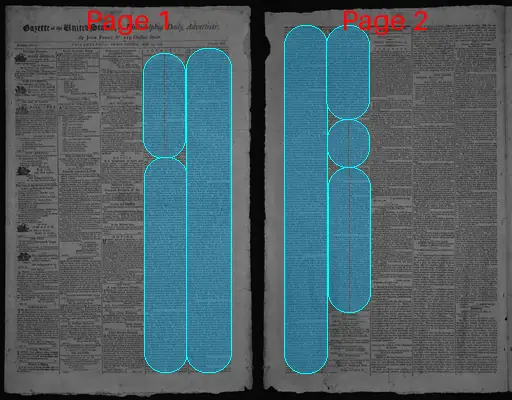
Gazette Of The United States, & Philadelphia Daily Advertiser
Philadelphia, Philadelphia County, Pennsylvania
What is this article about?
In the House of Representatives on May 10, Mr. Sumner opposes a bill authorizing the President to raise a provisional army, arguing against transferring congressional power to the executive, questioning the need due to remote threats, and praising the southern militia's Revolutionary War record. Mr. J. Williams supports retaining the bill's first section for defense, suggesting amendments, and defends the militia while advocating for a standing force.
Merged-components note: These components form a single continuous report on the House of Representatives debate regarding the army bill, spanning multiple columns and pages with sequential reading order and flowing text content. Relabeled to domestic_news as it fits congressional proceedings better than story.
Clippings
1 of 2
OCR Quality
Full Text
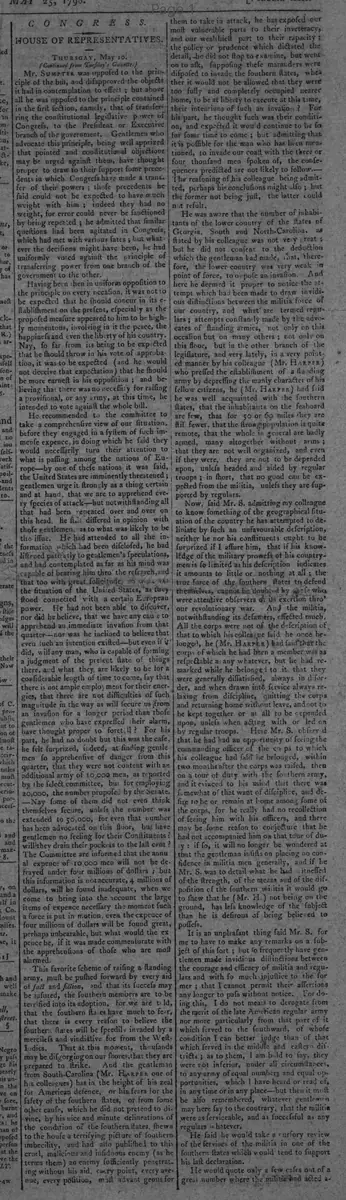
THURSDAY, May 10.
(Continued from Tuesday's Gazette.)
Mr. Sumner was opposed to the principle of the bill, and disapproved the objects it had in contemplation to effect ; but above all he was opposed to the principle contained in the first section, namely, that of transferring the constitutional legislative power of Congress, to the President or Executive branch of the government. Gentlemen who advocate this principle, being well apprised that pointed and constitutional objections may be urged against them, have thought proper to draw to their support some precedents in which Congress have made a transfer of their powers ; those precedents he said could not be expected to have much weight with him ; indeed they had no weight, for error could never be sanctioned by being repeated ; he admitted that similar questions had been agitated in Congress,
which had met with various fates ; but whatever the decisions might have been, he had uniformly voted against the principle of transferring power from one branch of the government to the other.
Having been then in uniform opposition to the principle on every occasion, it was not to be expected that he should concur in its establishment on the present, especially as the proposed measure appeared to him to be highly momentous, involving in it the peace, the happiness and even the liberty of his country.
Nay, so far from its being to be expected that he should throw in his vote of approbation, it was to be expected (and he would not deceive that expectation) that he should be more earnest in his opposition ; and believing that there was no necessity for raising a provisional, or any army, at this time, he intended to vote against the whole bill.
He recommended to the committee to take a comprehensive view of our situation,
before they engaged in a system of such immense expence, in doing which he said they would necessarily turn their attention to what is passing among the nations of Europe—by one of these nations it was said,
the United States are imminently threatened;
gentlemen urge it strongly as a thing certain and at hand, that we are to apprehend every species of attack—but notwithstanding all that had been repeated over and over on this head. He still differed in opinion with those gentlemen. as to what was likely to be the issue. He had attended to all the information which had been disclosed, he had listened patiently to gentlemen's speculations,
and had contemplated as far as his mind was capable of bearing him thro' the research,and that too with great solicitude, so various was the situation of the United States, as they stood connected with a certain European power. He had not been able to discover,
nor did he believe, that we have any cause to apprehend an immediate invasion from that quarter—nor was he inclined to believe that even such an intention existed—but even if it did, will any man, who is capable of forming a judgment of the present state of things there, and what they are likely to be for a considerable length of time to come, say that there is not ample employment for their energies, that there are not difficulties of such magnitude in the way as will secure us from an invasion for a longer period than those gentlemen who have expressed their alarm,
have thought proper to foresee, it ? For his part, he had no doubt but this was the case.
He felt surprised, indeed, at finding gentlemen so apprehensive of danger from this quarter, that they were not content with an additional army of 10,000 men, as reported by the select committee, but for employing 20,000, the number proposed by the Senate.
—Nay some of them did not even think themselves secure, unless the number was extended to 50,000, for even that number has been advocated on this floor, but have gentlemen no feeling for their Constituents?
will they drain their pockets to the last cent?
The Committee are informed that the annual expence of 20,000 men will not be defrayed under four millions of dollars ; but this information is not accurate, 4 millions of dollars, will be found inadequate, when we come to bring into the account the large items of expence necessary the moment such a force is put in motion, even the expence of four millions of dollars will be found great,
perhaps unbearable, but what would the expence be, if it was made commensurate with the apprehensions of those who are most alarmed.
This favorite scheme of raising a standing army, must be pushed forward by every aid of fact and fiction, and that its success may be insured, the southern members are to be terrified into its adoption, for we are told,
that the southern states have much to fear,
that there is every reason to believe the southern states will be speedily invaded by a merciless and vindictive foe from the West-Indies, That at this moment, thousands may be disgorging on our shores, that they are prepared to strike. And the gentleman from South-Carolina (Mr. HARPER one of his colleagues) has in the height of his zeal for American defence, or his fears for the safety of the southern states, or from some other cause, which he did not pretend to divine, by his nice and minute delineations of the condition of the southern states. shewn to the house a terrifying picture of southern imbecility, and had also published to this cruel, malicious and insidious enemy (as he terms them) an enemy sufficiently penetrating without his aid, every point, every avenue, every position, most advantageous for them to take in attack, he has exposed our most vulnerable parts to their inveteracy,
and our wealthiest part to their rapacity; the policy or prudence which dictated the detail, he did not stop to examine, but went on to ask, supposing these marauders were disposed to invade the southern states, whether it would not be allowed that they were too fully and completely occupied nearer home, to be at liberty to execute at this time, their intentions of such an invasion ? For his part, he thought such was their condition,
and expected it would continue to be so for some time to come : but admitting that it is possible for the man who has been mentioned, to invade our coast with the three or four thousand men spoken of, the consequences predicated are not likely to follow.— The reasoning of his colleague being admitted, perhaps his conclusions might also ; but the former not being just, the latter could not result.
He was aware that the number of inhabitants of the lower country of the states of Georgia, South and North-Carolina. as stated by his colleague was not very great :
but he did not consent to the deduction which the gentleman had made, that, therefore, the lower country was very weak in point of force, to oppose an invasion. And here he deemed it proper to notice the attempt which had been made to draw invidious distinctions between the militia force of our country, and what are termed regulars; attempts constantly made by the advocates of standing armies, not only on this occasion but on many others ; not only on this floor, but in the other branch of the legislature, and very lately, in a very pointed manner by his colleague (Mr. HARPER)
who pressed the establishment of a standing army by depressing the manly character of his fellow citizens, he (Mr. Harper) had said he was well acquainted with the southern states, that the inhabitants on the seaboard are few, that for 50 or 60 miles they are still fewer, that the strong population is quite remote, that the whole in general are badly armed, many altogether without arms ;
that they are not well organized, and even if they were, they are not to be depended upon, unless headed and aided by regular troops ; in short, that no good can be expected from the militia, unless they are supported by regulars.
Now, said Mr. S. admitting my colleague to know something of the geographical situation of the country he has attempted to delineate by such an unfavourable description,
neither he nor his constituents ought to be surprised if I assure him, that if his knowledge of the military prowess of his countrymen is so limited as his description indicates it amounts to little or nothing at all ; the true force of the southern states to defend themselves, cannot be doubted by any who were attentive observers of its exertion thro' our revolutionary war. And the militia,
notwithstanding its defamers, effected much.
All the corps were not of the description of that to which his colleague said he once belonged, he (Mr. Harper) had said that the corps of which he had been a member was as respectable as any whatever, but he had remarked while he belonged to it that they were generally dissatisfied, always in disorder, and when drawn into service always relaxing from discipline, quitting the corps and returning home without leave, and not to be kept together or at all to be depended upon, unless when acting with or led on by regular troops.
Here Mr. S. observed that he had had an opportunity of seeing the commanding officer of the corps to which his colleague had said he belonged, within two months after the corps was raised, then on a tour of duty with the southern army,
and it evinced to his mind that there was somewhat of that want of discipline, and desire to be or remain at home among some of the corps, for he really had no recollection of seeing him with his officers, and there may be some reason to conjecture that he had not accompanied him on that tour of duty : if so, it will no longer be wondered at that the gentleman insists on placing no confidence in militia men generally, and if he Mr. S. was to detail what he had witnessed of the strength, of the means and of the disposition of the southern militia it would go far to shew that he (Mr. H.) not being on the ground, has less knowledge of the subject than he is desirous of being believed to possess,
It is an unpleasant thing said Mr. S. for me to have to make any remarks on a subject of this sort ; but so frequently have gentlemen made invidious distinctions between the courage and efficacy of militia and regulars and with so much injustice to the former ; that I cannot permit their assertions any longer to pass without notice. For doing this, I do not mean to derogate from the merit of the late American regular army nor more particularly from that part of it which served to the southward, of whose condition I can better judge than of that which served in the middle and eastern districts ; as to them, I am bold to say, they were not inferior, under all circumstances,
to any army of equal numbers and equal opportunities, which I have heard or read of, in any time or in any place—but then it must be also remembered, whatever gentlemen may here say to the contrary, that the militia were as serviceable, and as successful as any regulars whatever.
He said he would take a cursory review of the services of the militia in one of the southern states which would tend to support his last declaration.
He would quote only a few cases out of a great number where the militia had acted as
Tone, without any co-operation or support from the regulars, and tried again the veteran and conquering cavalry and infantry of British corps, and in which actions they were distinguished for their bravery and success.
It may be remembered that very partial if any impressions had ever been made by our regular troops on the British corps of cavalry during the early period of the war; and it seemed to be reserved to the southern militia in convice them that their equals existed in our country. It is not to be attributed to the want of courage or discipline in our regular corps that this had not been done before, but to imperious circumstances which no skill could overcome, but this did not change the fact.
After the fall of Charleston in 1780, the first action, and that fought by the militia, without any aid from our regulars, was the action of Fishing Creek, where without entering into a minute description of all the circumstances attendant on such an occasion, it will be sufficient to say, that the gallant captain Rooke who commanded a squadron of Tarleton's legion fell, and the whole force was beaten and dispersed.
A few days after, and here permit me said Mr. S. to remark, that if my colleague does not remember, and our historians have neglected to record the achievements of the militia, yet justice is in some degree done them by A British Historian, who was an officer in the British service in that part of our country, and at the very time I am speaking of, who corroborates my facts. A few days after an attack was made by the militia on Rocky Mount, and Col. Turnbull who commanded the enemies force, and who is now in New York, I have no doubt has candour enough to acknowledge, that from the contest he had with them (although strongly defended by well constructed works) and which lasted ten hours, there is something due to their bravery and the effect of their arms.
Eight days after the affair on Rocky Mount, an attack was made on the British at their post of the Hanging Rock. The force on this occasion consisted of the same corps of South Carolina militia who had enterprized on the other occasion; they were in number about 600; they had been joined by a few of the militia from North Carolina, and it is a pleasure to reflect on the cordiality and bravery displayed by them on this occasion.
The enemy's force at this post was 1200 effectives; yet the result was, after an action which lasted through the greatest part of the day, that major Bryan's corps was totally defeated, the Prince of Wales' regiment exterminated, even its name has never since been recorded. Other detachments from the 63d and 71st under the command of major Carden were also cut up, driven from their encampment with the entire loss of baggage, &c., and, in the course of this action, captain Kinlaw, with a squadron of Tarleton's Legion arrived from Rocky Mount, made a desperate charge on the militia, was repulsed by them and fled to Camden, without attempting to renew the combat. In this, as well as other actions, it ought to be remembered, how many field officers, brave captains and other officers, as well as valuable citizens fell, or were wounded, while another nation had to regret in this action alone, the loss of upwards of 500 men.
Passing by a number of important and considerable conflicts which took place between the British regulars and the Southern militia, till unsupported by regulars of our own army, said Mr. S. I come now to mention the attack which was made in the neighbourhood of Winnsborough, while Lord Cornwallis lay in that town, upon the South Carolina militia by a British regular force under majors Wemyss and M'Arthur, supported by two troops of cavalry. the whole corps drawn together and formed for the purpose, after various charges made by the infantry and cavalry, and after repeated repulses, the enemy was totally repelled, their commanding officer wounded and taken, together with a number of his corps, and the rest were dispersed.
On the return of colonel Tarleton to Winnsborough, another effort was made, and from the number as well as the nature of the troops employed, it was certainly intended to be effectual in driving the South Carolina militia from that part of the country; for it was Tarleton's legion, M'Carthy's corps, and that part of the 63d under Major Money, which troops were led to the attack of the militia on the 20th of November, the result of this action is known, to those who do not wish to detract from the merit of the militia. The enemy's detachment consisted of 270 legionary horse, and upwards of 400 regular infantry, with two field pieces; the militia were between 500 & 600 without (as indeed they were thro' all the actions I have described) a single piece of artillery. In the number of militia are included some Georgians, who not only acquired honour to themselves from their exertions on that day, but did honour to their country.
The fate of the British cavalry was then decided; they had been formerly unconquerable, but after that day they were never known to be brought to act with either energy or effect.
Knowing the ardor and firmness of the southern militia, and not doubting but the militia of the several States in the Union possess equal motives for their exertions, equal spirit and activity, I cannot, said Mr. S. but rely on them as the natural and main support of our national independence—a support fully effectual without a recurrence to a standing army. These few cases, and it is stopping very short indeed of what the merits of the southern militia deserve, tend to shew that the charges brought against the militia generally are as unfounded as they are cruel to their feelings; while at the same time they demonstrate, that if an invasion (which is a contingency by no means likely to happen) should actually take place, we may rely with confidence on the manly exertions of the militia, to meet the attack, and to resist every effort, at least for such a period as until more effectual aid shall be drawn down to their support, and more permanent measures adopted.
Mr. S. concluded with saying, that near a million of dollars had been appropriated for the purchase of artillery and small arms; 350,000 for additional fortifications and 80,000 for fitting galleys. He wished the appropriation for the galleys to have been increased, by taking a part from the sum appropriated for additional fortifications; as he conceived from the nature of the attacks or injuries to which our sea-board is exposed, it would furnish the most expeditious and effectual means of safety to the inhabitants who might be threatened: if to this mean of defence, were added the vigilance, activity and firmness of the militia, he thought gentlemen might consider themselves tolerably safe, without resorting to that worst of all expedients a standing army; especially, if they believed with him that the danger of an invasion from Europe was very remote indeed: and that from the West-Indies not likely to take place for want of opportunity, even admitting such an intention is entertained. Under this view of the subject, he wished the question of raising an army to remain undecided until a future session of Congress:—and from the reasons and arguments he had urged, he was influenced not only to vote against the first section, but the whole bill generally—under a hope, that Congress might rely on the natural force of the country, on which alone they could depend in all cases of extreme danger, and without which neither a standing army or a navy, or strong holds or fortifications would be a security for our political existence or independence as a nation.
Mr. J. Williams believed there was but little real difference of opinion betwixt those who were in favour of striking out the first section, and those opposed to it. The former suppose an army will be necessary in case of war, or an invasion, and the latter wish to give the President the power to raise the men in case the danger of either was very great. He should vote for retaining the first section; though, as it stood at present, he did not altogether like it. If the motion for striking out was lost, he should move to amend it by confining the exercise of the power proposed to be given to the President, to the recess of Congress. He trusted gentlemen would not be willing that Congress should rise without something more being done for the defence of the country than has been done. No one could say how soon an attack might be made upon us, and whenever it was made, we ought certainly to be in a situation to repel it, which would not be the case, except a bill of this kind was passed.
A resolution had been laid upon the table, he said to increase our Standing Force to 10,000 men; but it might happen that no necessity would arise for increasing our present force. He wished only that the President might have the power of increasing, it, if there should be occasion to do so.
Gentlemen had said much in defence of the Militia of this country. Had he heard any thing said derogatory to the bravery of our Militia, he should long since have risen in their defence. No man could doubt for a moment that the Militia of this country are as brave as any in the world.
He was astonished to hear the gentleman from Tennessee say that when Regulars and Militia act together, they generally quarrel. This assertion must have arisen from his want of experience. He was himself for eight years engaged in the war, and never saw any thing to justify the remark. The plains of Saratoga spoke for themselves. At Bennington the Militia conquered superior numbers, in the second action they were, it is true, joined by Continental troops. But why recount these things? It was idle to suppose regular troops and militia should quarrel with each other, since they all fight in the same cause, and with the same feelings. No better troops could be employed than Militia in a sudden emergency; but, as had been already stated, they remained impatiently in the field for any length of time.
Considering the extensiveness of our exposed sea coast, it could not be supposed that our present small number of standing troops, could be sufficient for the present situation of things. Militia ought not to be called from their families and occupations, except in particular emergencies. As to any danger to be dreaded from an army of this kind to the liberties of the country it was a mere phantom, and he thought it was paying but little respect to our Militia to suppose the liberties of the country could be endangered by a regular force of 10 or 20,000 men! Besides it would be attended with less expense to raise these men, that to call out the Militia from time to time. He had something to do in the drafting of militia in 1794, and in consequence of the law of last session, and knew the difficulty attending it. Not one out of five who was drafted could leave his family. These people were obliged to find men in their stead. which they did at from 15 to 20 dollars. To call the Militia from the part of the country where he lived, which was betwixt 300 and 400 miles from the sea coast, would be attended with great inconvenience indeed. He hoped this bill would pass; if not, he foresaw great expense. We must augment our present army, and perhaps Congress would have occasion to sit here all summer, for they could not adjourn until some further provision was made for the defence of the country. It was true, the President might call into service a part of the 80,000 Militia held in requisition, but it would be attended with great expense and inconvenience, which he wished to avoid, by passing this bill.
(To be continued.)
What sub-type of article is it?
What keywords are associated?
What entities or persons were involved?
Where did it happen?
Domestic News Details
Primary Location
House Of Representatives
Event Date
May 10
Key Persons
Outcome
debate continued; no final vote reported.
Event Details
Mr. Sumner opposes the bill's first section for transferring power to the President to raise a provisional army of up to 20,000 men, argues no immediate threat from Europe or West Indies exists, criticizes costs, defends southern militia's Revolutionary War effectiveness with examples like Fishing Creek, Rocky Mount, Hanging Rock, and Blackstock's Farm, and suggests relying on militia and galleys instead. Mr. J. Williams supports retaining the section with amendment to limit to congressional recess, emphasizes need for defense preparedness, praises militia bravery but notes limitations for prolonged service, and argues for standing army to avoid militia mobilization expenses.