Thank you for visiting SNEWPapers!
Sign up free
The Rhode Island Republican
Newport, Newport County, Rhode Island
What is this article about?
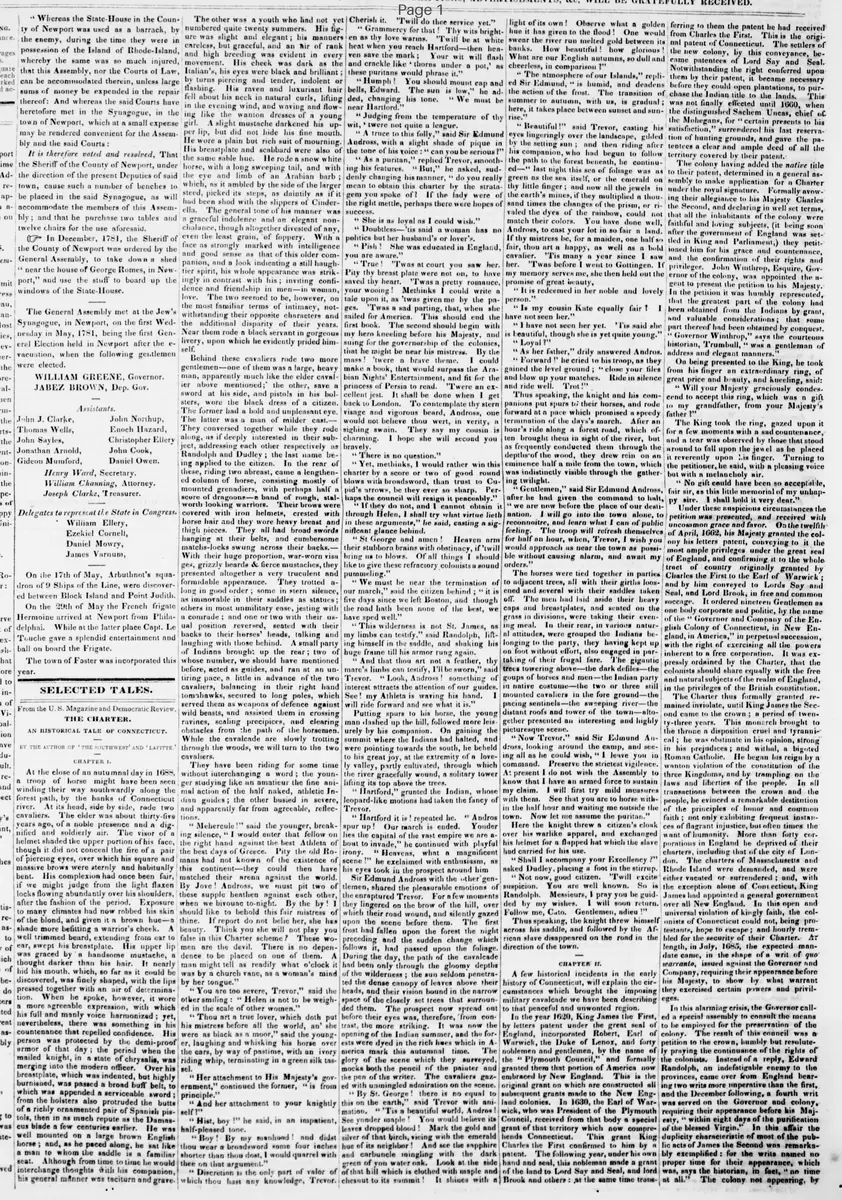
An historical fiction tale depicting Sir Edmund Andross leading a military cavalcade to Hartford, Connecticut, in 1688 to seize the colony's charter on orders from King James II. Interwoven with historical background on the charter's origins from 1620-1662 and threats under James II's tyranny. Ends with the colonists' defiant response.
Merged-components note: This is a continuation of the serialized historical tale 'The Charter' across pages 1 and 2.
Clippings
1 of 2
OCR Quality
Full Text
From the U.S. Magazine and Democratic Review.
THE CHARTER.
AN HISTORICAL TALE OF CONNECTICUT.
BY THE AUTHOR OF 'THE SOUTHWEST' AND 'LAFITTE.'
CHAPTER I.
At the close of an autumnal day in 1688, a troop of horse might have been seen winding their way southwardly along the forest path, by the banks of Connecticut river. At its head, side by side, rode two cavaliers. The elder was about thirty-five years old, of a noble presence and a dignified and soldierly air. The visor of a helmet shaded the upper portion of his face, though it did not conceal the fire of a pair of piercing eyes, over which his square and massive brows were sternly and habitually bent.
His complexion had once been fair, if we might judge from the light flaxen locks flowing abundantly over his shoulders, after the fashion of the period. Exposure to many climates had now robbed his skin of the blond, and given it a brown hue—a shade more befitting a warrior's cheek. A well-trimmed beard, extending from ear to ear, swept his breastplate. His upper lip was graced by a handsome mustache, a thought darker than his hair. It nearly hid his mouth, which, so far as it could be discovered, was finely shaped, with the lips pressed together with an air of determination. When he spoke, however, it wore a more agreeable expression, with which his full and manly voice harmonized; yet, nevertheless, there was something in his countenance that repelled confidence. His person was protected by the demi-proof armor of that day; the period when the mailed knight, in a state of chrysalis, was merging into the modern officer. Over his breastplate, which was indented, but highly burnished, was passed a broad buff belt, to which was appended a serviceable sword; from the holsters also protruded the butts of a richly ornamented pair of Spanish pistols, then in as much repute as the Damascus blade a few centuries earlier. He was well mounted on a large brown English horse; and, as he paced along, he sat like a man to whom the saddle is a familiar seat. Although from time to time he would interchange thoughts with his companion, his general manner was taciturn and grave.
The other was a youth who had not yet numbered quite twenty summers. His figure was slight and elegant; his manners careless, but graceful, and an air of rank and high breeding was evident in every movement. His cheek was dark as the Italian's, his eyes were black and brilliant; by turns piercing and tender, indolent or flashing. His raven and luxuriant hair fell about his neck in natural curls, lifting in the evening wind, and waving and flowing like the wanton tresses of a young girl. A slight mustache darkened his upper lip, but did not hide his fine mouth. He wore a plain but rich suit of mourning. His breastplate and scabbard were also of the same sable hue. He rode a snow white horse, with a long sweeping tail, and with the eye and limb of an Arabian barb; which, as it ambled by the side of the larger steed, picked its steps, as daintily as if it had been shod with the slippers of Cinderella. The general tone of his manner was a graceful indolence and an elegant nonchalance, though altogether divested of any, even the least grain, of foppery. With a face as strongly marked with intelligence and good sense as that of this older companion, and a look indicating a still haughtier spirit, his whole appearance was strikingly in contrast with his; inviting confidence and friendship in men—in woman, love. The two seemed to be, however, on the most familiar terms of intimacy, notwithstanding their opposite characters and the additional disparity of their years.
Near them rode a black servant in gorgeous livery, upon which he evidently prided himself.
Behind these cavaliers rode two more gentlemen—one of them was a large, heavy man, apparently much like the elder cavalier above mentioned; the other, save a sword at his side, and pistols in his holsters, wore the black dress of a citizen. The former had a bold and unpleasant eye. The latter was a man of milder cast.
They conversed together while they rode along, as if deeply interested in their subject, addressing each other respectively as Randolph and Dudley; the last name being applied to the citizen. In the rear of these, riding two abreast, came a lengthened column of horse, consisting mostly of mounted grenadiers, with perhaps half a score of dragoons—a band of rough, stalworth looking warriors. Their brows were covered with iron helmets, crested with horse hair and they wore heavy breast and thigh pieces. They all had broad swords hanging at their belts, and cumbersome match-locks swung across their backs.
With their huge proportion, war-worn visages, grizzly beards & fierce mustaches, they presented altogether a very truculent and formidable appearance. They trotted along in good order; some in stern silence, as immovable in their saddles as statues; others in most unmilitary ease, jesting with a comrade; and one or two with their usual position reversed, seated with their backs to their horses' heads, talking and laughing with those behind. A small party of Indians brought up the rear; two of whose number, we should have mentioned before, acted as guides, and ran at an untiring pace, a little in advance of the two cavaliers, balancing in their right hand tomahawks, secured to long poles, which served them as weapons of defence against wild beasts, and assisted them in crossing ravines, scaling precipices, and clearing obstacles from the path of the horsemen.
While the cavalcade are slowly trotting through the woods, we will turn to the two cavaliers.
They have been riding for some time without interchanging a word; the younger studying like an amateur the fine animal action of the half naked, athletic Indian guides; the other busied in severe, and apparently far from agreeable, reflections.
"Mehercule!" said the younger, breaking silence, "I would enter that fellow on the right hand against the best Athleta of the best days of Greece. Pity the old Romans had not known of the existence of this continent—they could then have matched their arena against the world. By Jove! Andross, we must pit two of these supple heathen against each other, when we bivouac to-night. By the by! I should like to behold this fair mistress of thine. If report do not belie her, she has beauty. Think you she will not play you false in this Charter scheme? These women are the devil. There is no dependence to be placed on one of them. A man might tell as readily what o'clock it was by a church vane, as a woman's mind by her tongue."
"You are too severe, Trevor," said the other smiling: "Helen is not to be weighed in the scale of other women."
"Thou art a true lover, which doth put his mistress before all the world, an'she were as black as a moor," said the younger, laughing and whisking his horse over the ears, by way of pastime, with an ivory riding whip, terminating in a green silk tassel.
"Her attachment to His Majesty's government," continued the former, "is from principle."
"And her attachment to your knightly self?"
"Hist, boy!" he said, in an impatient, half-pleased tone.
"Boy! By my manhood! and didst thou wear a broadsword some four inches shorter than thou dost, I would quarrel with thee on that argument."
"Discretion is the only part of valor of which thou hast any knowledge, Trevor. Cherish it. 'Twill do thee service yet."
"Grammerey for that! Thy wits brighten as thy love warms. 'Twill be at white heat when you reach Hartford—then heaven save the mark; Your wit will flash and crackle like 'thorns under a pot,' as these puritans would phrase it."
"Humph! You should mount cap and bells, Edward. The sun is low," he added, changing his tone. "We must be near Hartford."
"Judging from the temperature of thy wit, 'twere not quite a league."
"A truce to this folly," said Sir Edmund Andross, with a slight shade of pique in the tone of his voice: "can you be serious?"
"As a puritan," replied Trevor, smoothing his features.
"But," he asked, suddenly changing his manner, "do you really mean to obtain this charter by the stratagem you spoke of? If the lady were of the right mettle, perhaps there were hopes of success."
"She is as loyal as I could wish."
"Doubtless—'tis said a woman has no politics but her husband's or lover's"
"Pish! She was educated in England, you are aware."
"True! 'Twas at court you saw her. Pity thy breast plate were not on, to have saved thy heart."
"'Twas a pretty romance, your wooing! Methinks I could write a tale upon it, as 'twas given me by the pages. 'Twas a sad parting, that, when she sailed for America. This should end the first book. The second should begin with my hero kneeling before his Majesty, and suing for the governorship of the colonies, that he might be near his mistress. By the mass! 'twere a brave theme. I could make a book, that would surpass the Arabian Nights' Entertainment, and fit for the princess of Persia to read."
"'Twere an excellent jest. It shall be done when I get back to London. To contemplate thy stern visage and vigorous beard, Andross, one would not believe thou wert, in verity, a sighing swain. They say my cousin is charming. I hope she will second you bravely."
"There is no question."
"Yet, methinks, I would rather win this charter by a score or two of good round blows with broadsword, than trust to Cupid's arrows, be they ever so sharp. Perhaps the council will resign it peaceably."
"If they do not, and I cannot obtain it through Helen, I shall try what virtue lieth in these arguments," he said, casting a significant glance behind.
"St George and amen! Heaven arm their stubborn brains with obstinacy, if'twill bring us to blows. Of all things I should like to give these refractory colonists a sound pummeling"
"We must be near the termination of our march," said the citizen behind; "it is five days since we left Boston, and though the road hath been none of the best, we have sped well."
"This wilderness is not St. James, as my limbs can testify." said Randolph, lifting himself in the saddle, and shaking his huge frame till his armor rung again.
"And that thou art not a feather, thy mare's limbs can testify, I'll be sworn," said Trevor.
"Look, Andross! something of interest attracts the attention of our guides. See! my Athleta is waving his hand. I will ride forward and see what it is."
Putting spurs to his horse, the young man dashed up the hill, followed more leisurely by his companion. On gaining the summit where the Indians had halted, and were pointing towards the south, he beheld to his great joy, at the extremity of a lovely valley, partly cultivated, through which the river gracefully wound, a solitary tower lifting its top above the trees.
"Hartford," grunted the Indian, whose leopard-like motions had taken the fancy of Trevor.
"Hartford it is!" repeated he. "Andross, spur up! Our march is ended. Yonder lies the capital of the vast empire we are about to invade," he continued with playful irony.
"Heavens, what a magnificent scene!" he exclaimed with enthusiasm, as his eyes took in the prospect around him
Sir Edmund Andross with the other gentlemen, shared the pleasurable emotions of the enraptured Trevor. For a few moments they lingered on the brow of the hill, over which their road wound, and silently gazed upon the scene before them.
The first frost had fallen upon the forest the night preceding and the sudden change which follows it, had passed upon the foliage. During the day, the path of the cavalcade had been only through the gloomy depths of the wilderness; the sun seldom penetrated the dense canopy of leaves above their heads, and their vision bound in the narrow space of the closely set trees that surrounded them. The prospect now spread out before their eyes was, therefore, from contrast, the more striking.
It was now the opening of the Indian summer, and the forests were dyed in the rich hues which in America mark this autumnal time.
The glory of the scene which they surveyed, mocks both the pencil of the painter and the pen of the writer. The cavaliers gazed with unmingled admiration on the scene.
"By St. George! there is no equal to this on the earth," said Trevor with animation.
"'Tis a beautiful world, Andross! See yonder maple! You would believe its leaves dropped blood! Mark the gold and silver of that birch, vying with the emerald hue of its neighbor! And see the sapphire and carbuncle mingling with the dark green of yon water oak. Look at the side of that hill which is clothed with maple and chestnut to its summit! It shines with a light of its own! Observe what a golden hue it has given to the flood! One would swear the river run melted gold between its banks. How beautiful! how glorious! What are our English autumns, so dull and cheerless, in comparison?"
"The atmosphere of our Islands," replied Sir Edmund, "is humid, and deadens the action of the frost. The transition of summer to autumn, with us, is gradual; here, it takes place between sunset and sun-rise"
"Beautiful!" said Trevor, casting his eyes lingeringly over the landscape, gilded by the setting sun; and then riding after his companion, who had begun to follow the path to the forest beneath, he continued—"last night this sea of foliage was as green as the sea itself, or the emerald on thy little finger; and now all the jewels in the earth's mines, if they multiplied a thousand times the changes of the prism, or rivaled the dyes of the rainbow, could not match their colors. You have done well, Andross, to cast your lot in so fair a land. If thy mistress be, for a maiden, one half so fair, thou art a happy, as well as a bold cavalier. 'Tis many a year since I saw her."
"'Twas before I went to Gottingen. If my memory serves me, she then held out the promise of great beauty,"
"It is redeemed in her noble and lovely person."
"Is my cousin Kate equally fair? I have not seen her."
"'Tis said she is beautiful, though she is yet quite young."
"Loyal?"
"As her father," drily answered Andross.
"Forward!" he cried to his troop, as they gained the level ground; "close your files and blow up your matches. Ride in silence and ride well. Trot!"
Thus speaking, the knight and his companions put spurs to their horses, and rode forward at a pace which promised a speedy termination of the day's march. After an hour's ride along a forest road, which often brought them in sight of the river, but as frequently conducted them through the depths of the wood, they drew rein on an eminence half a mile from the town, which was indistinctly visible through the gathering twilight.
"Gentlemen," said Sir Edmund Andross, after he had given the command to halt, "we are now before the place of our destination. I will go into the town alone, to reconnoitre, and learn what I can of public feeling. The troop will refresh themselves for half an hour, when, Trevor, I wish you would approach as near the town as possible without causing alarm, and await my orders."
The horses were tied together in parties to adjacent trees, all with their girths loosened and several with their saddles taken off. The men had laid aside their heavy caps and breastplates, and seated on the grass in divisions, were taking their evening meal. In their rear, in various natural attitudes, were grouped the Indians belonging to the party, they having kept up on foot without effort, also engaged in partaking of their frugal fare. The gigantic trees towering above—the dark defiles—the groups of horses and men—the Indian party in native costume—the two or three still mounted cavaliers in the fore ground—the pacing sentinels—the sweeping river—the distant roofs and tower of the town—altogether presented an interesting and highly picturesque scene.
"Now Trevor." said Sir Edmund Andross, looking around the camp, and seeing all as he could wish, "I leave you in command. Preserve the strictest vigilance. At present I do not wish the Assembly to know that I have an armed force to sustain my claim. I will first try mild measures with them. See that you are to horse within the half hour and waiting me outside the town. Now let me assume the puritan."
Here the knight threw a citizen's cloak over his warlike apparel, and exchanged his helmet for a flapped hat which the slave had carried for his use.
"Shall I accompany your Excellency?" asked Dudley, placing a foot in the stirrup.
"Not now, good citizen. 'Twill excite suspicion. You are well known. So is Randolph. Messieurs, I pray you be guided by my wishes. I will soon return. Follow me, Cato. Gentlemen, adieu!"
Thus speaking, the knight threw himself across his saddle, and followed by the African slave disappeared on the road in the direction of the town.
CHAPTER II.
A few historical incidents in the early history of Connecticut, will explain the circumstances which brought the imposing military cavalcade we have been describing to that peaceful and unwonted region.
In the year 1620, King James the First, by letters patent under the great seal of England, incorporated Robert, Earl of Warwick, the Duke of Lenox, and forty noblemen and gentlemen, by the name of the "Plymouth Council," and formally granted to them that portion of America now embraced by New England. This is the original grant on which are constructed all subsequent grants made to the New England colonies. In 1630, the Earl of Warwick, who was President of the Plymouth Council, received from that body a special grant of that territory which now comprehends Connecticut.
This grant King Charles the First confirmed to him by a patent. The following year, under his own hand and seal, this nobleman made a grant of the land to Lord Say and Seal, and Lord Brook and others: at the same time transferring to them the patent he had received from Charles the First. This is the original patent of Connecticut. The settlers of the new colony, by this conveyance, became patentees of Lord Say and Seal.
Notwithstanding the right conferred upon them by their patent, it became necessary before they could open plantations, to purchase the Indian title to the lands. This was not finally effected until 1660, when the distinguished Sachem Uncas, chief of the Mohegans, for "certain presents to his satisfaction," surrendered his last reservation of hunting grounds, and gave the patentees a clear and ample deed of all the territory covered by their patent.
The colony having added the native title to their patent, determined in a general assembly to make application for a Charter under the royal signature. Formally avowing their allegiance to his Majesty Charles the Second, and declaring in well set terms, that all the inhabitants of the colony were faithful and loving subjects, (it being soon after the government of England was settled in King and Parliament, they petitioned him for his grace and countenance, and the confirmation of their rights and privileges. John Winthrop, Esquire, Governor of the colony, was appointed the agent to present the petition to his Majesty.
In the petition it was humbly represented, that the greatest part of the colony had been obtained from the Indians by grant, and valuable considerations; that some part thereof had been obtained by conquest.
"Governor Winthrop," says the courteous historian, Trumbull, "was a gentleman of address and elegant manners.
On being presented to the King, he took from his finger an extraordinary ring, of great price and beauty, and kneeling, said:
"May your Majesty graciously condescend to accept this ring, which was a gift to my grandfather, from your Majesty's father?"
The King took the ring, gazed upon it for a few moments with a sad countenance, and a tear was observed by those that stood around to fall upon the jewel as he placed it reverently upon his finger. Turning to the petitioner, he said, with a pleasing voice but with a melancholy air.
"No gift could have been so acceptable, fair sir, as this little memorial of my unhappy sire. I shall hold it very dear."
Under these auspicious circumstances the petition was presented, and received with uncommon grace and favor. On the twelfth of April, 1662, his Majesty granted the colony his letters patent, conveying to it the most ample privileges under the great seal of England, and confirming it to the whole tract of country originally granted by Charles the First to the Earl of Warwick; and by him conveyed to Lords Say and Seal, and Lord Brook, in free and common soccage. It ordered nineteen Gentlemen as one body corporate and politic, by the name of the "Governor and Company of the English Colony of Connecticut, in New England, in America," in perpetual succession, with the right of exercising all the powers inherent to a free corporation. It was expressly ordained by the Charter, that the colonists should share equally with the free and natural subjects of the realm of England, in the privileges of the British constitution.
The Charter thus formally granted remained inviolate, until King James the Second came to the crown; a period of twenty-three years. This monarch brought to the throne a disposition cruel and tyrannical; he was obstinate in his opinion, strong in his prejudices; and withal, a bigoted Roman Catholic. He began his reign by a wanton violation of the constitution of the three Kingdoms, and by trampling on the laws and liberties of the people. In all transactions between the crown and the people, he evinced a remarkable destitution of the principles of honor and common faith; not only exhibiting frequent instances of flagrant injustice, but oftentimes the want of humanity. More than forty corporations in England were deprived of their charters, including that of the city of London. The charters of Massachusetts and Rhode Island were demanded, and were either vacated or surrendered; and, with the exception alone of Connecticut, King James had appointed a general government over all New England. In this open and universal violation of kingly faith, the colonists of Connecticut could not, being Protestants, hope to escape; and hourly trembled for the security of their Charter. At length, in July, 1685, the expected mandate came, in the shape of a writ of quo warranto, issued against the Governor and Company, requiring their appearance before his Majesty, to show by what warrant they exercised certain powers and privileges.
In this alarming crisis, the Governor called a special assembly to consult the means to be employed for the preservation of the colony. The result of this council was a petition to the crown, humbly but resolutely praying the continuance of the rights of the colonists. Instead of a reply, Edward Randolph, an indefatigable enemy to the provinces, came over from England bearing two writs more peremptory than the first, and the December following, a fourth writ was served on the Governor and colony, requiring their appearance before his Majesty, "within eight days of the purification of the blessed Virgin." In this affair the duplicity characteristic of most of the public acts of James the Second was remarkably exemplified: for the writs named no proper time for their appearance, which was, says the historian, in act, "no time at all." The colony not appearing, by
their representatives, at the time and places
all its chartered rights were declared vacated.
In December 1686, therefore, Sir Edmund Andross arrived in Boston, to take
upon himself, under the crown, the administration of the government of New England,
including of course Connecticut. After he had become settled in his new government,
he addressed the Governor and Company of Connecticut, informing them
that he held a commission from his Majesty to receive their Charter; further signifying
his intention of marching to Hartford, to demand it in person at their hands,
and assume the government. The Assembly
was sitting on the arrival of this epistle.
Beneath its courteous and formal style,
they had penetration enough to see there
was couched a menace. Their reply was
brief and decisive.
"We will never, of
our own wills, exchange our liberties for
your chains."
[To be Continued.]
What sub-type of article is it?
What themes does it cover?
What keywords are associated?
What entities or persons were involved?
Literary Details
Title
The Charter. An Historical Tale Of Connecticut.
Author
By The Author Of 'The Southwest' And 'Lafitte.'
Subject
Historical Events Of The Connecticut Charter Under Threat From King James Ii In 1688
Form / Style
Historical Narrative In Prose
Key Lines