Thank you for visiting SNEWPapers!
Sign up free
The Glacier Reporter
Browning, Glacier County, Montana
What is this article about?
US President Kennedy responds firmly to Soviet Premier Khrushchev on the Berlin crisis, influenced by Eisenhower, European allies, and domestic pressures, amid considerations of reserve mobilization and concerns over US foreign policy resolve.
Clipping
OCR Quality
Full Text
News Notes
Kennedy On Berlin
Taylor's Role—
Mobilization—
Our Allies
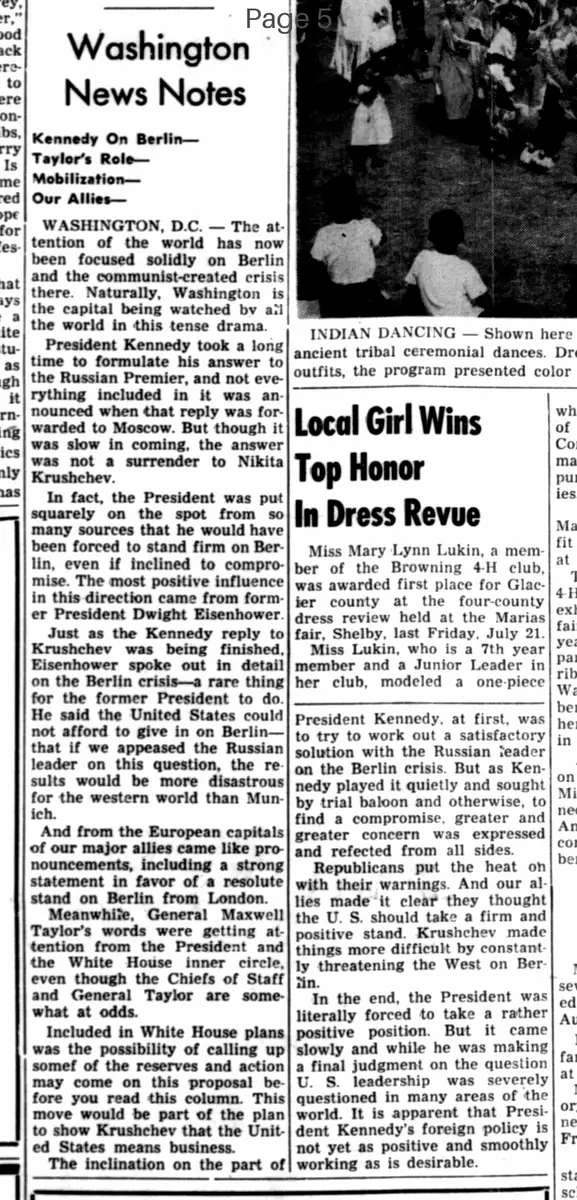
WASHINGTON, D.C. - The attention of the world has now been focused solidly on Berlin and the communist-created crisis there. Naturally, Washington is the capital being watched by all the world in this tense drama.
President Kennedy took a long time to formulate his answer to the Russian Premier, and not everything included in it was announced when that reply was forwarded to Moscow. But though it was slow in coming, the answer was not a surrender to Nikita Khrushchev.
In fact, the President was put squarely on the spot from so many sources that he would have been forced to stand firm on Berlin, even if inclined to compromise. The most positive influence in this direction came from former President Dwight Eisenhower.
Just as the Kennedy reply to Khrushchev was being finished, Eisenhower spoke out in detail on the Berlin crisis—a rare thing for the former President to do. He said the United States could not afford to give in on Berlin—that if we appeased the Russian leader on this question, the results would be more disastrous for the western world than Munich.
And from the European capitals of our major allies came like pronouncements, including a strong statement in favor of a resolute stand on Berlin from London.
Meanwhile, General Maxwell Taylor's words were getting attention from the President and the White House inner circle, even though the Chiefs of Staff and General Taylor are somewhat at odds.
Included in White House plans was the possibility of calling up some of the reserves and action may come on this proposal before you read this column. This move would be part of the plan to show Khrushchev that the United States means business.
The inclination on the part of President Kennedy, at first, was to try to work out a satisfactory solution with the Russian leader on the Berlin crisis. But as Kennedy played it quietly and sought by trial balloon and otherwise, to find a compromise, greater and greater concern was expressed and reflected from all sides.
Republicans put the heat on with their warnings. And our allies made it clear they thought the U. S. should take a firm and positive stand. Khrushchev made things more difficult by constantly threatening the West on Berlin.
In the end, the President was literally forced to take a rather positive position. But it came slowly and while he was making a final judgment on the question U. S. leadership was severely questioned in many areas of the world. It is apparent that President Kennedy's foreign policy is not yet as positive and smoothly working as is desirable.
What sub-type of article is it?
What keywords are associated?
What entities or persons were involved?
Where did it happen?
Foreign News Details
Primary Location
Berlin
Key Persons
Outcome
kennedy takes a firm position on berlin, rejecting compromise; potential reserve mobilization considered to demonstrate us resolve.
Event Details
World attention focuses on Berlin crisis created by communists. Kennedy formulates and sends a non-surrender reply to Khrushchev after delays. Influenced by Eisenhower's strong statement comparing appeasement to Munich, allied pronouncements from European capitals including London, Taylor's advice, Republican warnings, and Khrushchev's threats. Initial inclination for compromise shifts due to pressures; US leadership questioned during deliberation.