Thank you for visiting SNEWPapers!
Sign up free
Literary
July 10, 1790
Gazette Of The United States
New York, New York County, New York
What is this article about?
Philosophical essay critiquing false claims of moral virtue and vanity, emphasizing the union of virtue and knowledge for human dignity. Warns against slander from corrupted sources, links disappointed ambition to reprobation, and explores cowardice as stemming from wickedness, ignorance, or absence of moral faculty, referencing Servitus.
Clipping
OCR Quality
95%
Excellent
Full Text
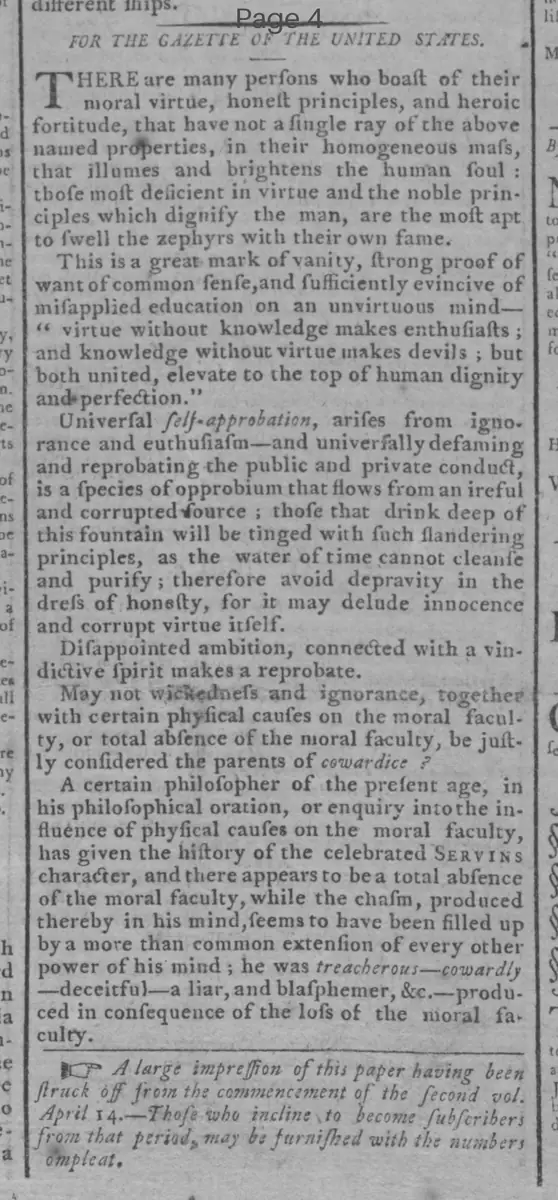
FOR THE GAZETTE OF THE UNITED STATES.
There are many persons who boast of their moral virtue, honest principles, and heroic fortitude, that have not a single ray of the above named properties, in their homogeneous mass, that illumes and brightens the human soul: those most deficient in virtue and the noble principles which dignify the man, are the most apt to swell the zephyrs with their own fame.
This is a great mark of vanity, strong proof of want of common sense, and sufficiently evincive of misapplied education on an unvirtuous mind—
"virtue without knowledge makes enthusiasts; and knowledge without virtue makes devils; but both united, elevate to the top of human dignity and perfection."
Universal Self-approbation, arises from ignorance and enthusiasm—and universally defaming and reprobating the public and private conduct, is a species of opprobium that flows from an ireful and corrupted source; those that drink deep of this fountain will be tinged with such slandering principles, as the water of time cannot cleanse and purify; therefore avoid depravity in the dress of honesty, for it may delude innocence and corrupt virtue itself.
Disappointed ambition, connected with a vindictive spirit makes a reprobate.
May not wickedness and ignorance, together with certain physical causes on the moral faculty, or total absence of the moral faculty, be justly considered the parents of cowardice?
A certain philosopher of the present age, in his philosophical oration, or enquiry into the influence of physical causes on the moral faculty, has given the history of the celebrated Servitus character, and there appears to be a total absence of the moral faculty, while the chasm, produced thereby in his mind, seems to have been filled up by a more than common extension of every other power of his mind; he was treacherous—cowardly—deceitful—a liar, and blasphemer, &c.—produced in consequence of the loss of the moral faculty.
A large impression of this paper having been struck off from the commencement of the second vol. April 14.—Those who incline to become subscribers from that period, may be furnished with the numbers complete.
There are many persons who boast of their moral virtue, honest principles, and heroic fortitude, that have not a single ray of the above named properties, in their homogeneous mass, that illumes and brightens the human soul: those most deficient in virtue and the noble principles which dignify the man, are the most apt to swell the zephyrs with their own fame.
This is a great mark of vanity, strong proof of want of common sense, and sufficiently evincive of misapplied education on an unvirtuous mind—
"virtue without knowledge makes enthusiasts; and knowledge without virtue makes devils; but both united, elevate to the top of human dignity and perfection."
Universal Self-approbation, arises from ignorance and enthusiasm—and universally defaming and reprobating the public and private conduct, is a species of opprobium that flows from an ireful and corrupted source; those that drink deep of this fountain will be tinged with such slandering principles, as the water of time cannot cleanse and purify; therefore avoid depravity in the dress of honesty, for it may delude innocence and corrupt virtue itself.
Disappointed ambition, connected with a vindictive spirit makes a reprobate.
May not wickedness and ignorance, together with certain physical causes on the moral faculty, or total absence of the moral faculty, be justly considered the parents of cowardice?
A certain philosopher of the present age, in his philosophical oration, or enquiry into the influence of physical causes on the moral faculty, has given the history of the celebrated Servitus character, and there appears to be a total absence of the moral faculty, while the chasm, produced thereby in his mind, seems to have been filled up by a more than common extension of every other power of his mind; he was treacherous—cowardly—deceitful—a liar, and blasphemer, &c.—produced in consequence of the loss of the moral faculty.
A large impression of this paper having been struck off from the commencement of the second vol. April 14.—Those who incline to become subscribers from that period, may be furnished with the numbers complete.
What sub-type of article is it?
Essay
What themes does it cover?
Moral Virtue
What keywords are associated?
Moral Virtue
Vanity
Cowardice
Slander
Philosophy
Literary Details
Form / Style
Prose Reflection On Virtue And Morality
Key Lines
"Virtue Without Knowledge Makes Enthusiasts; And Knowledge Without Virtue Makes Devils; But Both United, Elevate To The Top Of Human Dignity And Perfection."