Thank you for visiting SNEWPapers!
Sign up free
Douglas Daily Dispatch
Douglas, Cochise County, Arizona
What is this article about?
The US Navy, led by Assistant Secretary David S. Ingalls, plans to test the autogiro aircraft for shipboard use, including seaplane variants, for spotting and reconnaissance. The invention of Juan de la Cierva features freely rotating blades for lift independent of forward speed.
Clipping
OCR Quality
Full Text
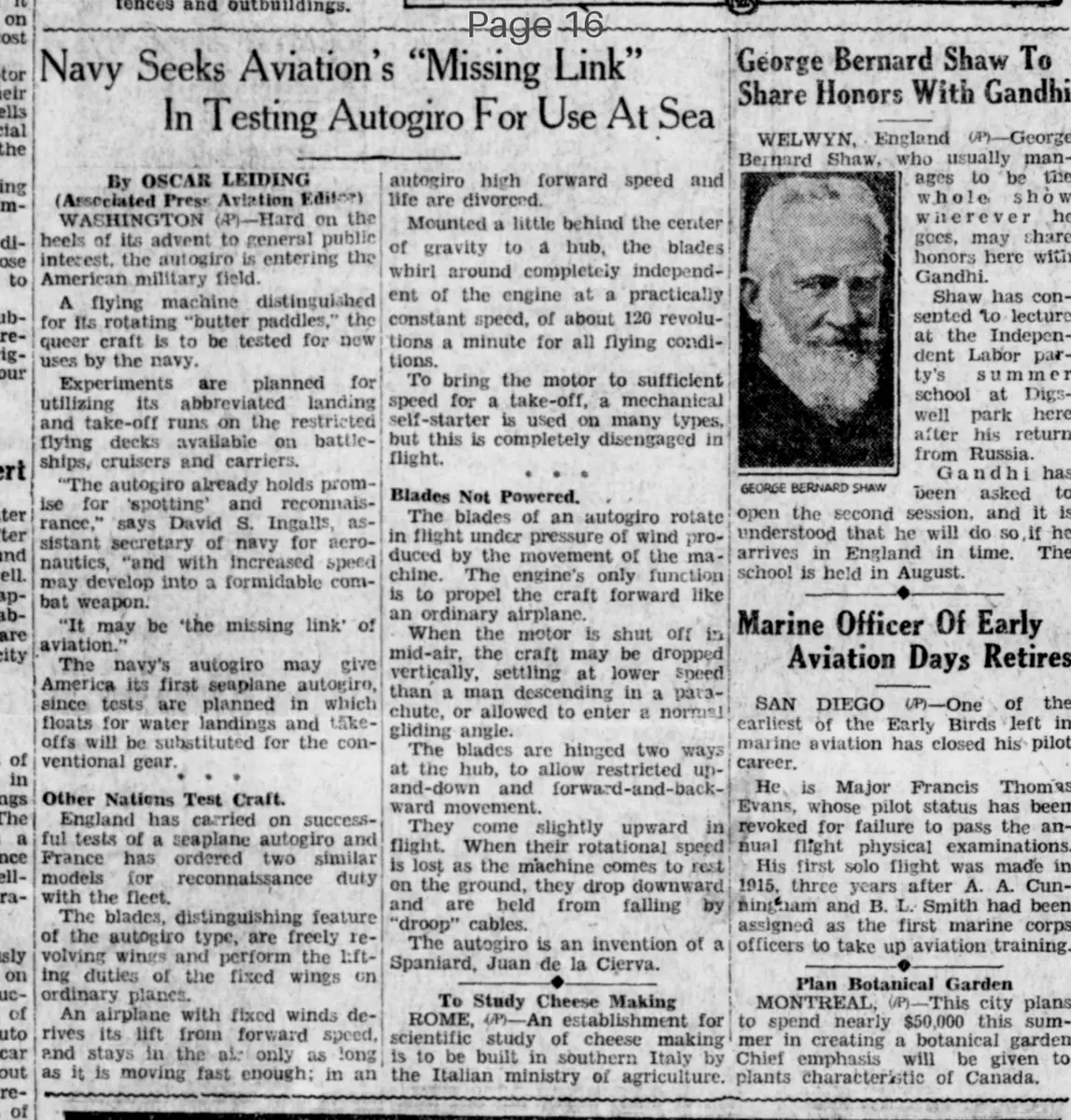
By Oscar Leiding (Associated Press Aviation Editor)
WASHINGTON (A)—Hard on the heels of its advent to general public interest, the autogiro is entering the American military field.
A flying machine distinguished for its rotating "butter paddles," the queer craft is to be tested for new uses by the navy.
Experiments are planned for utilizing its abbreviated landing and take-off runs on the restricted flying decks available on battleships, cruisers and carriers.
"The autogiro already holds promise for 'spotting' and reconnaissance," says David S. Ingalls, assistant secretary of navy for aeronautics, "and with increased speed may develop into a formidable combat weapon.
"It may be the missing link of aviation."
The navy's autogiro may give America its first seaplane autogiro, since tests are planned in which floats for water landings and take-offs will be substituted for the conventional gear.
Other Nations Test Craft.
England has carried on successful tests of a seaplane autogiro and France has ordered two similar models for reconnaissance duty with the fleet.
The blades, distinguishing feature of the autogiro type, are freely revolving wings and perform the lifting duties of the fixed wings on ordinary planes.
An airplane with fixed wings derives its lift from forward speed, and stays in the air only as long as it is moving fast enough; in an autogiro high forward speed and lift are divorced.
Mounted a little behind the center of gravity to a hub, the blades whirl around completely independent of the engine at a practically constant speed, of about 120 revolutions a minute for all flying conditions.
To bring the motor to sufficient speed for a take-off, a mechanical self-starter is used on many types, but this is completely disengaged in flight.
Blades Not Powered.
The blades of an autogiro rotate in flight under pressure of wind produced by the movement of the machine. The engine's only function is to propel the craft forward like an ordinary airplane.
When the motor is shut off in mid-air, the craft may be dropped vertically, settling at lower speed than a man descending in a parachute, or allowed to enter a normal gliding angle.
The blades are hinged two ways at the hub, to allow restricted up-and-down and forward-and-backward movement.
They come slightly upward in flight. When their rotational speed is lost as the machine comes to rest on the ground, they drop downward and are held from falling by "droop" cables.
The autogiro is an invention of a Spaniard, Juan de la Cierva.
What sub-type of article is it?
What keywords are associated?
What entities or persons were involved?
Where did it happen?
Domestic News Details
Primary Location
Washington
Key Persons
Event Details
The US Navy plans to test the autogiro, a flying machine with rotating blades, for use on battleships, cruisers, and carriers due to its short landing and take-off capabilities. Tests include substituting floats for water operations, potentially creating the first seaplane autogiro. It holds promise for spotting, reconnaissance, and possibly as a combat weapon. Other nations like England and France are also testing similar craft.